

Related

PRISM Wealth-Building Process
The year 2022 was a tough one for asset allocators as returns were down across the board.

Charles Rotblut leads a class in AAII's new Essential Investing Video Course. Go to https://www.aaii.com/ves for more information and to subscribe.
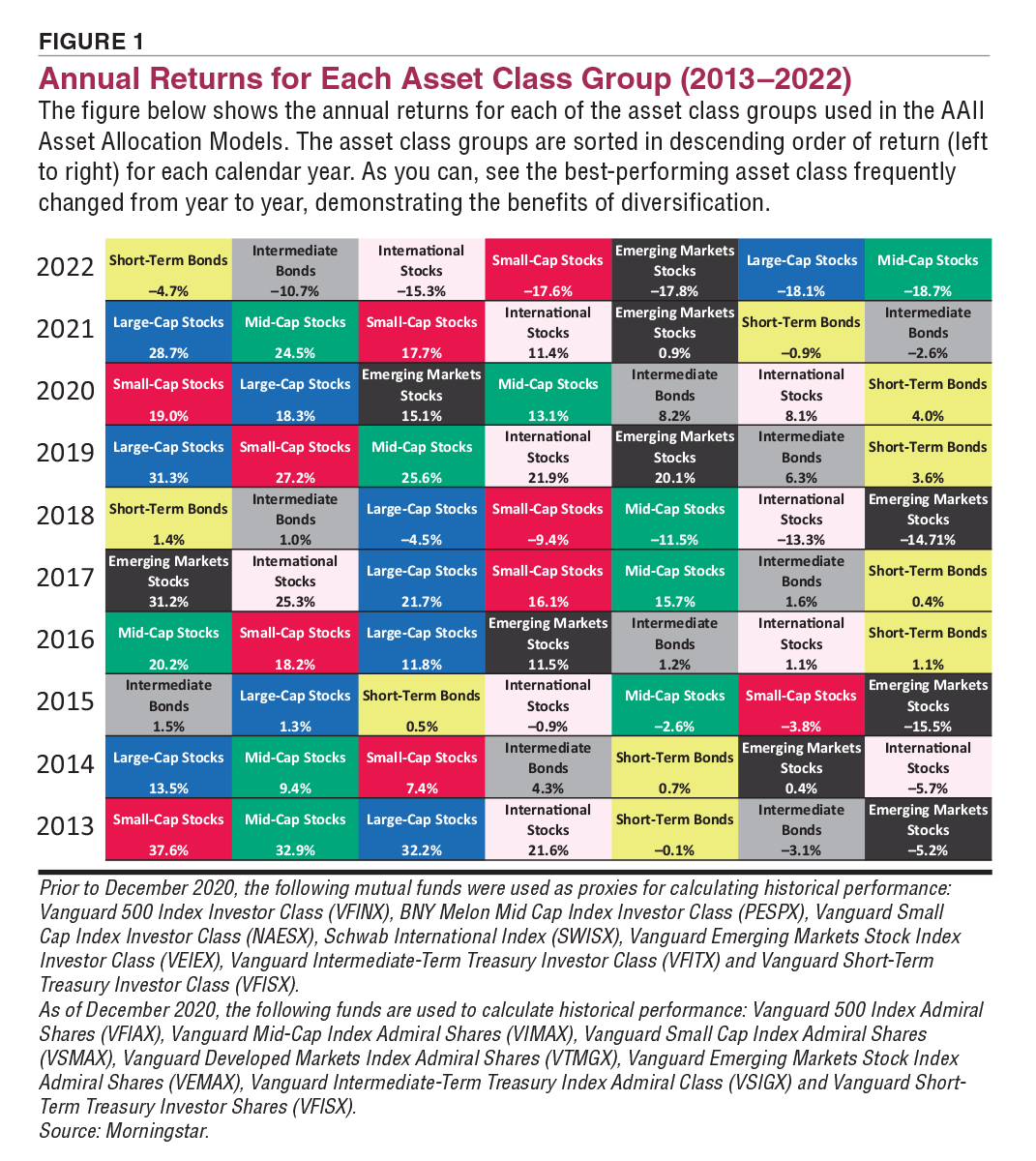
Figure 1 shows an updated “heat map” for the seven asset class groups that comprise the AAII Asset Allocation Models. (The models can be viewed at www.aaii.com/asset-allocation.) This heat map ranks each asset class group by its calendar-year performance in descending order from left to right. The groups are color-coded so you can track their relative performance over time.
Last year was a tough one for asset allocators as returns were down across the board. Both stocks and bonds fell as inflation rose globally. This was just the sixth time since 1878 that both stocks and bonds experienced negative returns in the same calendar year, according to The Leuthold Group.
Short-term bonds had the “best” performance last year, losing just 4.7%. This was the second time in five years that short-term bonds have led.
Mid-cap stocks, conversely, had the worst comparative returns. This is the first time in at least 16 years that mid-cap stocks have finished last. Perhaps true to their name, mid-cap stocks have also only led once in the past 16 years, in 2016.
There can be a tendency to look at last year’s returns and conclude that diversification is broken or doesn’t work. This is not the case. Diversification simply had an unusually bad year. Over longer time periods, diversification helps to reduce the volatility of a portfolio’s returns.
Diversification also reduces the risk of being wrong by increasing the odds of being allocated to the right asset class group at the right time. As the heat map shows, there has been a lack of consistency among each year’s best- and worst-performing asset class group.
Longer time periods smooth out the year-by-year fluctuations you see in the heat map. Over longer periods, stocks provide long-term growth of capital while bonds—particularly when held to maturity—provide preservation of capital. This difference allows them to complement each other within the context of a diversified portfolio.
Ultimately, your goals and tolerance for risk should drive your allocation decisions, not recent performance data or expectations of what will happen next.
PRISM Wealth-Building Process

Portfolio Strategies


CRAIG B from WI posted over 3 years ago:
David H from SC posted over 3 years ago:
You need to log in as a registered AAII user before commenting.
Log InCreate an account