
Millionaires Worry $1 Million Is Not Enough for Retirement

Thirty-five percent of high-net-worth investors think it will take a miracle to achieve a secure retirement, a survey found.

Thirty-five percent of high-net-worth investors think it will take a miracle to achieve a secure retirement, a survey by Natixis Investment Managers found.

High-net-worth individuals are classified by Natixis as those with a net worth of $1 million or greater. Between 2010 and 2020, the number of high-net-worth individuals nearly doubled from 10.9 million to 20.8 million.

This group’s median total assets is $2 million, but their median retirement savings is just $625,000. Despite having an income nearly four times that of the overall population, high-net-worth individuals are only saving about three percentage points more than the overall population (19.4% versus 16.6%).

Additionally, six in 10 high-net-worth individuals don’t think they will be able to retire at age 63 and 44% don’t think they’ll be able to work as long as they would like. Furthermore, 36% worry that retirement may not even be an option, while 42% avoid thinking about retirement because they are so worried about it.
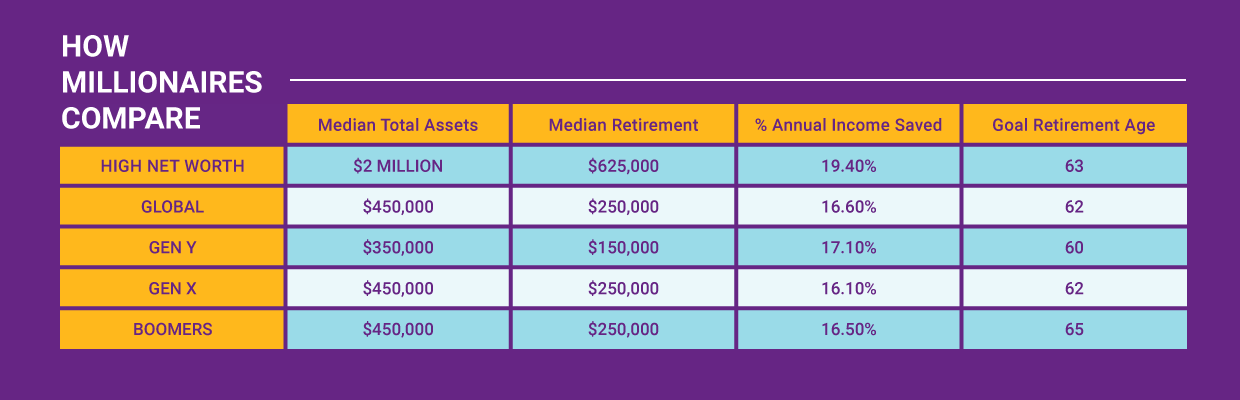
Natixis chart: how millionaires compare

High-net-worth individuals recognize that there are economic factors such as public debt and inflation that are out of their control. Public debt could potentially cause benefits such as Social Security to decrease and 38% of high-net-worth individuals say it will be hard to make ends meet without public benefits. With inflation reaching its highest level in 40 years in 2022, nearly seven in 10 individuals expressed angst about rising prices affecting their retirement.

Natixis also surveyed 2,700 advisers on the top five mistakes individuals make when saving for retirement. Those mistakes included underestimating the impact of inflation and how long life could be, setting unrealistic income and return goals and not being mindful of risk.

Natixis concludes that the best way to plan for retirement is to save early and often. The earlier an individual starts, the more time there is for compound interest to take effect.

Source: “The Million Dollar Question: Retirement sentiment among high net worth investors,” by Jessie Cross, Erin Curtis, Stephanie Giardina and David Goodsell; Natixis Investment Managers, 2022.

Discussion

CAREY C from NC posted over 3 years ago:

"This group’s median total assets is $2 million, but their median retirement savings is just $625,000." I assume the 625 is in retirement accounts. This is kind of ridiculous. I don't know about you, but my retirement savings are indistinguishable from my total assets. Mine are comparatively low because of contribution limits when I was working. Now, I will use assets from whatever source for retirement spending.


BARRY J from TX posted over 3 years ago:

Carey, a possible reason for the discrepancy between retirement savings and total assets is that total assets probably includes some assets that do not normally fall under the rubric of retirement savings – residence, other real estate, trust funds in the names of others, etc. For example, I do not count the market value of my residence as retirement savings since I do not intend to sell it. I also do not count mortgages I have paid off to assist other family members (or the liens to ensure they will repay me if they sell the property, a guardrail to protect their homes from temptations). Congratulations on maxing your 401(k). Don’t let the present day limits blur your focus on the long term. By the Rule of 72s, an estimated 7%-8% compounding rate means your current retirement saving will DOUBLE every 8-10 years. As the article says, the worst thing anyone can do is not start saving and investing as early as they can. Deconstructing the data in the article, this means that the mean (not average) retiree with $625,000 only had to save, invest, and accumulate about $80,000 30 years ago --- and leave it alone -- to let compounding do its magic -- to have $625,000 today. That means 87% of the wealth came from investing, not working. Remember “mean” is the middle amount. So, 67%-80% of retirees are below this mean because they did not save AND remain invested long term. Some of us poor folks paid attention when we read the “Three Little Pigs.” Words to the wise. That you are willing to question the data and are willing to do the math are two very good signs you will be successful. Net: stick 10-15% of today’s income it in the market, bet on the “don’t pass” line, and let it ride. Best of luck, Carey.


ROBERT F from VA posted over 3 years ago:

Hi Barry. Just wanted to clarify terminology. "Mean" isn't "the middle amount", "Median" is. "Mean" is "average." The article used the "median" as a measure of central tendency. Recalling my intro. statistics, the various measures of central tendency usually reported are: Mean = arithmetic average (sum all values in the set and divide by the number of values) Median = the middle value when a data set is ordered from least to greatest Mode = the value that occurs most often You indicated that "67%-80% of retirees are below this mean." I don't see the source for this statement in the article. If values are normally distributed, mean, median, and mode are equivalent, and 50% of any population would be expected to score at or below the mean, while 50% would be expected to score at or above the mean. However, distributions may be skewed, and in that case this wouldn't hold true. When discussing a median value, you can say that 50% of data points (retirees) have a value smaller or equal to the median, and 50% of data points have a value higher or equal to the median. Hope this helps!


You need to log in as a registered AAII user before commenting.
Create an account

Log In

Get your free copy of our special report analyzing the tech stocks most likely to outperform the market.

Download the FREE Report Here: