

- Comparison of dollar-cost averaging and value averaging as disciplined long-term investing strategies
- Explanation of how each method adjusts investments to market conditions and reduces timing risk
- Guidance on implementing, maintaining and automating averaging strategies for consistent wealth accumulation over time
Dollar-cost averaging and value averaging are long-term investing strategies for accumulating wealth regardless of market conditions. Both strategies lead you to purchase more shares when prices are low and fewer shares when prices are high, reducing the timing risk of purchases.
These disciplined approaches help remove emotion from investing decisions, encouraging consistency over time. While they don’t guarantee profits or protect against losses, dollar-cost averaging and value averaging can be an effective way to steadily build wealth and lower the average per-share cost of investments.
Two Disciplined Paths to Stay the Course
Dollar-cost averaging is a simple investing concept. The idea is to invest a fixed amount at equal intervals and continue to do so over a long period. The result is that more shares of a stock, exchange-traded fund (ETF) or mutual fund are purchased when prices are relatively low and fewer shares are purchased when prices are relatively high.
Value averaging differs by adjusting the amount invested at regular intervals based on a predetermined growth target. Unlike dollar-cost averaging, where a fixed amount is invested each period, value averaging requires investors to contribute more when the investment’s value falls below the target and contribute less—or even withdraw funds—when its value exceeds the target.
Each approach provides the benefit of taking timing considerations off the table. Your purchases automatically adjust to market conditions, alleviating concerns about whether now is a good time to invest. The discipline of investing regularly over extended periods regardless of market conditions can offer significant long-term benefits.
Implementing Dollar-Cost and Value Averaging
Dollar-cost averaging or value averaging can work for investors with a pool of cash or periodic cash flows, such as a regular paycheck or another stream of income. These approaches are also helpful for those who seek to invest in a risky asset and have a long-term investment horizon.
A key to successfully using any averaging strategy is to choose a long-term time frame. To avoid putting a large amount into a risky investment at a market peak, spread your investments over at least two years. A five-year period is ideal, as it can capture a full market cycle, though it may feel too long for some investors.
Another important factor is how often you invest. You can choose any interval and amount, but consistency is key. Investing every pay period, month or quarter works well. Weekly investing is usually unnecessary, while biannual or annual investing may be too infrequent to reap the benefits of compounding over time.
Concepts in Practice
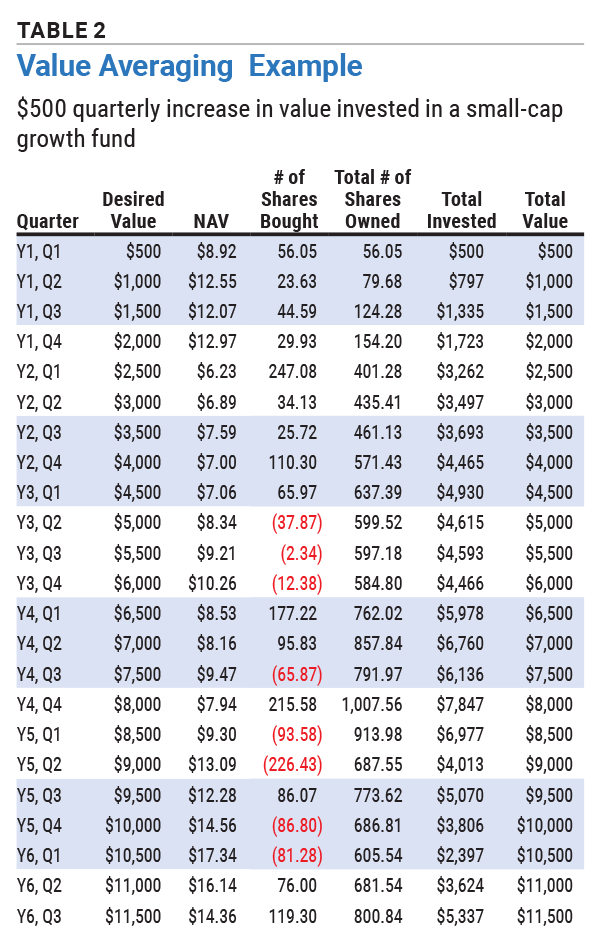
Tables 1 and 2 provide examples of dollar-cost averaging and value averaging, respectively, showing how each plan works and their key differences. The examples use a hypothetical small-cap growth mutual fund, invested quarterly over five and a half years.
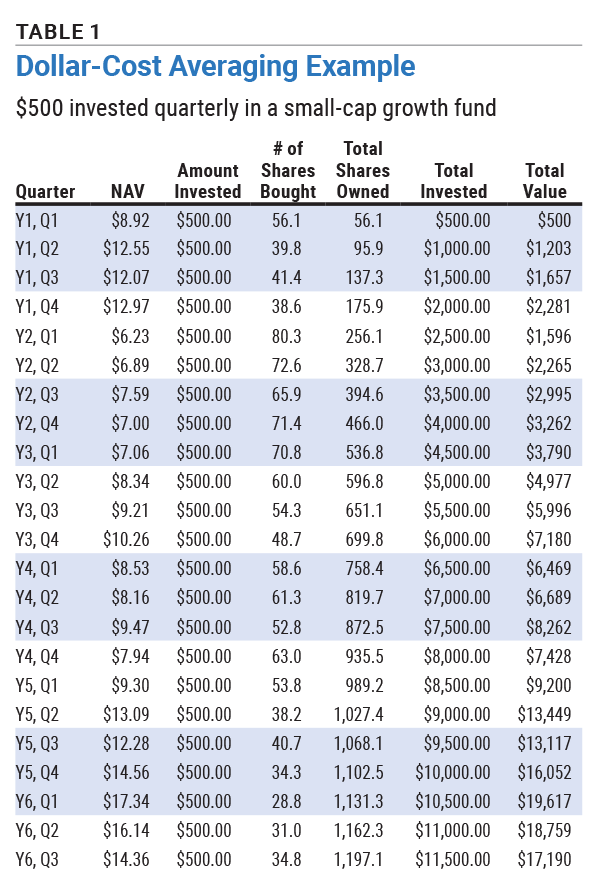
Investments made each quarter are at the prevailing price of the fund. To simplify the presentation, dividend and capital gains distributions are not considered. However, reinvesting these should be part of any investment plan.
For value averaging, a $500 quarterly increase in value is targeted. The amount invested each quarter varies such that the total value of the investment increases by $500. If the share price rises enough to cause the total investment value to rise by more than $500 during the quarter, shares would be sold to hold the increase to $500 for the period.
For example, in the second quarter of Year 3, the small-cap growth fund jumped from a net asset value (NAV) of $7.06 per share in the prior quarter to $8.34 per share. At the end of the quarter, the investor held 637.39 shares with a NAV of $8.34 per share, for a total value of $5,316 before any changes. This represented an increase of $816, which is $316 more than the planned $500 increase. Therefore, 37.87 shares ($316 ÷ $8.34, rounded) were sold.
Alternatively, value averaging forces larger share purchases when prices fall. For example, in the fourth quarter of Year 4 the share price of the fund fell from $9.47 per share in the prior quarter to $7.94 per share. Under the value averaging approach, that necessitated a $1,712 investment for the quarter.
Although there was a bigger price drop in the first quarter of Year 2, few shares were held at that time, so the increased investment required was lower at $1,539. This is an example of a volatile fund, so the $1,712 required investment in the fourth quarter of Year 4 was followed two quarters later by a sale of $2,964 worth of shares after a price run-up.
Results of Each Approach
The goal of value averaging is to increase an investment by a fixed amount each period, which can require investing significantly more—or less—than a steady dollar-cost averaging plan.
Under the value averaging approach, the ending value is the desired periodical value increase multiplied by the number of periods. In the Table 2 example, the ending value is $11,500 ($500 × 23 quarters). Ending amounts of value averaging are known, but the amount to be invested isn’t.
With dollar-cost averaging, the total value at the end of the period is unknown, but the total amount invested is equal to the number of periods multiplied by the periodic sum. In the Table 1 example, the total amount invested is $11,500 (23 quarters × $500).
Which method is better? Either can outperform at times, but value averaging often has an edge because it is more aggressive. However, it also demands more oversight, entails higher transaction costs and may trigger taxable sales. For value averaging contributions, taxable sales can only be avoided by not transacting when the investment’s total value is above target. Keep in mind, value averaging also carries greater loss potential since total investment amounts aren’t limited.
Though similar in concept, these are not apples-to-apples strategies. The amounts invested and the timing of the investments differ for the two approaches.
Getting Started
Most fund companies and robo-advisers offer fractional share purchases as well as automatic investment and exchange programs, providing a “cruise control” for your investment plan. This helps streamline the process of maintaining a dollar-cost averaging strategy. Brokerage firms may also offer investors the opportunity to set up automatic deposits, though the investor is typically responsible for allocating contributions into specific investments.
Lump sums can be placed in a money market or savings account, with automatic transfers to an equity fund, brokerage account or robo-adviser.
Related

Beginning Investor
How to Start Saving for Retirement
Related

Mutual Funds
How Target-Date Funds Work
Discussion
FREE REPORT

Get your free copy of our special
report analyzing the tech stocks
most likely to outperform the
market.
JOHN L from NJ posted 11 months ago:
BARRY J from TX posted 11 months ago:
SEAN S from CO posted 11 months ago:
You need to log in as a registered AAII user before commenting.
Log InCreate an account