


Charles Rotblut leads a class in AAII's new Essential Investing Video Course. Go to https://www.aaii.com/ves for more information and to subscribe.
- Overview of how investment income affects MAGI thresholds and eligibility for OBBBA tax breaks
- Key income limits for capital gains, dividends, deductions, surtaxes, and state and local tax benefits
- Guidance on optimizing for taxes without harming your portfolio strategy
The new and enhanced tax breaks introduced by the One Big Beautiful Bill Act (OBBBA) could be impacted by taxable income you realize from your portfolio. Most of the new breaks have thresholds based on modified adjusted gross income (MAGI). Adjusted gross income (AGI), which is the basis for MAGI, includes capital gains, taxable dividend income, taxable interest income and taxable retirement distributions.
This month, we show you how to understand the way portfolio decisions affect your eligibility for OBBBA tax breaks. Specifically, we discuss the different types of investment income that can move you toward or over the various MAGI thresholds.
Key Income Thresholds for Investors
Any discussion about the impact of investment income on taxes should start with an overview of the various thresholds. Crossing any of these can increase the marginal tax rate you will pay.
- Long-term capital gains and qualified dividend tax rates are based on taxable income. Their income thresholds differ from marginal tax rates, though. Both long-term capital gains and dividends are subject to a 15% tax when taxable income exceeds $96,700 for married joint filers and $48,350 for single filers in 2025 ($98,900 and $49,450, respectively, in 2026). The 20% tax rate applies when taxable income exceeds $600,050/$533,400 in 2025 and $613,700/$545,500 in 2026.
- The enhanced deduction for seniors starts to phase out at MAGI of $150,000 for married joint filers and $75,000 for single filers in both 2025 and 2026.
- The automobile loan interest deduction starts to phase out at MAGI of $200,000 for married joint filers and $100,000 for single filers in both 2025 and 2026.
- The no tax on tips and overtime both start to phase out at MAGI of $300,000 for married filing joint and $150,000 for single filers in both 2025 and 2026.
- The 3.8% surtax on net investment income (NII), which applies to the lesser of NII or MAGI in excess of $250,000 for married joint filers and $200,000 for single filers, was left unchanged by the OBBBA.
- State and local taxes of up to $40,000 can now be deducted in 2025 ($40,400 in 2026). The phaseout threshold begins at MAGI of $500,000 in 2025 and $505,000 in 2026.
Capital Gains and Dividends
Capital gains are realized when you sell an investment for more than you paid for it.
Short-term capital gains occur when an investment is sold within one year of purchasing it. They are taxed at ordinary (marginal) income rates for investments. Investments held for longer than one year in a taxable account qualify for the long-term capital gains rates of 0%/15%/20%. These rates remain below the ordinary income rates.
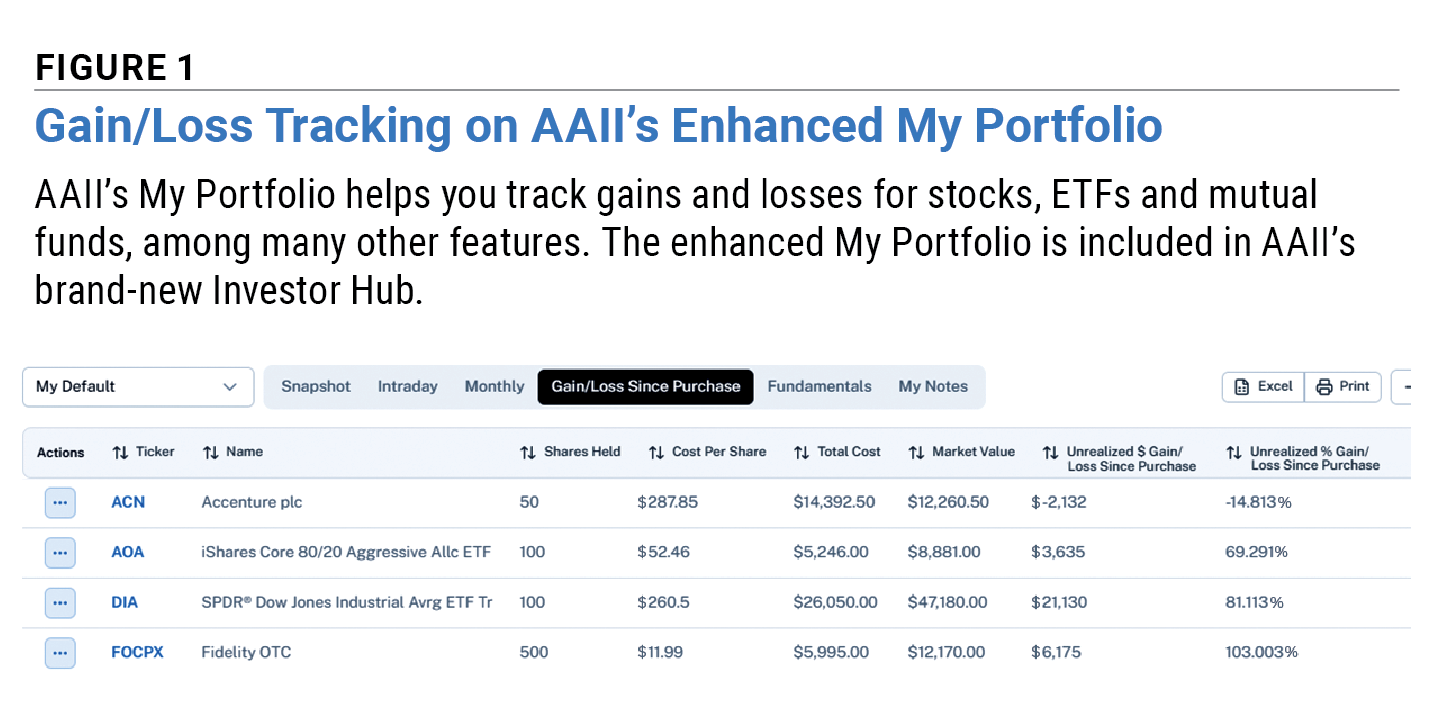
AAII’s enhanced My Portfolio—included in our brand-new Investor Hub—allows you to track the capital gains and losses on your stocks, exchange-traded funds (ETFs) and mutual funds (Figure 1). Simply click on the Gain/Loss Since Purchase tab above your holdings to see your current unrealized profits or losses. To see the purchase dates or to add new lots, click on the Modify Portfolio button located at the top-right of the My Portfolio page.
Note that the net capital gains from selling collectibles (such as coins or art) are taxed at a maximum 28% rate.
Capital gains taxes can be minimized by limiting turnover in taxable accounts, holding investments for over one year in taxable accounts and/or using tax-advantaged accounts—such as individual retirement accounts (IRAs)—for strategies or funds with higher levels of turnover.
Dividends
Dividends are categorized as either qualified or nonqualified.
Qualified dividends are taxed at the same favorable rates as long-term capital gains if holding period requirements are met. A stock must be owned for at least 61 consecutive days during the 121-day period beginning 60 days before the ex-dividend date. Preferred stocks must be held for at least 91 days during the 181-day period beginning 90 days before the ex-dividend date. Failure to meet these holding periods will result in the dividend being taxed at the higher ordinary income rates.
Nonqualified dividends are taxed as ordinary income. Most companies pay qualified dividends; contact the company’s investor relations department if you are unsure.
Distributions
Distributions are other payments of income to shareholders. Real estate investment trusts (REITs) make distributions that are taxable at ordinary income rates. Master limited partnerships (MLPs) often include a return of capital in their distributions. Whenever capital is returned, the payment decreases your cost basis in the investment. The return of capital is not taxable as long as your cost basis remains above $0, though your future taxable gains will be larger.
ETFs, mutual funds and closed-end funds may distribute capital gains, qualified dividends, nonqualified dividends, return of capital and/or interest income. Taxable distributions can occur even when a fund’s calendar-year returns are negative.
The tax-cost ratio indicates how tax-efficient or inefficient a fund has been. This ratio measures how much a fund’s annualized return is reduced by the taxes paid on distributions, assuming the maximum marginal tax rate. The lower the ratio, the more tax-efficient the fund.
The tax-cost ratio for a specific ETF or mutual fund can be viewed on AAII’s Evaluator pages. To access them, just type the fund’s name or ticker symbol into the search box located at the top-left of most pages on AAII.com. The tax-cost ratio is also included in the online tables of AAII’s ETF and Mutual Fund Guides (on the Management and Fees tab). Furthermore, A+ Investor and AAII Platinum subscribers can use the ETF and Mutual Fund Screeners to filter for funds with low tax-cost ratios.
Interest Income
Interest income is typically realized from bonds, money market funds and interest-bearing accounts. Interest income can be either taxable or tax-exempt.
Interest received from corporate bonds and most interest-bearing accounts is taxable at ordinary income rates. Interest (coupon) payments from Treasury bonds are generally taxable at the federal level at ordinary income rates but exempt from state taxes.
Municipal bond interest is exempt from federal taxes. It is also exempt from state taxes depending on the locale of the issuer and the taxpayer. Municipal bond interest is added back for calculating combined income (a form of MAGI), which is then used to determine how Social Security benefits are taxed. It is also included in the MAGI calculations for determining what your Medicare premiums will be two years from now.
Retirement Account Withdrawals
Withdrawals—whether required minimum distributions (RMDs) or additional amounts from tax-deferred accounts—are taxable at ordinary income rates in the year the withdrawals are taken. Tax-deferred accounts include traditional IRAs, Simplified Employee Pension (SEP) IRAs and Savings Incentive Match Plan for Employees (SIMPLE) IRAs, as well as 401(k), 403(b) and 457 accounts.
Qualified charitable distributions (QCDs) reduce or completely offset the need to take any RMDs. Because they reduce income dollar for dollar, they are even more advantageous under the OBBBA given the new 0.5% floor on charitable donations for those who itemize.
Roth IRA conversions are treated as taxable distributions in the year of conversion, though those age 65 or over can use the enhanced senior deduction to offset up to $12,000 (married joint) or $6,000 (single) of the conversion amount.
Don’t Let the Tax Tail Wag the Portfolio Dog
The temporary tax deductions put in place by the OBBBA give investors an opportunity to make portfolio moves without incurring large increases in their tax bill. Though potentially advantageous, investors should consider what is best for their portfolio first and the impact on their taxes second.
For example, if you desire to take a large withdrawal from your traditional IRA while your marginal tax rate is lower than that of your heirs, consider whether taking an in-kind distribution makes sense. This allows you to maintain your investment by withdrawing shares of the investment instead of selling it to fund the distribution.

Related

AAII How-To
What Fund Distributions Mean for Your Portfolio
Related

Tax Strategies
What the One Big Beautiful Bill Act Means for Your Taxes
Discussion
FREE REPORT

Get your free copy of our special
report analyzing the tech stocks
most likely to outperform the
market.
BARRY J from TX posted 10 months ago:
PATRICK C from CO posted 9 months ago:
CHARLES R from IL posted 9 months ago:
MIKE L from IL posted 9 months ago:
CHARLES R from IL posted 9 months ago:
You need to log in as a registered AAII user before commenting.
Log InCreate an account