


Related

ETFs and Mutual Funds
While you have no control over fund distributions, there are steps that can be taken to minimize their impact.

When selecting exchange-traded funds (ETFs) or mutual funds, investors often weigh factors such as the fund’s objective, strategy, performance, fees and how well it fits within their overall portfolio. Tax considerations take a back seat to these other features until a distribution is made or tax season arrives.
Distributions are payments made to investors from the income, gains and cash flow the fund generates. This includes dividends, interest income and capital gains. Dividends can be classified for taxation in two ways. Ordinary dividends are taxed at the investor’s regular income tax rate, while qualified dividends receive the lower long-term capital gains tax rate.
Interest earned from U.S. Treasury securities, corporate bonds, mortgage-backed bonds and similar holdings is taxed as ordinary income. Interest on municipal bonds is usually free from federal income tax. If a muni bond is issued within your home state, that interest may also be exempt from state and local taxes (SALT).
Capital gains are another type of distribution.
Some ETFs and mutual funds distribute potential tax thorns along with income to shareholders, while others are more tax efficient. Portfolio managers may sell securities within ETFs and mutual funds for a variety of reasons. This includes raising cash to meet investor redemptions and executing scheduled portfolio rebalancing or reconstitutions.
When a portfolio is rebalanced, the weights of existing holdings are adjusted to keep them in line with a target allocation. Reconstitution is the process of updating an index by adding or removing securities based on eligibility rules. When a security no longer qualifies for inclusion, it is removed from the index, which, in turn, prompts ETFs and mutual funds that track the index to sell the holding.
Actively managed, growth-oriented and international funds are more likely to make larger distributions. When a fund holds foreign securities, the returns are influenced not just by the price of the stocks or bonds themselves, but also by the exchange rate between the foreign currency and your home currency.
Suppose a fund holds European stocks priced in euros. If the euro strengthens against the dollar during the year, the U.S. dollar value of the fund’s holdings rises, even if the stock price in euros hasn’t changed. When the fund realizes gains by selling some of these holdings, those gains are calculated in U.S. dollars, potentially creating a capital gains distribution at year-end.
AAII’s ETF and Mutual Fund Evaluators report on a fund’s distribution schedule in the Assets Under Management section of the fund summary and in the Portfolio Statistics box (Figure 1). All AAII members can access the fund evaluators by typing an ETF or mutual fund name or ticker into the Search box at the top left of AAII.com pages.
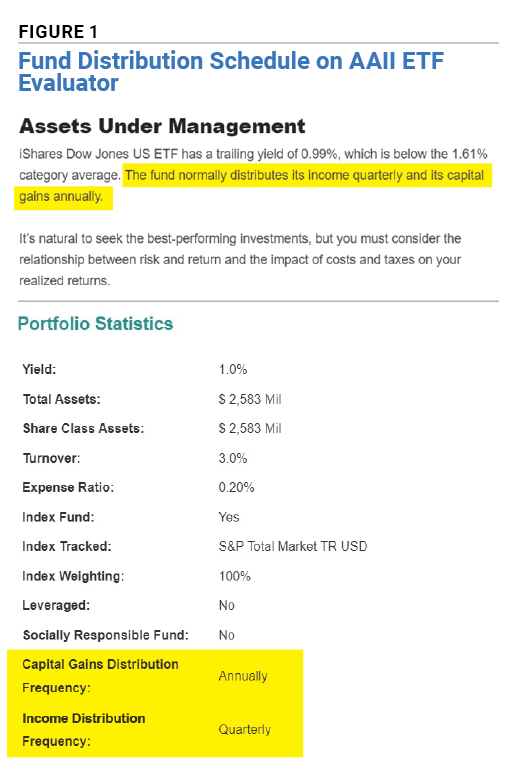
Fund distributions can trigger tax consequences. When sales made by the fund result in net capital gains, the fund generally passes those gains on to shareholders, with distributions typically made at year-end. Preliminary estimates may be released by the fund in the fall.
Mutual funds are particularly known for generating embedded gains. These are capital gains that have not yet been distributed to shareholders. When a new investor buys shares in a fund with embedded gains, these gains are reflected in the fund’s net asset value (NAV).
The specific tax consequences of fund distributions depend on the assets sold. If the fund sells appreciated stock, shareholders incur a per-share gain proportional to the increase in the fund’s NAV. How these gains are taxed depends on the holding period. Investments held by the fund for more than one year before selling generate long-term capital gains. These are taxed at favorable rates—0% to 20%, depending on the shareholder’s tax bracket—plus a potential 3.8% net investment income (NII) tax, if applicable. Investments held for less than one year generate short-term capital gains. These are taxed at ordinary income rates with the NII tax potentially applying. State taxes vary.
ETFs, on the other hand, are typically more tax efficient. Most ETF trading takes place between investors on the secondary market, with no impact on the securities held within the ETF. Their ability to create new shares or reduce the number of shares through an exchange of securities is inherently tax efficient. However, even with this “in-kind” creation/redemption process, ETFs are not entirely tax-free. They may still create taxable events when buying and selling securities as their underlying index is rebalanced or adjusted.
Fund distributions can include both capital gains and portfolio income, but taxes on these distributions apply only to funds held in taxable accounts. Funds held in tax-advantaged accounts such as traditional and Roth individual retirement accounts (IRAs), 401(k)s and 403(b)s are generally exempt. So, consider placing income-heavy or high-turnover funds in tax-advantaged accounts.
Note that the fund making the distribution usually does not pay federal income tax on gains it distributes to its shareholders.
While you have no control over fund distributions, there are steps that can be taken to minimize their impact.
Most fund companies announce distribution dates and estimates in advance. Investors can research distribution history and projected payouts on most funds’ websites. For example, Figure 2 shows the distribution history for the iShares Dow Jones U.S. ETF  (IYY) from iShares’ website. A schedule of upcoming distributions is also provided.
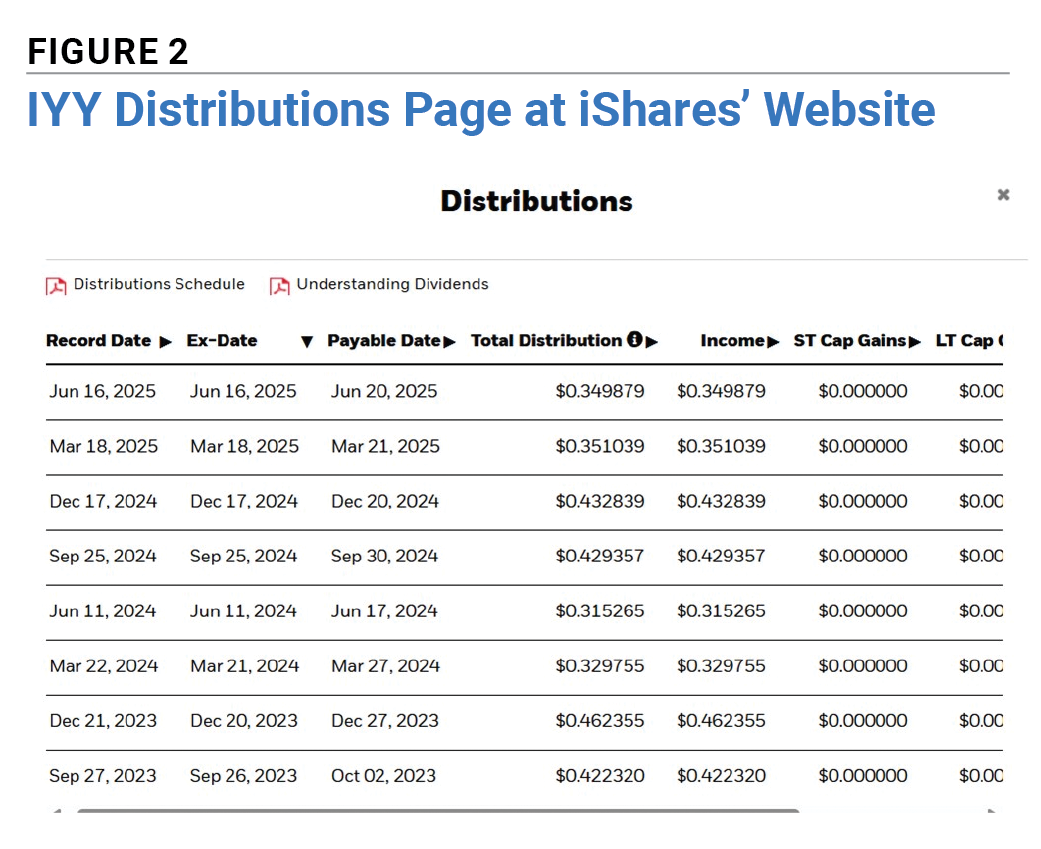
Investors thinking about purchasing a fund for a taxable account that shows an upcoming distribution may want to wait until after the payout occurs. In doing so, you will avoid receiving a taxable distribution without benefiting from the associated gains.
Conversely, you could sell the fund ahead of a scheduled distribution to avoid a potential tax problem. In this case, comparing your potential capital gains tax exposure to the fund’s distribution can inform your decision. If you are likely to realize a profit from selling the fund that is larger than the distribution, then holding onto the fund could make sense. For example, if you invested $10,000 in a fund 10 years ago and it’s now worth $20,000, a 20% distribution would be much smaller than the gain you’d get from selling the fund. But if you just bought the fund recently and it is about to pay a 20% distribution, selling may make sense—especially if you have a loss or small gains. In that case, you could consider selling the fund before the distribution and then potentially rebuy it more than 30 days after your sell date to avoid the wash-sale rule.
Reinvesting a fund’s distributions will allow compounding and growth to continue. Investors in taxable accounts must pay taxes on any distributed gains, even if they reinvest them. But those distributed gains can be offset by losses realized elsewhere.
Reinvesting distributions can increase your cost basis. If the reinvestment price is above your original purchase price, your capital gains taxes will be reduced when you eventually sell the fund (presuming you sell at a gain). For funds that regularly distribute gains, future sales may be less costly than expected because the repeated reinvested distributions will have gradually stepped up your cost basis over time.
ETFs and Mutual Funds

ETFs and Mutual Funds

AAII How-To

ROBERT A from NC posted about 1 year ago:
You need to log in as a registered AAII user before commenting.
Log InCreate an account