


This article is part of The Individual Investor’s Guide to Personal Tax Planning for 2025–2026. See all sections | Download complete PDF
- Key 2025–2026 tax changes across deductions, credits, income thresholds, retirement plans, AMT rules, the SALT deduction cap, and estate and gift rules
- Guidance on eligibility limits, phaseouts and inflation indexing for senior, education, child, medical and investment-income provisions
- What taxpayers can deduct, contribute or exclude, plus how laws like the SECURE 2.0 Act and the OBBBA alter tax-planning strategies
Key Tax Numbers for 2025 and 2026
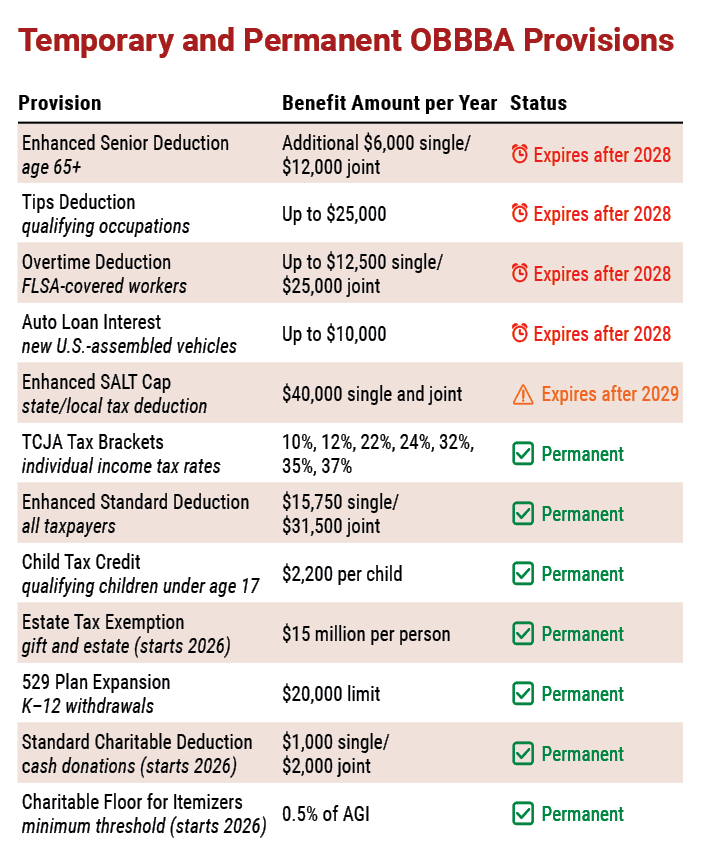
Here are the tax rates, deductions, credits and other key provisions that apply to your 2025 and 2026 taxes. They include changes from the Setting Every Community Up for Retirement Enhancement (SECURE) 2.0 Act and the OBBBA, such as the enhanced senior deduction, increased SALT deduction cap and higher standard deduction.
Alternative Minimum Tax
The AMT exemption is $137,000 for married couples filing jointly and $88,100 for single filers in 2025. The phaseout levels are $1,252,700 for married filing jointly and $626,350 for singles.
In 2026, the exemptions will rise to $140,200 and $90,100, respectively. However, the OBBBA lowered the phaseout levels to $1 million and $500,000, respectively.
Automobile Loan Interest Deduction
Interest on loans related to the purchase of new vehicles for personal use is deductible up to a limit of $10,000 per year between 2025 and 2028. Final assembly of the vehicle must occur in the U.S. to qualify for the deduction. This deduction can be claimed even if the standard deduction is claimed.
The auto loan interest deduction phases out beginning at MAGI of $200,000 for married filing jointly and $100,000 for single filers. For this deduction, MAGI is defined as AGI less foreign income and income earned in certain U.S. territories. Neither the deduction nor its phaseouts are indexed to inflation.
Capital Gains and Investment Income
The rate at which your long-term capital gains and dividends will be taxed depends on your taxable income and not your marginal tax bracket. Married couples filing joint returns with taxable income up to $96,700 ($48,350 for single filers) in 2025 will not owe taxes on capital gains or qualified dividends. Couples with income of $96,701 to $600,050 ($48,351 to $533,400 for singles) will pay a 15% tax rate. Filers with income above those levels will pay a 20% tax on long-term capital gains and dividends. These levels are indexed to inflation. In 2026, the thresholds are $98,900/$613,700 for married joint filers and $49,450/$545,500 for single filers.
Short-term capital gains are taxed as ordinary income.
Municipal bond interest is exempt from federal tax, as well as state and local taxes if you live in the same state as the issuer. Treasury bond interest is taxable at the federal level, but not the state level. Corporate bond interest is taxable at the federal and state level (if state income taxes are levied).
Married couples filing joint returns with net investment income (NII) and MAGI above $250,000 and single filers with NII and MAGI above $200,000 must also pay the additional 3.8% NII surtax on capital gains (including collectibles) and dividends. The $250,000/$200,000 thresholds are not indexed to inflation. See the Health Care Reform’s Impact on Taxes box in this year’s tax guide for more details.
Charitable Donations
Only those who itemize can deduct charitable donations for the 2025 tax year. The deduction limit is up to 60% of your contribution base (typically AGI).
In 2026, taxpayers who take the standard deduction can deduct up to $1,000 of charitable cash contributions ($2,000 for married filing jointly). These limits are both permanent and not indexed to inflation.
Also starting in 2026, taxpayers will face a 0.5% floor on charitable donations. This floor is based on the taxpayer’s contribution base. Only donations exceeding this floor can be deducted.
Those age 70½ or older can distribute up to $108,000 from their traditional individual retirement account (IRA) to qualified charities in 2025. The cap was indexed to inflation by the SECURE 2.0 Act. The 2026 limit is $111,000.
Child Tax Credit
The OBBBA increased the maximum child tax credit to $2,200 for 2025. The refundable portion of the credit is $1,700 in 2025. These numbers are indexed to inflation, but will remain at $2,200 and $1,700, respectively, for 2026. The income phaseout thresholds are $400,000 for married filing jointly and $200,000 for other filers. These phaseouts are not indexed to inflation.
Education Savings
The maximum Hope Scholarship Credit (the American Opportunity education credit) for the first four years of post-secondary education for tuition and related expenses (including books) is $2,500 per year and is not indexed to inflation.
The Lifetime Learning Credit can be claimed for education expenses beyond the fourth year of post-secondary education and for nondegree courses intended to improve job skills. The maximum credit is $2,000 annually and is subject to income phaseouts.
Contributions to a Coverdell Education Savings Account are limited to $2,000 per beneficiary. The limit is not subject to inflation adjustments. Contributions are not deductible, but they grow tax-free in the IRA.
Estate Tax Exemption
The estate tax exemption is both portable and indexed to inflation. The exemption is $13.99 million in 2025. The exemption will rise to $15.00 million in 2026. This is a per-spouse exclusion, and it is portable, meaning that if one spouse dies, the surviving spouse can claim the deceased’s exclusion, resulting in a total effective exclusion of $27.98 million in 2025 and $30.00 million in 2026.
The large figures will prevent most families from having to pay estate taxes.
The maximum estate tax rate is 40%. The step-up basis rule applies when an inherited asset is sold: The capital gain resulting from the sale is calculated as the difference between the proceeds at the time of the sale transaction and the value of the assets at the time of the inheritance.
Executors have to report the fair value of the property included in the gross estate to both the IRS and the heirs. Beneficiaries claiming a basis for inherited property above the reported value may be subject to a 20% penalty.
Gift Tax Exemption
The annual gift tax exclusion in 2025 is $19,000 for individuals and $38,000 for consenting couples. (The IRS says “you probably must file Form 709” for gifts exceeding these respective limits. Spouses may not file a joint gift tax return; each must file their own Form 709.) These limits are indexed to inflation but will remain at $19,000 and $38,000, respectively, for 2026.
Flexible Spending Accounts
Workers participating in flexible spending accounts (FSAs) can carry over up to $660 of unused 2025 contributions ($680 for 2026 contributions) into the next plan year if their plan sponsor allows them to. Plan sponsors have the choice of either offering employees the ability to carry the amount over or allowing employees a grace period of up to two-and-one-half months to spend it. Dependent care is also eligible for the grace period option, but not the carryover option.
Health Savings Accounts
The 2025 minimum annual deductible for self-only coverage is $1,650; it is $3,300 for family coverage. These amounts are indexed to inflation and will increase to $1,700 and $3,400, respectively, in 2026. The 2025 maximum limits for annual deductible and other out-of-pocket expenses are $8,300 for self and $16,600 for family. The maximum limits will rise to $8,500 and $17,000, respectively, in 2026.
Health savings account (HSA) contributions cannot exceed $4,300 for individual coverage and $8,550 for family high-deductible health care plan (HDHP) coverage in 2025. In 2026, the maximum contributions will be $4,400 and $8,750 for individual and family coverage, respectively.
All of these amounts are indexed to inflation. More information on HSAs can be found in “Health Savings Account Rules,” which is included in the tax guide.
Individual Retirement Accounts and 401(k) Plans
The maximum allowed IRA contribution in 2025 is $7,000 ($8,000 for individuals age 50 or older). The contribution limit will rise to $7,500 in 2026 ($8,600 for individuals age 50 or older).
IRA contributions can be fully deducted for MAGI below $126,000 for married filing jointly and $79,000 for singles in 2025. The 2025 phaseout is $236,000 for a person filing a married joint return who is not covered by a workplace retirement plan but whose spouse is. In 2026, the phaseouts start at $129,000 and $81,000 for married filing joint and singles, respectively. The phaseout for a person filing a married joint return who is not covered by a workplace retirement plan but whose spouse is will be $242,000 in 2026.
The maximum annual contribution limit to a 401(k) plan or similar type of defined-contribution plan in 2025 is $23,500, plus a $7,500 catch-up contribution for those age 50 or over. The catch-up contribution limit is $11,250 instead of $7,500 for those age 60, 61, 62 or 63. The maximum contribution limit will rise to $24,500 in 2026 and the catch-up contribution for those age 50 or over will be $8,000. The catch-up contribution for those age 60, 61, 62 or 63 will remain at $11,250 in 2026.
The maximum annual contribution for Savings Incentive Match Plan for Employees (SIMPLE) IRAs is $16,500 in 2025. Those age 50 or over can make a maximum catch-up contribution of $3,500. Those limits will rise to $17,000 and $4,000, respectively, in 2026. Participants ages 60 through 63 have catch-up limits of $5,250 in 2025 and 2026.
All of the aforementioned retirement account contributions are indexed to inflation.
Married couples with 2025 AGI below $79,000 and singles with AGI below $39,500 ($80,500 and $40,250, respectively, in 2026) can qualify for the Saver’s Credit. The credit is equivalent to 50%, 20% or 10% of retirement plan, IRA or Achieving a Better Life Experience (ABLE) account contributions totaling no more than $4,000 for married filing jointly and $2,000 for single filers. While the income thresholds are indexed to inflation, the credit itself is not.
Kiddie Tax
The “kiddie tax” applies to children who are age 17 or younger by the end of the year. In 2025, the kiddie tax will apply if the child’s total investment income exceeds $2,700. The exemption is indexed to inflation but will remain at $2,700 in 2026.
Medical Expenses
Medical expenses can be deducted if they exceed 7.5% of your AGI.
Medical insurance premiums for the self-employed are deductible and can be used to reduce AGI on Form 1040.
Premiums for qualified long-term care insurance can be deducted along with other qualifying medical expenses—for 2025, up to $480 for those age 40 or less, $900 for those 41–50, $1,800 for those 51–60, $4,810 for those 61–70 and $6,020 for those older than 70. These limits are indexed to inflation. In 2026, the limitations will increase to $500 for those 40 or less, $930 for those 41–50, $1,860 for those 51–60, $4,960 for those 61–70 and $6,200 for those older than 70.
Medicare
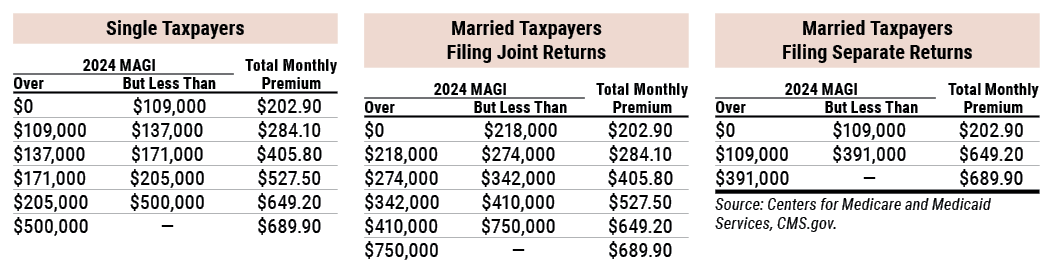
Medicare Part B premiums are based on MAGI as reported on returns from two years ago. As such, the Medicare Part B premium will be $202.90 per month in 2026 for taxpayers who file married joint returns with 2024 MAGI of $218,000 or less and single filers with 2024 MAGI of $109,000 or less. If your MAGI is higher, see the Medicare Part B Premiums for 2026 box below for the income-related monthly adjustment amounts (IRMAAs).
Medicare Part B Premiums for 2026
The premiums for Medicare Part B are determined by the amount of modified adjusted gross income (MAGI) reported two years ago. MAGI is adjusted gross income (AGI) plus tax-exempt interest (e.g., interest from municipal bonds). AGI can be found on IRS Form 1040. AGI includes the taxable portion of Social Security benefits plus taxable distributions from retirement accounts such as required minimum distributions (RMDs).
Roth IRA conversions can lead to higher Medicare premiums two years into the future. While it’s impossible to predict what the MAGI threshold breakpoints will be, you can use the thresholds for the upcoming year as a guideline.
Here are the Medicare Part B MAGI thresholds and premiums for 2026.
No Tax on Overtime or Tips
Workers in customary tipping occupations can deduct up to $25,000 of qualified tips. Workers who earn qualified overtime compensation can deduct up to $12,500 ($25,000 for married filing jointly). The overtime compensation must be covered by the Fair Labor Standards Act and reported on Form W-2.
The deductions can be taken regardless of whether a taxpayer itemizes or takes the standard deduction. The deductions begin to phase out at MAGI of $150,000 for single filers and $300,000 for married filing joint returns. Neither the deductions nor the phaseouts are subject to inflation adjustments. MAGI for both is defined as AGI less foreign earned income and income from certain sources in U.S. territories, including Puerto Rico.
Qualified Plan Contributions
In 2025, the maximum annual contribution for qualified plans, including Simplified Employee Pension (SEP) and Keogh plans, is $70,000 or 25% of your compensation, whichever is less. The limit is indexed to inflation and will rise to $72,000 in 2026.
Social Security
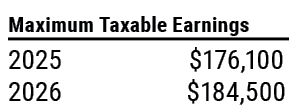
The Social Security tax is 6.2% for employees and 12.4% for those working in self-employed positions on the first $176,100 of 2025 wages. The wage cap will rise to $184,500 in 2026.
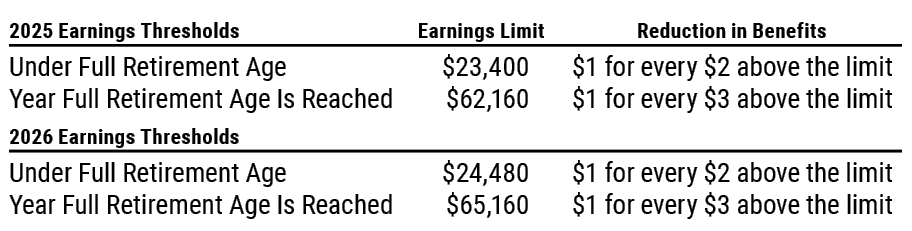
Retirees younger than full retirement age (FRA) who have claimed Social Security benefits can earn up to $23,400 without benefits being withheld in 2025. This limit will rise to $24,480 in 2026 (see the Social Security Earnings Thresholds box below).
Social Security Earnings Thresholds
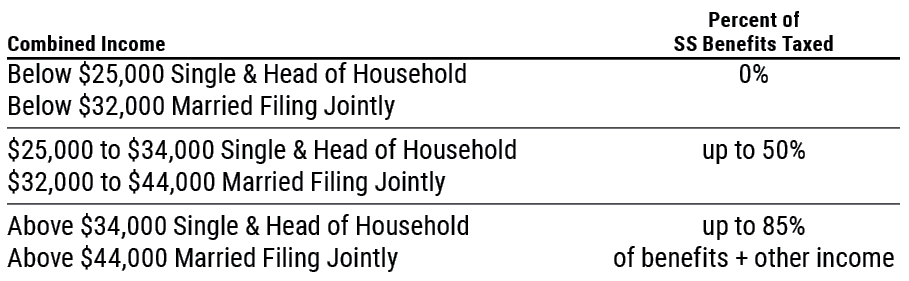
The calculation for how much of your Social Security benefits are taxed is based on combined income for the current tax year. The Social Security Administration (SSA) defines combined income as: MAGI + tax-exempt interest + one-half of your Social Security benefits. The amount of benefits subject to taxation for the 2026 tax year is determined by your 2026 combined income. The table below shows how much of Social Security benefits are taxed. These thresholds are not indexed to inflation.
Retirement Earnings Test
Recipients of Social Security retirement benefits are subject to an earnings test if they are below the full retirement age (FRA). A different threshold and benefit reduction exist in the year a recipient reaches FRA up until the month before FRA is reached. Afterward, the earnings test no longer applies.
These thresholds are as follows:
Social Security Taxes on Wages
Those who earn wages are generally subject to a 6.2% Social Security tax on net earnings. Those who are self-employed must also pay the employer portion, which increases the total tax rate to 12.4%. Social Security is taxed on net earnings up to these thresholds:
Medicare Tax on Earnings
A 1.45% Medicare tax (2.90% for the self-employed) is also levied on earnings. There is no cap on the amount of earnings this tax is applied to. An additional 0.9% Medicare tax is levied on married couples with income above $250,000 and singles with income above $200,000.
Standard Deduction
For 2025, the standard deduction is $31,500 for married couples filing a joint return, $15,750 for those who are single or married filing separate returns and $23,625 for heads of household.
The higher standard deduction is now permanent and is adjusted for inflation. It will rise to $32,200 for married joint filers, $16,100 for single taxpayers and $24,150 for heads of households in 2026.
The additional standard deduction for individuals who are elderly or blind is $1,600 in 2025 ($1,650 in 2026). For single taxpayers who are elderly or blind and not a surviving spouse, the additional standard deduction is $2,000 in 2025 ($2,050 in 2026).
Individuals who are age 65 or older may also claim a new “enhanced” senior deduction of $6,000 ($12,000 for married joint filers who are both 65 or older) in 2025 and 2026. The deduction is in addition to the additional standard deduction for those who are elderly. It can be claimed by both those who claim the standard deduction and those who itemize. The deduction phases out for taxpayers with MAGI over $75,000 ($150,000 for married joint filers). It is not indexed to inflation and will expire at end of 2028.
State, Local and Sales Taxes
Taxpayers who itemize deductions have the option of choosing between a deduction of sales taxes or income taxes when claiming a SALT deduction. Taxpayers cannot deduct both. The OBBBA raised the limit on SALT deductions to $40,000 in 2025. The higher cap is in effect through 2029 and is subject to 1% annual increases. In 2026, the cap will be $40,400. The phaseout starts at $500,000 of MAGI in 2025 and $505,000 in 2026.
Trump Accounts for Minors
Starting some time in 2026, contributions of up to $5,000 per year can be made to Trump accounts for a child under the age of 18. The contribution limit is subject to future inflation adjustments.
Beyond the Guide: AAII’s Tax Seminar

Charles Rotblut leads this practical video master class designed to help investors keep more of what they earn through tax-efficient strategies that go beyond a single filing season.
Across seven one-hour sessions, you’ll learn how to build a tax-planning road map, reduce taxes on investments, plan Roth conversions, manage Medicare costs and protect your heirs. You’ll also get interactive worksheets, downloadable resources, case studies and lifetime access to all seminar materials.
PRICE: $199

Related

Financial Planning
A Case Study: How to Reduce Marginal Tax Rates in Retirement
Related

Financial Planning
The Rules Regarding Retirement Account Rollovers
Discussion
FREE REPORT

BARRY J from TX posted 10 months ago:
David L from AK posted 10 months ago:
You need to log in as a registered AAII user before commenting.
Log InCreate an account