


This article is part of The Individual Investor’s Guide to Personal Tax Planning for 2025–2026. See all sections | Download complete PDF
Tax rates, deductions, credits and other provisions for your 2025 taxes are presented in the tables below. Inflation adjustments for the 2025 tax year were modest, but the OBBBA introduced significant changes, including the enhanced senior deduction and increased state and local tax (SALT) deduction cap; see our Key Tax Numbers for 2025 and 2026 article for details on those changes.
For a review of the 2026 tax numbers, see the 2026 Tax Rates, Deductions and Allowable Benefits article.
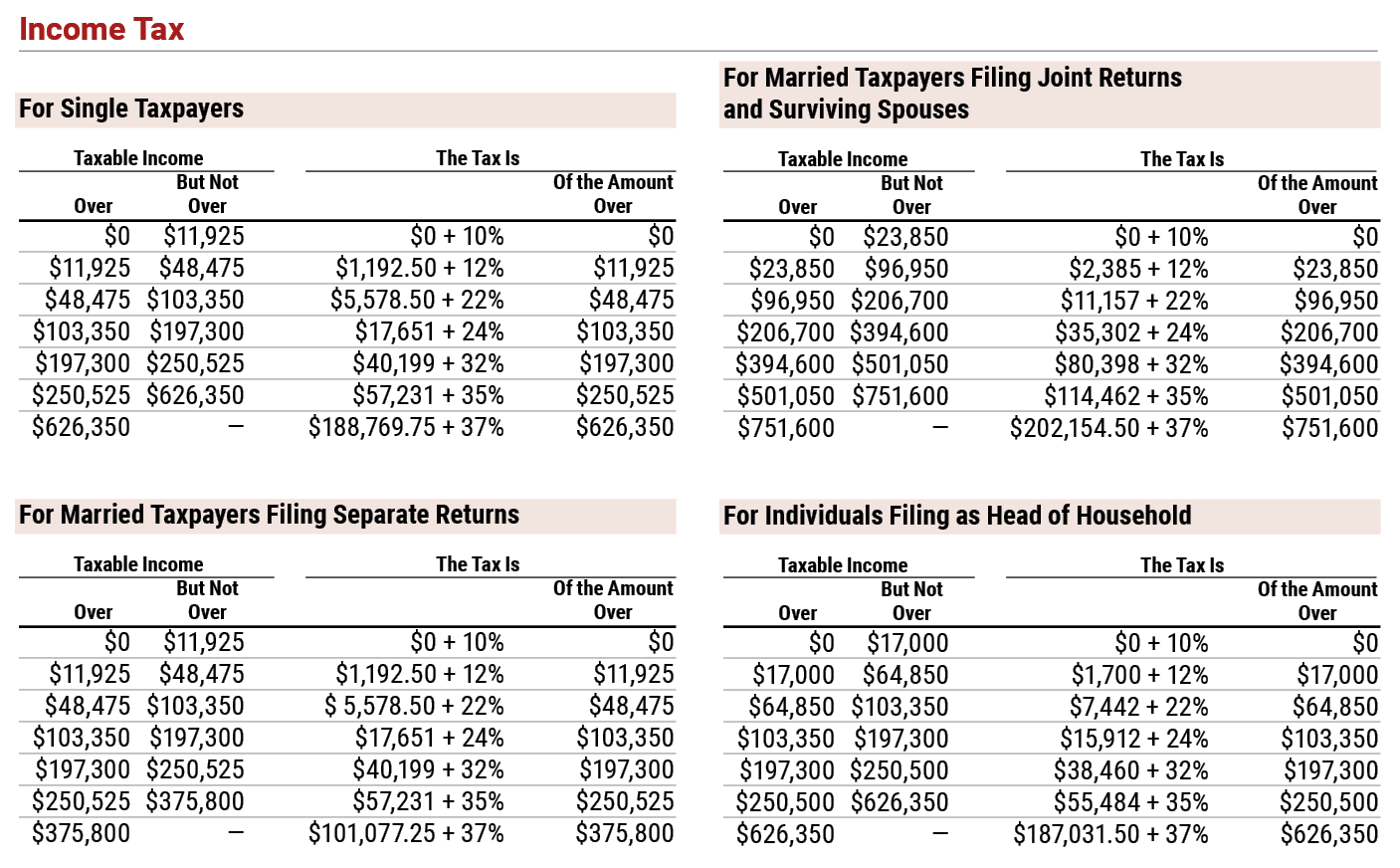
2025 Federal Income Tax Brackets and Rates
The federal income tax brackets are adjusted annually for inflation. For 2025, income thresholds increased 2.8%. The seven tax rates (10%, 12%, 22%, 24%, 32%, 35% and 37%) remain unchanged.
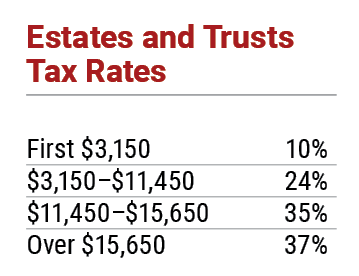
2025 Tax Rates for Estates and Trusts
Estates and trusts reach the highest tax bracket (37%) at much lower income levels than individual taxpayers. For 2025, the top rate applies to taxable income above $15,650.
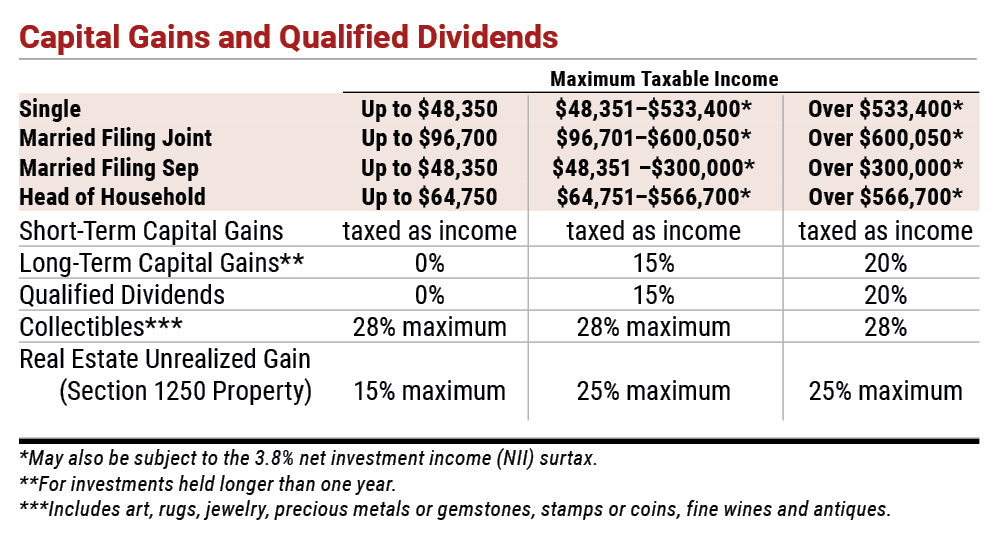
2025 Capital Gains and Qualified Dividends Taxes
Long-term capital gains and qualified dividends are taxed at 0%, 15% or 20%—significantly lower than ordinary income tax rates.
Holding period requirements:
- Long-term capital gains: Assets must be held more than one year
- Qualified dividends: Common stocks must be held more than 60 days during the 121-day period beginning 60 days before the ex-dividend date
The income thresholds for these preferential rates are different from ordinary income tax brackets and are adjusted annually for inflation.
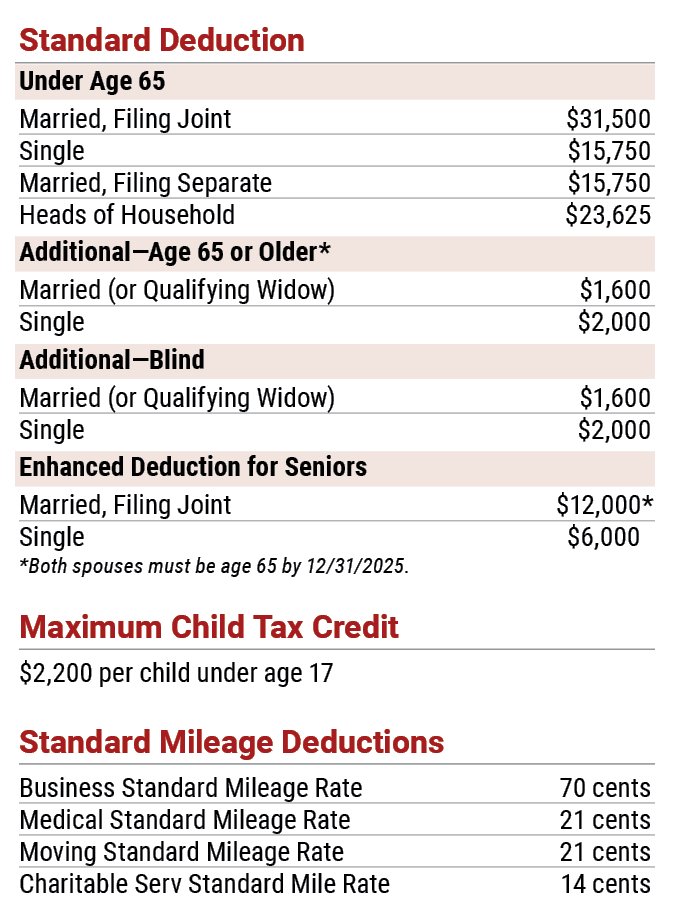
2025 Allowable Tax Benefits
This 2025 standard deduction was adjusted for inflation and increased further by the OBBBA.
New for 2025 is the enhanced deduction for seniors. It can be claimed by taxpayers who attain age 65 on or before December 31 and can be combined with the standard deduction and the additional standard deductions for older adults and those who are blind. It can also be taken by those who itemize.
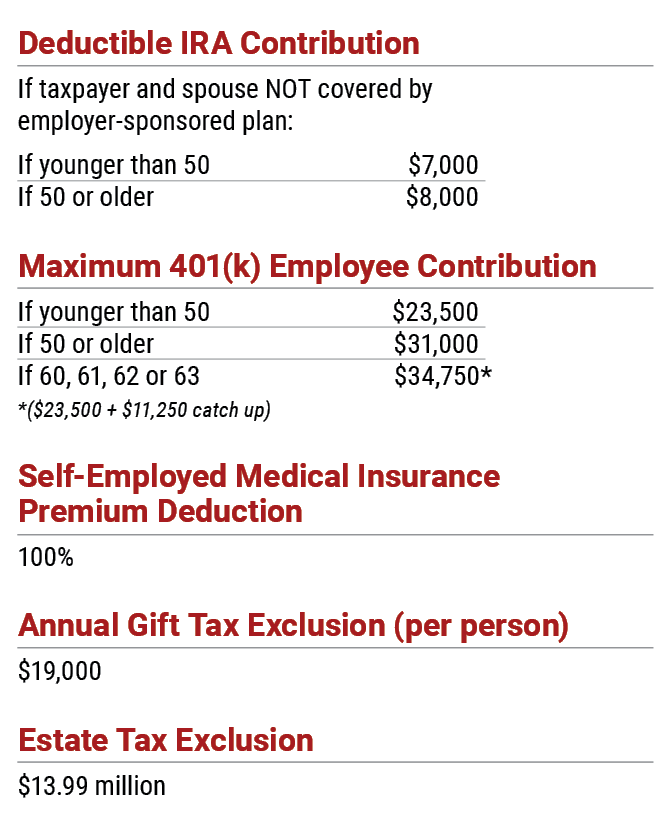
2025 Other Tax Items
The SALT deduction cap has been temporarily increased to $40,000 for 2025–2029, up from the previous $10,000 limit. This change particularly benefits taxpayers in high-tax states who itemize deductions.
The OBBBA also introduced several new temporary deductions available from 2025 through 2028, including deductions for auto loan interest (up to $10,000), qualified tips (up to $25,000) and overtime pay (up to $12,500 for single filers/$25,000 for married filing jointly). These deductions have income phaseout thresholds. See our What’s New for 2025–2026 Taxes article for complete details.

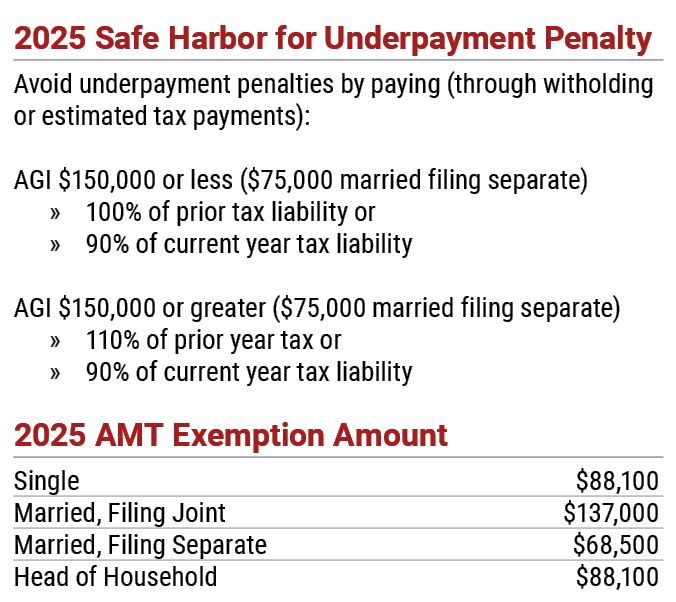
2025 Tax Benefit Phaseout Levels
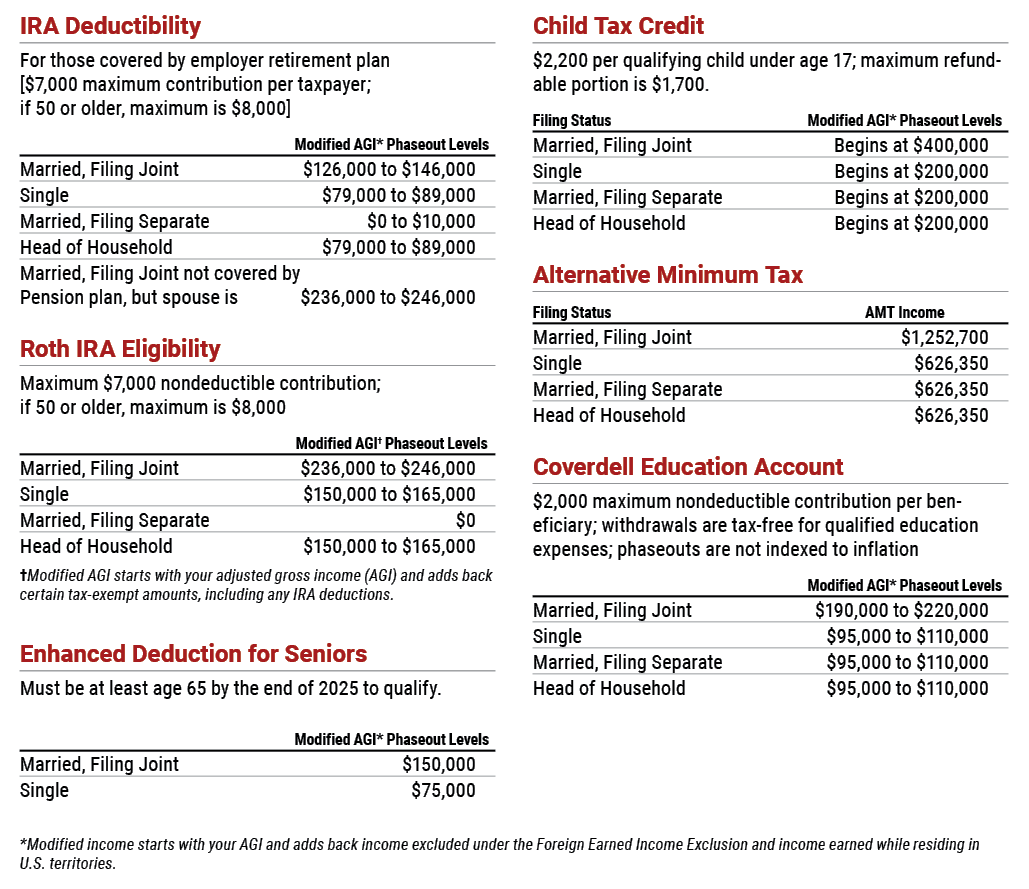
Many tax deductions and credits are reduced or eliminated at higher income levels. The tables below show the modified adjusted gross income (MAGI) thresholds where these benefits begin to phase out for 2025. Note: Definitions of MAGI vary across the tax code, so pay attention to the specific definition for each deduction or credit.
Download our 2026 Interactive Tax-Forecasting Worksheet.
Beyond the Guide: AAII’s Tax Seminar

Charles Rotblut leads this practical video master class designed to help investors keep more of what they earn through tax-efficient strategies that go beyond a single filing season.
Across seven one-hour sessions, you’ll learn how to build a tax-planning road map, reduce taxes on investments, plan Roth conversions, manage Medicare costs and protect your heirs. You’ll also get interactive worksheets, downloadable resources, case studies and lifetime access to all seminar materials.
PRICE: $199
Discussion
FREE REPORT

CRAIG B from WI posted 10 months ago:
JONDAVID P from WV posted 10 months ago:
BRIAN D from MI posted 10 months ago:
RICHARD S from FL posted 10 months ago:
D. R from MD posted 10 months ago:
D. R from MD posted 10 months ago:
You need to log in as a registered AAII user before commenting.
Log InCreate an account