

Related

AAII How-To
Learn how your taxes are affected by changes due to the OBBBA and the IRS inflation adjustments for 2026.
by AAII Staff | December 2025

This article is part of The Individual Investor’s Guide to Personal Tax Planning for 2025–2026. See all sections | Download complete PDF
This year’s tax guide includes two changes. The most important is the passage of the One Big Beautiful Bill Act (OBBBA) in July 2025. The act created new tax-saving opportunities while also extending many provisions included in the Tax Cuts and Jobs Act (TCJA) of 2017. We list the new OBBBA deductions, credits and limits for both 2025 and 2026.
Secondly, we’ve redesigned the presentation of this guide on AAII.com for better online reading. The guide is spread across several different, but related, articles on our website. This makes it easier to find the key tax information you are seeking. A comprehensive PDF file of the entire guide is also available for those of you who wish to download a digital copy.
The biggest changes many of you will see in your tax bills this year and next year will be caused by the OBBBA. The 2026 inflation adjustments announced by the Internal Revenue Service (IRS) are the lowest we’ve seen in five years. Most marginal tax brackets for married couples filing jointly and single filers will be 2.3% higher next year. The thresholds for capital gains will rise by the same amount.
The TCJA mandated the use of the chained consumer price index (CPI) for determining inflation adjustments. The OBBBA follows this practice. To the extent this change is smaller than the increase in your taxable income, you could have more dollars taxed at higher marginal rates.
The OBBBA added certainty to the tax code through 2028. Without its passage, many of the TCJA’s changes affecting individual taxpayers would have expired. However, many parts of the OBBBA are temporary, and it is uncertain how many of the new deductions, exemptions and credits will be extended in the future.
No matter how the tax laws (and tax forms) evolve in the future, one thing is constant: You will still have to pay taxes. The tax code is complex, hence the need for tax guides. As has been the case in years past, our tax guide provides an overview of the tax rates and deductions likely to impact the majority of AAII members. Since there are many details, loopholes and pitfalls within the tax code, it is impossible for this guide to provide enough details to cover specific tax situations. If you have questions, consult a tax professional. It is your tax return, and the IRS will hold you responsible for any errors made on it.
Some of the changes made by the OBBBA affect 2025 taxes, while others do not go into effect until 2026.
The lowered tax brackets mandated by the TCJA are now permanent; they had been set to revert to 2017 levels at the end of 2025. The 2026 inflation adjustments for the 12% and the 22% brackets are larger (4.0% increases) than they are for the higher brackets (2.3% increases).
The higher standard deduction mandated by the TCJA was not only made permanent by the OBBBA, but also increased. Married couples filing joint returns will be able to claim a standard deduction of $31,500 instead of the $30,000 originally listed in the IRS’ 2025 inflation adjustments. The standard deductions for other filing statuses have also been increased.
Taxpayers who attain age 65 on or before December 31, 2025, will be able to immediately take advantage of the new enhanced deduction for seniors. The deduction is $12,000 for married couples filing joint returns where both spouses qualify and $6,000 for single filers. It is on top of the existing additional standard deductions for older adults and those who are blind: $1,600 for married couples filing jointly and $2,000 for single filers in 2025. The enhanced senior deduction is in effect through tax-year 2028. Income phaseout levels apply.
The state and local tax (SALT) deduction has been both increased and extended through 2029. The maximum deduction for 2025 is $40,000. It will increase 1% each year through 2029. Income phaseouts apply.
High-income earners will see a new restriction on itemized deductions. Those in the 37% tax bracket will see their itemized deductions reduced by 2/37ths (5.4%) of the lesser of total itemized deductions or the amount by which taxable income exceeds the threshold for the 37% tax bracket. This effectively caps the tax value of itemized deductions at the 35% tax rate starting in 2026.
The higher alternative minimum tax (AMT) exemption amounts established under the TCJA are maintained under the OBBBA and will continue to be indexed to inflation. The OBBBA does, however, reduce the AMT exemption phaseout thresholds to 2018 levels. More significantly, the new law doubles the phaseout rate from 25% to 50%, meaning that once taxpayers exceed these thresholds, their AMT exemption disappears twice as quickly. This accelerated phaseout effectively expands the reach of the AMT among high-income taxpayers while maintaining protection for middle-income families.
Automobile loan interest is deductible up to a limit of $10,000 per year between 2025 and 2028. Final assembly of the vehicle must occur in the U.S. to qualify for the deduction. This deduction can be claimed even if the standard deduction is claimed. Income phaseouts apply.
The mortgage interest deduction cap of $750,000 for most filers ($375,000 for married filing separately) is now permanent. In addition, the OBBBA allows private mortgage insurance (PMI) associated with the purchase of a residence to now also be treated as mortgage interest.
Taxpayers taking the standard deduction can deduct up to $2,000 of cash donations to charities if married filing a joint return ($1,000 for single filers) beginning in 2026. This change is permanent unless altered by future legislation. Those who itemize will only be able to deduct donations to the extent that they exceed 0.5% of their contribution base, which is typically adjusted gross income (AGI), starting in 2026. This change creates a floor below which charitable contributions provide no tax benefit for itemizers.
The 60% of AGI limitation on cash gifts to public charities becomes permanent. Excess contributions that cannot be deducted due to the new 0.5% floor can be carried forward for up to five years, subject to meeting the floor test in future years.
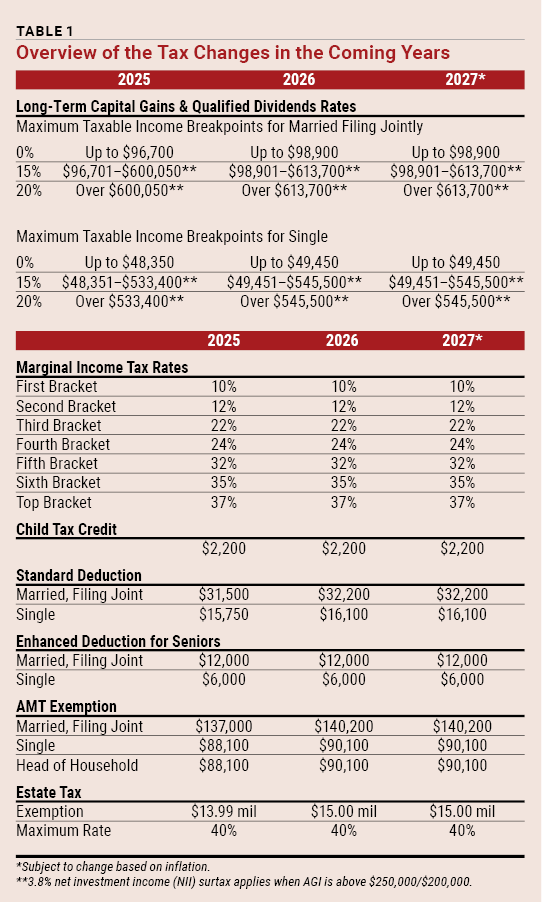
The child tax credit for 2025 is increased to $2,200 per qualifying child under the age of 17. The credit is permanent and will be indexed to inflation.
Beginning in 2026, the annual limit for tax-free K–12 withdrawals from 529 plans will increase permanently from $10,000 to $20,000 per beneficiary. Additionally, effective immediately for distributions made after July 2025, the definition of qualified K–12 expenses is expanded to include curriculum materials, books, online educational materials, qualified tutoring services, standardized test fees, dual enrollment fees and educational therapies for students with disabilities.
Both the estate tax exemption and the lifetime gift tax exemption will increase to a permanent base of $15 million per person in 2026. They had previously been set to revert back to pre-TCJA levels.
Most of the miscellaneous itemized deductions that were temporarily suspended under the TCJA are now permanently suspended.
Trump accounts for minors are expected to become available for contributions in 2026. The contribution limit is $5,000 per year.
Workers in customary tipping occupations can deduct up to $25,000 of qualified tips. Additionally, qualified overtime compensation can be deducted up to $12,500 ($25,000 for married couples filing jointly). Both deductions are in effect for tax-years 2025 through 2028 and are subject to income phaseouts.
Employees age 60, 61, 62 or 63 can contribute up to $34,750 to their 401(k), 403(b) and 457(b) plans. Starting in 2026, high earners (those with more than $150,000 in FICA wages—that is, wages subject to Social Security and Medicare tax—in the prior year) can only make Roth catch-up contributions.
The IRS began phasing out paper refund checks in September. Taxpayers who file returns with valid bank account information will continue to receive refunds via direct deposits. The agency says just 7% of individual refund recipients received their refunds by check through the mail during the 2025 tax-filing season.
All taxpayers will have to file their 2025 tax returns or request for extension by April 15, 2026. This deadline applies to those living in Maine or Massachusetts as well, since Patriots’ Day will not be observed until April 20, 2026. Even though you can wait until the deadline, we continue to advise filing your taxes as early as possible to make it more difficult for a fraudster to file a false return under your name.
Various tax deadlines have been extended for victims of natural disasters. See www.irs.gov/newsroom/tax-relief-in-disaster-situations if you were affected by a hurricane, flooding, wildfire or other disaster for more information and the available tax relief options.
Medicare Part B premiums for married joint and single filers with modified adjusted gross income (MAGI) at or below $218,000 and $109,000, respectively, will see their monthly premiums rise 9.7% to $202.90 in 2026. For Medicare Part D, joint filers with MAGI greater than $218,000 and less than or equal to $274,000 ($109,000 and $137,000, respectively, for single filers) will pay an additional $14.50 per month in 2026.
Mark Wilson, who runs the CapGains Valet website, predicts that 365 mutual funds will make capital gains distributions of at least 10% of their net asset value (NAV) this year. The number is close to the 11-year average for such distributions of 350 mutual funds. His prediction is based on the strong performance of the stock and bond markets, outflows from mutual funds continuing to occur at a consistent pace, and the fairly normal numbers for the mutual funds that had announced their capital gains distributions as of the end of October.
Be aware that mutual funds, as well as exchange-traded funds (ETFs), will make capital gains distributions whenever the gains they realize from selling profitable positions exceed the amount of realized losses they can use to offset the gains. Even if the fund’s NAV declines, capital gains distributions can still be made.
The draft versions of the 2025 Form 1040 and Form 1040-SR—which is for taxpayers age 65 or older—ask for more information than in 2024. The new Schedule 1-A for Form 1040 will be used for determining some of the new OBBBA tax breaks, including the enhanced deduction for seniors and car loan interest deduction.
Taxpayers will continue to be asked if they received, sold, exchanged or gifted a digital asset. These assets include both cryptocurrency and nonfungible tokens (NFTs). Check the final version of the 1040 instructions if in doubt. The draft version of the instructions says you “generally” aren’t required to check “yes” if you purchased “digital assets using U.S. or other real currency, including through the use of electronic platforms such as PayPal and Venmo.”
You can estimate your 2025 and 2026 tax liabilities on our Tax Forecasting Worksheet. This downloadable Excel spreadsheet will calculate the results based on the data you enter and can be saved for your records.
It’s painful enough to pay taxes. Paying additional amounts to file your taxes can add to the pain. Taxpayers with AGI of $84,000 or less may be able to file their taxes for free through certain providers. See https://apps.irs.gov/app/freeFile for more information. (Direct File, a pilot program that allowed taxpayers to file their returns directly with the IRS at no cost, has been suspended.)
You may also be able to file your state taxes for free. Check with your state’s revenue department. Illinois, for instance, allows taxpayers to file through its website at no charge.

Charles Rotblut leads this practical video master class designed to help investors keep more of what they earn through tax-efficient strategies that go beyond a single filing season.
Across seven one-hour sessions, you’ll learn how to build a tax-planning road map, reduce taxes on investments, plan Roth conversions, manage Medicare costs and protect your heirs. You’ll also get interactive worksheets, downloadable resources, case studies and lifetime access to all seminar materials.
PRICE: $199
AAII How-To

Tax Strategies


Linda C from NC posted 10 months ago:
Michael C from NY posted 10 months ago:
FERNANDO R from FL posted 9 months ago:
JEAN H from IL posted 8 months ago:
JEAN H from IL posted 8 months ago:
You need to log in as a registered AAII user before commenting.
Log InCreate an account