


Related

AAII Stock Ideas
Some of Wall Street’s most cited maxims aren’t suitable for individual investors.

AAII and BetterInvesting held a joint webinar on July 28, 2026, in which AAII’s John Bajkowski and BetterInvesting’s Doug Gerlach explained why some of Wall Street’s most cited maxims aren’t suitable for individual investors. The following is an edited excerpt of their discussion. For the full recording, please see the box at the end of this article.
Doug Gerlach (DG): It is worth asking who Wall Street wisdom is designed to serve.
Words of advice are handed down from individual to individual over time, and the media loves to run them as headlines. They’re not really intended to be reassurances that you’re on the right track. Rather, they tend to support products that are not worthwhile for individuals, such as a lot of actively managed funds, or products that are so complicated that it takes a professional to describe them.
Furthermore, many of the words of advice that are frequently repeated advocate for market timing strategies. At BetterInvesting, we counsel against trying to time or guess the direction of the market in the near term.
The one commonality of much of Wall Street wisdom is that it’s often very general, not specific. It’s intended to be that way, and it may not impact your particular approach. If you have figured out a method of investing or trading that works for you and if you have the experience that gives you the license to successfully break the rules, that’s great. But, if you’re entering the market for the first time and looking for guidance, you ought to reconsider some of the rules you’ve heard about what you should and shouldn’t do in the market.
DG: One of my biggest pet peeves is the adage “Invest in what you know.” This was, in part, driven by former Fidelity manager Peter Lynch, who wrote about going to the shopping mall with his wife and discovering L’eggs pantyhose at the very beginning of its product cycle. He also talked about other companies that he discovered while going about his normal life.
This mantra is meant to offer confidence that your observations about and experience with products and services can aid you in your research and analysis. The problem is that as individuals, we are human and susceptible to cognitive biases. Many of those unconscious modes of thinking cause us to be overconfident and support an overinflated sense of expertise about familiar things. [For more on how cognitive biases impact investing, see the article “Costly Cognitive Biases and How to Manage Them” in this issue.]
In other words, we assume that because we shop at a particular store or work in a particular industry, we have expertise and familiarity with a company’s business that other individuals don’t. That can be a problem. If we elevate our sense of knowledge and experience to a point where we see ourselves as the experts, then it becomes too easy to throw off any analysis, research and contrarian points of view we discover that might dissuade us from our particular path.
DG: The adage “No one ever went broke by taking profits” is meant to reassure you that you’ll never be wrong if you always sell when you’re ahead. This is a great strategy if you’re a broker advising clients, because their account statements will always be in the green.
The counterargument to this strategy is that just being positive doesn’t mean that you’re beating the market. You can’t judge your investing strategy to be successful simply because the bottom of your account statement shows a plus sign.
I believe that selling merely to lock in profits is a misguided strategy because it means selling companies that have performed well and appreciated over time. You are also locking out any future profits. And if you sell all the winners out of your portfolio, or if you sell big chunks of those positions, you are left with your losers.
BetterInvesting’s portfolio management techniques suggest that instead of cutting the blooms off all the flowers in your garden and letting the weeds grow, weed out the worst offenders—the losers and underperformers—first and let your winners ride. If you’re carrying large unrealized capital gains in those big winners, consider using a trailing stop-loss order or other strategy to minimize the downside if you’re worried about them. But otherwise, we like to let our winners ride.
DG: Another adage that you often hear is “Buy the rumor, sell the news.” I don’t know anybody who does this. Speculators price in positive catalysts that are coming from the rumor mill and then sell the stock when the official announcements come out. This is why companies often decline in price after releasing very strong earnings reports or officially announcing that they’re going to be acquired following much speculation. The rumor mill is active, and when the rumored event happens, a stock’s price might decline in value.
These “words of wisdom” lead investors to focus on the wrong thing: short-term market noise. Furthermore, these types of buying and selling strategies could generate more tax liabilities.
DG: “Follow the smart money” sounds like a great piece of advice. It encourages individual investors to look for the opportunities that large, successful institutional investors and actively managed mutual funds are exploiting. One example commonly put forth is to focus on companies that have the biggest amounts of institutional dollars chasing after them.
There are some problems with this approach. For one, big, actively managed mutual funds only report their holdings twice per year—typically around June 30 and December 31. Additionally, if an adviser or a mutual fund manager doesn’t want to disclose their strategies, they might intentionally dump some of their holdings in order to avoid holding them on the reporting date. In other cases, reporting delays mean that you’re not getting real-time information.
Furthermore, this approach has a bias against small and midsize companies by virtue of the size of actively managed mutual funds and pension funds. In many cases, institutional investors actually can’t invest in those smaller companies.
Instead of following the large institutions, create your own smart money research. Take advantage of opportunities where institutions can’t compete with you. Individuals have an edge in the smaller segments of publicly traded securities. We can invest in small and midsize stocks, and as they get bigger, they will eventually start to attract institutional attention, which will help boost their value.
DG: Every time the Federal Reserve is having a meeting, some talking head on television will bring up the guideline “Don’t fight the Fed.” This is meant to signal whether you should be aggressive or conservative. In other words, you should buy when the Fed is cutting interest rates and move to cash or turn defensive when the Fed is raising interest rates.
The problem with this approach is that macroeconomic policy lags the fundamentals of companies. Interest rate moves aren’t a good predictor for a lot of companies. Plus, over the long term, the impact of following the Fed trend really won’t boost your returns significantly.
You should pay attention to the Fed’s actions, understand the basics of monetary policy and understand the country’s broader economic environment. But let your fundamental analysis and your understanding of individual valuations drive your stock selections.
DG: Like many of these adages, the saying “Pigs get fat and hogs get slaughtered” is meant to restrain you from focusing on maximizing your profits. It encourages investors to sell their winners too soon, which eliminates future gains. It also has the potential to create short-term capital gains, which are taxed at higher rates than long-term gains (Figure 1).
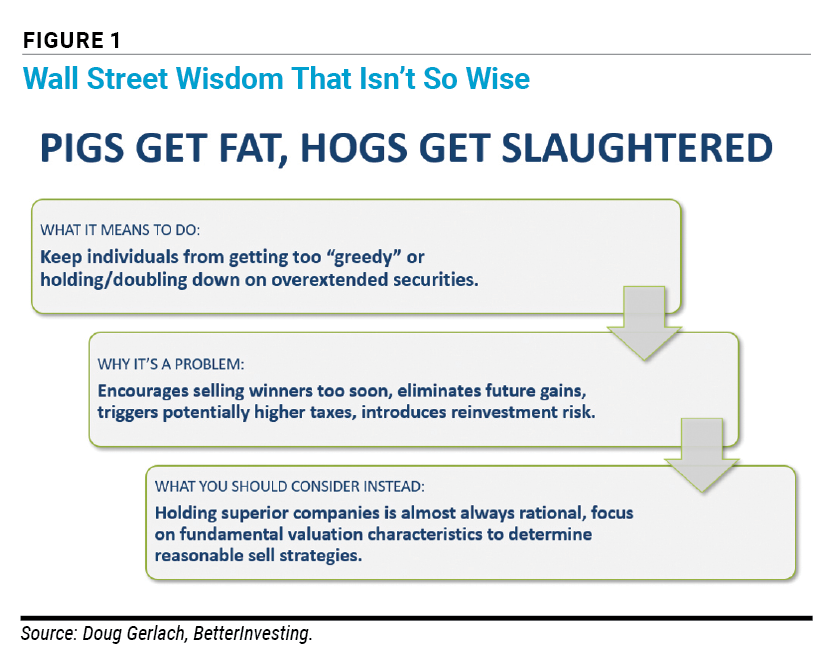
Furthermore, this strategy introduces reinvestment risk. If you’re constantly selling stocks because you’re afraid of making too much money and being a hog, will you be able to replace those investments with others that could perform as well as the ones you just dumped?
Holding well-managed, superior companies is almost always a rational investing approach. Focusing on valuation characteristics will help you develop a reasonable, functional sell strategy that’s driven by underlying fundamentals instead of arbitrary limits on the high end.
John Bajkowski (JB): There are many common trading approaches that sound very good on the surface and sometimes even have attractive rates of return but are not practical for typical individuals to employ.
At the beginning of the year, you often hear the phrase “As goes January, so goes the year.” The notion is that if your portfolio has a strong January, the whole year is going to turn out well. The first challenge with this is that January is often a good part of the overall year. One has to take a close look at whether the performance of the whole year incorporates January, as well as whether that performance translates into a type of action that we as individuals should follow.
To test this strategy, I looked at the performance of AAII’s Model Shadow Stock Portfolio and the S&P 500 index. I wanted to determine whether it would be an effective strategy to stay in the market if the market was up during January of a given year and go into cash—only receiving the January return—if the market was down during January.
Over the 33 years since we created the Model Shadow Stock Portfolio, January’s market returns have tended to be somewhat characteristic of the direction of the whole year. There have also been some exceptional years where returns were positive in January but very negative for the full year. Take 2008 for instance. The Model Shadow Stock Portfolio was up 1.9% in January. However, if you had stayed in the market that whole year, you would have had a big loss.
Over the following two years, the opposite was true for the Model Shadow Stock Portfolio and the S&P 500. January’s rate of return was negative in 2009 and 2010, but both years had full-year returns approaching triple digits. So, if you simply followed the approach of getting out of the market because January itself was bad, you would have missed out on tremendous returns.
Over the long term, you’re much better off staying invested in the market. An investor following the Model Shadow Stock Portfolio would have had a 13.6% compound annual return if they stayed invested for all 33 years. They would have had a lower rate of return if they had skipped the rest of the year when January was down. The same is true for an investor following the S&P 500. Over that 33-year period, investing in the full year would have produced an annual return of 10.7%, versus an 8.0% return for selling when January was down. This is ignoring all the tax implications of getting in and out of the market, which would have further reduced the net return.
It’s also worth highlighting that the January Barometer is based on the S&P 500. What is true for the S&P 500 may not be true for other markets. Small-cap, international, mid-cap and even equal-weighted large-cap markets can move differently.
JB: Another adage that we hear a lot is “Sell in May and go away.” As in many of these cases, there is a certain amount of truth to this saying. Statistically speaking, the market is typically stronger in the winter months and weaker in the summer months. But every year is a little bit different.
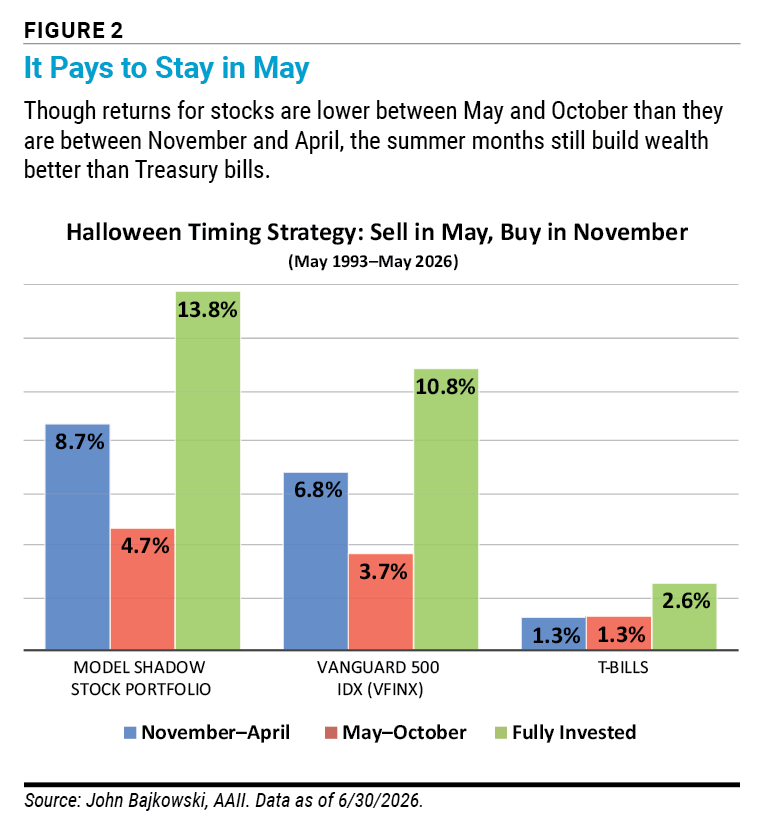
To test this approach, I calculated the Model Shadow Stock Portfolio’s average monthly return over the last 33½ years to get a sense for which particular months were better than others. For comparison, I looked at returns for the S&P 500 and Vanguard Morningstar Total Stock Market Index fund  (VTSMX) over the same period. For the Model Shadow Stock Portfolio, there is some accuracy to the sayings “Sell in May and go away” and “Buy in November and hold it.” On average, the best-performing month has been November. That proved true not only for the Model Shadow Stock Portfolio, but also for the S&P 500 and the total market index fund.
What about other months? When it comes to the Model Shadow Stock Portfolio, the second-best month has been January. The third-best month has been July. July has also been the fourth-best month to be in the market for the S&P 500 and the total market index fund. The worst months have typically been around August and September. October has actually been one of the better-performing months for the S&P 500 over the last 33 years.
Figure 2 compares the various holding periods for the Model Shadow Stock Portfolio, Vanguard 500 Index fund (VFINX) and Treasury bills. The blue bars indicate the average annual return you would have earned if you’d been in the market between November and April. While returns have been lower between April and October (red bars), the returns that you would have earned in the summer months are still higher than what you would have earned in Treasury bills. Plus, if you sold at the start of May, you would have incurred capital gains and lost out on an aftertax basis.
JB: I often see investors expressing fear about investing in a particular company because its stock price is up. Similarly, I often see the perception that a drop in a stock’s share price makes it a good time to buy it, especially if you are a value investor.
Price alone is never a good reason to invest in a stock. It is important to look at the fundamentals to determine why a particular stock has moved up, why an earnings surprise is meaningful, why a company’s guidance was revised and whether investors are reacting rationally.
As long-term investors, our strength is not in chasing short-term profits. It’s in being able to absorb some of the short-term market volatility to gain long-term returns.
AAII’s Earnings Estimate Revisions screens really encompass that idea. These screens track the performance of companies that have had upward and downward earnings estimate revisions. There’s a big performance gap between stocks, as a group, with upward revisions and those with downward revisions. But the key point here is that the screens’ rates of return include stocks added after experiencing a big price move in reaction to earnings revisions.
So, if a company has had upward revisions or a positive earnings surprise, it’s not too late to buy into that company as long as the fundamentals are good. And if a company has had downward revisions or a negative surprise, don’t catch that falling knife and invest in the company just because its price is down and you think it’s a bargain. It’s only a bargain if the fundamentals are good.
AAII members can join BetterInvesting for just $99 for the first year (regularly $145). Visit BetterInvesting’s site and use the promo code AAII. New BetterInvesting membership includes: the BetterInvesting Magazine, full access to the SSGPlus online tools suite, First Cut stock studies and a learning library.
We think you’d like this related webinar! What’s Wrong with Wall Street Wisdom?
AAII Stock Ideas

Financial Statements

Stock Strategies

No comments have been added yet. Add your thoughts to the discussion!
You need to log in as a registered AAII user before commenting.
Log InCreate an account