


Related

Stock Strategies
The key to managing our biases is to become knowledgeable about how we think when investing.
by Sam Levine | September 2026

Clara is self-confident, poised and wears designer clothes. She’s above average height. Her friends call her beautiful and frequently ask her for fashion advice. She gets along well with her co-workers and clients. What do you think Clara’s job title is most likely to be? Choose one:
If you selected any of the first three jobs, your brain is playing tricks on you. The answer is the last option, accountant, and it has nothing to do with Clara’s description. That was a distraction. There are far more jobs available for accountants than there are for broadcast journalists, professional models and corporate spokespeople.
We are (arguably) hardwired to use mental shortcuts to help us make decisions quickly, but they sometimes come at the cost of accuracy or precision. Psychologists have exhaustively studied these cognitive biases and found them to be pervasive and very difficult to avoid. They can also lead us to make poor investing decisions.
Cognitive biases are systemic errors that stem from our need to process complex situations quickly. Though researchers often focus on how frequently these biases can lead to mistakes, quick thinking is sufficient for most day-to-day judgments, reduces our cognitive load and helps us maintain positive opinions of ourselves.
This article describes some of the more well-known cognitive biases that are most likely to affect how we make (and defend) our investing decisions. I end by discussing how we can try to combat them.
We often make decisions based on stereotypes. In the earlier example, Clara’s description might have led you to suspect that she has a glamorous occupation because it included traits that fit those roles. But those traits don’t exclude her from working as an accountant either.
As investors, we are prone to fall victim to representativeness bias when we mistakenly assume that a company that is in the same industry as a stock market darling will enjoy a similar level of success. Stocks within the same industry can vary widely in their market capitalizations, target markets, managerial skill sets and financial conditions.
We may also make snap judgments based on economic conditions that have led to stock rallies in the past without considering alternative hypotheses.
The halo effect is our tendency to extend a positive assessment of one characteristic beyond what’s warranted. Just as people are likely to assume that physically attractive people are more competent or intelligent than those judged to be less attractive, we are prone to overestimating how well success in one endeavor will translate into a subsequent endeavor.
Two examples of this are the recent initial public offering (IPO) of Space Exploration Technologies Corp.  (SPCX), aka SpaceX, and Virgin Galactic Holdings Inc. (SPCE).
Given the astounding success of Elon Musk’s Tesla Inc. (TSLA)—which has an approximate 18,000% return from its June 2010 IPO through July 29, 2026—it’s unsurprising that the IPO for SpaceX, which has the same CEO, was met with huge enthusiasm.
Even acknowledging SpaceX’s considerable technological accomplishments in reusable rockets, it is worth questioning whether Musk’s considerable talents will translate into Tesla-like success at SpaceX.
Tesla and SpaceX are very different businesses. Tesla is driven by consumer demand. SpaceX’s Starlink is a relatively new entrant in a highly competitive space: internet access. Its rocket business is highly exposed to government regulations, and its Starship platform is still in its infancy.
Likewise, Sir Charles Branson has enjoyed many business successes, beginning with a mail-order record business when he was 20 years old. His privately owned company Virgin Group Ltd. encompasses air travel, vacations, hotels, health and wellness, and communications ventures. It’s understandable that investors were over the moon about his publicly traded space tourism venture, Virgin Galactic, but, as Musk said, “Rockets are hard.” The stock traded at $1,142.40 per share in February 2021, but as of August 13, 2026, the stock price was down to only $3.14 per share.
This bias is very similar to the “hot hand fallacy,” which overemphasizes the predictive value of a stretch of outperformance. That can lead investors into increasingly riskier position sizing or more speculative investments.
Have you ever bought a stock because it suddenly dropped from a 52-week high? That 52-week high was an arbitrary reference point. Studies have shown that we are prone to rely heavily on the first numbers that are presented to us. Instead of ignoring that “anchor” number, we adjust based on it.
Anchoring is a notoriously difficult bias to overcome. One study asked participants to write down the last two digits of their Social Security number and then bid on items such as chocolates, electronics and bottles of wine. Participants with higher Social Security final digits placed higher bids than those with lower numbers, even though there was no relationship between the Social Security numbers and the items that were bid upon.
Retailers take advantage of this bias by inflating regular prices so they can put items on “sale.” Investors might judge a market as “overheated” simply because stock prices have gone up more than the long-term average instead of considering changes in interest rates, discretionary income or other favorable macroeconomic factors.
Let’s say you have to choose to either accept $5 now or flip a coin and receive $15 if it lands on heads but nothing if it lands on tails. Which would you choose? Many would opt for the certainty of the $5. That seems sensible, but your expected return if you chose the coin flip would be $7.50. Our human brains are prone to ignore expected return in favor of avoiding loss.
There’s a famous saying that perfectly illustrates loss aversion: “I’m not as concerned about the return on my principal as the return of my principal.” (This quote, in one form or another, has been attributed to everyone from Will Rogers to Benjamin Franklin.) Rational investing requires accepting calculated risk to achieve better returns. Though avoiding loss might feel secure, making sensible long-term investments has tended to yield more satisfactory results.
Now, about that coin flip: Nobel Prize–winning psychologist Daniel Kahneman asked college students how much they would have to win from a coin flip if they had to pay $10 when they lost. The answer logically should have been only slightly more than $10. Kahneman said the answer was usually greater than $20. To read more of Daniel Kahneman’s findings on investor behaviors, see our interview with him in the July 2012 AAII Journal article “Behavioral Errors Hurt Your Returns.”
Most investors don’t try to fund their retirement with coin flips, but we are often quick to sell our winners and slow to sell our losers. Locking in a profit might feel better than selling a loser, but the Internal Revenue Service (IRS) allows capital losses to be applied against capital gains and even some income, leading to less tax due.
We tend to estimate probabilities by how quickly we can think of examples. A traveler who regularly flies an often-delayed route is likely to overestimate how often all flights are delayed. Investors deluged with a stream of bad geopolitical news may overestimate that news’ relevance to stock market prices.
Similarly, investors are often tempted by IPOs because we can easily recall examples of smoking-hot IPOs in the past. In actuality, IPOs are speculative investments that often lead to subpar returns. One study looking at data from 2012 to 2024 showed that IPOs underperformed the market by 25.5% on average over a three-year period.
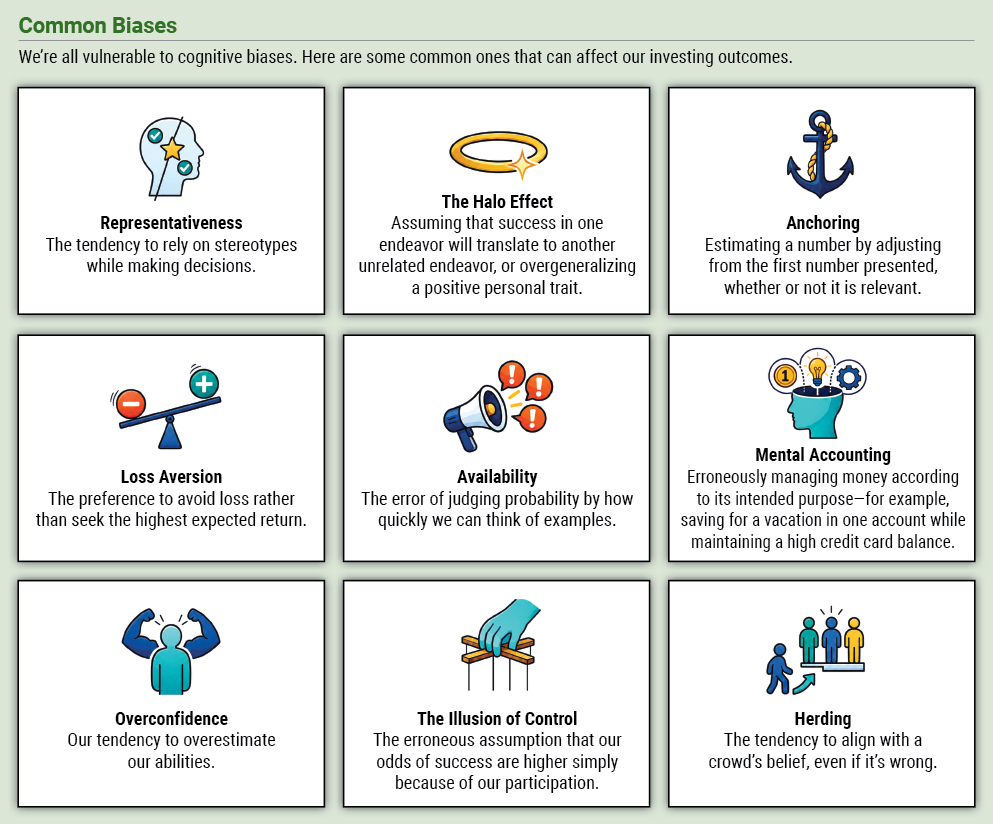
Have you ever taken a profit and then reinvested those profits into a riskier stock, thinking that you were playing with the house’s money? There is no such thing as house money; it has become your money. Another example is taking out a loan or using your credit card so the balance of your savings account isn’t affected. A loan is a liability that counts just as much on a net worth statement as a withdrawal but with the added downside of charging interest.
You might also be making long-term investments in your retirement accounts and making short-term investments in your non-retirement accounts because retirement is more distant. Most retirement accounts don’t tax capital gains until the funds are withdrawn, meaning that they could be a better vehicle for investments that regularly spin off capital gains.
Though dividing money into buckets according to their expected use can help us budget properly, we should also take care to holistically optimize our finances and not allow our mental accounting to blind us to tax-minimizing strategies.
You knew this was coming, didn’t you? Yes, we are prone to overestimate our abilities, investing skills included. Studies and surveys indicate that approximately 80% of us think of ourselves as above-average drivers, even though that’s implausible.
Overconfidence can lead us to trade too frequently or to buy stocks that are in free fall, thinking that we have information or insight that the rest of the market doesn’t. That is rarely the case.
Overconfidence is related to the hindsight bias, otherwise known as the “I-knew-it-all-along” phenomenon. We tend to selectively recall past events that seemingly led to an outcome. In hindsight, the outcome appears predictable, even if forecasting the future can be fraught with error.
Also related to overconfidence is the illusion of control. We might use an investing process that adds little value, but, because we chose to use it, we are more confident in our decisions. This is in the same vein as a traveler who knocks on the outside of an airplane while boarding as a lucky way to prevent the plane from crashing.
By taking a position, our brains try to tell us that we are exerting some control over the markets. Unless we are activist investors who can influence a company’s strategies, what we are really doing is selectively exposing our capital to the possibility of gain or loss. We have little control beyond our small ownership, as much as we might tell ourselves otherwise.
It is easier to invest with the crowd than it is to invest against it. If we are wrong, we are in good company. This stings a lot less than when we take an outlier position and are the odd person out. Many academics point to the herd effect as a contributing factor to investment bubbles. This is why hardwired brains have led some to have “investments” in Beanie Babies, Cabbage Patch Kids or, more recently, Labubus.
Studies have shown that experimental subjects can be persuaded to agree with patently false statements if everyone else in the room is saying the same thing. Herd behavior can lead to buying wildly inflated investments that inevitably crash once the herd moves on to a new pasture.
It’s very difficult to circumvent our cognitive biases, but here are some ways you can challenge them.
If you’re discouraged about all the mental traps your mind is setting for you, remember that intuitive thinking is functional. Psychologists believe that these cognitive biases evolved from the evolutionary imperative of making quick decisions that are mostly right. As the French writer and philosopher François-Marie Arouet, aka Voltaire, once said, “The perfect is the enemy of the good.” Since these biases aid our survival, they can be very difficult to overcome.
We can start by obtaining as much objective information as possible about important decisions, and then using deeper mental processing than we might perform on more mundane tasks. The key to managing our biases is to become knowledgeable about how we think. The awareness of our mental processes is called metacognition. Metacognition involves knowing how we learn and how we pursue goals, both of which apply to successful investing.
In the book “Thinking, Fast and Slow” (Farrar, Straus and Giroux, 2013), Kahneman divided our mental processing into two very different modes. The first, which he calls System 1 thinking, is rapid, automatic and intuitive. There is little mental effort involved. Experienced drivers rely on automatic thinking on their daily commutes. The second mode, called System 2 thinking, requires effort, using reasoning and deliberation. Investors should seek to use that more conscious cognition to make complicated investing decisions.
We can tap into that less reactive part of our brains by pausing to generate as many alternative scenarios as possible. Instead of assuming that your investment thesis is correct, take some time to list reasons why it could be incorrect. You might also seek out expert opinions that contradict your views.
One last way to manage our biases is to limit the number of decisions we make in our investing. Simply “winging it” exposes investors to endless data and opinions that can serve as blank canvases for our predispositions and faulty thinking. Impulsive investors might be better off with passive investing strategies that rely on index funds. People who prefer a more active approach should consider rules-based investing that relies on only a few variables, but ones that are supported by exhaustive research.
Stock Strategies

Behavioral Finance

Financial Planning

ROBERT A from NC posted about 1 month ago:
ROBERT A from NC posted about 1 month ago:
ROBERT A from NC posted about 1 month ago:
JOHN L from NJ posted about 1 month ago:
SAM L from USA posted about 1 month ago:
JOHN L from NJ posted about 1 month ago:
SAM L from USA posted about 1 month ago:
JOHN L from NJ posted about 1 month ago:
SAM L from USA posted about 1 month ago:
DANIEL E from CA posted about 1 month ago:
ROBERT A from NC posted about 1 month ago:
SAM L from USA posted about 1 month ago:
BARRY J from TX posted about 1 month ago:
SAM L from USA posted about 1 month ago:
Robert N from KS posted 22 days ago:
You need to log in as a registered AAII user before commenting.
Log InCreate an account