Employees whose retirement plan assets are automatically rolled over into an IRA when they leave their jobs are at greater risk of losing track of their accounts.
The trend toward automatic enrollment in employer-sponsored defined-contribution plans [such as 401(k) plans] as the default option has increased the number of so-called passive savers. After leaving their jobs, if their plan assets are automatically rolled over into an IRA account, there is a risk that passive savers will forget about these accounts. A study by the Federal Reserve Bank of Chicago found that “forced-transfer IRAs” are at a greater risk of abandonment, but the extent of abandonment behavior patterns remains unclear.
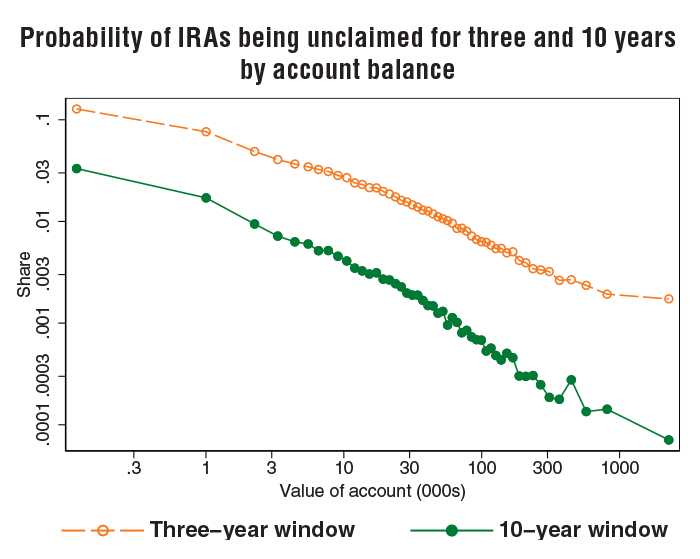
Currently, employers are allowed to make automatic rollovers to IRAs for separated employees with retirement account balances between $1,000 and $5,000. The goal of this policy is to promote the preservation of saved funds for use in retirement instead of cashing out accounts for immediate consumption. The researchers believe passive savers often may not have ongoing contact with their plan custodian. This lack of engagement could lead to account neglect and a greater likelihood of missing required minimum distributions (RMDs) later in life.
The tax code requires individuals to withdraw a share of their IRA account balance each year starting at age 73. The study focused on the number of retirement-age IRA account owners who failed to take their RMDs for 10 years after they started retirement. The study found that about 0.4% failed to claim their accounts within 10 years. The median value of an unclaimed account was $5,742. The abandonment rate was lower as account balances increased, but was still about 0.23% for accounts valued near $25,000.
Understanding the behavior of passive savers helps judge the effectiveness of policies such as automatic enrollment and automatic rollover that are enacted to expand participation in retirement plans. Individuals can make financial mistakes that cost them opportunities to grow their money in the long run or forget to claim their savings when the time comes.
“Set It and Forget It? Financing Retirement in an Age of Defaults,” by Lucas Goodman, Anita Mukherjee and Shanthi Ramnath; Federal Reserve Bank of Chicago Working Paper; October 19, 2022.







No comments have been added yet. Add your thoughts to the discussion!
You need to log in as a registered AAII user before commenting.
Log InCreate an account