

Related

Beginning Investor
Understanding the complexities of how your 401(k) savings are managed can help you make more informed retirement planning decisions.
by Michael Rose | October 2026

 The process of saving for retirement seems simple: Earn a paycheck, contribute a portion of it to savings and watch your retirement account grow over time. However, a sophisticated network of employers, financial institutions and investment professionals operates in the background to manage your retirement money in a safe manner.
Most employees know that their money goes into their workplace 401(k) plan [called a 403(b) plan at public and nonprofit corporations]. Yet, few understand exactly how many organizations are involved in the management of their retirement savings. A retirement account may involve employers, payroll companies, recordkeepers, custodians, investment managers, advisers, regulators and service providers. Each one of these parties plays a role in this journey, and many charge a fee for their services.
Understanding the complexities of how your 401(k) savings are managed can help you make more informed retirement planning decisions.
Individual retirement accounts (IRAs) differ from 401(k)s and similar employer-sponsored retirement plans in several key ways. An investor can open an IRA through the financial institution of their choice. Both brokerage firms and mutual fund companies can serve as the IRA’s custodian. Contributions to an IRA come out of your checking or savings account instead of being deducted from your paycheck. There are also fewer restrictions on what you can invest in through an IRA. Options include individual stocks, individual bonds, exchange-traded funds (ETFs) and mutual funds.
The annual contribution limits are much lower for an IRA than they are for a 401(k). A maximum $7,500 ($8,600 for individuals age 50 or older) can be contributed to an IRA or Roth IRA in 2026. This limit applies to the cumulative amount contributed to traditional and Roth IRAs; you cannot contribute $7,500 to a traditional IRA and another $7,500 to a Roth IRA. In 2026, the tax deduction for contributing to a traditional IRA begins to phase out at modified adjusted gross income (MAGI) of $129,000 for married couples filing jointly and $81,000 for singles. The phaseout for a person filing a married joint return who is not covered by a workplace retirement plan, but whose spouse is covered, is $242,000 in 2026. These phaseout limits do not apply to 401(k) contributions.
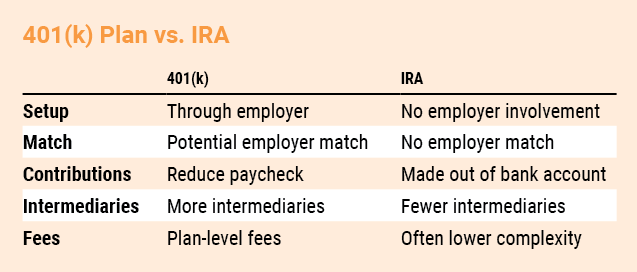
Building retirement savings in your 401(k) begins with your paycheck. You specify a percentage of your paycheck or a flat dollar amount to be contributed to your retirement savings each pay period—which is why it is called a defined-contribution plan.
For the year, savers can contribute up to $24,500 in 2026. An additional catch-up contribution of $8,000 can be made by workers age 50 or older. (The catch-up contribution for those age 60, 61, 62 or 63 is $11,250.) If you do not select a contribution amount, your employer may do so for you. According to Vanguard, 61% of 401(k) plans had default contribution rates, default portfolio allocations or both as of 2025.
It is the employer’s responsibility to withhold funds from your paycheck, as the payroll system processes the deduction. Common payroll processors include ADP, Paychex and Workday. Any fees for payroll administration are primarily paid by the employer.
How the contribution affects your paycheck depends on the type of 401(k) contribution you select. Traditional 401(k) contributions are generally made with pretax dollars, reducing your taxable income for the year. Roth 401(k) contributions are made after taxes have been paid and do not reduce your current-year taxable income. Both reduce your take-home pay, with Roth contributions leading to a bigger reduction.
Employers may also offer matching contributions. These add money to your account and do not count as taxable income. According to Vanguard’s 2026 “How America Saves” report, 48% of employers match employees’ contributions up to a certain percentage of pay, 37% both match contributions and make a separate nonmatching contribution, and 11% provide only a nonmatching employer contribution. An example of a nonmatching contribution is a profit-sharing plan.
After an employer sends the cumulative employee contributions to the retirement plan, a recordkeeper plays a key role in the management of this retirement money. A recordkeeper is a company that tracks balances, processes transactions, maintains participant records and produces statements. This ensures that assets are allocated according to each individual employee. Retirement plan advocate PlanSponsor lists Fidelity Investments, Empower, Vanguard and Alight as the largest recordkeepers by the dollar value of assets managed.
Such companies typically charge for responsibilities like recordkeeping, administrative work and servicing participants. Recordkeeping is considered an administrative expense for which fees may be charged against the employer, charged against plan assets or deducted from individual participant accounts. Depending on the selected plan, recordkeeping costs can be charged as a flat dollar amount or a percentage of the account assets.
The Employee Retirement Income Security Act (ERISA) and the Internal Revenue Code (IRC) mandate that 401(k) and related-plan assets must be kept in a trust, separate from the employer’s other assets. This structure protects the plan’s assets should the employer, trustee or custodian file for bankruptcy.
The trustee holds legal title to the plan’s assets on behalf of participants. A trustee can be an institution, such as a bank or trust company, or an individual associated with the plan sponsor. (The plan sponsor is typically the employer.) In participant-directed 401(k) plans, the trustee is often a “directed trustee,” meaning that they hold the assets but take direction on investment decisions from the plan sponsor, an investment manager or the participants (employees) themselves.
The custodian is responsible for safeguarding the financial assets held by the retirement plan. Rather than maintaining employee records of contributions, balances and investment selections, a custodian holds assets on behalf of the plan and helps facilitate transactions involving those assets.
In addition to safeguarding assets, core responsibilities of the custodian include executing settlements, maintaining ownership records and reporting to regulators. Key examples of common custodians include large financial institutions such as BNY, Charles Schwab, Fidelity and State Street. Companies like Fidelity or Charles Schwab can serve both the recordkeeper and custodian roles and maintain multiple responsibilities in this ecosystem.
Custodial and trustee services can also generate administrative fees. These costs may be paid by the employer or charged against plan assets and ultimately allocated to participants of the retirement plan. Fees may be charged separately or bundled together with other administrative services, making a distinct custodial charge less visible to the employee.
The custodian holds the retirement plan’s assets and securities, which are typically mutual funds or collective investment trusts (CITs). CITs are alternatives to mutual funds that are offered in some retirement plans.
Once a retirement contribution reaches its selected investment, investment managers determine how those dollars are put to work based on the mutual funds or CITs selected by each participant. Both mutual funds and CITs pool the assets of all shareholders—including 401(k) participants like you—into portfolios. These portfolios consist of stocks, bonds or other securities that the manager chooses in accordance with the mutual fund or CIT’s objective. One or more portfolio managers oversee these funds. Major fund providers include BlackRock, Fidelity, T. Rowe Price and Vanguard.
The mutual funds and CITs follow either active or passive strategies. Actively managed strategies rely on portfolio managers and analyst teams to select investments with the goal of outperforming a market benchmark. After researching securities, fund managers trade investments to achieve the fund’s targeted investing goals. These funds also monitor the portfolio’s risk. Passive funds seek to replicate or closely track the performance of an index and rely less on extensive research for investments that could outperform expectations. Investment options can vary by asset class, ranging from U.S. and international stocks to fixed income, which are bonds and related interest-generating securities.
When it comes to fees for these funds, investment expenses are generally paid indirectly by the investor through the fund. Each mutual fund and CIT charges an expense ratio. These fees are charged as a percentage of the fund’s assets and cover management fees and other operating expenses. These expense ratios range from close to 0.00% for passively managed funds to 2.00% or higher for actively managed funds. Lower fees are preferable.
Median expense ratios for domestic large-cap stock funds in AAII’s Guide to the Top Mutual Funds range between 0.75% to 0.90%. A popular choice in retirement plans is a target-date fund, which gradually evolves to a lower-risk allocation as your retirement date nears. Median expense ratios for target-date funds range between 0.59% and 0.63%.
You will not see a bill for these charges. Rather, these costs are typically deducted from the fund’s assets and reduce the overall net return you realize.
Beyond the investment managers lies a hidden layer that most investors never see. This layer includes the traders, market makers, exchanges and clearing firms that make up the market infrastructure and assist in the trading process for fund holdings. Examples include the New York Stock Exchange (NYSE), the Nasdaq and dark pools. This ecosystem facilitates the exchange of assets from buyers and sellers. Traders acting on behalf of the mutual fund or CIT company place the buy and sell orders on exchanges, where buyers and sellers are brought together and trades can be executed. Trades may also be routed through dark pools, which are private trading venues that don’t display quotes publicly.
Trading costs arise when securities are bought or sold, and they include movement in the security’s price caused by transactions (increases for purchases and decreases for sells). These transactions can reduce the returns of the mutual fund or CIT, particularly if the manager engages in a lot of transactions. The turnover ratio indicates how frequently investments within a fund are sold. Ratios of 100% imply the equivalent of the portfolio being completely turned over within one year.
To protect investors and their retirement dollars, regulatory safeguards are implemented.
The U.S. Department of Labor enforces ERISA standards governing most private-sector retirement plans, including fiduciary responsibilities (ensuring that decisions are in the best interest of the investor) and disclosure requirements (obligation for information to be transparent, accurate and timely). The Internal Revenue Service (IRS) oversees tax rules and requirements for retirement plans, including contribution and distribution rules. Meanwhile, the U.S. Securities and Exchange Commission (SEC) regulates securities markets and investment firms, while the Financial Industry Regulatory Authority (FINRA) oversees its member brokers and registered financial professionals. ERISA rules protect 401(k) assets from most creditor claims, including bankruptcy and civil judgments, but not qualified domestic relations orders related to divorce settlements or child support.
Together, these rules provide protection for retirement savers as their money moves through the financial system.
Beginning Investor

PRISM Wealth-Building Process

Mutual Funds

BARRY J from TX posted 20 days ago:
MICHAEL W from CA posted 20 days ago:
ROBERT A from NC posted 19 days ago:
You need to log in as a registered AAII user before commenting.
Log InCreate an account