

Related

PRISM Wealth-Building Process
A good plan with enough guidance to help an investor align their investment decisions with their goals can be written on a single page.

Charles Rotblut leads a class in AAII's new Essential Investing Video Course. Go to https://www.aaii.com/ves for more information and to subscribe.
AAII founder James Cloonan had two rules for achieving investment success. Rule #1 was to develop a consistent, well-defined approach to investing. Rule #2 was to stick to rule #1.
Having a written plan greatly helps you stick to Rule #1. A plan provides clarity and gives you guidelines for making decisions.
 The AAII PRISM Wealth-Building Process was designed to do just this. It provides a framework for aligning your investment decisions with your goals. AAII members who have completed PRISM have concrete plans they can use to achieve their financial goals.
While investing can be complex, a plan for achieving success does not need to be. It is very possible to write a comprehensive plan on one page in a fairly short time period. In this article, we show you what a one-page PRISM Wealth-Building Plan looks like.
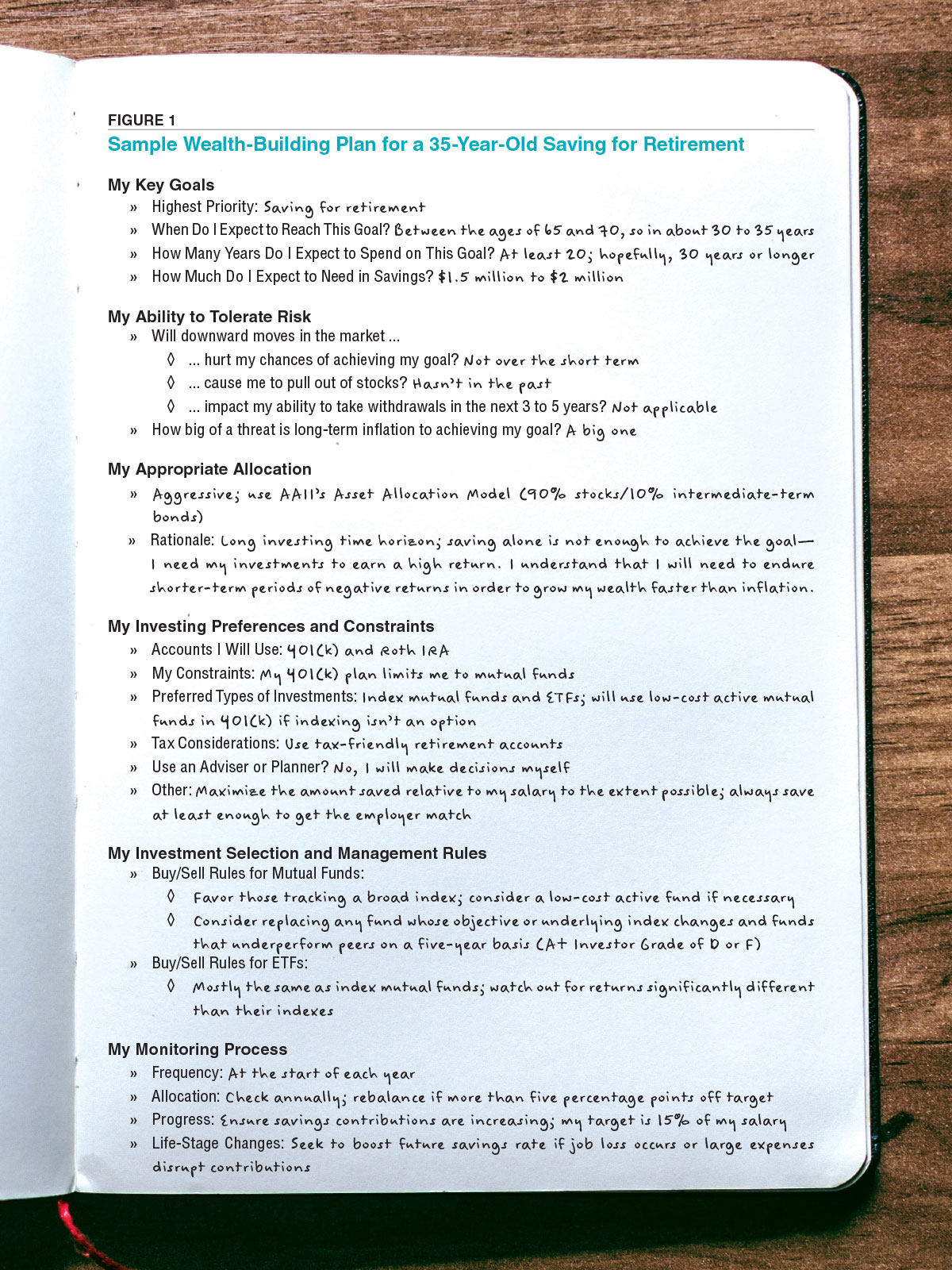
The specific plan presented in this article is for an investor in their mid-30s who is saving for retirement (Figure 1). We purposely chose this persona since April is National Financial Capability Month. While the plan created for this imaginary investor, Liz, will not apply to all AAII members, the components of the plan and the decisions made for what to include apply to investors of all ages with varying goals. If you have a family member in a similar life stage as Liz, we encourage you to share this article with them. Future AAII Journal articles will present a one-page PRISM Wealth-Building Plan for other personas and goals.
The first step and the cornerstone of the PRISM Wealth-Building Process is prioritizing goals. Every investor has a reason for accumulating and managing wealth. The highest-priority goal for many investors is to be able to live comfortably in retirement. Others may want to buy a house, pay for children’s (or grandchildren’s) college, leave a legacy for their heirs, support charitable causes or simply have enough wealth to be financially independent.
Whatever your goal, merely writing it down will have a big, positive impact on your ability to achieve it. An oft-cited study from Dominican University found “Those who wrote their goals accomplished significantly more than those who did not write their goals.”
This applies to investing too. Writing down your goals establishes why you are investing and what you hope to do with the money. It also helps you better visualize the goal, thereby providing a purpose to your wealth-building plan. Most importantly, defining your goals lays the foundation upon which all your other investing decisions will be made.
Liz is 35 and seeks to retire between the ages of 65 and 70. Her exact age matters less than the simple fact that she has at least three decades between now and when she expects to retire. (Reducing Liz’s age to 25 or increasing it to age 40 doesn’t make a significant difference in terms of defining risk or allocation. However, the younger the investor, the lower the savings rate required.)
Liz cannot predict how long she’ll live in retirement, but she estimates at least 20 years and hopes for 30 or more years. She crunches some numbers on a retirement calculator and estimates she’ll need between $1.5 million and $2 million for retirement.
By having Liz write this information down at the top of her wealth-building plan, a few key things are established. First, Liz makes saving for retirement a key priority. This impacts not only her investing decisions but also her savings decisions. The lengthy time before reaching retirement and the amount needed mandates the need for higher-returning investments in her portfolio.
If she were to stop here, any adviser would tell Liz to save aggressively, allocate to stocks, take advantage of tax-preferred accounts and think long-term. All of this can be determined from her statement about her top financial goal. But with a relatively small amount of effort, Liz can add even more clarity.
Risk and return are closely tied together when it comes to investing. Higher returns are compensation for taking on greater risk in terms of price volatility and the chance of losing money.
For the purposes of recognizing an investor’s risk tolerance, risk can be divided into four different types:
For an investor like Liz who will not take withdrawals for many years, systematic and sequence risk are not threats. She has plenty of time to recover from any shorter-term drops in the market over the coming decades. In fact, Liz should embrace downside volatility as she builds up her savings since it will allow her to buy more shares for the same dollars saved.
Behavioral risk is determined by how Liz has acted in the past as well as her understanding of market history. This varies by investor. A younger investor may not have previous experience with bear markets. In such cases, they will have to make a judgment call—one that should be revisited each time they go through a bear market and can see how they reacted to it. In this example, we’re going to assume Liz did not react during the March 2020 pandemic bear market and has left her portfolio unchanged so far throughout the ongoing (at least as of press time) reflation bear market.
Inflation, conversely, is a major risk for Liz. Her long investing time horizon requires returns well above the rate of inflation. To put this into perspective, consider that $1 invested today will need to grow to $2.43 just to maintain a steady level of purchasing power if inflation averages just 3% over the next 30 years. This amount excludes any additional return needed to build wealth beyond merely inflation-adjusted levels.
The appropriate allocation stems from the goal prioritized and the risk tolerance recognized. Once these first two steps are done, choosing an appropriate allocation becomes much easier.
Consider what we know about Liz so far. Her goal of retiring is at least 30 years in the future. She’ll be making ongoing contributions (instead of taking withdrawals). She’ll need a high enough real (inflation-adjusted) rate of return to grow her savings to cover the cost of retirement. And she has reason to believe that she won’t freak out and pull her dollars out of equities when future downturns in the market occur.
All of this leads to an aggressive allocation. This type of approach calls for most (if not all) of Liz’s portfolio to be allocated to equities.
Liz chooses to use AAII’s Asset Allocation Model as the basis for allocating her own portfolio, as you can see on her wealth-building plan. The aggressive allocation model assigns a 60% weighting to domestic equities, divided between large-cap, mid-cap and small-cap stocks; a 20% allocation to developed markets stocks; a 10% allocation to emerging markets stocks and a 10% allocation to intermediate bonds. Liz could, if she desires, skip the bond exposure altogether, given her a high risk tolerance.
There can be a temptation to immediately start finding investments to match the chosen allocation. Identifying any key preferences or constraints beforehand simplifies the process of choosing investments by narrowing down the vast field of options.
Preferences and constraints vary by investor. Preferences can include—but are not limited to—whether to use mutual funds and exchange-traded funds (ETFs) or individual stocks and bonds, favoring passive or active management, tilting toward certain factors or styles (e.g., value, income, etc.), and whether or not to use an adviser. Constraints can include being limited in the choice of investment options (e.g., specific mutual funds), employer restrictions (such as those meant to avoid conflicts of interest) and liquidity needs for funding withdrawals.
Taxes may also be a consideration. Some investors may place an emphasis on tax-friendly strategies or investments. The type of account(s) used is another tax consideration.
The bulk of Liz’s retirement contributions will go into her employer’s 401(k) plan. This allows her to not only receive the employer matching contribution but also let her dollars grow tax-free for many years. The trade-off is that her investment options will be limited to what’s included on the plan menu. Thus, even though she may prefer index funds, she notes the possibility of having to use active funds on her wealth-building plan.
Liz’s non-workplace retirement savings account is a Roth IRA. Again, tax preferences play a role, as avoiding capital gains and dividends helps to maximize long-term growth. Since Liz has no constraints on what she can put in the Roth IRA, she opts for ETFs that track broad-based indexes.
There can be other preferences too, and we encourage investors to include them in their wealth-building plan. Liz realizes the importance of keeping her savings rate as high as possible, so she includes this in her own wealth-building plan.
Cloonan exemplified his belief in following a consistent, well-defined approach to investing by having written buy and sell rules.
Whereas preferences define what types of investments you’ll consider, rules—even basic ones—establish clear standards for what makes an investment a buy and, more importantly, what makes it a sell. These rules should always be tailored to the type of investment being purchased, with the inclusion of any style, factor or other preferences.
Since Liz intends to use mutual funds and ETFs, there will be a lot of overlap in the rules she establishes—as she notes on her wealth-building plan. Funds following broad indexes will be favored first. If such funds are not available in her 401(k) plan, she’ll give first preference to the actively managed funds with the lowest expense ratios. Liz will use AAII’s A+ Investor grades to identify and replace any funds that underperform their category peers on a five-year basis as defined by an A+ Investor grade of D or F.
Since both mutual funds and ETFs can change objectives or, in the case of passive funds, change the index they track, Liz will look out for such modifications. She will also check in with her investments on a quarterly basis to ensure her ETFs’ returns don’t vary too much from the performance of the underlying indexes.
The final step of the PRISM Wealth-Building Process calls for periodic monitoring. The portfolio’s allocation is checked to ensure it remains within an acceptable range of the specified target. Progress toward the goal is reviewed to ensure it is still on track. Changes in one’s life are considered to determine whether the specified goal is still valid or if it needs to be revised. This step ensures that one’s wealth-building plan evolves as their life does.
Liz decides to perform her monitoring process at the beginning of each year.
She sets a five-percentage-point band as the acceptable range she’ll allow each asset class category to fluctuate within before taking action to bring the portfolio’s allocation back to the designated target weightings.
Progress will be measured in terms of savings. While Liz cannot control the returns her investments will realize, she can exert control over how much of her salary she saves. She lists 15% as the savings rate she wants to reach. Once reached, she can then make an assessment about whether to increase it further.
In terms of life-stage changes, Liz writes instructions for herself about what to do should she lose her job or otherwise have an event occur that disrupts her ability to save. She could also add notes to revisit her goals should she get married or have children—though, with either, she would still need to think about having enough savings to retire in the future.
As you can see, a wealth-building plan does not have to be complex or lengthy to help someone achieve their goal. A good plan with enough guidance to help an investor align their investment decisions with their goals can be written on a single page.
The key is to prioritize the goals you want to achieve, recognize your risk tolerance, use both your goals and risk tolerance to recognize your allocation, identify your preferences and constraints, select your investment rules and monitor your portfolio on a regular basis. A written plan that covers all of these will help you to follow Cloonan’s rules of investment success.
PRISM Wealth-Building Process

PRISM Wealth-Building Process

PRISM Wealth-Building Process

Hugh P from WA posted over 3 years ago:
ROBERT A from NC posted over 3 years ago:
You need to log in as a registered AAII user before commenting.
Log InCreate an account