


Related

Financial Statements
Prioritizing companies that focus on how to efficiently run their business and allocate capital to reward shareholders.

Charles Rotblut leads a class in AAII's new Essential Investing Video Course. Go to https://www.aaii.com/ves for more information and to subscribe.
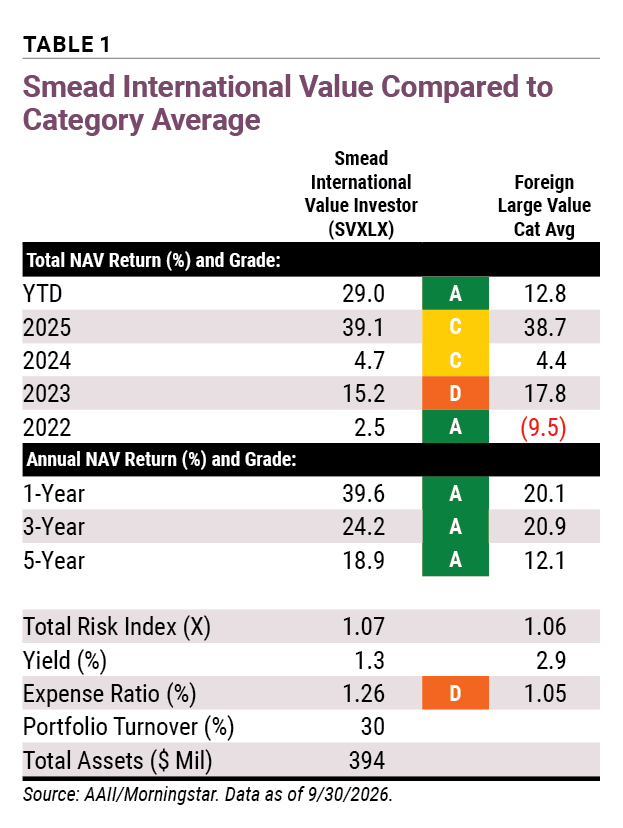
Cole Smead, CFA, is the CEO of Smead Capital Management. He is also the lead portfolio manager of Smead International Value fund  (SVXLX) and a co-portfolio manager of Smead Value fund (SMVLX). I spoke to Smead in mid-October about the reasons to invest internationally and his approach to value investing.
—Charles Rotblut, CFA
Charles Rotblut: Many investors believe that they can’t get high returns outside of the U.S., particularly given the underperformance of foreign stocks over the last 15 years. Is that belief warranted?
Cole Smead: To understand foreign stocks’ underperformance, one has to look at banks, which are a big component of non-U.S. indexes. Banks’ serial weakness in the 2010s was not good for global indexes. They had bad loans, and unlike in the U.S., foreign banks did not recapitalize quickly. Rather, regulators outside of the U.S. allowed banks to amortize bad loans off over 10 years, which forestalled the cleaning that they needed to do on both the capital structure and the expense structure. Once that 10-year period passed, they began to do that cleaning more meaningfully.
Additionally, during the pandemic, banks could not deliver their excess capital. In many cases, regulators like the European Central Bank (ECB) didn’t allow it. At that point, non-U.S. banks around the world were way overcapitalized. There was a stigma against them that they were never going to be successful entities. That stigma remained, but the facts around the situation changed.
Fast forward to today, and those global banks are way more efficient. Their cost-to-income ratios are much lower than they were in the past. They continue to increase their returns on capital because they’re cutting costs, cutting staff and rightsizing—all the strategies that we’ve already seen be used in the U.S.
The U.S. is the driver of modern-day capitalism in terms of entrepreneurship and ingenuity. Many of the corporate actions that are common in the U.S.—such as buybacks and rightsizing income statements—are not present in many non-U.S. businesses. Currently, Asia is on the far opposite end of the spectrum. In general, Asian companies are fairly unwilling to allocate capital more efficiently. Asian companies also tend to be unwilling to cut staff or rightsize operations.
The U.S. has been highly efficient. Asia has been unwilling, in many cases, to implement those practices. I think Europe is somewhere in between. I would put Latin America closer to Asia in some respects.
At Smead Capital Management, we like to look for companies that focus on how to efficiently run their business and allocate capital in order to reward shareholders, particularly on an aftertax basis. This includes understanding that buybacks are more attractive than dividends because the governments of the world always get their piece of dividends. We believe that such companies, regardless of where they are based, will be rewarded.
We believe that as businesses employ good capital allocation strategies and smart methods of rewarding their shareholders, they will garner higher valuations. Is every part of the international markets doing so? No. On average, the U.S. runs the highest returns on capital across its markets, Europe runs the second-highest and Asia runs the third-highest.
However, that’s if you only look at the returns on capital. If you look at the multiples on the returns on capital, you might feel like you’re not being compensated enough to take that risk in the U.S. That’s not an unfair way of looking at it from a broad perspective. In other words, the U.S. is better at capital allocation, but is it better at the valuation multiple you pay today? I think we’re finding out quickly that similar capital allocations, or improvements in capital allocation, are doing wonders for non-U.S. equities in a way that they really can’t for U.S. equities.
How would you describe your firm’s approach to valuation?
I see us as classical value folks. We don’t have the attributes of the deep-value camp that hides out in industries like mining and metals. Some people are good at that. Those just aren’t our historical touches. We also don’t buy growth at a reasonable price or overpay for quality businesses because, as we’ve learned in the stock market, that ultimately doesn’t work either. There are a lot of “quality” businesses that are getting crushed right now. Rather, we take a rational look at each situation.
We cannot predict the future, so there are no areas of the stock market that we would cross off our list. This doesn’t mean that every part of the stock market has a high probability of fitting our discipline. But we know that the future is unknown and things change over time. For example, we owned nothing in the energy sector during the 2010s because, in general, the sector failed our criteria. Companies in the sector had bad balance sheets, lacked significant free cash flow and spent way too much money on things like capital expenditures (capex). But now, all those issues that we thought would never change did change dramatically and magnificently. We were just too pragmatic to ask ourselves what the future could bring.
I think a lot about the characters Sniff and Scurry, who are mice in the classic book “Who Moved My Cheese?” by Spencer Johnson, M.D. (G.P. Putnam’s Sons, 1998). When the cheese disappears, two littlepeople—people the size of mice—named Hem and Haw keep returning to where the cheese used to be even though they know it is no longer there. But Sniff and Scurry decide to go to where there is cheese. I think the learning process of stock picking is very similar to that. Not only do you have to learn where the cheese—in this case, the great investing opportunities—has moved, you need to learn how to figure out where it has moved. I don’t think there are enough Sniffs and Scurrys in the active management community.
At Smead Capital Management, we also like to ask ourselves what hasn’t changed. For example, we know that utilities businesses produce bad returns. They fund a lot of their capex and dividends through secondary offerings. Would I say that utilities stocks will be this way forever? No. They could change. There could be an occasion where a utilities business, even though it has a history of bad returns on capital and is regulated, ends up being the most attractive thing to own in the stock market.
We try to ask what’s uniquely true for an industry, company, etc., as opposed to what’s broadly true. If we invest in a handful of businesses that can drive attractive returns for our shareholders, we don’t really care what the world’s problems are, because our investment fits our investors’ needs and desired outcome.
Do you look at certain traditional valuation ratios? For example, do you try to forecast potential earnings based on companies’ return on capital?
We look at the history of the business to understand it. We examine things like the cyclicality of the business and the consistency of the earnings power and free cash flow. It’s necessary to understand the business because it’s easy to buy a business whose current numbers look nice, but it’s really tough to understand how the business will perform in the future.
We don’t model or forecast because we don’t think people are very good at it. We look back at the history of the business and ask questions like: What are the current and historical returns on capital? How predictable have they been? How much did they change year to year? Understanding a business’ history is crucial because it should inform you about when you want to buy it and what circumstances you would have around buying it.
We also look at metrics like price to invested capital and price to free cash flow. Benjamin Graham once said, “Price is what you pay; value is what you get.” For a lot of businesses, I would say that price to invested capital is the price you pay and the returns on invested capital throughout your holding period are what you get.
When I refer to returns on invested capital, I don’t mean earnings or earnings before interest, taxes, depreciation and amortization (EBITDA). I mean free cash flow (operating cash flow less capex). That’s our proxy for return. I think a lot about the free cash flow relative to the capital in the business and the multiple on the capital that you have to pay.
Some people ask why we don’t use book value. Book value doesn’t count the leverage. When you go to pay off your debt, that’s capital that you’re employing. So, we think invested capital is a better way to look at it.
When looking at the history of the business, we also ask: Has that invested capital had to grow as the business has grown, or was the company able to apply less capital through the cycle to grow more, meaning that their returns on invested capital go up? We want to understand the interaction between how much capital is needed to grow a business and whether that has increased its returns on invested capital.
That reminds me of Warren Buffett’s story about See’s Candy Shops Inc., aka See’s Candies. Buffett often talked about how little Berkshire Hathaway paid for See’s Candies. Why? Well, look how much capital was given back to the owners that didn’t require any extra capital to run. The returns on invested capital were far higher than they ever could have imagined.
What does that teach us as investors? The name of the game in investing is not how much you can grow a business. If you can grow a business but you have to employ a lot more invested capital to do so and the returns on invested capital only maintain or go down, there’s no point in growing. You’re going to get the highest multiple on your company by having the highest returns on invested capital. I think most executives conflate growth with returns on capital.
For example, at one point, The Walt Disney Co. (DIS) thought that if it grew its Disney+ platform, it would get a higher valuation, because its share price would increase if it generated more earnings and its price-earnings (P/E) ratio stayed steady. However, the returns on capital from Disney+ were lower than those from the company’s existing content and parks. This meant that Disney got a lower valuation because, ultimately, its returns on invested capital declined.
Required over entire holding period:
Favored, but not required:
Source: Smead Capital Management.
You have an investing book podcast called “A Book With Legs.” What investing book would you recommend?
The book that really got me going was “You Can Be a Stock Market Genius” by Joel Greenblatt (Touchstone, 1999). Greenblatt says something in the book that’s just as true as the day he wrote it, and most people don’t believe he’s right. He argues that the smaller investor has an edge.
When the big asset managers have massive amounts of capital and highly educated people working for them, a common belief is that there is no way a small investor can have an edge. Herein lies the problem: The big asset managers have all this capital, but they don’t have the nimbleness and the ability to focus their capital like a small investor does. Greenblatt points that out in the book, and I’m always reminded of it because it’s a timeless truth.
The book explained something else that people disagree with. People tend to believe that the markets are so efficient today that wild opportunities don’t come about anymore. They’ve been arbitraged away in the sands of time. I totally disagree with that.
Here’s an example involving Cenovus Energy Inc. (CVE), a Canadian energy company we hold in our portfolios. Around December 2020, Cenovus Energy announced that it was going to merge with Husky Energy Inc. A sweetener in the deal gave investors 1/16th of a warrant for every share of Husky Energy they owned. [A warrant allows an investor to buy shares from the company.]
Imagine you’re a nimble investor who was optimistic about the oil industry. On the day the merger was announced, you could have gone long (bought) Husky Energy and sold Cenovus Energy short because there are no restrictions on individual investors doing so. For every 16 shares of Husky Energy you bought, and every 16 shares of Cenovus Energy you shorted, you would have received one warrant.
Here’s the crazy part: Those warrants were negatively priced that day. In other words, if you went long one and short the other, you were getting paid to be the warrant owner. You would have had to sit on your shorts and longs until the merger closed in order to profit, but you would have made money.
I bring this up because if you look at what you could have gotten as a small, nimble investor once those warrants were exercised, it was an incredible opportunity to take advantage of. We don’t short and could not take advantage of the opportunity. Other, bigger asset managers couldn’t either.
We continue to see situations like that where the small investor has the edge in a world where it seems like they can’t have an edge. I think the individual investor’s focus of their capital is one of their edges. The key for individual investors is to determine who you are and the kinds of risks that you are both comfortable with and are good at taking. I always recommend Greenblatt’s book because it excites the appetite and explains a timeless truth.
Is there anything I should have asked you that I didn’t?
There is one thing that I’ve come to hold dearer as I get older. I like reading. That said, I don’t always understand everything I read perfectly the first time I read it. That’s a lot like investing in the stock market. Someone introduces you to a business, and as you’re learning about the business, you often don’t totally understand it initially. Maybe you don’t get how the company makes money or you don’t understand the business model. Perhaps you don’t understand how the investors get rewarded.
In the stock market and in reading, you’re learning to learn. In every book I read, I always try to ask myself, “What’s one thing I can tangibly take away from this?” I think that same question holds true in businesses.
Financial Statements

Portfolio Strategies

ETFs and Mutual Funds

BARRY J from TX posted 5 days ago:
You need to log in as a registered AAII user before commenting.
Log InCreate an account