



Although the choice of which stocks to purchase directly influences the performance of a portfolio, market volatility causes the decisions about when to buy and when to subsequently sell to also play major roles in determining investment returns. This market volatility is the result of the stock prices, and therefore the market capitalizations, of even the largest firms in the U.S. significantly fluctuating over time.
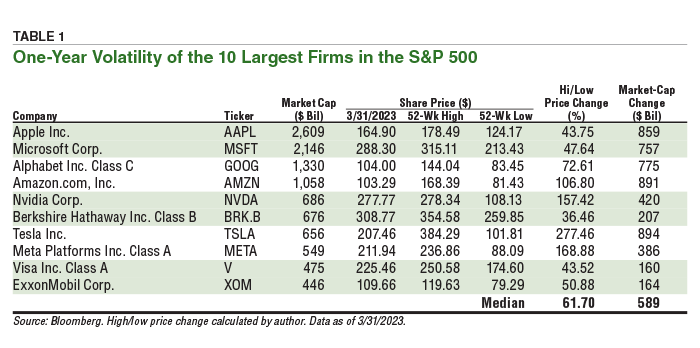
Table 1 illustrates the stock price movements of the 10 largest firms in the S&P 500 index for the 12 months ended March 31, 2023. As you can see, the median change in market cap during the period was 61.7%. It is worth noting that these changes in market values are comparable to those for large growth stocks that I discussed in the March 2022 AAII Journal (“Be a Wiser Investor Than the Crowd”). Indeed, annual price volatility of this magnitude can be found surprisingly often.
The Problem of Undisciplined Investing
I told the story of Joseph Kennedy, father of late President John F. Kennedy, in that earlier article. A noted speculator, Joseph Kennedy was getting his shoes shined in New York in 1929 when the shoeshine boy offered him tips about which stocks to buy. Kennedy realized that if the shoeshine boy, who had little education and was not an experienced stock investor, was recommending stocks, then the market was likely completely saturated. Since practically every potential investor, including those who were completely ignorant about stock valuations, were already in the market, who else was there left to drive prices even higher? This realization prompted Kennedy to close out his positions and get out of the market—just ahead of the spectacular crash. Indeed, this insight can be used to explain most bubbles, including the one in the housing market that led to the 2007 mortgage crisis.
The lesson of the story is that market excesses are often driven by inexperienced or undisciplined investors who tend to behave in the exact opposite fashion to the way a prudent investor would. They tend to buy as the market is nearing a peak, drawn in by the apparent unceasing market appreciation. Then, when the market turns down, as it inevitably does, they panic and sell—often close to the bottom.
The poor decisions made by these investors are driven largely by greed and fear. When the market has fallen sharply, for example, fear keeps many investors out of the market precisely when they should be investing—at the bottom. Conversely, as the market is topping out, more and more investors are driven by greed and overconfidence to invest, not realizing that the market is probably becoming more and more overvalued daily.
The result of this behavior is that stock markets are typically mean-reverting, meaning that when they are overbought (went up too much and too quickly) or oversold (fell more than can reasonably be justified) they tend to correct. Unfortunately for investors, when the market has peaked, it will typically fall at a faster rate than that at which it appreciated.
The Loser’s Game
In a 1975 Financial Analysts Journal article titled “The Loser’s Game,” Charles Ellis compared investing to sports and referred to a book by Simon Ramo, Ph.D., “Extraordinary Tennis for the Ordinary Player” (Crown Publishers, 1973). Ramo pointed out that while professional tennis players win points, ordinary tennis players lose points in unforced errors. Drawing a parallel to investing, Ellis argued that the average investor is unlikely to be able to outperform the market because of the mistakes they make.
And this appears to be true. Many investors underperform the market. According to Dalbar’s Quantitative Analysis of Investor Behavior—which looks at the return of individuals who invest in mutual funds—while the S&P 500 returned an average of 7.5% annually in the 20 years through December 31, 2020, the average stock investor earned a return of just 2.9%. This equates to an average annual deficit to the market of 4.6% (7.5% minus 2.9%). Investor performance is particularly unimpressive when we note that inflation over this period averaged about 2.1% annually.
In addition to market performance, investor returns are influenced by factors such as market timing and emotions that lead them to switch from one investment to another, often at the most inopportune times. This ill-considered performance chasing, coupled with insufficient diversification and the fees incurred by their strategies, leads to suboptimal returns and increased risk.
If undisciplined investing leads to underperformance, what strategy should we follow when investing? Should we simply invest in an index mutual fund or exchange-traded fund (ETF), such as the SPDR S&P 500 ETF Trust  (SPY)? Doing so almost certainly guarantees a return close to that of the broad index. Indeed, for an investor who believes the market is efficient, that consistent outperformance is not possible to achieve and that the underperformance of many managers is due to transaction costs, such an indexing strategy makes sense. However, critics of this approach argue that because it guarantees a return close to that of the market, significant outperformance is not possible with indexing.
Coffee Can Investing
In an article in the Fall 1984 Journal of Portfolio Management entitled “The Coffee Can Portfolio,” investment adviser Robert Kirby discussed how he bought and sold stocks for a client in the 1950s. Kirby had managed the client’s portfolio for about 10 years when she called to say that her husband had died suddenly. She told Kirby that she would be adding her husband’s investments to those in her own portfolio. When he received the list of securities, Kirby discovered that her husband had been following Kirby’s recommendations for his own portfolio as well. However, Kirby was shocked at the size of his portfolio.
Although the husband had followed Kirby’s buy recommendations, investing about $5,000 in each stock, he had ignored the sell recommendations. By the time of his death, some holdings were worth less than $2,000, but some had values in excess of $100,000. One monster holding that was worth $800,000 exceeded the total value of the wife’s portfolio. It was in a firm called Haloid Co., which later changed its name to Xerox Holdings Corp. (XRX).
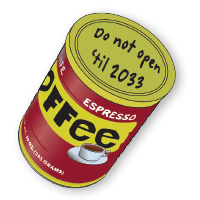
This led Kirby to develop the “Coffee Can” portfolio. The name is an allusion to the Old West, when people stored their valuables in a coffee can that was kept under the mattress. The ultimate value of the coffee can, which had no transaction costs or other administrative expenses, depended entirely on the prescience of the owner in choosing which objects to place in the coffee can.
Kirby believed that investors could learn from his experience. While they shouldn’t necessarily expect to find the next Xerox in its infancy, simply purchasing a portfolio of undervalued stocks in a “set it and forget it” strategy would enable investors to avoid the market’s fluctuations and excessive trading costs and more than likely outperform many other strategies in the long run.
An investor who pursues the Coffee Can approach—including a diversified set of stocks in a portfolio held for the long term—is likely to benefit from the Pareto principle. More popularly known as the 80-20 rule, this principle suggests that 80% of the effects arise from 20% of the causes. More than likely, most of the returns to the Coffee Can portfolio will come from a small number of the holdings that end up performing significantly better than average in the long run but that might have been discarded prematurely from the portfolio had it been subject to too-frequent rebalancing.
Building and Managing a Coffee Can Portfolio
In his 1984 Journal of Portfolio Management article, Robert Kirby described how to build and manage a Coffee Can portfolio. The steps were:
- Divide the initial amount equally among all stocks—Kirby used an example of dividing $100 million among 50 stocks.
- Bury and forget about the portfolio for a while—Kirby suggested not reevaluating or reexamining the portfolio for a period of at least 10 years.
If 10 years seems like a long period, keep in mind that the biggest downside risk posed by any of the stocks in the portfolio was a 2% loss in the portfolio’s starting value based on a beginning allocation to 50 equally weighted stocks. Furthermore, Kirby pointed out that “the most the portfolio could gain from any one holding is unlimited. After all, there would be no one to apply the concepts of diversification and too much exposure to a given company, or a given industry.”
Good Stocks for a Coffee Can Strategy
Stocks to consider for a Coffee Can strategy include those of firms that operate successful businesses commanding consistently high profit margins, generating a high return on invested capital (ROIC) and large amounts of free cash flow with above-average dividends and share buybacks and having significant economic goodwill. Ideal firms include those that generate a lot of cash and pay it out as dividends (e.g., Dividend Aristocrat stocks).
You don’t necessarily want to buy companies with the highest dividend yields, however. In many cases where the dividend yield is high, the security’s price is low because the firm is considered risky. Instead, you should focus on firms with a consistent dividend history. Look for firms that have been paying a dividend for years, particularly one that has been growing over time. The strongest companies in their respective industry are often the ones with the best dividend history and are likely to offer an attractive dividend that will continue to increase in the future.
There are several reasons why firms that pay dividends are attractive. Dividends represent a return of capital to shareholders from a business that has excess equity or no sufficiently profitable use for the cash. By paying consistent dividends, management sends a signal to the market that the company is sufficiently well-run to generate earnings that can be distributed to shareholders, providing current income and offering the opportunity to potentially reinvest capital in higher-yielding investments to those who wish to do so.
Changes in profit margin can be a good predictor of future stock performance for industrial companies. A profit margin that is stable—or, better yet, increasing—is a sign of an attractive business. In many cases margins get squeezed over time due to competition, so a stable profit margin is highly desirable. This is one reason why noted fund manager Peter Lynch liked mature or declining businesses, where there was little threat of new competition. Similarly, it’s a reason why Warren Buffett likes monopolistic businesses, which due to their size have pricing pressure over suppliers and customers and can maintain attractive margins.
Buffett tends to ask four questions when evaluating potential investments. Is the firm’s business one he can understand? Does the company have a long-term competitive advantage? Does he admire and trust its senior management? And are the shares selling at an attractive price? Buffett would rather buy a wonderful company at a fair price than a fair company at a wonderful price.
On the other hand, some investors like hedge fund manager Seth Klarman see value in complexity, noting that if a business is complex many analysts and institutions will shun it. This may make the stock comparatively underpriced.
Lynch, like Buffett, advocated buying only those companies whose businesses you understand. “Never invest in any idea you can’t illustrate with a crayon.” If you don’t understand the firm and its business model, how can you possibly value it? And if you are unable to value it, why would you consider investing in it?
Lynch wrote, “I think you have to learn that there’s a company behind every stock, and that there’s only one real reason why stocks go up. Companies go from doing poorly to doing well or small companies grow to large companies.” He noted that, in the short term, a stock’s performance can be divorced from the company’s performance, but in the long run, the two are 100% correlated. You have to know why you’ve invested in the company and take a long view.
Philip Fisher, in his book “Common Stocks and Uncommon Profits” (Wiley, 1996), listed 15 questions to ask. Those questions focused on how likely it is that there will be a sales increase and profit margins will change, as well as what the quality of the sales force and management is.
A common recommendation of many of these successful investors is that you should buy the industry leader—the company with the greatest sales volume—provided its margins and net income are also among the best in the industry. Before investing, you should pay attention to the firm’s cash flow statement to understand where earnings are coming from as well as its balance sheet to ensure that the firm is solvent.
Remember that price is not the only determinant of value. A stock can be relatively expensive today, but when considered over, say, a five- or 10-year period, its growth prospects may be irresistible because of its competitive advantage. Still, you should not overpay for growth. Don’t be afraid to miss out on a future star if its price is too high. You may miss a winner, but you may also miss a turkey.
Filling Your Coffee Can Portfolio
You should focus on identifying a diversified portfolio of well-managed, fairly priced companies with stable and competitive models. They should not be subject to excessive financial risk (due to higher leverage than necessary) and should not be subject to technological obsolescence.
You should invest in businesses, not in stocks, seeing yourself as a part owner of the business. You should look for good management willing to invest and own shares in the company. While your target firms must have good financials and low price-earnings (P/E) and price-to-book (P/B) ratios, you also need to have a deep understanding of the company and its industry dynamics. For example, unless you understand complex technology or genetics, you should avoid these types of companies. Your target firms should be simple and understandable and have predictable and consistent earnings, high return on equity, high and consistent margins and an economic moat.
When looking at earnings per share, be careful to examine the number of shares outstanding. An increase in earnings per share resulting from a reduction in share count is qualitatively different from one that is due to revenue growth or an increase in operating margins.
One advantage that individual investors often have over professional investors is the ability to purchase small firms. These firms often have greater potential for long-term growth than their larger peers. Managers of large investment funds tend not to invest in small stocks. When they have a large amount of capital to deploy, investing in small stocks is just not worth their while because they don’t want to own too large of a position in an individual stock and they don’t have time to monitor hundreds or thousands of stocks. Furthermore, many managers may not wish to take a risk on a stock that is outside the mainstream. There is not much downside in being down if everyone else also has losses on the same stocks, while owning an unpopular stock that performs poorly can lead to unwanted criticism. As a result, these managers tend to stick to the larger, more popular names.
This can lead to potentially great bargains existing for the individual investor who is prepared to do some research. At the same time, those managers who have a mandate to invest in smaller stocks may be forced by their fund guidelines to dispose of a stock that performs well because its market cap has exceeded an arbitrary threshold. Individual investors do not face this constraint.
Buying good firms and holding them for the long term is recommended by many successful investors. “Our favorite holding period is forever,” Buffett has stated. Lynch also believes in holding good stocks for a long time, cautioning investors against “cutting the flowers and watering the weeds.” So, once you’ve filled your coffee can, leave it alone.
Conclusion
The Coffee Can strategy—which involves buying good, or great, companies, and holding them forever—has several advantages over other strategies, including pure indexing. It is a highly tax-efficient way to invest, using (in effect) an interest-free loan from the tax authorities by delaying the capture of capital gains, which can significantly improve investment performance. It also avoids transaction costs that arise from rebalancing or churning a portfolio.
The Coffee Can strategy can be a complement to, rather than a replacement for, a pure indexing strategy. It insulates an investor from emotional decision-making and behavioral biases that often result in poor investment performance. Finally, unlike investing in a broad index, it allows the investor to selectively invest in a subset, ideally a superior one, of the stocks in the broader index.

Related

Stock Strategies
Oakmark Funds’ Long-Term Approach to Stock Investing
Related

Stock Strategies
The Power of Compounded Growth and Reinvested Dividends
Discussion
FREE REPORT

Get your free copy of our special
report analyzing the tech stocks
most likely to outperform the
market.
ROBERT A from NC posted over 3 years ago:
BOB KAPICKA & B from IL posted over 3 years ago:
BARRY J from TX posted over 3 years ago:
Gene M from IL posted over 3 years ago:
BARBARA K from MA posted over 3 years ago:
You need to log in as a registered AAII user before commenting.
Log InCreate an account