

Related

Behavioral Finance
If someone knows that they have a strong tendency to be on the cautious side, they could benefit from investing slightly more aggressively than they otherwise would.

Charles Rotblut leads a class in AAII's new Essential Investing Video Course. Go to https://www.aaii.com/ves for more information and to subscribe.
Hongjun Yan is the Richard H. Driehaus chair in behavioral finance at DePaul University. He co-authored the research paper “Personality Differences and Investment Decision-Making,” which utilized findings from a survey of AAII members. We spoke about how certain personality traits affect economic expectations and investing decisions.
—Charles Rotblut, CFA
Could you explain the key personality traits and how they influence investing decisions?
Psychologists have spent a long time studying the main personality traits. They believe that those traits will influence how people think, how people form beliefs and how people make decisions.
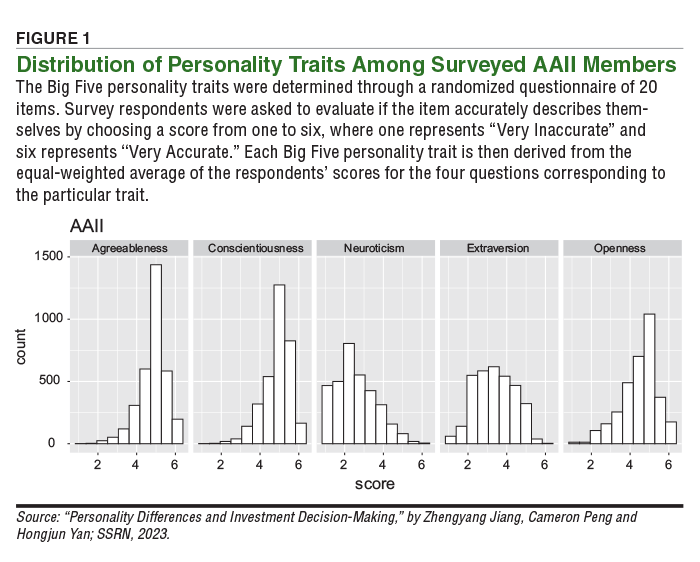
In general, economists haven’t paid too much attention to those variables yet. That’s what we tried to do in our paper, “Personality Differences and Investment Decision-Making.” For example, one might expect that neuroticism, one of the Big Five personality traits, is linked to the way people form beliefs (Figure 1). Those who score high on neuroticism tend to form beliefs that are too pessimistic.
This gives us a motivation to study those personality traits. While we do not expect all the traits to be equally important for financial decisions, we do have a clear hunch that some of the traits—like neuroticism—should play some role in the way people form beliefs and eventually make decisions.
The effect that high neuroticism has on expectations and investing decisions came up quite a bit in the study. What made it stand out as a personality trait?
Let me use one of the other traits, like agreeableness, as an example.
We understood from prior studies that agreeableness is very important in some economic contexts, like negotiation for wages. In that context, agreeableness plays a huge role. People who are more agreeable tend to avoid confrontation, even to the point of sacrificing their own benefits. They may eventually, after the fact, regret that they didn’t ask for a bigger pay raise, for example, just to avoid a confrontation. As a result, we see that people with high agreeableness tend to do worse in wage negotiations. Interestingly, in this economic context, people interact face to face. This makes confrontation avoidance more relevant.
When it comes to financial decisions where people are trading, let’s say, in front of a screen instead of talking to someone face to face, that potentially will make agreeableness much less important. It’s also what we found in our analysis. Neuroticism plays an important role across all the datasets we examined. But agreeableness barely shows up anywhere in the analysis of how personality traits affect financial decisions.
In terms of investing, neuroticism also leads to being influenced by social circles, correct?
Absolutely. In a social circle, people with high neuroticism may worry about missing out. Our survey, at least, shows clearly that if they hear from their friends that a certain investment worked out well, they may be worried about missing out. As a result, they may be more likely to jump into those investments.
And is it the opposite when they’re looking at economic forecasts? If someone has stronger traits of neuroticism, do they tend to be more pessimistic about, say, the economy?
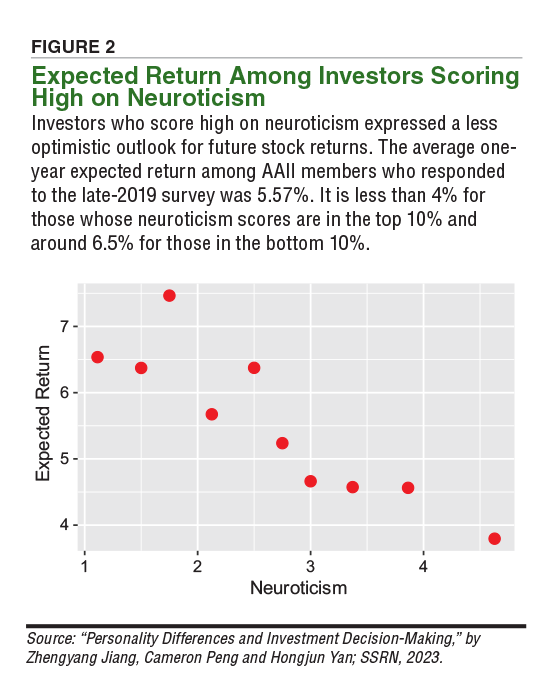
For neuroticism, yes. Overall, their level of optimism will be lower. They will expect lower economic growth and lower stock returns, and if you ask them to forecast their own wealth growth rate, they tend to forecast it at a lower level as well (Figure 2). Basically, they are pessimistic across the board.
So, they have a greater fear of regret and perhaps don’t want to invest as much over fear of losing money. But they are willing to follow a crowd that they trust by investing in certain investments. Is that fair to say?
That is certainly very likely, according to the evidence we have. Even though, in general, those with high levels of neuroticism tend to be more pessimistic, they might be more likely to be influenced by their friends. If they see other people aren’t doing it, they are more likely to follow exactly as you suggested.
You also found the level of openness to have an impact on investing. Openness tends to have a different impact on attitudes toward equities compared to neuroticism.
In our study, people who score high on openness tend to invest more and are more interested in the stock market, relative to other investments like savings accounts or bonds. We think that may be related to the fact that people who score high on openness are more open to adventures, for example. They are also more likely to invest in risky ventures, to the extent it is not fully captured by traditional economic variables, like risk aversion. So perhaps one way to think about it is that people ranking high on openness are more willing to participate in an unknown situation, in an adventure.
Would an investor who scores high on openness also be more willing to go into newer types of investments like artificial intelligence (AI) or cryptocurrency?
By definition, high openness means the person is more open to having an entirely new experience. They tend to be more creative. Those who are more open are also more likely to participate in something totally new. They are more likely to think, “Why not just try it?”
If you score very low on openness, your behavior is exactly the opposite. If there’s a new opportunity and you don’t know much about it, you tend to say no to those opportunities rather than just try it. Cryptocurrency, as you mentioned, is a pretty good example.
We discussed how agreeableness doesn’t have a big effect on investing. What about extraversion? How much of an impact does it have?
Our evidence suggests that extroverts are more likely to follow the trading strategies their friends have. One of the reasons is perhaps they have more opportunities to interact with different people, as they prefer to spend time with friends rather than be alone.
Introverts, conversely, feel more comfortable being alone rather than being with friends. So, they probably have less exposure to what their friends are doing to begin with, and they are less likely to follow what their friends are doing.
For extroverts, it is exactly the opposite. They’re more likely to see what other people are doing. They have a strong tendency to participate in the same activities and investments.
You and your co-authors surveyed AAII members for the study. But you also looked at investors in other countries, where you found personality traits and their impact on investing to be similar to what you observed among U.S. investors.
Absolutely. I want to give a huge shout-out to AAII’s membership. I really appreciate those AAII members who participated in our survey. I am very much grateful for it.
It’s the main dataset we use in the study. The reason it is so important for our study is that this dataset provided unique variables we just don’t have in other datasets. Because we could tailor our survey, we were able to obtain variables that we are really interested in analyzing. For example, the AAII dataset allows us to link personality traits with expectations on the economy and on inflation, as well as investments.
Typically, the large-scale surveys—like, say, those in Germany or in Australia—have some information about investors’ portfolios, but they have very little information on expectations. For our research, it was very important for us to obtain this information, both expectations and portfolios. The survey of AAII members was perfect for this analysis.
As a robustness check to see whether the results are similar in other datasets, we analyzed a huge dataset in Australia and one in Germany. We found very similar results in terms of the correlation between personality traits and portfolio choices.
The one trait obviously standing out was neuroticism. Those with strong neurotic traits tend to be less likely to participate in the stock market. For example, according to the dataset in Germany, investors who scored high on neuroticism also tended to hold less stocks, which is exactly consistent with what we see in the AAII dataset.
Recently, we even got some data from China where we obtained a large group of investors’ personality traits and their expectations and stock holdings as well. Once again, this data showed very similar results. It is quite remarkable that the measurement based on a very standard methodology was consistently correlated with expectations. It was also consistently correlated with portfolios not only in the U.S., but also in Australia, Germany and China. So even in different economies with different languages and different institutional and legal environments, we have very similar results. That gave us a lot of comfort that the correlation we discovered between personality traits and investments is likely to be genuine.
Agreeableness: The tendency to act in a cooperative, unselfish manner. Agreeable individuals are more considerate, kind, generous, helpful, trustworthy and altruistic.
Conscientiousness: The tendency to be organized, responsible and hardworking. Conscientious people display self-discipline, have a strong sense of duty and responsibility and strive for achievement against outside expectations.
Extraversion: An orientation of one’s interests and energies toward the outer world of people and things rather than the inner world of subjective experiences; it is often characterized by positive affect and sociability. Extraverts are enthusiastic, action-oriented people who enjoy interacting with people, possess high group visibility and tend to assert themselves.
Neuroticism: A chronic level of emotional instability and proneness to psychological distress. More neurotic people are less predictable and less consistent in their emotional reactions. They tend to be flippant in the way they express emotion and are more likely to interpret ordinary situations as threatening and minor frustrations as difficult.
Openness: The tendency to be open to new aesthetic, cultural or intellectual experiences. People who are open to experience are intellectually curious, open to emotion, sensitive to beauty and willing to try new things. They tend to be more creative and more aware of their feelings. They are also more likely to entertain unconventional ideas.
Source: “Personality Differences and Investment Decision-Making,” by Zhengyang Jiang, Cameron Peng and Hongjun Yan; SSRN, 2023.
If somebody can identify which of the Big Five personality traits they score high on—I know there are various online tests people can take to determine this—how can they use your insights to manage their portfolios?
This is a great question! Although our analysis so far does not have a definite answer, it does offer some potential suggestions.
For example, we know that people who score high on neuroticism tend to be too pessimistic. As a result, if someone knows that they have a strong tendency to be on the cautious side, then perhaps in the long run this individual will benefit from investing slightly more aggressively than they would otherwise based on their instinct. They can also try to remind themselves that maybe they don’t need to be so cautious. This is one possibility.
A slightly more promising possibility is from the financial adviser’s perspective. If an adviser knows that some of their clients score high on neuroticism, then the portfolios based on those clients’ own expectations will tend to be too conservative. Our analysis suggests that those clients would benefit in the long run if the adviser fine-tunes their recommended portfolios to be less conservative on the margin.
Behavioral Finance

Portfolio Strategies

Behavioral Finance

JAMES M from MT posted over 3 years ago:
JOHN L from NJ posted over 3 years ago:
TERRANCE O from OH posted over 3 years ago:
You need to log in as a registered AAII user before commenting.
Log InCreate an account