

Charles Rotblut leads a class in AAII's new Essential Investing Video Course. Go to https://www.aaii.com/ves for more information and to subscribe.
The interest rate environment has changed significantly since we asked AAII members three years ago what they are doing to realize portfolio income (“Many Individual Investors Are Relying on Equities for Portfolio Income,” September 2020 AAII Journal). The yield on the 10-year Treasury note was 3.99% as of mid-July 2023. In August 2020 when we conducted the previous survey, the benchmark note yielded 0.69%. The change in six-month Treasury bills has been even more dramatic: 5.55% now versus 0.12% in 2020.
Given the big change in interest rates, we thought it would be interesting to see what AAII members are now doing for portfolio income. Dividends continue to be frequently used. Relative to 2020, many more AAII members now are using bonds and money market funds as sources for generating portfolio income.
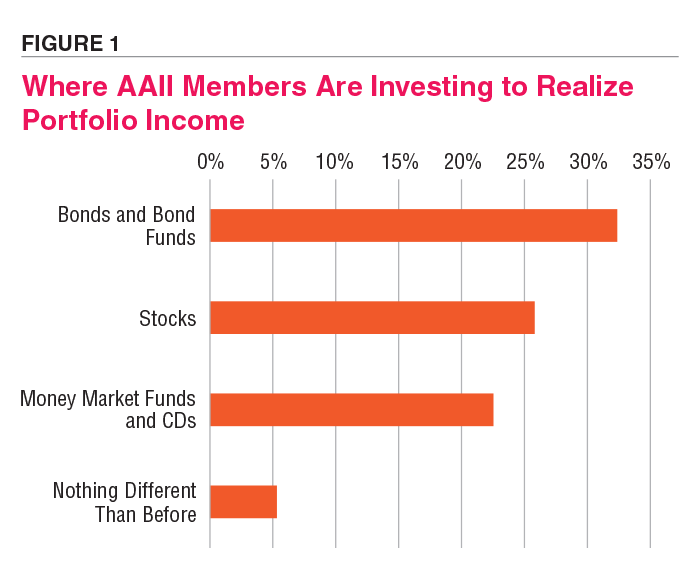
When asked “In the current higher-interest-rate environment, what are you doing to realize portfolio income?” about one-quarter (26%) of survey respondents said investing in stocks, as shown in Figure 1. Bonds and bond funds were cited by even more (32% of respondents). Money market funds, money market accounts or certificates of deposit (CDs) were listed by a combined 23% of respondents. Some respondents listed a combination of each.
High-quality short-term bonds, bond mutual funds or bond exchange-traded funds (ETFs) are held by nearly two-thirds (65%) of the respondents who shared the types of fixed-income investments they own (three-quarters of all survey respondents). Intermediate-term bonds and bond funds are held by 58% of respondents. Several respondents talked about laddering bonds and/or CDs. Treasury inflation-protected securities (TIPS) are utilized by just 19% of respondents to this question.
On the equity side, dividend stocks were a popular choice (95% of respondents to this question and 86% of all survey respondents). Real estate investment trusts (REITs) were also a popular investment option, owned by 52%. Preferred stocks are owned by 24%, and covered call options—a strategy used to realize income by selling call options on owned stocks—are utilized by 19%.
“I have built a renewable maturity ladder of Treasurys and CDs with 25% of my portfolio. So far, the ladder is built with securities up to two years in maturity. Another 20% of my portfolio is in money market funds,” wrote AAII member Hill Williams.
Dan Pouliot described himself as an “‘Investing at Level3’ acolyte” in reference to AAII founder James Cloonan’s 2016 book that advocated for a large allocation to stocks and a small allocation to defensive assets. “I’m parking my three-year cash in a CD ladder stretching from three-month to 60-month maturities. I am also selling covered calls on a portion of my equity holdings.”
Comparatively, about 18% of respondents to our 2020 survey said they were decreasing their allocation to bonds. Two out of five respondents (40%) said they would have had greater exposure to bonds if interest rates were higher back then.
The Big Question survey is part of a periodic initiative to give AAII members a chance to talk about their investment decisions and challenges. Each survey asks what we’re describing as a “big question” about a subject of interest to many individual investors. A randomly selected group of AAII members is asked a specific question, as well as follow-up questions intended to provide more clarity and background. More than 260 AAII members responded to the latest survey, which was conducted in July 2023.
Cash Has Increased as an Allocation Choice
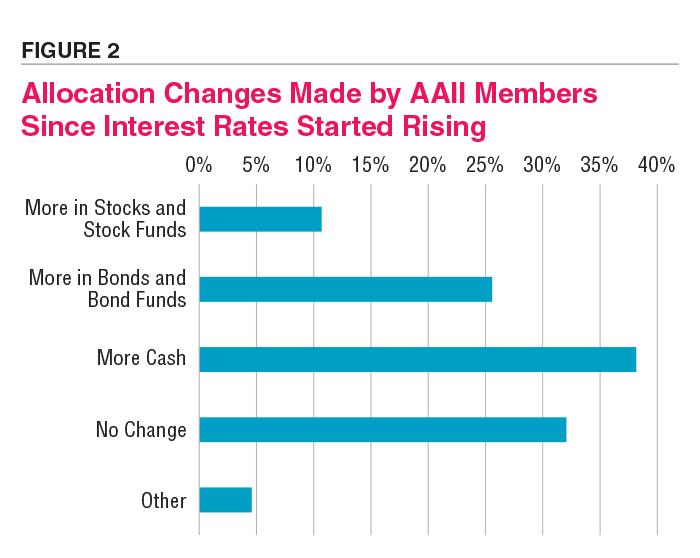
To get a better sense of the impact higher interest rates have had, we asked AAII members how their portfolio allocations have changed since the current interest rate hike tightening cycle began last year. Nearly two of out five survey respondents (38%) said they are holding more cash, in response to the multiple-choice question. Allocations to bonds or bond funds (mutual and exchange-traded) were increased by 26% of respondents. On the other hand, about one-third (32%) haven’t changed their allocation, as shown in Figure 2.
We followed up by asking those who changed their allocation since the Federal Reserve began raising interest rates why they did so. There were two common themes apparent in the majority of the responses: a desire to reduce risk and/or the opportunity to realize higher yields in a risk-free or low-risk manner.
AAII member Gerald Farmer summed up the sentiment of many respondents by saying, “There now exists an alternative that was not previously there when money market rates were virtually nil.”
“Since I can get CD interest above 4%, I have put more funds there since they are insured. On average, stocks yield less than that and can lose value,” explained AAII member John DuBois.
Given that there are also many respondents who didn’t change their allocation, we asked them why they chose not to. Many in this group discussed how they follow a long-term strategy, have balanced portfolio allocations or otherwise are comfortable with their portfolio strategies. Many respondents expressed their confidence in the ability of the stock market to build wealth.
AAII member Joseph Miller is keeping his allocation unchanged because he has “a long-term plan and nobody knows what the market is going to do. Sometimes you can be right, but sometimes you will be wrong.”
“I am a long-term investor and comfortable with the long-term potential of the positions held,” explained AAII member Jonathan Ladd Hagmaier. He added in a follow-up email, “Lots of in-and-out trading may make a few dollars but after short-term taxes and having to find another winning short-term investment, I seldom come out ahead, whereas long-term capital gains and dividends of solid proven companies have served me well over my investment history.”
We also asked survey respondents how their current allocation to stocks, REITs and equity-focused funds compares to what it was a few years ago when interest rates were low. Here we saw 16% of all survey respondents say they decreased their allocation to equities. A little under 25% shifted to bonds or added cash equivalents such as CDs. On the other hand, 34% maintained their equity allocations while 16% increased it.
“When interest rates were low, I kept less money in cash (CDs and money market) and looked to invest in above-average dividend-paying stocks or dividend ETFs,” wrote AAII member Larry Fox. “Now with interest rates much higher, I am much more selective in my stock investments.”
“My cash levels are up due to increased interest income, but I have not liquidated any long-term equity positions,” explained AAII member Neal Ross.
Higher Interest Earned on Cash Savings
Close to 70% of all survey respondents took action to realize a higher interest rate on their cash savings. When we asked them to explain what they did to earn a higher interest rate, about one-quarter of those who responded used the words “move” or “moved.” CDs, money market funds and Treasurys were the primary types of vehicles these respondents moved their savings to.
This is a stark change from 2020 when just 38% of respondents said they took steps to realize higher interest rates.
No Impact on Withdrawal Strategies
Most of the respondents (80%) to this survey said they are retired. About half of the respondents said they are taking regular withdrawals from their portfolio. Given this, we asked what impact the rise in interest rates is having on their withdrawal strategies.
The consensus response was nothing. Two-thirds of the respondents (67%) who are taking withdrawals wrote “none” or “no change” in their responses to this question. In 2020, slightly more than 53% of retired respondents said the then low interest rates didn’t have an impact, while 47% said low interest rates had only had a modest impact.
Individual Investors Split on Fed Policy
A sign of how much the interest rate environment has changed, our 2020 survey asked AAII members about the Fed’s expectation of keeping its interest rate target range at 0% to 0.25% potentially through 2022. Respondents were split back then, with 28% saying they agreed versus 30% who disagreed.
Fast forward three years and the target interest rate range is 5.00% to 5.25% as of mid-July 2023. Thus, we revised the question to ask if the Fed should hold interest rates at their current level, continue to raise them or begin to lower them.
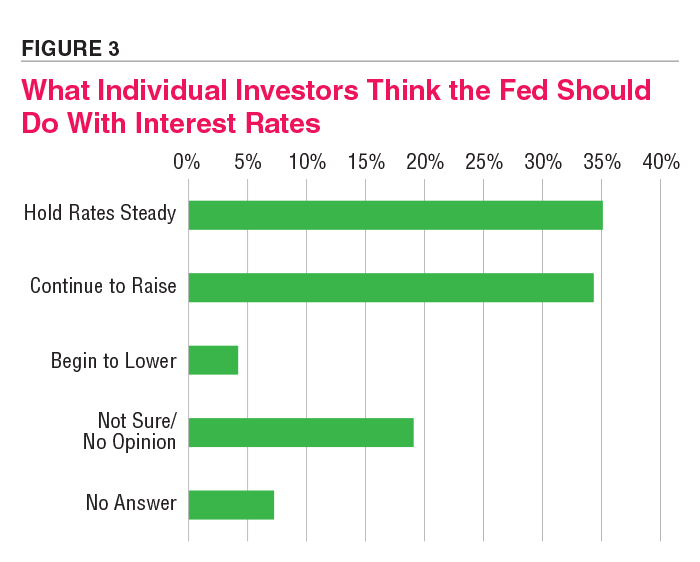
As Figure 3 shows, individual investors are once again split. A nearly equal number of survey respondents think the Fed should hold interest rates steady (35%) and think the Fed should continue to raise interest rates (34%).
A common theme among those who feel the Fed should hold interest rates steady was the need to determine the full impact of the past 10 increases. AAII member Alan Groover was among those who expressed this sentiment: “Give the economy time to adjust to the impact of the higher-rate environment.”
Inflation was the top concern among respondents who thought the Fed should continue to raise interest rates. Many expressed concerns that a premature pause in interest rate hikes could allow inflation to remain at elevated levels and thereby damage the economy. “Reduce inflation successfully. A little pain is worth it. Rates won’t go too much higher,” wrote J. Zebrowski.
Guidance on Navigating Rate Hikes
Finally, we asked AAII members what suggestions they have for how to allocate a portfolio in response to the rise in interest rates. There was not a clear consensus among those who were willing to give a suggestion.
About 25% of those who answered this question mentioned money market accounts, CDs, Treasury bills and high-quality bonds. Some suggested keeping maturities short, while others suggested buying intermediate-term bonds. Shopping around for higher interest rates on savings was also commonly mentioned. Not included in this count were AAII members who suggested maintaining adequate cash reserves for emergencies and to fund portfolio withdrawals.
Many respondents suggested stocks. Dividend-paying stocks and other types of income-paying equities were frequently mentioned. Others suggested a balanced portfolio of stocks and bonds.
“Depends entirely on your goals,” commented AAII member Ramin Olson. “If you are in retirement, I would consider allocating a heavier portion than usual to (mostly short-term) Treasurys. If your investing time horizon is 20 years or more, I would stick with a high allocation to stocks and ignore the current noise.”

Related

Related

Discussion
FREE REPORT

Get your free copy of our special
report analyzing the tech stocks
most likely to outperform the
market.
Don P from USA posted over 3 years ago:
JUAN K from FL posted over 3 years ago:
You need to log in as a registered AAII user before commenting.
Log InCreate an account