


Dan Villalon is a principal at global investment firm AQR Capital Management and is global co-head of the firm’s portfolio solutions group. We talked about following a quantitative approach toward investing and incorporating factors into a portfolio.
—Charles Rotblut, CFA
Your firm utilizes quantitative approaches in portfolio management versus traditional bottom-up approaches. Could you give us the argument for using a quantitative approach to investing?
Quantitative and fundamental investing have a lot more in common than I think most people realize. Folks think that fundamental managers are all about shaking hands with management and getting a comfort level with the company, but that’s not true. They look at income statement and balance sheet information to make an investment decision.
Quantitative investors (“quants”) look at the exact same information too. We process tons of financial documents and data to get a sense of things like current and future earnings, profitability, leverage risk, etc. We want to know as much fundamental information about a company as possible. The difference is that we ingest that information broadly and fairly technically. That’s what makes us quants.
At AQR, we think of ourselves as being on the fundamental side of the quantitative landscape. We can be described as fundamental investors who use quantitative processes to make decisions.
Now, that said, there are some differences—there are some investment signals or investment philosophies that tend to show up more in quantitative than fundamental portfolios. These would be things like momentum investing. This was the dissertation topic of Cliff Asness, who is one of AQR’s co-founders. It was a fairly controversial thing to write about because it’s hard to think of momentum investing as having some true kind of fundamental risk-based explanation for why it should work. It tends to be more of a domain for quants: I rarely see a fundamental manager explicitly think of a company’s momentum as much as quants do.
Asness’ doctoral dissertation adviser was University of Chicago professor Eugene Fama. Fama strongly believes in the idea of all known information being priced into stocks. It would seem that momentum almost goes against this.
The idea of the markets being efficient has been the Chicago way of thinking historically, but it has certainly shifted through time.
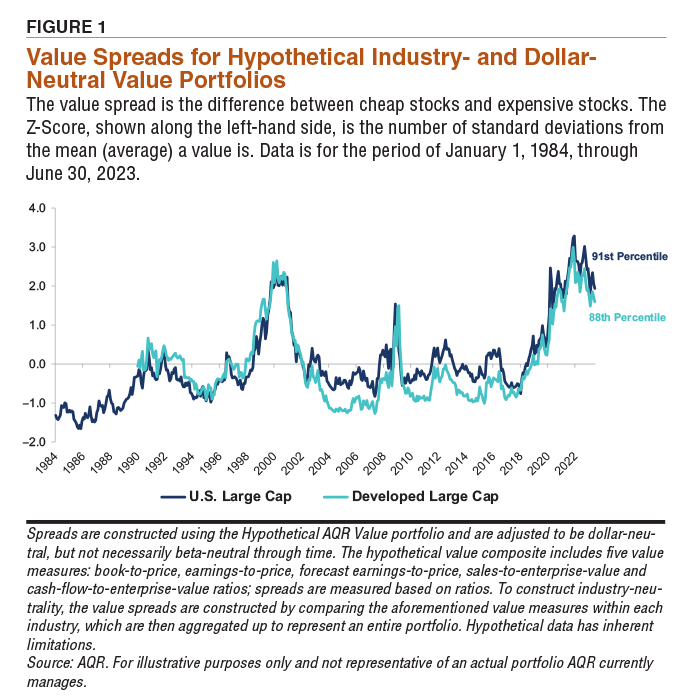
With Fama, the idea is that if you find an investment factor that works, there ought to be a risk that comes along with it. Take for instance the value factor—the tendency for cheap stocks to outperform expensive stocks: The basic theory is that you’re getting compensated with those additional returns because you’re bearing some additional risk (Figure 1). Maybe the cheap stock is more likely to be in distress in bad times for the economy, something like that. It’s the risk/reward relationship that everyone learns about in finance class. This would be the rational, risk-based explanation for why you should get rewarded for focusing on the cheaper stocks in an index.
Now, here comes momentum. Momentum says let’s look at the stocks that have outperformed their peers over the past 12 months. And what do those outperformers go on to do? Well, they tend to continue to outperform their peers. This is really difficult to reconcile with the risk-based, efficient view of the world because if you’re being compensated for something, you must be bearing some kind of risk.
But what kind of risk are you being compensated for by investing in winners? If anything, you would expect the winning stocks to be less risky, right? They’ve been the ones that’ve been doing well. It is hard to reconcile the momentum premium with traditional rational, risk-based economic explanations. Behavioral economics may have a better ability to explain what’s going on with momentum. The behavioral explanation is that investors have a tendency underreact to new information relevant to a stock, causing the stock’s current price to only reflect this information slowly over time, therefore causing a price trend.
When we look at capturing sources of returns, it doesn’t really matter quite as much whether it’s a rational, risk-based explanation for why the thing works, or if it’s more of a behavioral reason. Ideally, we’d like both explanations of what is occurring, but as long as there is a strong theoretical underpinning for it, we’ll probably be interested in applying it in our portfolios.
Value and momentum pair well together, but they seem to be opposites. Value involves buying what appears to be cheap, while with momentum you’re buying what’s outperforming. So why does their pairing work?
Value and momentum tend to be negatively correlated. That is the technical reason why they pair well together. The intuition is just what you’ve said, a value stock is one whose price has been beaten up for a while, whereas a momentum stock has been outperforming its peers over the past 12 months.
The way I like to reconcile value and momentum, just conceptually, is time horizon. Value stocks tend to be ones that have been beaten up for a pretty long while. Momentum stocks are ones that have only recently begun to outperform. So, by combining these factors, it means you’re looking for an underpriced stock that is starting to show signs of improvement. Value helps you identify what the cheap ones are, while momentum, in a sense, tells you they may be starting to revert to fair price.
For us, finding a stock that looks good along both characteristics is a far better proposition than finding a stock that only looks good on one. We find empirically that stocks exhibiting positive momentum and value characteristics offer superior expected returns over ones that only look good on one of the two dimensions.
In terms of getting exposure to both factors, should individual investors target stocks that rank well on both value and momentum instead of, say, buying one momentum exchange-traded fund (ETF) and one value ETF?
We believe there’s a theoretically right way to do this: Look for a stock that looks attractive on all the different characteristics, or factors, that you like. Take three factors that are well-known in stocks: value, momentum and quality. [Quality indicates a high-profitability, low-risk stock.] If you think of a triathlon, it’s not the fastest swimmer that wins, it’s the competitor who’s a good swimmer, a good cyclist and a good runner. It’s the same with portfolio construction. If you are looking to harvest the value premium, the momentum premium and the quality premium, find a stock that looks good across all three. That tends to be the most effective way to do it.
At AQR, we look for a stock that seems to score well on all those characteristics. But there is a trade-off. One, it’s a little bit more complicated. Your portfolio construction is now taking into account multiple characteristics. Two, you end up losing some of the explanation for why your portfolio outperforms and underperforms. If you’re just doing value investing in one area of your portfolio, momentum in a second part and quality in a third, it’s easier to understand when there is outperformance and underperformance in any one of those individual segments. Once you use a multifactor approach—what we call an integrated approach—where you’re looking for stocks that look good on all three of these things simultaneously, you start to lose some of that simple intuition for why the portfolio outperformed or underperformed.
The complication can be a difficult consideration for some people. I think that explains some of the appeal for single-factor ETFs even though, in our view, they are suboptimal. They are easier to understand.
Another thing is timing. I think a lot of investors enjoy trying to time factors. Single-factor ETFs are a way that people try to put those views into their portfolios. We’ve spent a lot of time researching the outcome of timing individual factors rather than just holding them all in a diversified basket, and we found that the diversified basket is hard to beat. The reason is these factors are so diversifying to each other, the combination tends to be better than the sum of the parts.
Value was out of favor over the last decade and that impacted the returns of multifactor portfolios. If the reasons why a multifactor approach is underperforming are not clear, what can an investor tell themselves to help stick with such a strategy?
Asness is fond of saying a good portfolio you can stick with is better than a great portfolio you’re forced to sell at a bad time. I think an investor should ask themself what their breaking point is with a strategy before incorporating it into a portfolio. What’s my patience? How much underperformance can I stomach before calling it quits?
Factors are no different than stock markets in that they work more often than they don’t, but they don’t work every year. Stock markets can go through multiple years where they underperform. They have tail events where they lose more money than you may have expected. The global financial crisis was one example and the dot-com bust was another.
It’s the same with factors: Investors should go into them with open eyes and not view them as a silver bullet for excess returns. We at AQR think factors are a great component of—or an addition to—most portfolios, but they don’t work all the time. And often, the explanation for why they’re not working can be difficult.
The factor that we think has had the toughest past five years is value. From 2018 through 2020, most kinds of value investing had a historically poor period. That leads you to ask whether value is still working. This is a question that I think investors are always going to have with factors. Has a factor stopped working? Has it been arbitraged away? Has the world gotten hip to this thing and taken away the future profits of it?
In the case of value, we spent a lot of time kicking the tires to figure out whether there was an explanation for the underperformance—was the factor somehow “broken,” was it no longer relevant in today’s market? And despite those tough years, we found the future case for value seemed to hold up to all of the mud we could throw at it.
Despite value’s performance improving since its nadir in 2020, we at AQR believe firmly that we continue to be in a growth bubble—or a value anti-bubble, for lack of a better term. We think that the value factor can get untied from fundamentals every once in a while, and that can represent a nice opportunity for investors who are able to stick through it.
Why It Makes Sense to Pair Momentum With Value in a Portfolio Video
We think you’d like this related webinar! Weed Out the Weak With VMQ Stocks
If someone is putting together their own portfolio, any suggestions on how they can get adequate diversification?
Diversification is your friend when it comes to factors. If you want to capture the returns of the equity market, you don’t just buy a single stock. Sure, a single stock will have the equity risk premium inside it, but it’s also going to have a whole bunch of additional risks specific to that one company. We think it’s true with other factors too—the momentum factor, the value factor and the quality factor. You don’t buy just one quality stock, because you’re going to get a whole bunch of other unrelated, and potentially unwanted, risks. So, for us, diversification is key in terms of building a good factor portfolio.
There are some things to watch out for. For instance, if you wanted to build a value portfolio, the simplest thing would be to take all the stocks in an index, say the S&P 500 index, and just rank them according to how cheap or expensive they are. You then just buy the cheap ones.
But what if an entire industry was cheap? If utilities are cheap, you could end up with a portfolio that’s massively overweight in utilities and completely out of some other industries. In this example, in seeking to capture the value premium, you’ve actually made a huge bet on utilities. When it comes to diversification, we think about it not just in terms of the number of stocks in your factor portfolio, but also diversification along other attributes, like across industries.
One of the great things about factors is they have been shown to be pervasive. This is the case not just with U.S. stocks, but also internationally. So, investing across more than just U.S. equity markets is another way of ensuring adequate diversification.
I want to pivot and ask you to talk about trend following versus buying put options in terms of managing portfolio risk.
This would potentially be a useful pivot with factors. So far, we’ve talked about them as long only. For value, I just buy cheap stocks. For momentum, I only buy outperformers. That’s not the only way to get exposure to factors.
The next level, or the next step, would be long and short. If it’s the case that cheap stocks outperform the average, you would expect the opposite to hold too—that expensive stocks must underperform. By buying the cheap stocks and shorting the expensive stocks, you’re able to capture “both sides” of the value premium. A second benefit with long/short is that you’ve hedged out the underlying equity risk because you’re equally long and short on stocks. You have something that is potentially highly diversifying to other sources of returns and risks in your portfolio, which tend to be dominated by market risk, particularly the equity risk premium.
Can we do better than mere diversification? Can we come up with a strategy that delivers during bad times for traditional markets? Among factors, there seems to be a clear winner: trend following.
Trend following is a form of momentum. And in some sense, trend following is even simpler. If an asset class or market has been going up over the past month, three months, 12 months, you go long. If it’s been going down over those periods, you go short. At its core, it’s as simple as that.
One of the potentially valuable things about trend following is that in a protracted crisis or market drawdown, these strategies will naturally, by construction, be positioned short. During those deteriorating markets, trend-following strategies tend to have their day in the sun. So, this opens up the possibility of having a factor strategy that can also help you with downside risk.
Now, this gets into a debate, because portfolio protection is a very valuable thing, as long as you can find it for a low cost. If you’re able to find an insurance policy in financial markets—something that pays off when you need it most—that would be a great. Traditionally, people have gone to the options markets, particularly put options, for protection.
A few years ago, we wrote a paper where we basically ran a horse race. We focused on the worst drawdowns for investor portfolios and compared options-based portfolio protection strategies versus trend following. What did we find? Over short, fast crashes—like the coronavirus crash or October 1987’s Black Monday—put options worked really well. What about the slower ones? Well, if it’s a multimonth or even multiyear drawdown like the global financial crisis or the dot-com bust, trend following tends to be the victor (Figure 2).

It’s like Aesop’s fable with the tortoise and the hare. Trend following tends to be more tortoise-like, it’s slow and steady over those longer drawdowns. That’s not the case for options. As the demand for insurance picks up, the cost that you would have to pay to buy put options also goes up. The longer the crisis, the more expensive options-based insurance becomes. So, you end up bleeding out any gains via the premiums paid. On the other hand, trend following will continue to be positioned to short those deteriorating assets until things stabilize and turn around. So round trip and for longer tail events or drawdowns, we find empirically that trend following is among the most successful factor-based or quantitative strategies for protecting a portfolio.
Is there anything I should have asked you that I didn’t?
Why factors matter today. I think there are two reasons. The first is a permanent reason: Factors are systematic sources of returns. The factors we talked about here are sources of return that have been shown to be pervasive through time and markets—and we rarely find investors to be capturing them at scale. In fact, often when we look at investor portfolios, they’ll be long on a value index and also long on a growth index, effectively canceling out the presumed benefits of either one. When it comes to diversification, for most folks, we believe factors can be low-hanging fruit in terms of additional sources of returns that you can introduce to a portfolio.
The second, more tactical argument is that the stock and bond markets, and therefore traditional portfolios, are priced to deliver lower-than-average returns over the next five to 10 years. Equity valuations are higher [more expensive] than normal. Real (inflation-adjusted) bond yields are not particularly attractive either, even though yields have come up over the past few years. Over the next five to 10 years, we think portfolios could use all the help they can get. We think factors should be on the menu for investors looking to make up for the low expected returns that markets are offering today.

Related

AAII How-To
The Benefits of Combining Value & Momentum
Related

Trading Strategies
Protecting Against a Price Drop: Puts Versus Stop Orders
Discussion
FREE REPORT

Get your free copy of our special
report analyzing the tech stocks
most likely to outperform the
market.
BARRY J from TX posted over 3 years ago:
JOHN L from NJ posted over 3 years ago:
RONALDO J from IL posted over 3 years ago:
HARRY C from KS posted over 2 years ago:
BARRY J from TX posted over 2 years ago:
You need to log in as a registered AAII user before commenting.
Log InCreate an account