

Related

Portfolio Strategies
No consensus exists on an acceptable risk of outliving savings, and current models don’t reveal the magnitude of the shortfall retirees face.

Charles Rotblut leads a class in AAII's new Essential Investing Video Course. Go to https://www.aaii.com/ves for more information and to subscribe.
Moshe A. Milevsky is a tenured professor at the Schulich School of Business at York University (Canada). In a viewpoint published in the March/April 2016 issue of the Financial Analysts Journal (FAJ) that is available to AAII members (www.cfapubs.org/doi/abs/10.2469/faj.v72.n2.4), Milevsky expressed his concerns about using the probability of running out money as the guiding risk metric for retirement income planning. He talked with me about why he doesn’t think this is the best metric and about the role annuities can play in providing retirement income.
—Charles Rotblut, CFA
Charles Rotblut (CR): The whole concept of ruin probability underlies a lot of retirement planning practices and concepts. Could you briefly explain what ruin probability is?
Moshe Milevsky (MM): Sure. Ruin probability is a term that not many people have heard. It’s a term that was invented by actuaries a hundred years ago. Its modern incarnation is shortfall probability—that is, a deficiency probability or a loss probability—or failure probability, which is something you see a lot of in financial planning calculations and discussions.
Ruin probability is simply a number between zero and one of something very bad happening to you, your company, your economy or your country. That number is now used in financial planning to tell people if they’re on track to reach their goals.
CR: One of your concerns about using ruin probability for retirement planning is that there isn’t a consensus on what an acceptable level of failure is.
MM: Yes. I think that was one of the five or six issues I raised in my viewpoint article in the Financial Analysts Journal; it’s the one that tends to get the most quoted. But, yes, you’re absolutely right. Can somebody please tell me what a “bad” number is?
When it comes to your blood pressure, you go to a doctor. They’ll take out a chart, and it’ll say, “The numerator (systolic) is 140 and the denominator (diastolic) is 90 and its time to get scared.” There’s a scientific consensus on what number is unacceptable and when a person better change their behavior.
When it comes to financial planning, I don’t think there’s a consensus out there. And that’s rightfully so, because I don’t think there is a right number. When someone says to you, “There’s a 97% chance you’re going to achieve your retirement goals,” that’s a 3% chance that you won’t. I’m not getting on an airplane if it has a 3% of not landing where it should.
CR: William Bengen, in his often-quoted study (“Determining Withdrawal Rates Using Historical Data,” Journal of Financial Planning, October 1994) discussed failure in terms of the number of years a portfolio will last without running out of money. Is that a good metric, or is that something that we should throw out the window?
MM: I think that you have to look at the historical context of where these things came from. What Bill Bengen did—in the early 1990s before anybody was using any computer simulation technology—was to shed light on the fact that the objectives of retirement withdrawals are very different from those of retirement accumulations.
What he pointed attention to is that when you start withdrawing money from a portfolio, some strange things can happen. A whole stream of literature has emerged that is built on his work, that has refined it and made it more scientific.
It’s not to say that he was wrong, or that his approach is inappropriate. He was the beginning of a discussion about something that’s very important, but it’s not the state of the art in 2016 and it is certainly not how a financial economist would approach the problem.
CR: Among the other issues you raised in the FAJ piece was that asset allocation models, while they account for failure or success, are not accounting for the sequence of returns in which good and bad market environments can occur.
MM: To make that a bit more refined: They don’t account for the magnitude. When I tell you, “Look, there’s a 10% chance that your portfolio will not take you through retirement,” your next question will be, “Okay, how bad will it be? Will I be in a nursing home that’s not the one I wanted, but second best? Will my kids have to take me in? Will I be living on the street? Will I be a bag lady?”
There’s no magnitude to the shortfall amount. I can’t make economic decisions without a magnitude and the associated statistical distribution of outcomes.
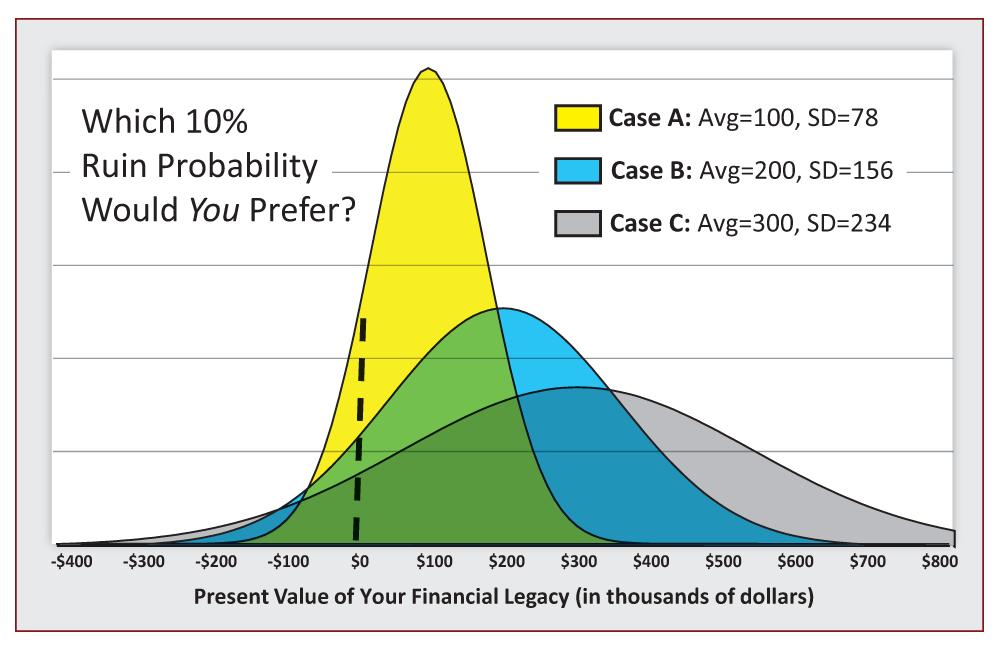
So, that’s my concern. The models are telling me a part of the scenario, but they’re not giving me the entire scenario, and I can’t make decisions. More importantly, if you make decisions exclusively based on probabilities, you can go wrong, because sometimes the probability is high but the magnitude isn’t that bad. In the FAJ viewpoint piece, I show three different portfolios and how the probabilities are identical, but, boy, the magnitude can be different (reproduced in the box below).
Yes, some of this statistical stuff sounds technical and removed from the process of stockpicking or asset allocation, but the accumulation of all of these points is that we have to take a step back and say, “Gee, is this the right philosophy for retirement income planning?”
Figure 1 shows three portfolio allocation strategies, all sharing the same dollar spending amount. Case A is a very conservative retirement portfolio, Case B is a more balanced portfolio allocation and Case C is an aggressive allocation. Under all three scenarios, there is high likelihood of enough wealth existing at death to leave an inheritance with average legacies of $100,000, $200,000 and $300,000, respectively (positive values on the chart).
There is also a 10% chance of a shortfall occurring under each of the three strategies (negative values on the chart). A shortfall occurs when the retiree outlives his or her savings. Notably, depending the type of allocation strategy followed, the magnitude of the shortfall varies. This is shown by the standard deviation (SD) or the variance of outcomes for three strategies. Thus, while the probability of a shortfall is the same, the actual amount of the shortfall varies.
Source: “It’s Time to Retire Ruin (Probabilities),” Moshe A. Milevsky, Financial Analysts Journal, March/April 2016. The chart is reprinted with permission.
CR: So, it’s not just returns, but it’s also longevity, where we focus on the risk of living longer than expected. There’s also, obviously, the risk of dying with more assets than you expected. That’s the other wild card to this.
MM: Yes. If you are only willing to accept a 0.1% chance of running out of money in your retirement plan then there’s going to be a lot of happy grandkids.
CR: You also brought up the issue of performance, and that we only have about 150 years’ worth of return data.
MM: I’m very skeptical, with all due humility and respect toward the empirical research giants like Jeremy Siegel, Roger Ibbotson and Robert Shiller. They’ve looked at historical returns and have been able to come up with 150 years, 200 years of data points.
I actually spent time working on a book that I just published last year on the behavior of financial markets in the late 17th century (“King William’s Tontine,” Cambridge University Press, 2015). This was the very, very beginning of stock markets in London. While the focus of the book was on retirement annuity products, after immersing myself in the period it became clear to me that you simply cannot compare financial markets 100 to 200 years ago to today. It’s a little bit deceiving when we say, “Well, we’ve got hundreds and hundreds of years of data to rely on.” We really don’t. As I wrote in the FAJ viewpoint article, the dice were loaded.
CR: What are individual investors supposed to do if they’re looking at the historical data and trying to base expectations on it?
MM: I don’t want to step above my pay grade here and get involved in the very weighty discussion of what the equity risk premium is (the excess return for holding stocks instead of a risk-free investment), meaning: What can we expect from the market? I’m trying to make a smaller point here. I don’t want to blow this out of proportion.
My point is, when you’re sitting with your financial adviser—and this may not resonate with do-it-yourself investors—and the planner says, “You’re not on track to reach retirement. You might want to change something.” The reason the planner says this is because some software package—some black box—is telling them that their client has only a 70% or a 51% chance of realizing a 95% success rate.
I think that people have to be skeptical of that number and what that means. That’s the limited point that I’m making. One of the reasons is because it’s assuming an equity risk premium where we have a lot of uncertainty about what it’s going to be going forward. We don’t have enough data to be able to provide that number with confidence.
CR: In that case, for someone sitting with their adviser or trying to figure it out themselves, is there a benchmark they can look at to determine if they’re on track or not?
MM: That’s a beginning of the discussion. At the very beginning, I think you plan based on the risk-free rate. If I retire today and I put all of my money in Treasury bonds and I try to live off the interest payments, would I be able to do so? If the answer is absolutely not, you do not have enough saved, you don’t want the next thought to be, “Well, then I guess I have to take some financial risk.”
That doesn’t make me feel good—taking some risk to get out of a quandary because I haven’t saved enough. So, my advice is for the very first step to be that you do all your planning based on current interest rates, not necessarily Treasury bills, but maybe municipal bonds or maybe some corporate bonds. It provides a sense of feasibility.
Do all your planning assuming you take no risk in order to give yourself a very clear picture of whether your lifestyle is sustainable. Then you move on to, “Am I comfortable with my risk asset allocation?” But the very first step should be to ask, “If I put my money in the safest of assets, could I live off this?” If the answer is “no, no way; I could never do that,” well, you may want to work harder. You may want to save more. I don’t think that taking risk is the answer to it. Why? Because of the probabilities and the arguments I made earlier. So that’s the first step of what a good financial adviser does. Remember that many defined-benefit pension plans got themselves into an enormous amount of financial trouble by planning for the future (and discounting cash flows) at too high of an investment rate. They forgot the risk.
CR: Should people assume that maybe they’re looking at a 0.5% interest in a money market account or 1% or 2% in a bond?
MM: No. You want to use a longer-term rate, obviously.
If I had to pick a number for the current environment, it may be 2% or 3% if you buy some of the longer-term bonds, if it’s more tax efficient. That’s a financial planning exercise. Really, that was my main point, at the very end of the FAJ viewpoint piece, “Estimate the number of years their portfolio will last.” It’s a number; it’s in years. Do you like the longevity of your portfolio?
Say you just came from a physician. Your doctor did an exam. You’re 65 years old and in perfect health. You’ve got an expected longevity of 30 years. You then go to the financial adviser and you say, “Look, my doctor just gave me 30 years. What do I have in my portfolio? What’s the longevity in my portfolio?” If the adviser says, “Well, you’ve got 15 years,” then you have a mismatch. That’s a problem. You’ve got to fix that mismatch. There’s a 15-year gap between your lifestyle’s longevity and your life’s longevity. You got to do something about it.
I think that’s the language to communicate to people so that they take action. You start throwing statistics around, and probabilities, coefficients and confidence intervals. Yeah, that might work for the engineers, but not for the majority of the population.
CR: What about in terms of just checking how they’re doing in retirement, once they start taking withdrawals: Is there a certain interval at which retirees should do a check-up on their portfolio?
MM: At least once a year, using the physician analogy. You sit down once a year with someone. They go through your portfolio and look at what you are withdrawing, and then ask what health you are in. What are your goals for the money? What are your objectives? Are you being tax efficient?
I’ll share something with you. The publisher of the FAJ distributed my article to the media. I got a call from someone at USA Today. He said, “Professor, what does this mean for the individual investor reading USA Today?”
And my answer was, “Well, this article was really geared to CFAs and financial analysts.” At some point, you distill this to something too simplistic. It’s, “Well, you know, check up your portfolio on an annual basis,” which sounds so trivial.
So, you have to remember who the audience for this FAJ viewpoint message is: It’s for the financial advisers who are using very sophisticated tools that I don’t think they quite understand. That’s the intended audience.
CR: Okay. Let’s shift to withdrawal rates. In your book “Pensionize Your Nest Egg” (2nd Edition, John Wiley & Sons, 2015), you argued that having some type of a pension-like instrument, either an annuity or an actual pension, can boost withdrawal rates. Could you elaborate?
MM: I’m on the record as being a very huge fan of any type of annuity product. Point of disclosure here, I have a financial stake and am on the board of directors of a firm that disseminates information about all types of annuities, CANNEX Financial. They’re a very large data and technology firm based in Toronto. They have a large business presence in the U.S. That said, for many years, I’ve been doing a lot of research on annuities and I find that the right annuity can extend the longevity of a portfolio.
What that means is that if you take a look at how long the money will last without any annuity products and you then take a look at how long the money will last with some sort of annuity allocation, you add a few more years. And if your objective is to make the money last as long as possible, there’s an argument for annuitization.
I like to joke that no two economists can agree on anything. There’s just such a debate about all things economic. But when it comes to the value of annuities and pensions, you almost have complete unanimity. This is a good thing for retirees looking for a consensus view before they make a decision.
CR: The thought is that retirees can take a higher withdrawal rate, because if they do overshoot on the withdrawals, they still have that income coming in? Is that the basic logic?
MM: That’s it. That’s the basic logic. If I can get a little bit more technical: Built into every annuity product is something called mortality credits. Although it’s a horrible name (invented by actuaries), what it basically means is that when some people die, the money gets distributed to the survivors, which enhances the return. At advanced ages, it becomes very high, because mortality rates tend to be very high at those stages and it provides you with an enhanced yield.
So, this is not magic; this isn’t some sleight of hand. This isn’t some derivative concoction. This is just pure insurance economics.
CR: Is there any rule of thumb about how much someone should annuitize?
MM: That’s a good question. In fact, I sort of try to suggest that in “Pensionize Your Nest Egg.” What I like to do is to start at the end by looking at how much income people have from Social Security, defined-benefit pensions—if they’re lucky—or state pensions—if they’re a state employee. Then I make sure that the majority of income is coming from some sort of annuity product.
So, I work backward. It’s not the way asset allocation tends to be done. Usually, asset allocation is, “Well, how much should I have in stocks? How much should I have in bonds? How much should I have in cash? How much in alternatives?”
I like to start the discussion of annuities on the income and cash flow side as opposed to the main sum of money a person is trying to invest.
CR: You think annuities are really probably best for those with moderate wealth, where they’ve got considerable savings, but not so much they don’t have to worry about running out of money, and not so little they’re way behind the eight ball anyway, right?
MM: Yes. Something that I said many years ago that now gets widely quoted is that Bill Gates and Warren Buffett don’t need an annuity. They’re not going to outlive their money. So, if you’re in that category, you don’t need an annuity.
Likewise, in the other direction, people whose entire retirement income, or the majority of it, is Social Security don’t need another annuity; they’re already overly annuitized. They have too much in annuities.
So, think of it as an inverted U-shaped curve, where those at the very, very low-income end of the wealth scale don’t need annuities and those at the very, very high end don’t need annuities. They’re never going to run out of money. Then there’s this sweet spot in the middle.
CR: In figuring out whether someone needs an annuity, should they factor in Social Security and, if they’re lucky enough to have it, an actual pension?
MM: Absolutely. The way I would phrase this is that you may have an annuity, but you don’t know it. “Hey, I don’t have an annuity; I have money in my local savings and loan.” No, no, you have an annuity called Social Security. You retired as a teacher: You’ve got a pension; that’s an annuity.
If you’ve got more annuity-like income than you need, tell that annuity salesman, “Thank you very much; I have an annuity already.” That’s sort of the way I would phrase it.
CR: As far as, buying, say, an immediate-term annuity or one that pays in the future, such as the newer qualified longevity annuity contracts (QLACs), any thoughts about one over the other?
MM: I’m a big fan of deferred income annuities or qualified longevity annuity contracts, whether it’s inside of a tax-favored plan or outside. I’ve advocated for them a long time. In fact, I wrote some of my first articles about this 15 years ago, well before the Treasury Department started advocating for these.
So, yes, I’m a big fan of them. I actually just bought one about a year ago. I went into an insurance company that shall remain unnamed and I said, “I am 45 years old. I want income if I ever reach 85, and here’s the premium. I want no death benefit; I want nothing in the next 40 years. If I reach 85, I want an income for the rest of my life.”
And, of course, I needed to review and sign hundreds of pages from the attorneys to make sure that I understood what they understood. It’s not easy, but, yes, I bought one. So, I’m a big fan of them.
CR: Shifting gears again, I wanted to ask you about glide paths. I know you’ve commented on Michael Kitces’ and Wade Pfau’s discussion about doing more of a U-shaped glide path, where investors’ equity allocations fall as their retirement date approaches and then rebound afterward. Other people advocate decreasing equity allocations gradually as they approach and age throughout retirement. Any opinions?
MM: First of all, as I said earlier about Bill Bengen’s work, I have a huge amount of respect for Michael and Wade. I consider both of them friends. We run into each other at conferences, and I actually had a lovely dinner with Michael a few months ago. So I’m in no way criticizing them. They’ve done a lot of very important work. In fact, a number of academic economists have made similar arguments over the years (but with much less publicity and fanfare.)
Also, just to be clear, I don’t want this to become a boxing match where, “He said this, but they said this.” I think that it’s important to understand that their result is intuitive. It’s mildly acceptable. At retirement it’s a very sensitive time for your portfolio. You might not want to take a lot of risk.
But I have technical issues with the methodology, which gets back to what I wrote in that article in FAJ about probabilities and shortfall. I’m not sure I like the methodology with which they’re proving it. Whether or not you should have 62% or 65% at retirement in equity, do we really know what the answer is?
Anybody who gives me a second digit, in some sense—and I hate to use this term—is fibbing. I mean, do you really need 63% in equities? That’s optimal? Not 61%, not 64%, but 63%? You have such confidence in all of the variables in your model that you can say 63%? Here is what I say: The answer should be “Somewhere between 60% and 70%,” or, say, “Somewhere between 50% and 60%.” That’s honesty.
I think that once you take that into account, we don’t really know what the optimum allocation at retirement should be. You have arguments both ways.
To put it even more clearly: If someone informs me that (for example) the optimal retirement glide path is to start off at age 65 with 67% equity and then reduce it to 63% equity by age 70 and then increase it to 65% by age 75, I worry that the confidence interval around the [63%, 67%] range is just too wide. At some point it becomes like the philosophical question “How many angels can dance on the head of a pin?”
Personally, I think the glide-path solution is to get yourself some guaranteed income so that if you live a long time and markets don’t cooperate, you know that’ll be there. That’s sort of my approach to it. It’s more pragmatic than debating whether it should be 61% or 67%.
CR:Should the allocation be adjusted based on the retiree’s perceived risk level—what they think they can handle in terms of volatility?
MM: Well, yes, although the behavioral economists are chipping away at the notion of a perceived risk level. What’s a risk level? When markets go up phenomenally in one day, we all get drunk on risk: “Yeah, I can take more risk when the markets are up 300 points.”
So, I’m not sure it’s more risk levels or risk tolerance. I think anything like this should be done slowly. You don’t do it all at once at retirement. And you don’t just wake up at the age of 65 and say, “Gee, I need some sort of pension, because I don’t have one. Let me buy an annuity today; here’s $200,000.”
No, no, no. Never do anything like that in one day, at one interest rate, at one price. Act slowly. Which is why I’m a fan of the QLAC concept. You’re buying your guaranteed income slowly, over 20 to 30 years. That’s how you want to do it—dollar cost averaging.
Listen to Bonus Audio
In this bonus audio from the conversation Milevsky discusses common steps for not outliving your retirement savings and the biggest lessons he’s learned.
Portfolio Strategies

Insurance Products

Financial Planning

Kenny from Texas posted over 10 years ago:
Frank Thibault from AR posted over 10 years ago:
Marsh from Massachusetts posted over 10 years ago:
Harry Rich from OH posted over 10 years ago:
Bill from MI posted over 10 years ago:
Gerard Bieker - Administrator from KS posted over 10 years ago:
Charles Clark from WA posted over 10 years ago:
Erik Wiener from PA posted over 10 years ago:
John Barclay from CA posted over 10 years ago:
William Warren from IL posted over 10 years ago:
James Hogg from FL posted over 10 years ago:
James Hogg from FL posted over 10 years ago:
Theodore Dafflisio from wa posted over 10 years ago:
J Morlock from NJ posted over 10 years ago:
Larry Roche from CO posted over 8 years ago:
Kendrick Miller from NC posted over 8 years ago:
Don Huebschen from Illinois posted over 8 years ago:
Burt Loper from FL posted over 8 years ago:
Don Huebschen from IL posted over 8 years ago:
You need to log in as a registered AAII user before commenting.
Log InCreate an account