


Related

Financial Planning
The optimal age for a single individual claiming benefits depends on life expectancy and the need to extend a retirement portfolio’s longevity.
In this second of a three-part series on claiming Social Security benefits, we present two of the four key points we hope to convey.
The first is that individuals and couples should use two criteria when deciding when they will begin benefits. The second key point is that the breakeven age when cumulative lifetime benefits for the single individual will be approximately equal no matter what age benefits actually begin is 80. To assist with explaining our analysis, we have included Table 1, which shows the age requirements for Social Security eligibility, from last month’s article “Social Security Basics” (AAII Journal, October 2013).
The strategies in this article assume that no one else can receive benefits based on the individual’s earnings record. If a spouse, children or parents can receive benefits based on the single’s earnings record, then the material presented here is not sufficient to make the claiming decision. The strategies further assume no pension is received from work not covered by Social Security (e.g., public-school teachers, police officers, firefighters and other government employees). Finally, the strategies are based on the current promises of the Social Security system, which may change.
We’ll start with Lesson 1, which is: If a single individual lives to age 80, the cumulative lifetime benefits will be approximately the same whether benefits begin at age 62, 63, 64 or any age through 70. This is not an accident. The Social Security Administration’s SSA actuaries set the reductions to benefits for beginning benefits before full retirement age FRA. They also set the delayed retirement credits for postponing benefits until after full retirement age so that the benefits would be approximately fair on an actuarial basis, assuming a 3% real return on Treasury securities.
Table 2 presents the cumulative lifetime benefits in today’s dollars through ages 70, 75, 80, 85, 90, 95 and 100 if Social Security benefits begin at ages 62 through 70. It assumes the individual has a full retirement age of 66 and primary insurance amount of $2,000, but the relative sizes of cumulative lifetime benefits are identical for other primary insurance amount levels. All benefit amounts are expressed in today’s inflation-adjusted dollars. Therefore, cumulative benefits represent the lifetime consumption power of Social Security benefits (ignoring taxes).
The age 80 column in Table 2 illustrates this lesson. If the single retiree lives to 80, cumulative lifetime benefits are approximately the same no matter what age benefits begin. Age 80 is the age where cumulative benefits are “closest” no matter when benefits actually begin, where close is measured by the standard deviation of the column of numbers.
Table 2 demonstrates that if a single individual dies much sooner than 80, cumulative benefits are maximized when benefits begin at 62. And if the individual lives much longer than 80, cumulative benefits are maximized when benefits begin at 70. For example, if the single individual lives to 75, cumulative lifetime benefits are maximized at $234,000 when benefits begin at 62, [$1,500 per month x (12 months) x (13 years)]. This cumulative benefits level is $18,000 larger than if benefits begin at 66 and $75,600 larger than if benefits begin at 70. If the individual lives to 90, cumulative lifetime benefits are maximized at $633,600 when benefits begin at 70. This cumulative benefits level is $57,600 larger than if benefits begin at 66 and $129,600 larger than if benefits begin at 62.
Table 3 presents breakeven ages between two starting dates. It presents breakeven points for starting Social Security benefits at age 62 instead of 63 (62 versus 63), 63 instead of 64, and so on through starting benefits at age 69 instead of 70. For example, the breakeven age of 78 means that the cumulative benefits in today’s dollars are the same if a single individual starts benefits at 64 or 65 and dies in the month of his or her 78th birthday. It also shows the breakeven points for starting Social Security at age 62 instead of 66 and other combinations. In general, the breakeven points tend to be a couple of years sooner than age 80 in the early years (e.g., 62 versus 63, and 62 versus 66) and a few years later than 80 in the later years (e.g., 69 versus 70, and 66 versus 70).
| This table shows the full retirement age (FRA) for your own and spousal benefits. A retiree would receive the primary insurance amount (PIA) if his own benefits are begun at FRA. It also shows the reductions and credits for early and delayed benefits. | |||||
| Age 62 | Per Month | Age 70 | |||
| Full | Benefit | Delayed | Benefit | ||
| Year of | Retirement | Per Month Reduction to PIA If | as % | Retirement Credit | as % |
| Birth* | Age | Benefits Begin Prior to FRA** | of PIA | (%) | of PIA |
| 1943-54 | 66 | 5/9% for 36 mos + 5/12%/mo | 75.00 | 3-Feb | 132 |
| 1955 | 66 and 2 mos | 5/9% for 36 mos + 5/12%/mo | 74.17 | 3-Feb | 130.67 |
| 1956 | 66 and 4 mos | 5/9% for 36 mos + 5/12%/mo | 73.33 | 3-Feb | 129.33 |
| 1957 | 66 and 6 mos | 5/9% for 36 mos + 5/12%/mo | 72½ | 3-Feb | 128 |
| 1958 | 66 and 8 mos | 5/9% for 36 mos + 5/12%/mo | 71.67 | 3-Feb | 126.67 |
| 1959 | 66 and 10 mos | 5/9% for 36 mos + 5/12%/mo | 70.83 | 3-Feb | 125.33 |
| 1960 or later | 67 | 5/9% for 36 mos + 5/12%/mo | 70.00 | 3-Feb | 124 |
| *Social Security considers people born on January 1 to have been born in the prior year. | |||||
| **The monthly reduction is 5/9% for the first 36 months prior to full retirement age, and 5/12% for every month after the first 36 months. | |||||
In short, if a single individual dies well before 80, he will maximize lifetime benefits by starting benefits at 62. If he lives well past 80, he will maximize lifetime benefits by starting benefits at 70. Table 3 explains why we used the two qualifiers “well before” and “well past” in the prior sentence. These two qualifiers allow us to state Lesson 1 succinctly. Nevertheless, you should be aware of the breakeven ages in Table 3 when deciding when to begin benefits.
If the only objective is to maximize expected cumulative lifetime benefits, we could stop here. However, as we explain next, most retirees should be concerned about two criteria when deciding when to begin benefits.
Most retirees will want to consider two criteria when deciding when to begin Social Security benefits.
We suspect that, if left on their own, most single individuals and couples would approach the Social Security claiming decision by thinking the best strategy is the one that maximizes cumulative lifetime benefits if they live to their precise life expectancyies. But nobody knows their precise life expectancy. It is important to understand that the claiming strategy also affects the longevity of the financial portfolio. Many retirees are at least as concerned about minimizing the risk that they will deplete their portfolio during their lifetime. The following example helps illustrate this point.
| Age | |||||||
| Soc Sec | |||||||
| Benefits | Cumulative Lifetime Benefits Through Age | ||||||
| Begin | 70 | 75 | 80 | 85 | 90 | 95 | 100 |
| 62 | $144,000 | $234,000 | $324,000 | $414,000 | $504,000 | $594,000 | $684,000 |
| 63 | $134,400 | $230,400 | $326,400 | $422,400 | $518,400 | $614,400 | $710,400 |
| 64 | $124,800 | $228,801 | $332,801 | $436,802 | $540,802 | $644,802 | $748,803 |
| 65 | $112,000 | $223,999 | $335,999 | $447,998 | $559,998 | $671,998 | $783,997 |
| 66 | $96,000 | $216,000 | $336,000 | $456,000 | $576,000 | $696,000 | $816,000 |
| 67 | $77,760 | $207,360 | $336,960 | $466,560 | $596,160 | $725,760 | $855,360 |
| 68 | $55,680 | $194,880 | $334,080 | $473,280 | $612,480 | $751,680 | $890,880 |
| 69 | $29,760 | $178,560 | $327,360 | $476,160 | $624,960 | $773,760 | $922,560 |
| 70 | $0 | $158,400 | $316,800 | $475,200 | $633,600 | $792,000 | $950,400 |
| Primary insurance amount is $2,000 with full retirement age of 66. The bold number in each column indicates the highest cumulative lifetime benefit for that age. (Someone trained in financial economics would correctly insist that we calculate the present value of cumulative benefits. Today, the appropriate inflation-adjusted discount rate is approximately 0%; that is, the real interest rate on comparable risk investments in 10-year Treasury Inflation-Protection Securities [TIPS] is about 0%. Therefore, the present value of cumulative benefits is also cumulative benefits when expressed in today’s dollars. We use the latter terminology, because it is easier to understand. Thus, if one strategy provides a present value of lifetime benefits that is $40,000 higher than another strategy’s, then this first strategy provides cumulative lifetime benefits that are worth $40,000 more in today’s purchasing power.) | |||||||
Figure 1 illustrates that delaying the start of Social Security can extend a financial portfolio’s longevity. It shows the values of a single retiree’s financial portfolio if he begins Social Security benefits at ages 62, 64, 66, 68 and 70. He begins retirement in 2009 with $700,000 in a 401(k) and he spends $41,700 after taxes in real terms each year. His primary insurance amount is $1,500. If he begins benefits at 62, the portfolio lasts 30 years. By delaying the start of Social Security benefits until age 64, 66, 68 or 70, he can extend the portfolio’s longevity by, respectively, 1+, 2+, 4+ or 6+ years, where 1+ indicates that the portfolio provides full funding for one more year plus part of a second year. Thus, beginning benefits at age 70 instead of 62 extended the portfolio’s longevity by more than six years.
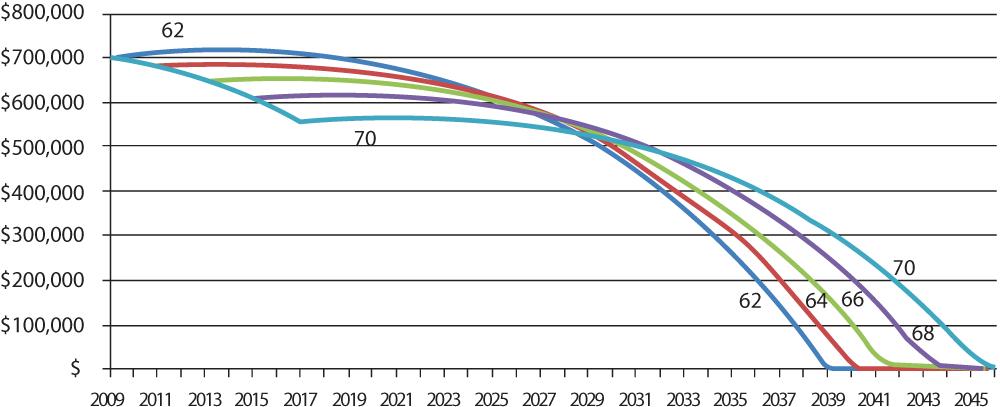
Figure 1 illustrates why both criteria—maximizing benefits and minimizing longevity risk—are important to most retirees. Consider a single individual with a life expectancy of about 80 who will leave his remaining assets to his son. If he lives to age 80, his son will inherit a fair amount and the size of the inheritance will not be particularly sensitive to his starting date. He also wants to consider two other possibilities. If he dies much earlier than age 80, his son will inherit the most if he starts benefits at age 62. This is essentially the same thing as saying if he dies much earlier than 80, his cumulative lifetime benefits would be maximized by starting benefits at age 62. Next, he considers the possibility that he might live to age 95. If he begins benefits at 62, he will run out of money and be a financial burden on his son for his last few years. If he delays benefits until at least age 68, he will not run out of money and his son will inherit a small amount.
| Beginning | Breakeven |
| Dates | Points (ages) |
| 62 versus 63 | 78 |
| 63 versus 64 | 76 |
| 64 versus 65 | 78 |
| 66 versus 67 | 79.5 |
| 67 versus 68 | 81.5 |
| 68 versus 69 | 83.5 |
| 69 versus 70 | 85.5 |
| 62 versus 66 | 78 |
| 66 versus 70 | 82.5 |
| 62 versus 70 | 80.5 |
| The “62 versus 63” of 78 means that the breakeven point for delaying beginning benefits from age 62 to 63 is age 78. Therefore, if the individual lives past 78, cumulative lifetime benefits will be higher by delaying benefits from age 62 to 63. The table assumes a full retirement age of 66. | |
Although this example is for a single individual, the same lesson applies to couples. Many retirees are more concerned about not running out of money than about the amount of money their beneficiaries may inherit. These retirees are more concerned about longevity risk and should be especially interested in delaying their benefits, possibly until age 70.
Figure 1 illustrates the additional portfolio longevity from delaying Social Security for a single individual with $700,000 of wealth. The additional longevity from delaying benefits varies by level of wealth, primary insurance amount and length of planning horizon. This additional longevity decreases as the level of wealth increases. Conceptually, at lower levels of financial wealth, Social Security represents a larger portion of combined retirement resources, that is, financial assets plus Social Security. By delaying Social Security benefits from age 62 to 70, the monthly real benefit level increases by 76%. It should not be surprising, therefore, that delaying benefits can lengthen the longevity of a retiree’s portfolio.
Figure 1 conveys the costs and benefits of delaying Social Security benefits for a retiree with $700,000 of financial assets. For additional examples, we provide case studies with estimates and implications of additional longevity from delaying benefits from age 62 to 70 for single retirees with primary insurance amounts of $1,500 and $2,400 for a wide range of wealth levels, and similar figures for both singles and couples across wealth levels, on our website at www.retireeinc.com/resources/case_studies.html.
Most single retirees are concerned about two criteria: maximizing expected cumulative lifetime benefits and minimizing longevity risk. Due to these dual objectives, it is not always possible to determine the optimal Social Security starting date for a single individual. However, Table 4 provides guidance that we think will serve most singles. It assumes the single individual is concerned about both criteria.
| Life Expectancy | Start |
| (Years) | Benefits at |
| Less than 75 | 62 or ASAP* |
| At least 75 but less than 77 | 64 |
| At least 77 but less than 80 | 67 |
| At least 80 but less than 83 | 69 |
| At least 83 | 70 |
| *Depending upon the day of the month on which the single individual was born, the earliest month of eligibility for Social Security benefits may be 62 years or 62 years and one month. | |
| ASAP = as soon as possible. | |
For example, consider single individuals with full retirement age of 66 and life expectancy of at least 77 but less than 80 years. We recommend beginning benefits at age 67. We base this recommendation on the projected lifetime. It also assumes the single retiree is concerned about both criteria when deciding when to begin benefits.
If this single dies at age 78.5 (the midpoint in this range), cumulative lifetime benefits if benefits are begun at 67 will be about 1% less than the maximum cumulative benefit, which occurs if benefits are begun at 64 years and nine months.
However, beginning benefits at age 67 instead of 64 years and nine months would increase the monthly benefit by 17.8% and thus lower the longevity risk should an individual live considerably longer than expected. We believe most single individuals in this group would consider starting benefits at age 67 to be a good tradeoff between these two criteria.
In our next article, we will discuss strategies for married couples.
Financial Planning

Financial Planning

John Logger from CA posted over 12 years ago:
Stephen Levine from CA posted over 12 years ago:
E M Easterly from OR posted over 12 years ago:
R Carnwath from AL posted over 12 years ago:
D Brown from TN posted over 12 years ago:
John Duff from MA posted over 12 years ago:
Ted Schott from NC posted over 12 years ago:
S S from Pa posted over 12 years ago:
S S from Pa posted over 12 years ago:
Paul Hopler from VA posted over 12 years ago:
Jim Caldie from WI posted over 12 years ago:
Edwin Perkins from CA posted over 12 years ago:
Anthony Crocker from CA posted over 12 years ago:
You need to log in as a registered AAII user before commenting.
Log InCreate an account