


Related

Behavioral Finance
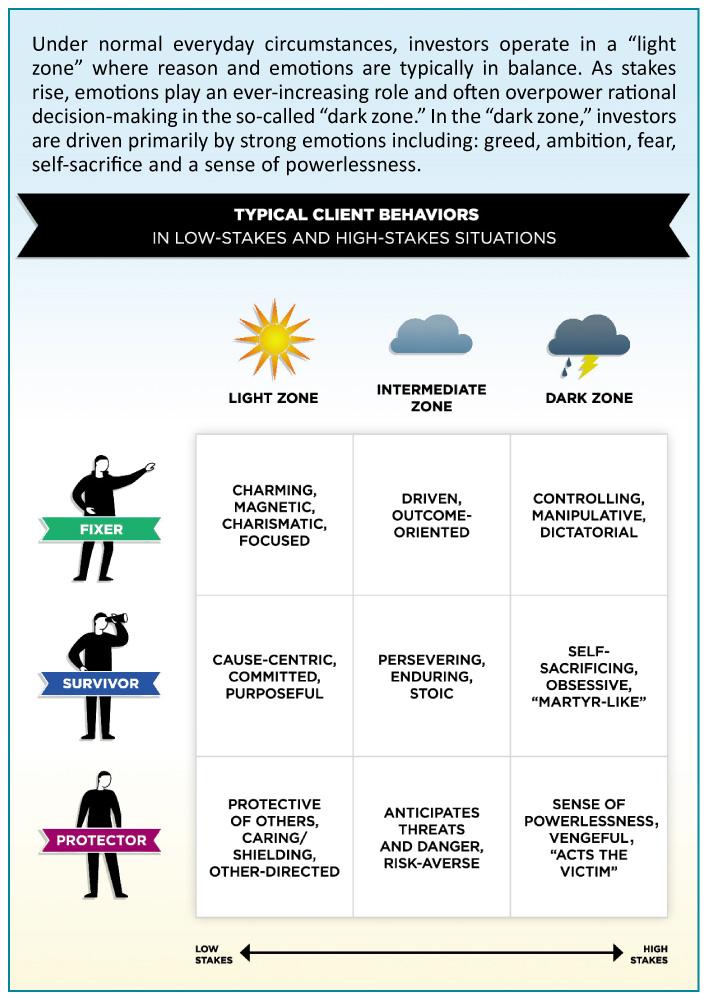
Investors’ personalities often change from being balanced to a “dark zone” of greed, self-sacrifice and a sense of powerlessness.
by Chris White | June 2017
How do emotions drive your behavior as an investor?
Have you ever considered how your emotional makeup influences your thinking about money, wealth and risk-taking under everyday (low-stakes) market circumstances? How about when the stock market becomes volatile and financial uncertainty becomes the high-stakes norm of the day?
I’ve been a wealth adviser for over 25 years. If there’s one thing I’ve learned, it’s that most investors have dual personalities when it comes to investing. There’s the “rational” investor whose personality reveals itself under normal, everyday (low-stakes) circumstances. There is also the hidden, darker personality that emerges when stakes get high, when financial nest eggs are threatened and when one’s financial future is no longer assured.
In essence, investors live in two worlds: a low-stakes world where reason and careful planning prevail (the “light” side) and a high-stakes world in which an investor’s “dark” or shadow side appears, driven by a welter of emotions and feelings including fear, greed, ambition, stoicism and powerlessness.
As an investor, it’s important to become knowledgeable about your emotional makeup and the factors and forces in the marketplace that serve as emotional triggers for you—particularly, those triggers that cause your “shadow side” to appear and can threaten to overwhelm a balanced, reality-based approach to investing.
This article aims to help you better understand yourself as an investor, from an emotional and psychological perspective. It explores the roots of our attitudes about money and how early life experiences shape our risk tolerance, investing style and the investing goals we embrace as adults. It identifies three predominant investor types that I typically observe when counseling investors, and it analyzes how each type can undergo profound personality changes as market conditions move from low to high stakes.
Many of the ideas presented in this article are based on the pioneering research of David Kantor, Ph.D. He is a world-renowned systems psychologist who has done decades of work with individuals, families and organizations. I’ve adapted his therapy and social psychology models and applied them to understanding investor behavior in markets.
Where do your personal views about money and investing come from? Believe me, the origins are as diverse as investors themselves!
Some people’s views about money have their roots in a person’s early life experiences of pain and loss. For example, a person who experiences a painful personal loss early in life—such as the loss of a parent or other loved one—may grow up to see the world as a scary, unpredictable place. This kind of investor may also have a deep distrust of others, a high need for security and control and little tolerance for risk-taking when it comes to investing.
Other people’s attitudes about money are influenced by what their parents, grandparents or other authority figures said about it when they were growing up. Did you, for example, grow up hearing that “money doesn’t grow on trees” and that it’s important to be frugal and “save for a rainy day?” Alternatively, did you grow up in a household where money was never talked about and your parents never taught you any life lessons about how to manage money and invest it wisely?
Still other people’s feelings about money are shaped by whether they grew up with wealth or achieved it for themselves. Thus, the popular—if somewhat simplistic—images of wealth creators as world-class penny-pinchers and wealth inheritors as world-class spendthrifts.
Yet, other people’s views about money are influenced by family dynamics, personal beliefs, college professors, TV stock market analysts and philosophical convictions. Who made the greatest impression on you as a child? Who shapes your thoughts about investing today?
Finally, people’s attitudes about money, risk-taking and wealth accumulation are driven by primal emotions like fear, greed, desperation, hope and ambition. Such emotions, if not acknowledged, can sweep over a person, immobilizing them from making clear and rational choices or acting in their own best interests at critical times.
So, how do specific emotions and feelings influence your thinking about investments and wealth management?
Over the years, I’ve observed that every investor is essentially an emotional “system” characterized by motivations and emotions unique to them. For example, Client A may enjoy risk-taking, so much so that it keeps them from taking a balanced, prudent approach to investing. Client B, on the other hand, may be so risk-averse that they can’t commit themselves to taking any risk and thus forgo taking even reasonable risk to see their portfolio’s value grow. Client C may be more concerned with wealth preservation (for family and loved ones) than aggressive growth and wealth maximization. And Client D may want to use their wealth to support worthwhile causes rather than to maximize profits.
To be an informed investor, it’s important to understand yourself as an emotional system. Specifically, it’s vital to understand how your emotions drive your decision-making under both normal and volatile market conditions.
Generally speaking, there are three investor types I encounter as a wealth adviser. They include the Fixer, the Survivor and the Protector. Each has their own unique emotional makeup and associated characteristics and behaviors.
If you’re a Fixer, you’re a results-oriented investor who may be inclined to take big risks with your money in hopes of seeing a big “payoff” in the markets. You have a strong sense of self, a belief in your ability to make good investment choices and may become impatient with advisers you perceive as not acting aggressively enough on your behalf.
Fixers like to be in control. When the stock market is bullish, they’re focused and often charming to be around. When the market becomes volatile, they can become agitated and frustrated. The possibility of financial losses is anathema to them. Consequently, they may be inclined to double down on risky investments in a rocky market in hopes of winning big when the market comes back.
Take “Joseph,” for example.
“I don’t like to take losses! What part of that statement don’t you understand?” he groused to me at the start of 2009 when I suggested he sell his falling Proctor & Gamble  (PG) stock and buy shares of Church & Dwight (CHD). Church & Dwight is a successful developer and manufacturer of household and personal care products in the U.S. and abroad that had growth prospects better than those of P&G.
At the time, Joseph was feeling out of control, watching the value of his portfolio drop.
Ultimately, we sold P&G and bought Church & Dwight. This proved to be the right thing to do, because P&G has since struggled and now labors in its turnaround, while Church & Dwight has done relatively well, even during subsequent turbulent markets. Still, for a long time afterward, Joseph complained about “selling out” his P&G stock. Why? Because the idea of a loss was so repugnant to him, and somehow he couldn’t let go of this feeling.
What accounts for Joseph’s behavior?
It’s called anchoring, which is the tendency to rely on an initial data point as the basis for making future decisions. In this case, the purchase price of Joseph’s P&G stock became the “anchor” data point of value in Joseph’s mind, rather than current market fundamentals. People who display anchoring characteristics base business decisions not on facts but on emotions, perceptions, feelings and experiences. It is instinctual, anal-retentive reasoning rather than reality-based thinking.
For Fixers, feelings about gain and loss are particularly powerful as motivators of their behavior. Thus, anchoring is hard to overcome as a predisposition. Fixers always need to win, so they hold on to things (e.g., a bad stock) even when the opportunity costs of doing so should motivate them to reinvest their capital elsewhere.
If the above scenario rings true for you, you may be a Fixer. If the market goes south, you may decide to hang onto a stock, simply because the idea of not “winning” with that particular stock prevents you from making the “rational” decision to sell and move your capital elsewhere. Be mindful of this Fixer tendency, because you don’t want to be left holding an empty bag if a long-held stock begins to sink fast.
If you work with an adviser, make them aware of your anchoring tendencies. When the market becomes turbulent, stay calm and be open to the adviser’s recommendations. Know that their fiduciary responsibility requires them to keep your financial interests utmost in mind at all times.
Survivors are altogether different from Fixers. Unlike Fixers, who often invest to achieve aggressive returns (and are willing to take big risks to do so), Survivors frequently take an idealistic, cause-centric approach to investing. That’s because they see investing as a means to other ends.
Consider the wealthy angel investor, who as a Survivor, pours millions into a medical start-up because he believes the firm’s experimental technology will help find a cure for cancer. Also consider the small investor who decides to divest her stocks from a company that has a poor human rights record in developing countries. Both these investors’ choices are driven by their Survivor sense of mission, purpose and commitment to causes beyond themselves.
While idealistically motivated in their investment choices, Survivor investors must be careful not to let stubbornness or even fatalism cloud their business judgment. Survivors can become very wedded to their investment decisions to the point of sacrificing reasonable financial gains. Example: Because they’re “risk-indifferent,” they may resist selling underperforming stocks that are sentimental favorites or riskier stocks that can be a drag on their portfolio in bear markets. Their stoicism as investors means they’re often willing to endure rough stock market times, without taking prudent and actionable measures to protect their assets.
If you’re a Survivor investor and you manage your own portfolio, cultivate a sense of when to adjust your asset mix, rebalance the portfolio and offload stocks and investments that no longer generate sufficient risk-adjusted returns to at least keep pace with inflation over a market cycle. If you work with a wealth adviser, ask for their advice about how and when to adjust your asset mix to protect and prudently grow your wealth.
The third type of client investor I encounter is the Protector. Protectors are the most risk-averse of the client types. They often assume guardian and caretaker (shielding) roles as investors and typically focus on how to use their wealth to benefit others (spouses, children and others) or to benefit specific causes (e.g., the environment, the arts, etc.).
While conscientious about conserving their wealth, and their personal use of it, Protectors often doubt their ability to manage their assets. Under normal (low-stakes) market circumstances, they’re often hesitant to take even prudent risks to ensure their portfolio grows. Thus, they opt for extremely safe asset options such as bonds and may be underinvested in equities. When stock market conditions become turbulent, Protectors may panic, feel like victims of circumstances beyond their control, become vengeful and be inclined to sell everything to avoid taking a financial bath. This, however, is precisely the time when Protectors may want to consider buying into the market to grow their portfolio when the market eventually rebounds.
Recently, I worked with a protector client, “Jill.” Jill stood to inherit $11 million upon the death of her father, but she was so anxious about money that it was impossible for me to get her to discuss it either with me or her siblings, although they and their father thought prudent investment/estate planning ahead of the father’s death was appropriate.
I eventually got Jill to open up about her anxieties around money. Once she did, she was able to proactively think about how she wanted to use her inheritance to benefit others once she received it. She decided to use much of her wealth to care for disadvantaged children, a goal she eagerly embraced as she had no children of her own.
The ability to talk about money and investing that Jill acquired proved liberating. She developed an interest in the stock market and began to educate herself about how careful investing could help her grow her estate going forward. She embraced this goal because she tied investing to an ideal: service to children. This gave her immense satisfaction and awareness of how she was contributing in a very positive way to the lives of others.
If you think you’re a Protector investor, be mindful of your tendency to avoid risk at any cost. Consider the reasons behind your risk aversion and how it could be limiting your current approach to investing. Because you may doubt your ability to deal effectively with rapidly changing stock market circumstances, consult an adviser (at least periodically). An adviser can help you explore investment options that enable you to steadily grow your portfolio’s value, while minimizing turbulence that can occur in bear markets. Also, think about how you might want to use your wealth management planning to benefit loved ones both now and in the future.
You may be asking, “Where does a person’s shadow side come from? How is it formed? What specifically causes its appearance?” The emergence of a person’s shadow, or dark, self is typically triggered by something in the present—an event, situation, person or interaction—that sparks a flashback. The flashback reminds an individual of an event from their distant childhood past that threatened or hurt them deeply, according to psychologist Kantor. Kantor conducted extensive research on human emotions under both low-stakes and high-stakes circumstances. He determined that there are many triggers of the human shadow, or dark side, including a person’s fear of:
It’s easy to see how marketplace volatility, financial uncertainties or anticipated loss or depletion of one’s financial assets could trigger any of the above fears on an investor’s part. In my experience, the specific kind of emotion (fear) a client feels (and its degree) is determined principally by a person’s unique personality type, as is the intensity of loss or gain he or she feels based on market performance.
Take the experience of loss. Economists Daniel Kahneman and Amos Tversky determined that, in general, people’s experience of loss is twice as intense (painful) as their experience of gain is pleasurable. Their research led to the concept of “loss aversion.” By this gauge, I estimate that for Fixers the intensity of pain they feel from loss is far greater than that of the general population. Why? Because Fixers ascribe great power to themselves to shape and influence events in their lives by virtue of the actions they take. Consequently, when a loss occurs, it is offensive to them. To the Fixer, life is a battle to be won. Thus, it’s very hard for Fixers to accept defeat.
Protectors, on the other hand, also hate to lose, but for them loss is mitigated because they believe the power to affect events lies mostly outside themselves—with others and with abstract market forces. Moreover, a protector’s experience of pleasure with financial gains (when they occur) is dampened by their generalized sense of anxiety about dangers and threats that lurk around them. (Remember, the Protector is the most risk-averse client type of all!) Because they anticipate that danger and threats surround them as they ponder financial and investment decisions, Protectors are less emotionally invested in securing big market gains at any cost. Consequently, they’re better able to keep both market gains and losses in reasonable perspective.
Survivors are another case again. They expect their lives to be difficult and, from an investor’s standpoint, expect losses to occur. Consequently, they assiduously “salt away gains” (hedge their bets with investments) in anticipation of losses, feeling such experiences are inevitable. Their experience of both loss and gain tends to be more muted than it is for either Fixers or Protectors. If the market goes up, they’re pleased, but they always anticipate that loss is not far behind. If losses occur, it simply validates the Survivor’s belief that losses are to be expected.
My experience has been that while Survivors don’t enjoy losses any more than other personality types do, they bear them better and with greater resilience than do Protectors and much better than Fixers. When financial gains do result from investments, Survivors are likely to experience less pleasure (about half as much) as the average Protector does.
There are numerous emotional factors that influence investor thinking and behavior and that drive the formation of our personalities as investors. Our view of ourselves in the world is profoundly impacted by early life experiences, and messages we get from others about money, wealth and risk-taking. As adults, our life experiences manifest themselves in the type of investor personality we take on: Fixer, Survivor or Protector. Each personality type has unique emotional characteristics that drive investment behaviors, and each personality type morphs emotionally as market conditions shift from low to high stakes.
By understanding ourselves as emotional beings, we can bring greater self-awareness to the investing process and to the behaviors that impel us both in low-stakes and high-stakes situations. By becoming self-aware investors, we can recognize and manage our emotional triggers and make better, more reality-based decisions about investing. In so doing, we can avoid excessively emotional responses to the marketplace that undermine otherwise well-constructed wealth management plans and consistent achievement of our financial goals.
The opinions in this article and in the book, “Working With the Emotional Investor,” belong solely to Chris White and do not express the opinions of Hemenway Trust Company.
Behavioral Finance

Beginning Investor

Behavioral Finance

No comments have been added yet. Add your thoughts to the discussion!
You need to log in as a registered AAII user before commenting.
Log InCreate an account