Yesterday, The Wall Street Journal published an article headlined, “Rock-Bottom Bond Yields in Europe Hit All-Time L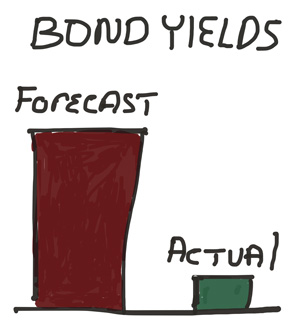 ows.” This morning, a headline on The Financial Times’ website declared: “Relentless: Bund Yields Take Fresh Step Down.” The headlines were written in reaction to what is occurring in global bond markets. Earlier today, yields on the 10-year German bund fell below 0.03%. Traders sent the yield on the 10-year British gilt down to a record low of 1.22%.
Here in the U.S., 10-year Treasuries trade with a yield of 1.68%. Expectations for the Federal Open Market Committee (FOMC) to raise its federal funds target rate by a quarter point to between 0.50% and 0.75% are now essentially nonexistent. The CME Group’s FedWatch shows the futures market pricing just a 4% probability of a hike occurring at the committee’s meeting next week. As far as the July FOMC meeting is concerned, the probability of a rate hike is a mere 27%.
This leads to the question: Where is the bond Armageddon? Weren’t interest rates and yields supposed to be higher—much higher—by now?
I remember seeing Dan Fuss, who co-manages the Loomis Sayles Bond Fund (LSBRX), speak at a conference six years ago. When asked about a forthcoming rise in yields, he responded by explaining how he didn’t want to find out about it after the fact. Fuss was not alone; there are many others who could be cited. Even I’ve published articles about strategies for a rising rate environment. For example, in 2011, Marilyn Cohen wrote in the AAII Journal, “If you are worried about the direction of interest rates, history lends support to your view.” In the five years since the article appeared, the 10-year Treasury note’s yield has declined by approximately 40%.
So again, I must ask, where is the bond Armageddon? Cearly, the big rise in yields (and corresponding plunge in bond prices) has been postponed until further notice.
Weather forecasters, oft-criticized for their incorrect forecasts, ought to be jealous of the ability of economists and financial market strategists to brush off their poor soothsaying skills. In the early part of this decade, there were expectations for a rise in interest rates. It hasn’t happened.
Even traders cannot predict what’s going to happen two weeks in advance. As we pointed out in our Dividend Investing newsletter, the futures market was pricing in a 21% chance of the Fed raising rates this month and a 60% chance of a rate hike occurring in July. Again, those odds are now 4% and 27%, respectively. As for the September and November meetings, the probabilities are currently below 50%. In other words, if you want to make a forecast about when the Fed will raise rates next, flip a coin. You’ll have better odds than trusting the so-called experts.
None of this is to say yields won’t rise. The long-term historical averages suggest they will. It’s the timing and the magnitude of the increase (and the corresponding fall in bond prices) that remain unknown. All we do know is that expectations for a sharp rise in rates have been wrong for approximately six years running and don’t show any signs of being correct in the near future. Food for thought if your allocation decisions have been made based on the expectations of a sharp rise in rates.
Bonds and bond funds can have a useful role when owned for the right reasons. A high-quality bond held to maturity provides cash flow and preservation of capital. A municipal bond provides tax-free income. A bond fund can provide access to a diversified portfolio and professional management. From a behavioral finance standpoint, bond and bond funds may lower overall portfolio volatility enough to enable you to stick with stocks over the long term. The proper allocation depends on your reasoning, your financial goals and your tolerance for risk.
For those of you who are frustrated by the nominal interest paid on your savings accounts, shop around. BankRate.com lists several savings accounts paying 1.0% in interest. Financial institutions offering this rate included Synchrony Bank, Goldman Sachs Bank (yes, that Goldman Sachs), Barclays and Ally Bank. AAII members can even currently get 1.01% plus a $100 bonus with Discover Bank. Some financial institutions may ask you to bank solely online, so ask questions to ensure that the account suits your needs. Be sure to read the fine print, make sure the savings account is ensured by the FDIC and be skeptical of any rate that sounds too high or any financial product that is marketed aggressively to you.

- Should You Maintain an Allocation to Bonds When Current Rates Are Low? – Craig Israelsen says history shows an advantage to owning bonds in a diversified portfolio even when rates rise.
- Defined-Maturity Funds: A Bond Alternative with Compromises – These mature like bonds, but offer the ease of trading and professional management of funds.
- Why a New Allocation Approach Is Needed – AAII founder and chairman James Cloonan explains in this month's AAII Journal why the traditional way of portfolio allocation is both costly and fails to consider how risk actually occurs in the real world.
- Cash Flow and Allocation Strategies for Retirees – Jane Bryant Quinn discusses how a reverse mortgage can help retirees take large withdrawals from their portfolios in the second part of my interview with her.
Only two members of the S&P 500 are scheduled to report earnings: The Kroger Co. (KR) and Oracle Corp. (ORCL). Both will announce their results on Thursday.
As noted above, the Federal Reserve Open Market Committee (FOMC) will hold a two-day meeting, starting on Tuesday. The meeting statement and updated forecasts from committee members will be released on Wednesday afternoon at 2:00 ET. Chair Janet Yellen will hold her quarterly press conference at 2:30 ET.
Elsewhere on the economic calendar, May retail sales, May import and export prices and April business inventories will be released on Tuesday. Wednesday will feature the May Producer Price Index (PPI), the June Empire State manufacturing survey and May industrial production and capacity utilization. The May Consumer Price Index (CPI), the June Philadelphia Fed business outlook survey and the June housing market index will be released on Thursday. The week will conclude with the release of May housing starts and building permits on Friday.
- Uses and Misuses of Ben Graham–Style Investing
- The Weiss Approach to Value in Blue-Chip Stocks
- Investing’s Odd Couple: Value and Momentum
Pessimism about the short-term direction of stocks is at a six-week low, according to the latest AAII Sentiment Survey. Neutral sentiment is higher, while optimism pulled back.
Bullish sentiment, expectations that stock prices will rise over the next six months, pulled back by 2.3 percentage points to 27.8%. The decline follows last week’s 12.4-percentage-point jump to a six-week high of 30.2%. This week’s decrease keeps optimism below its historical average of 38.5% for the 31st consecutive week and the 64th out of the past 66 weeks.
Neutral sentiment, expectations that stock prices will stay essentially unchanged over the next six months, rebounded by 3.6 percentage points to 44.3%. This is the 13th consecutive weekly reading above 40% and the 19th consecutive week that neutral sentiment has been above its historical average of 31.0%.
Bearish sentiment, expectations that stock prices will fall over the next six months, declined by 1.2 percentage points to 27.8%. Pessimism was last lower on April 20, 2016 (23.9%). Bearish sentiment has been below its historical average of 30.5% for the 13 out of the past 15 weeks.
Giving individual investors cause for concern is the slow pace of U.S. economic growth and uncertain pace of global economic growth, terrorism and global unrest, lackluster corporate earnings, the prevailing level of valuations, the forthcoming election and monetary policy. Some AAII members, however, are encouraged by sustained domestic economic growth, corporate earnings and still comparatively low energy prices.
This week’s special question asked AAII members why it does or does not matter if the major U.S. stock indexes rise above their record highs in the near term. Almost half of respondents (49%) said it does not matter. Many of these members said they invest for the long term and/or are more focused on their allocations. Several others said factors such as the economy and the presidential election are having a bigger influence on their outlook. One-third (33%) of respondents said a new high would be a positive event and should lead to higher prices. A small number of respondents (6%) think such a move would confirm their belief that stocks are overpriced and would increase the odds of a new decline occurring.
Here is a sampling of the responses:
- “It does not matter. I just look for continued growth in the economy and among companies.”
- “Record levels do not matter. They are regularly broken as stocks go up.”
- “A rise above prior highs would confirm the continuation of a bull market.”
- “Does not matter. Dollars invested in the market are much longer-term-oriented.”
- “It matters to me because I believe valuations are much too high and unsustainable.”

Bullish: 27.8%, down 2.3 points
Neutral: 44.3%, up 3.6 points
Bearish: 27.8%, down 1.2 points
Bullish: 38.5%
Neutral: 31.0%
Bearish: 30.5%
Local Chapter Meetings

June 2, 2016 Valuing Stocks Based on Their Dividend
May 26, 2016 The Most Tax-Efficient Investment
May 19, 2016 Crowdfunding Is Here; What You Need to Know
May 12, 2016 My Notes From the CFA Conference