Three new exchange-traded funds began trading today: Davis Select U.S. Equity (DUSA), Davis Select Financial (DFNL) and Davis Select Worldwide (DWLD). Normally such an event is not particularly noteworthy from our viewpoint. The launches of these funds are, however. They are actively managed equity ETFs based on strategies used for Davis Advisors’ mutual funds, separately managed accounts and institutional funds. More importantly, they will follow the disclosure rules long used by index ETFs.
A bit of context is needed to understand why the launch of these funds is raising eyebrows. Actively managed ETFs remain relatively few in number. Most mutual fund companies have refrained from offering actively managed exchange-traded funds—particularly ETF versions of their equity-focused strategies. One particular hurdle has oft been attributed as the reason: transparency. Index (passive) ETFs disclose their holdings daily. Most mutual funds do not.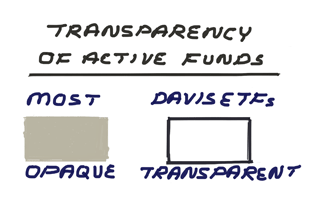
Attempts to provide a hybrid approach, meaning ETFs with reduced transparency, have generally not been successful. One platform that did pass the Securities and Exchange Commission’s muster is Eaton Vance’s NextShares. NextShares’ exchange-traded managed funds provide limited transparency. Vanguard has its own platform and has filed to created ETF share classes for some of its actively managed funds. Last year, the SEC approved petitions from Bats Global Markets and the New York Stock Exchange for a streamlined process for listing actively managed ETFs. This was viewed as a positive for the industry, but it’s not clear that the approval resolved the transparency hurdle.
Mutual fund provider Davis Advisors has settled on a simple solution for dealing with the issue of transparency. In registration statements filed earlier this month, the company wrote: “On each day that the Trust is open for business… the names and amounts of Deposit Securities to be included in the current Fund Deposit for each Fund will be published.” Restating this in layman’s terms, the ETFs’ holdings will be disclosed daily. No lag. No complicated structure. Davis’ actively managed ETFs will follow the same rules for disclosing their portfolios as index ETFs have done since the first exchange-traded fund (SPDR S&P 500 (SPY)) was launched in 1993.
Full, daily disclosure among actively managed ETFs is not a new concept. PIMCO provides it, as does Doubleline. The difference is that these companies offer bond ETFs. Since an issuer can have many bond issues outstanding and because the trading volume in each specific bond varies, there is less concern about active traders trying to jump ahead of a bond fund manager making portfolio changes then there is for a stock fund manager making portfolio changes. There are some actively managed equity ETFs offering daily disclosure [e.g., AdvisorShares Wilshire Buyback ETF (NYSE Arca: TTFS)], but they are relatively few in number and small in size. The four largest actively managed bond ETFs alone accounted for more than $2 out of every $5 invested in the 176 actively managed ETFs in existence as of December 31, 2016, based on data from Morningstar.
Davis Advisors is better positioned than other actively managed mutual fund providers to provide daily transparency because its mutual funds have below-average turnover ratios for their respective categories. The firm intends to follow a similar approach with its ETFs. Barron’s quoted chairman Chris Davis as saying “it would be very strange if [the ETFs] ended up with a different kind of portfolio” than Davis Advisors’ mutual funds. As such, it will be interesting to see if Davis Advisors turns out to be a trailblazer or more of an exception. The headlines and trends I’ve seen so far suggest that Davis will be an exception—unless these new ETFs turn out to be quite successful.
We’ve excluded the Davis funds from our mutual fund guide (which will be updated next month) because of the loads and expenses associated with the share classes most available to individual investors. Morningstar shows the Davis New York Venture (NYVTX), Davis International (DILAX) and Davis Financial (RPFGX) mutual funds as outperforming their category benchmarks. This potentially bodes well for the ETFs, but—as is the case with any brand new financial product—it would be prudent to monitor how they perform before making a decision on whether or not to invest in them.
- An Inside Look at Exchange-Traded Funds – Mutual funds and ETFs share many similar traits, but there are also significant differences between them.
- How to Measure the Skills of Your Fund Manager – Davis Advisors’ mutual funds tend to have lower R-square scores, which implies they truly are active as this article explains.
- Downward Estimate Revisions Screen Tops Unconventional Year – This month’s AAII Journal includes our annual review of the more than 60 stock screens featured on AAII.com
- Stocks With the Largest Change in Earnings Estimates – The 15 stocks with the largest positive and negative changes to their consensus earnings estimates.
The U.S. financial markets will be closed on Monday in observance of Martin Luther King Jr. Day. President-elect Donald Trump will be inaugurated on Friday. Even though it can be hard at times, it’s best to separate your political views (favorable or unfavorable) from your investment decisions.
Fourth-quarter earnings season is underway, with 35 members of the S&P 500 scheduled to report. Included in this group are five Dow Jones industrial components: UnitedHealth Group Inc. (UNH) on Tuesday; Goldman Sachs Group (GS) on Wednesday, American Express (AXP) and International Business Machines (IBM) on Thursday, and General Electric (GE) on Friday.
The week’s first economic reports will be the January Empire State manufacturing survey, which will be released on Tuesday. Wednesday will feature the December consumer price index, December industrial production, the January housing market index and the Federal Reserve’s Beige Book. December housing starts and building permits and the Philadelphia Fed’s January business outlook survey will be released on Thursday.
Four Federal Reserve officials will make public appearances: New York president William Dudley on Tuesday, San Francisco president John C. Williams on Tuesday, Thursday and Friday; Minneapolis president Neel Kashkari on Wednesday; and Philadelphia president Patrick Harker on Friday.
The Treasury Department will auction $13 billion of 10-year Treasury inflation-protected securities on Thursday.
- Vanguard’s Dynamic Spending Strategy for Retirees
- Model Shadow Stock Portfolio: New Additions, Plus Value Leads
- Why Buy Bonds If Interest Rates Will Rise?
The percentage of investors describing themselves as bullish pulled back to a five-week low in the latest AAII Sentiment Survey. At the same time, neutral sentiment rose to a five-week high. Pessimism rose as well.
Bullish sentiment, expectations that stock prices will rise over the next six months, pulled back by 2.6 percentage points to 43.6%. Optimism was last lower on December 7, 2015 (43.1%). Nonetheless, bullish sentiment is above 40% for a ninth consecutive week and above its historical average of 38.5% for a 10th consecutive week.
Neutral sentiment, expectations that stock prices will stay essentially unchanged over the next six months, rose 0.8 percentage points to 29.4%. Neutral sentiment was last higher on December 7, 2016 (30.4%). Even with the increase, neutral sentiment remains below its historical average of 31.0% for the sixth consecutive week and the eighth time in nine weeks.
Bearish sentiment, expectations that stock prices will fall over the next six months, rebounded by 1.7 percentage points to 27.0%. The rise was not large enough to keep pessimism from staying below its historical average of 30.5% for the ninth time in 10 weeks.
This week’s shifts in sentiment are not significant enough to alter the trend that has existed since the week of the election. More than two out of five individual investors have an optimistic short-term outlook for stocks. It is a level of optimism we have not seen hold relatively steady since the approximate six-month period of August 2014 to March 2015. Though bullish sentiment is currently high compared to what was registered throughout most of 2016, it is within its typical historical range.
The potential impact that President-elect Donald Trump could have on the economy is encouraging some individual investors and creating uncertainty or concern among others. Also influencing investor sentiment are valuations, earnings, consumer sentiment and the magnitude and timing of future interest rates.
This week’s special question asked AAII members for their opinion of the current pace of economic growth. More than one out of four respondents (26%) described growth as slow or below average. An additional 14% described growth as sluggish and/or poor. About 15% believe the economy is getting stronger or will gain upward momentum under the new administration. Expectations for stronger growth was also shared among many of the 9% of respondents who say growth is moderate. Just 7% of respondents said the economy is growing at a good pace.
Here is a sampling of the responses:
- "It will accelerate in the first and second quarter because of the new policies of the new administration.”
- "Slow, but steady.”
- "Sluggish globally, and not much better in the U.S.”
- "For now, the data suggests moderate economic growth will continue.”
- "Good, and will pick up this year.”
- "Needs to be higher.”

Bullish: 43.6%, down 2.6 points
Neutral: 29.4%, up 0.8 points
Bearish: 27%, up 1.7 points
Bullish: 38.5%
Neutral: 31.0%
Bearish: 30.5%
Local Chapter Meetings

January 5, 2017 Is Now a Good Time to Invest in Stocks?
December 29, 2016 17 Investing Resolutions for 2017
December 22, 2016 Dow 20,000 Shows How Bad We Are at Analyzing Numbers
December 15, 2016 Those 2017 Fed Forecasts May Prove to Be Wrong