There are two questions investors may have following yesterday’s rate hike. The first is: What happens next? The second is: What do I do now? The short answers are: Don’t put too much faith into the forecasts and enjoy the marginally higher level of interest income, but don’t make big changes. I will expound on both answers.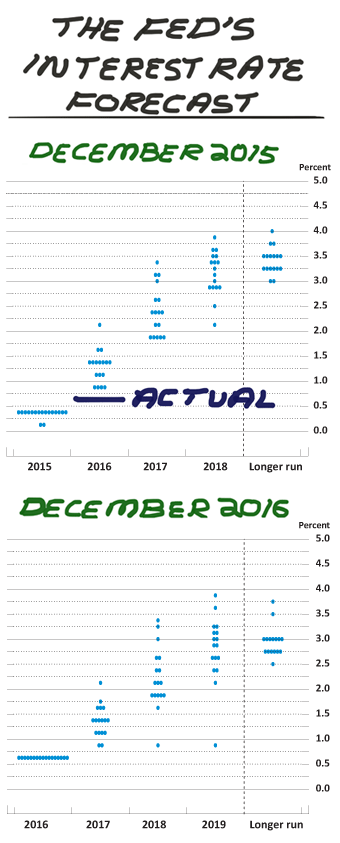
In regard to the first question, a bit of context is useful. Yesterday’s increase was just the second in a span of more than 10 years. As you probably recall, a 25-basis point (0.25%) increase was announced last December. What you may not remember is that the second most recent increase was announced way back on June 29, 2006. Between then and now, there has been a large number of forecasts proven to be wrong and a large number of forecasters who kept making incorrect forecasts.
Even the Federal Open Market Committee’s (FOMC) members haven’t displayed much in the way of soothsaying skills. The first chart on your right (aka, the Fed dot plot or simply “the dots”) shows last December’s target levels for the federal funds rate. Described differently, the dots represent the individual interest rate forecasts for each year. As you can see, most committee members were forecasting interest rates to be above 1.0% by now. Yesterday’s announcement raised rates to a range of just 0.50% to 0.75%. (To quote Homer Simpson, “D’oh!”) The second dot plot is the latest forecast made by FOMC members. Do you believe the committee’s crystal ball has become clearer? I don’t.
While the market has rallied since the election, there are structural issues in the economy that can’t be immediately fixed. President-elect Donald Trump’s spending and tax plans will face early tests when the debt ceiling agreement expires in March and the current spending authorization expires in April. While some regulatory changes could happen quicker, others will likely require the rewriting of rules. None of this is to say that economic growth won’t accelerate—I hope it does—but rather to say it’s not certain that growth will accelerate or by how much.
From a portfolio perspective, it’s best to stick to a long-term plan. Making changes based on what you expect to happen leaves you exposed to tactical errors. Such errors often have a far more damaging impact on your wealth than any short-term drag caused by your long-term strategy not being optimal for the prevailing environment. The hare always looks enticing, but it’s often the tortoise that does best in the realm of investing.
This isn’t to say that you shouldn’t make any changes. If you’ve loaded up on utility and consumer stocks in a quest for dividend income, diversify. Our Dividend Investing portfolio holds shares of financial, technology, travel and chemical companies, for instance. If you haven’t looked at your portfolio’s allocation in a long while, see if it is still within, say, a 5% range of your target. If you are close to retirement, build up short-term reserves from which to withdraw if you don’t have enough guaranteed income (e.g., pension, Social Security, annuity, etc.) to cover your expenses. The key thing is to make changes that will keep you on your long-term plan, and avoid making those changes based on what you think might happen.
Beyond your investments, review your savings accounts. The rate hike should boost the amount of interest paid on your cash savings, though not by much. You may realize a bigger benefit by moving your account to a bank paying a higher interest rate. For instance, Discover makes FDIC-insured savings accounts paying a little over 1% available to AAII members. A handful of other banks pay similar levels of interest rates, though just about all are online (including the aforementioned Discover account). If you prefer visiting a local branch versus banking online, call around your local area to see what’s being offered. Be sure to ensure that any bank account you open is FDIC-insured (NCUA-insured for credit unions) and the rate isn’t a teaser rate. Also beware that if the interest rate sounds too good to be true, it probably is.
- Building a Balanced Portfolio: An Unconventional Approach – Adding commodities and inflation-protected bonds to a traditional stock/bond portfolio helps to smooth volatility over a variety of market environments.
- Dividends Are Still Valuable – In this 2015 AAII Journal article, John Buckingham shared research showing that dividend-paying stocks perform well 12 months following a rate hike.
- Asset Returns During High and Low Inflationary Periods – Commodities, real estate and small-cap stocks have outperformed when inflation was high, as Craig Israelsen explains in this month’s AAII Journal.
- The Individual Investor’s Guide to Personal Tax Planning 2016 – Our new tax guide is now online, just in time for your year-end tax planning.
Following quarterly his portfolio review, AAII founder and chairman James Cloonan removed one stock from the Model Shadow Stock Portfolio: Marlin Business Services Corp. (MRLN). The stock was removed because the company is primarily involved in leasing and rental operations, and is now being treated as belonging to the financial sector. (The Shadow Stock portfolio avoids financial stocks.) In its place, two stocks are being added: RCI Hospitality Holdings (RICK) and Roadrunner Transportation Systems (RRTS).
In addition, three other existing holdings are listed as “qualitied,” meaning they met the portfolio’s buy rules as of the end of November. Those stocks are AV Homes Inc. (AVHI), Seneca Foods Corp. (SENEA) and VOXX International Corp. (VOXX).
The Model Shadow Stock Portfolio, which is a real-money portfolio of micro-cap value stocks, added 12.2% in November. Year to date, the AAII Model Shadow Stock Portfolio is up 23.5%, compared to the S&P 500 as represented by the Vanguard 500 index fund (VFINX), which is up 9.7%. The DFA U.S. Micro Cap Fund (DFSCX) is up 20.7% for the 10 months ended November 30. Since its inception in 1993, the AAII Model Shadow Stock Portfolio has a compound annual average return of 15.8% versus the Vanguard 500 Index fund, which as gained 9.0% a year, on average, over the same period.
The Model Fund Portfolio climbed 6.1% in November, compared to a 3.7% gain for the SPDR S&P 500 ETF (SPY). The Model Fund Portfolio has gained 13.3% year to date, while the SPDR S&P 500 ETF is up 9.7%. Since its inception in June of 2003, the Model Fund Portfolio has a compounded annual average return of 8.6%, while the SPDR S&P 500 ETF has an 8.4% average annual return over the same period.
There were no changes to the Model Fund Portfolio this month. The next quarterly review of the Model Fund Portfolio will take place in February 2017.
We’ll start to see earnings results from the traditional season early reporters. Dow component Nike (NKE), which will report on Tuesday, as well as 13 other S&P 500 members (including FedEx (FDX), also on Tuesday) are on the calendar.
The week’s first economic report will be the November existing home sales, which will be released on Wednesday. Thursday will feature November durable goods orders, November personal income and spending and the second revision to third-quarter GDP. November new home sales and the revised December University of Michigan consumer sentiment survey will be released on Friday.
The Treasury Department will auction $14 billion of five-year Treasury inflation-protected securities (TIPS) on Thursday.
- How Interest Rate Changes Affect the Price of Bonds
- Choosing Between Mutual Funds and ETFs
- The Individual Investor’s Guide to Personal Tax Planning 2016
The percentage of individual investors describing their market outlook as "neutral" is now at its lowest level in more than two years, according to the latest AAII Sentiment Survey. Pessimism extended its rebound, and optimism is higher as well.
Bullish sentiment, expectations that stock prices will rise over the next six months, rose 1.5 percentage points to 44.7%. The increase keeps optimism above 40% for a fifth consecutive week and above its historical average of 38.5% for a sixth consecutive week.
Neutral sentiment, expectations that stock prices will stay essentially unchanged over the next six months, plunged 7.4 percentage points to 23.0%. This is the lowest reading since November 13, 2014 (22.8%). The drop also keeps neutral sentiment below its historical average of 31.0% for the fourth time in five weeks.
Bearish sentiment, expectations that stock prices will fall over the next six months, rose 5.8 percentage points to 32.3%. This is a six-week high. The rise also puts pessimism back above its historical average of 30.5%.
The Federal Open Market Committee’s decision to raise interest rates was announced near the end of our survey period, which runs Thursday through Wednesday. As such, the current results mostly do not reflect any reaction to the meeting statement or Chair Janet Yellen’s press conference.
Neutral sentiment is down by a cumulative 19 percentage points from its pre-election (November 2) reading of 42.0%. At its current level, neutral sentiment is near the bottom of its typical range. Historically, the stock market has underperformed during the six- and 12-month periods following unusually low neutral sentiment readings. Any reading below 22.6% would be unusually low.
As I explained last week, opinions about the post-election rally among individual investors are mixed. Some are optimistic about the impact President-elect Donald Trump could have on the economy, while others think stocks have risen too far too fast or view the rally not being temporary in nature. Also playing a role is uncertainty among some individual investors about the president-elect’s policies, the direction of interest rates, valuations and the pace of economic and earnings growth.
This week’s special question asked AAII members how, if it all, they have adjusted their stock investing strategy recently. We received a large variety of responses. Slightly more than 12% of all respondents said they have not made a change. About 7% are placing a bigger emphasis on small-cap stocks, versus 3% who are favoring large-cap or mid-cap stocks. Approximately 6% are focusing on value stocks, whereas more than 3% prefer growth or momentum stocks. Almost 5% say they’ve increased their allocation to stocks, while 6% said they have reduced their exposure and 2% have rebalanced their portfolios.
Here is a sampling of the responses:
- “Focusing more on growth due to the election outcome.”
- “I have not made changes recently and don’t plan to.”
- “I read [AAII founder and chairman] Jim Cloonan’s Investing at Level3 book and have adjusted my portfolio to use the passive approach described in it.”
- “Raising cash for the end of the Trump honeymoon.”
- “Small-cap and micro-cap value. I think these stocks are attractively priced and have significant upside.”

Bullish: 44.7%, up 1.5 points
Neutral: 23%, down 7.4 points
Bearish: 32.3%, up 5.8 points
Bullish: 38.5%
Neutral: 31.0%
Bearish: 30.5%
Local Chapter Meetings

December 9, 2016 Not Clear That Mutual Funds Are Becoming More Tax-Friendly
December 1, 2016 Sentiment Supports the Borrowing of 2017 Gains Argument
November 24, 2016 Insights From Conversations With Great Investors
November 17, 2016 Putting the Rise in Bond Yields Into Perspective