This is the time of year when mutual funds make their annual distributions. The distributions, in this case, involve capital gains and ordinary income. They are the profits realized by the funds, most commonly through the sale of their portfolio’s holdings. To the extent that these gains cannot be offset by losses, they are passed onto shareholders.
The distributions are taxable events for investors holding such funds in taxable accounts. Fortunately, the size of the tax bite appears to be less severe at the high end. Mark Wilson of CapGainsValet.com says that only 109 funds have announced distributions in excess of 10% of their net assets. 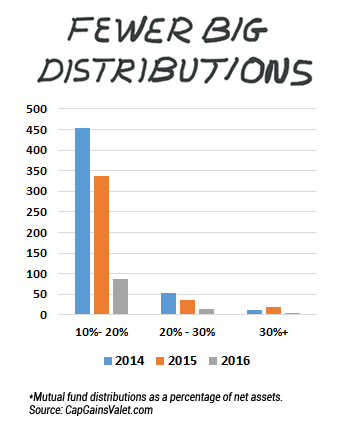 This is down from 517 in 2014 and 391 in 2015.
Mark’s data was surprising given the length of the bull market. Should the current bull market keep running into March, it will celebrate its eighth birthday. Such a long length will have given fund managers plenty of time to use up their losses from the last bear market and accumulate plenty of gains to pass along to shareholders. The distributions data for this year shows this is not the case. So what gives?
One possible explanation may be found in the return data. Domestic large-, mid- and small-cap mutual funds realized very good returns in 2013. To the extent that fund managers used up any remaining losses stemming from the 2007-2009 bear market to offset those gains, distributions would have been boosted in 2014. A down year for the average domestic and international stock fund in 2015 would have also given managers new losses to work with, helping to offset any capital gains they realized last year and this year.
Another explanation would be greater tax efficiency on the part of mutual fund managers. To test this theory, I analyzed the tax-cost ratio trends from our mutual fund guide. The tax-cost ratio shows how much annualized returns are reduced by taxes resulting from distributions. If fund managers are being more tax-efficient, the ratio should trend lower.
Since 2011, the tax ratio is largely stable for bond funds, but rising for stock funds. Put another way, the managers of stock mutual funds have become more tax-inefficient instead of efficient. Our ratio uses a rolling three-year period, with the 2015 tax-cost ratio factoring in distributions for 2013, 2014 and 2015; the 2014 ratio using distributions for 2012-2014, etc. It is possible that the 2016 tax-cost ratios could be lower than the 2015 ratios given the decline in large distributions.
In an attempt to gain further insight, I looked at the trends in turnover. Turnover measures how often a manager jumps in and out of positions. In general, average portfolio turnover decreased for most, but not all, major stock fund categories between 2012 and 2015. Turnover has increased so far this year, based on our third-quarter Quarterly Mutual Fund Update. There isn’t a clear trend among bond funds, though average turnover ratios are higher this year compared to last year for many categories. Thus, while the comparisons aren’t perfect, there does appear to be reason to question whether the decrease in large distributions reflects greater intentional tax efficiency on the part of mutual fund managers.
Tax efficiency matters because fund shareholders—be they owners of mutual funds or exchange-traded funds (ETFs)—can be taxed in three ways. The first is on any appreciation between the purchase price (aka, cost basis) and the sale of a fund’s shares. The second is on any dividends or interest payments distributed by a fund. The third is on distributions made by a fund. The day you buy a share is the day you inherit all of the fund’s current embedded gains. These are unrealized gains in securities held by the fund. As a shareholder, you have no control over when these gains will be distributed, but you have to pay taxes on them once they are realized and distributed—even if the fund’s share price has declined in value.
A way to reduce this risk is to seek out funds with better (lower) tax-cost ratios and lower turnover ratios. You should also call the fund company before purchase to find out when they intend to make the distributions (typically late in the calendar year) so you do not buy shares ahead of that date. And yes, holding less tax-efficient funds in a retirement account (e.g., an IRA) can help to greatly reduce (and often eliminate) the tax headaches of fund management.
- The Individual Investor’s Guide to the Top Mutual Funds 2016 – The data about tax-cost ratios and turnover was pulled from our comprehensive annual mutual fund guide.
- An Inside Look at Exchange-Traded Funds – For taxable accounts, exchange-traded funds can make more sense. Here’s how they differ from mutual funds.
- Investment Strategies: 2017 and Beyond – Our tax guide includes suggestions on how to minimize the impact of investment-related taxes.
- Seven Steps That Couples in Their 50s Should Take – Money Magazine listed seven smart money moves that couples should make to better prepare themselves for retirement.
Just two members of the S&P 500 are scheduled to report earnings: Adobe Systems (ADBE) and Oracle Corp. (ORCL) on Thursday.
The Federal Open Market Committee will hold a two-day meeting, starting on Tuesday. The meeting statement along with updated committee member forecasts will be released at approximately 2 p.m. ET on Wednesday. Fed chair Janet Yellen will hold a press conference at 2:30 p.m ET. The CME’s FedWatch tool places a 97.2% chance on interest rates being raised by a quarter of a percentage point.
Elsewhere on the economic calendar, November import and export prices will be released on Tuesday. Wednesday will feature the November Producer Price Index (PPI), November retail sales, November industrial production and capacity utilization and October business inventories. The November Consumer Price Index (CPI), the December Philadelphia Fed business outlook survey, the December Empire State manufacturing survey and the December housing market index will be released on Thursday. Friday will feature November housing starts and building permits.
Richmond Federal Reserve Bank president Jeffrey Lacker will speak on Friday.
The Treasury Department will auction $24 billion of three-year notes and $20 billion of 10-year notes on Monday, and $12 billion of 30-year bonds on Tuesday.
- Why Buy Bonds If Interest Rates Will Rise?
- The Weiss Approach to Value in Blue-Chip Stocks
- Stocks: An Underappreciated Asset Class in Retiree Portfolios
Optimism among individual investors about the short-term direction of the stock market is above 40% for a fourth consecutive week for the first time in approximately two years. This week’s AAII Sentiment Survey also shows a decline in neutral sentiment and a modest rise in pessimism.
Bullish sentiment, expectations that stock prices will rise over the next six months, declined 0.7 percentage points to 43.1%. This marks the fourth consecutive week that optimism is above 40% and the fifth consecutive week that it is above its historical average of 38.5%.
Neutral sentiment, expectations that stock prices will stay essentially unchanged over the next six months, declined 0.7 percentage points to 30.4%. The modest decrease puts neutral sentiment back below its historical average of 31.0%.
Bearish sentiment, expectations that stock prices will fall over the next six months, rose 1.4 percentage points to 26.5%. Even with the increase, pessimism is below its historical average of 30.5% for a fifth consecutive week.
Bullish sentiment readings in the low- to mid-40s have been a normal occurrence throughout the history of the survey. During most of the past 24 months, however, readings above 40% have been fairly rare. For example, the last time optimism held above 40% on four consecutive weeks was December 25, 2014, through January 15, 2015. In total, there have only been 14 weeks over the past 24 months with optimism at or above 40%.
Though the new record highs are giving individual investors encouragement, or at least calming fears about a drop occurring in the short term, the election’s outcome remains front and center for many AAII members. Some are encouraged by possible changes President-elect Donald Trump could make, while others are uncertain or want to wait to see how his administration’s policies and their impact evolve. There are also individual investors who are pessimistic following the election. Beyond the election, the direction of interest rates, the pace of economic and earnings growth, and valuations are influencing individual investors’ expectations for the stock market.
This week’s special question asked AAII members what they thought about the post-election rise in stock prices. Responses were mixed. The largest group, nearly 38% of all respondents, think prices are rising on expectation of the changes President-elect Donald Trump will bring. The easing of business regulations and lower taxes were specifically mentioned. Slightly less than a quarter of all respondents (22%) think the rally is temporary, with a reversal potentially occurring during the first half of next year. Nearly 14% think stocks have either risen too far too fast or do not believe the rally is justified by the current underlying fundamentals. Other respondents described the rally as a reaction to the uncertainty about the election being over, are taking a wait-and-see approach or say they are surprised by the rally.
Here is a sampling of the responses:
- “The market likes the idea of a Republican-controlled government. Less regulation and less business taxes.”
- “A temporary boost due to the election of a market-friendly president. I see a downside to the market in the new year.”
- “Fleeting, as there are not solid fundamentals to support run-up.”
- “People are optimistic about the economy and possible tax cuts.”
- “I think it’s a relief that the uncertainty is over.”

Bullish: 43.1%, down 0.7 points
Neutral: 30.4%, down 0.7 points
Bearish: 26.5%, up 1.4 points
Bullish: 38.5%
Neutral: 31.0%
Bearish: 30.5%
Local Chapter Meetings

December 1, 2016 Sentiment Supports the Borrowing of 2017 Gains Argument
November 24, 2016 Insights From Conversations With Great Investors
November 17, 2016 Putting the Rise in Bond Yields Into Perspective
November 3, 2016 Thanks to Mr. Market, My Portfolio Doesn’t Need Altering