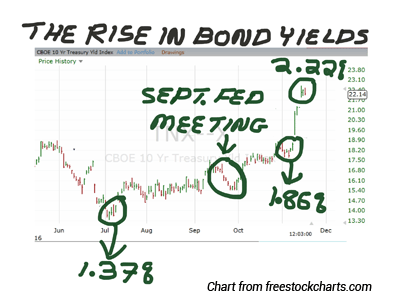
Bond yields have suddenly found themselves in the financial headlines. Since Donald Trump became president-elect, the yield on the 10-year Treasury has risen from 1.86% on Election Day to a near-term closing high of 2.22% on Tuesday. That is nearly a half-percentage point jump in just seven days. (The closing yield was slightly higher today, Thursday, at, 2.28%.)
The move extends what has been a longer trend in bond yields. Since hitting a low of 1.37% on July 5, 2016, yields have trended upward. The move hasn’t been steady—yields temporarily fell back following the Federal Open Market Committee’s September meeting—but it has occurred. Yields particularly gained upward momentum in October before making their very recent big jump.
 Fiscal plans by the president-elect are being attributed to as the reason for the post-election move. Trump wants to cut taxes and invest significantly in infrastructure. Bond traders are betting on more fiscal stimulus leading to more debt, as well as the possibility of higher inflation. Notably, in the background of this, expectations for rate hikes by the Federal Reserve remain tame. The CME’s FedWatch Tool assigns a 70% probability to the Fed’s target being no higher than 1% at the November 2017 meeting. Assuming a rate hike is announced at next month’s meeting—the futures market is assigning a 91% chance to this occurring—traders are anticipating just one additional rate hike during the first 11 months of 2017. Though the 2017 odds are very much subject to change, they stand in sharp contrast to recent reports about money being shifted from traditional bonds to inflation-protected Treasuries (TIPS).
As some of you might remember, it was just this past June when I asked where the bond Armageddon was. The question still applies. Though yields have risen sharply as of late, they are still very low on an absolute basis. Yields on the benchmark 10-year Treasury were higher at the very beginning of this year than they are now. The benchmark note’s yields were also higher during much, but not all, of 2013 and 2014.
As far as how high yields will rise, that remains to be seen. The 10-year Treasury has only briefly traded with a yield above 3% during the past five years. The president-elect’s spending and tax plans will require an approval by Congress, whose budget hawks may not easily go along. It’s worth noting that the current agreement on the debt ceiling is set to expire in March.
The other wildcard is inflation. Not only do we not know what the pace of future economic growth will be, it’s uncertain what actions president-elect Trump will actually take on trade. It’s one thing to talk tough on trade, it’s another thing to actually renegotiate a trade deal. In between are a range of scenarios from maintaining the status quo to some type of trade of war, the latter of which could lead to higher prices on imported goods. I’m not a political expert and I’m certainly not going to make any prediction about what will happen.
As to what do with bonds (and bond funds), the answer comes down to asking yourself why bonds are in your portfolio in the first place? Are you allocated to bonds and bond funds because they have historically offered diversification benefits to stocks? Are you holding bonds or bond funds to help you cope with the higher volatility of stocks? Are you holding individual bonds to get a certain stream of cash flow and probable return of capital? All of these are valid reasons that have not changed over the past week, month or even since last summer.

- TIPS and the Nature of Inflation Protection – This 2010 AAII Journal article explains how inflation-protected Treasuries work and how their prices are influenced by inflation expectations.
- Defined-Maturity Funds: A Bond Alternative With Compromises – An option for those concerned about rising interest rates is to hold these types of bond funds, which mature by a specified date.
- How to Harvest Losses While Maintaining the Position – There’s still time to capture losses for tax purposes; here are strategies for doing so.
- William O’Neil’s CAN SLIM Approach to Selecting Growth Stocks Using Fundamental and Technical Data – This strategy seeks stocks exhibiting characteristics shared by big winners just before they staged their big move.
AAII founder and chairman James Cloonan did not perform any portfolio reviews this month, so there are no changes to either the AAII Model Shadow Stock Portfolio or AAII Model Fund Portfolio. Three Shadow Stocks currently qualify for purchase: AV Homes Inc. (AVHI), Beazer Homes (BZH) and Key Tronic Corp. (KTCC)
The AAII Model Shadow Stock Portfolio was roughly in line with the DFA U.S. Micro Cap Fund (DFSCX), which was down 3.5% in October. Year to date, the AAII Model Shadow Stock Portfolio is up 10.1%, compared to Vanguard 500 index fund (VFINX), which is up 5.8%. The DFA U.S. Micro Cap Fund (DFSCX) is up 6.7% for the 10 months ended October 31. Since its inception in 1993, the AAII Model Shadow Stock Portfolio has a compound annual average return of 15.3% versus the Vanguard 500 Index fund, which has gained 8.9% per year, on average, over the same period.
The AAII Model Fund Portfolio declined 3.0% in October, compared to a 1.8% loss for the SPDR S&P 500 ETF (SPY). The Model Fund Portfolio has gained 6.8% year to date, while the SPDR S&P 500 ETF is up 5.8%. Since its inception in June of 2003, the Model Fund Portfolio has a compounded annual average return of 8.2%, while the SPDR ETF has an 8.1% average annual return over the same period.
The U.S. financial markets will be closed on Thursday in observance of Thanksgiving. The U.S. stock exchanges will close early on Friday, at 1:00 p.m. ET. On behalf of everyone at AAII, have a great holiday with friends, family and delicious food!
Third-quarter earnings season continues to wind down with just 13 members of the S&P 500 scheduled to report. Those companies include Tyson Foods (TSN) on Monday; Campbell Soup Company (CPB), Hewlett Packard Enterprise Co. (HPE), Hormel Foods Corp (HRL), HP (HPQ) and Medtronic (MDT) on Tuesday; and Deere & Company (DE) on Wednesday.
The week’s first economic reports will be October existing home sales, which will be released on Tuesday. Wednesday will feature October durable goods orders, the November PMI Manufacturing Index Flash, October new home sales, the University of Michigan’s revised November consumer sentiment survey and the minutes from the November Federal Open Market Committee. Weekly jobless claims data will also be released on Wednesday, a day earlier than normal.
The Treasury Department will auction $26 billion of two-year notes on Monday; $13 billion of two-year floating rate notes and $34 billion of traditional five-year notes on Tuesday; and $28 billion of seven-year notes on Wednesday.
- Why Buy Bonds If Interest Rates Will Rise?
- 18 Recommendations for Minimizing Inheritance Conflict
- The Importance of Diversification in Retirement Portfolios
Optimism about the short-term direction of stock prices continues to rise, reaching its highest level in 21 months. At the same time, neutral sentiment fell to a two-year low in the latest AAII Sentiment Survey. Pessimism is also lower.
Bullish sentiment, expectations that stock prices will rise over the next six months, jumped 7.8 percentage points to 46.7%. Optimism was last higher on February 18, 2015 (47.0%). The jump keeps optimism within its typical range, but above its historical average of 38.5%.
Neutral sentiment, expectations that stock prices will stay essentially unchanged over the next six months, fell 5.0 percentage points to 26.8%. This is the lowest neutral sentiment has been since November 12, 2014 (22.8%). The drop puts neutral sentiment below its historical average of 31.0% for the first time in 42 weeks.
Bearish sentiment, expectations that stock prices will fall over the next six months, declined by 2.8 percentage points to 26.6%. Pessimism was last lower on August 17, 2016. The historical average is 30.5%.
During the past two weeks, optimism has risen by a cumulative 23.0 percentage points—the 14th largest such move in the 29-year history of our survey. At the same time, neutral sentiment has fallen by a cumulative 15.3 percentage points, the 20th largest such drop. Both optimism and neutral sentiment are currently within their historical ranges.
There isn’t a clear trend as to how the market has performed following unusually large two-week increases in bullish sentiment. The median six-month gain for the 13 periods when there was a larger two-week increase in optimism was 5.9%. Though above the historical median for all periods, the number is skewed upward by a 34.5% gain following the two-week, 26.1 percentage-point increase in optimism on March 19, 2009.
The big shift in sentiment started in the days leading up to the election and has continued since. Though some individual investors are optimistic about president-elect Donald Trump, others are uncertain or pessimistic, as the responses to this week’s special question show. At the same time, the stock market has rebounded strongly from its autumn lows, with the Dow Jones industrial average setting new record highs. This has likely alleviated some concerns about a larger drop in stock prices occurring over the short term.
This week’s special question asked AAII members what factors are most influencing their six-month outlook for stocks now that the elections are over. Not surprisingly, many said president-elect Donald Trump. Slightly more than one out of every four respondents described themselves as being uncertain about the impact his presidency will have or did not specifically state a positive or negative bias. Many of the respondents are waiting to see what policies he puts into action and the impact of those policies. Approximately 22% are pleased with the election with Trump, particularly the prospects of tax cuts, deregulation and/or the repeal of the Affordable Care Act. About 5% have a negative view, with some fretting about the impact Trump will have on the economy and trade.
Beyond Trump, 18% of respondents are focused on the Federal Reserve and the possibility of higher interest rates. Corporate earnings were cited by 9% of respondents, the economy by 8%, and 3% are focused on valuations. Some respondents listed more than one factor.
Here’s a sampling of the responses:
- "How much Trump tries to interfere with global trade agreements.”
- "Trump will be great for business by lowering taxes and reducing government involvement in business.”
- "I will be holding my breath to see what new policies are implemented by Donald Trump.”
- "The actions of the Federal Reserve.”
- "Can the economy grow fast enough to justify the increase in stock prices?”
- "The current valuation of stocks is quite high.”

Bullish: 46.7%, up 7.8 points
Neutral: 26.8%, down 5.0 points
Bearish: 26.6%, down 2.8 points
Bullish: 38.5%
Neutral: 31.0%
Bearish: 30.5%
Local Chapter Meetings

November 3, 2016 Thanks to Mr. Market, My Portfolio Doesn’t Need Altering
October 27, 2016 An Election Trend That Might Not Be Repeatable
October 20, 2016 Earnings Estimates’ Effect on Stock Prices
October 13, 2016 You Could Spend More Years Being Retired Than Working