Sometimes, the market does the hard work for you. Such is the case with my 403(b) account, which is similar to a 401(k) account. Over the weekend, I looked at it for the first time in six months. I could have easily skipped doing so because Mr. Market took care of things for me. There was nothing for me to do except to forget the balance and not look again until the end of next April.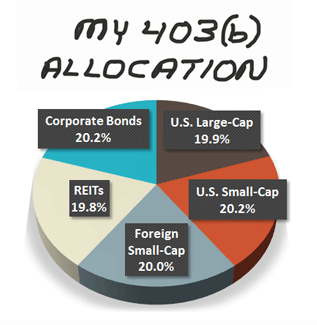
Each six months, I look to see if I need to rebalance. I hold five funds in the account: Vanguard S&P 500 (VFINX), Vanguard FTSE All-World ex-US Small-Cap (VFSVX), Vanguard Intermediate-Term Investment-Grade (VFICX), Vanguard REIT (VGSIX) and Vanguard Small-Cap Value (VISVX). Each fund as has the same target allocation of 20%. When one fund goes too far astray from this target, I rebalance the portfolio. (As a quick side note for those who are interested, the ETF versions of the funds are Vanguard's S&P 500 (VOO), FTSE All-World ex-US Small-Cap (VSS), REIT (VNQ) and Small-Cap Value (VBR). Vanguard does not offer an ETF version of the bond fund.)
I expected some difference in the allocation weightings because of the portfolio’s diversification. Bonds move differently than stocks and REITs don’t follow the same path as stocks or bonds. What I found instead was surprising. The largest positions (the bond fund and the U.S. small-cap fund) each accounted for 20.2% of the portfolio. The smallest position (the REIT fund) had a 19.8% allocation. Given that investing is messy and over time each fund will experience different returns, I expected bigger differences. Perhaps not large enough to warrant rebalancing, but certainly more than a 0.4-percentage-point difference between the largest and the smallest positions.
There are two things worth noting. First, this is my workplace retirement plan. Contributions are made into the account on a monthly basis. These contributions are automatically and evenly invested in each of the five funds. As such, I buy proportionately more shares of the underperforming funds and proportionately less shares of the outperforming funds in a given month. The constant dollar cost averaging causes the return I realize for each fund to differ from the published returns for a given time period (e.g., six months, 12 months, etc.)
Second, two assets can be uncorrelated, not highly correlated or even slightly negatively correlated and still experience similar returns over short periods of time. When people say diversification doesn’t work, it’s often because they are looking at too short of a period of time. Just because two assets experience different return characteristics over long periods of time does not mean they always experience different returns. Add in dollar cost averaging and it’s entirely possible for a diversified portfolio to be close to its targeted allocation at a given point of time. It’s also possible for different asset classes to zig and zag enough that at various points in time the portfolio will swing back close to its targeted allocation. The latter is what happened with my 403(b) account.
Had I checked my portfolio on a different date—say, the day after the Brexit vote—I would have likely seen different weightings for each fund. They also might be different next week depending on how the market reacts to the outcome of the election. (I’m not making any predictions, as I still haven’t managed to get my cracked crystal ball repaired and my Magic 8 Ball is currently misplaced.)
What I do know with certainty is that the less frequently I check my portfolio, the less I will notice how much the value of my portfolio changes. Though the volatility of the financial markets and individual investments doesn’t change just because we’re not looking at it, our perception of volatility does. Look more often and you’ll perceive more volatility. Look less often and you’ll perceive less volatility. More importantly, look less often and you will be less tempted to change something in your portfolio. Avoiding the temptation to tinker—or worse, make a significant change—is why I limit looking at my 403(b) account to the end of the worst six months for stocks (late October) and the end of the best six months for stocks (late April).

- Best Practices for Portfolio Rebalancing – My use of 5% thresholds as triggers for rebalancing is based on this Vanguard study.
- Data Mixed on Whether Volatility is Rising – Volatility has been rising over the long term when measured on a daily basis, but no discernible trend exists when volatility is tracked on a monthly basis.
- Model Fund Portfolios: Answers to Questions About the Level3 Approach – AAII founder and chairman Jim Cloonan gives further insight into his new approach in the November AAII Journal, which is now online.
- The Art of Creating an Investment Policy Statement – Having a written investment policy statement helps to guide your decisions in a manner that is beneficial to reaching your long-term goals.
Tuesday is Election Day, though early voting has already started in many states.
AAII president John Bajkowski will discuss our Model Shadow Stock portfolio with our Portland Chapter on Saturday, November 12.
Earning season marches on as 31 members of the S&P 500 will report. Included in this group is Dow component Walt Disney (DIS) on Thursday.
The week’s first economic reports will be the Labor Department’s September job openings and labor turnover survey (JOLTS), released on Tuesday. Friday will feature the University of Michigan’s preliminary November consumer sentiment survey.
Four Federal Reserve officials will make public appearances: Chicago president Charles Evans on Monday and Tuesday; Minneapolis president Neel Kashkari and San Francisco president John Williams on Wednesday; and St. Louis president James Bullard on Thursday.
The Treasury Department will auction $24 billion of three-year notes on Tuesday, $23 billion of 10-year notes on Wednesday and $15 billion of 30-year bonds on Thursday.
- Common Investor Mistakes and Other Investing Insights
- Aging and Investing: The Risk of Cognitive Impairment
- Cash Dividend Types, Dates and Taxes
Optimism among individual investors about the short-term direction of stock prices fell to a very low level as the streak of below-average readings was extended to a full year’s span. This week’s AAII Sentiment Survey also shows increases in both neutral and bearish sentiment.
Bullish sentiment, expectations that stock prices will rise over the next six months, declined 1.1 percentage points to 23.6%. Optimism was last lower on June 22, 2016 (22.0%). The drop keeps bullish sentiment below its historical average of 38.5% for the 52nd consecutive week and the 85th out of the past 87 weeks.
Neutral sentiment, expectations that stock prices will stay essentially unchanged over the next six months, rose 0.9 percentage points to 42.0%. This is a four-week high. This week’s rise keeps neutral sentiment above its historical average of 31.0% for the 40th consecutive week.
Bearish sentiment, expectations that stock prices will fall over the next six months, edged up 0.2 percentage points to 34.3%. This is the first time that pessimism has been above its historical average of 30.5% for a period of four consecutive weeks or more since an eight-week stretch between January 6 and February 24, 2016.
This week’s bullish sentiment reading ranks as the 104th lowest reading out of the more than 1,500 weekly results recorded during the 29-year history of our weekly survey. Optimism was last above its historical average of 38.5% on November 4, 2015 (39.0%).
The very low level of bullish sentiment is occurring as stock prices continue to show weakness and Election Day nears. Other factors contributing to low readings include the possibility of the stock market experiencing a larger drop, valuations, global economic uncertainty and the pace of corporate earnings growth. Giving some individual investors reason for optimism are the perceived lack of investment alternatives, corporate earnings, low/stable energy prices and sustained, albeit slow, economic growth.
This week’s special question asked AAII members for their opinion of the dividend yields that stocks currently trade at. Responses varied. The largest group of respondents (23%) described dividends as currently being too low. Several said that the low dividends indicate high valuations for stocks. Slightly more than 12% felt that dividend yields are currently adequate. Approximately 10% described the current dividend yields as being better than what is available on bonds and bank accounts. Roughly 7% said that dividends are currently too high or otherwise unsustainable. Nearly 4% thought that yields are attractive at current levels.
Here is a sampling of the responses:
- “It’s better than the yield from fixed-income investments.”
- “You have to be careful, as very high dividend yields may not be sustainable.”
- “It’s good, but we need higher earnings to support further dividend increases.”
- “Adequate, but could be better if the economy got rolling.”
- “It’s just too low, meaning most are overvalued.”

Bullish: 23.6%, down 1.1 points
Neutral: 42%, up 0.9 points
Bearish: 34.3%, up 0.2 points
Bullish: 38.5%
Neutral: 31.0%
Bearish: 30.5%
AAII Asset Allocation Survey
Individual investors’ cash allocations rebounded to a five-month high last month, according to the October AAII Asset Allocation Survey. Fixed-income allocations also rose, while equity allocations declined.
Stock and stock fund allocations declined 0.6 percentage points, to 64.7%. Even with the small decrease, equity allocations remained above their historical average of 60.5% for the 43rd consecutive month.
Bond and bond fund allocations rebounded 0.3 percentage points to 16.6%. October was the 15th consecutive month that fixed-income allocations were above their historical average of 16.0%.
Cash allocations rose 0.4 percentage points, to 18.7%. This is the largest allocation to cash since May 2016. Even with the rise, cash allocations remained below their historical average of 23.5% for the 59th consecutive month.
The increase in cash precedes the November elections. In addition to the election, some individual investors believe stocks could fall further than they have during the third quarter. Beyond the election, potential interest rate hikes and valuations are cited as catalysts for a potential drop in stock prices. It is worth noting that over the past six weeks, only 25.3% of AAII members described their six-month outlook for stock prices as bullish—an unusually low level of optimism.
Despite the lack of optimism, several AAII members previously said that they see no good alternatives to stocks currently existing or have otherwise said that they feel like they are being forced to allocate more to stocks because of the current interest rate environment.
Last month’s special question asked AAII members what, if any, investment decisions they are postponing until after the outcome of the election is known. Slightly more than one out of three respondents (35%) said they are not postponing any decisions. Many of these respondents said they are following long-term strategies or are looking past the election. Approximately 20% are postponing buying stocks, particularly adding to their stock allocations. A few said they are postponing buying stocks until after a correction occurs. An additional 3% of respondents said they are specifically postponing purchases of health care and medical stocks. Nearly equal numbers of respondents (8% for each group) are postponing all investment decisions, holding onto cash or adjusting their portfolio’s allocation.
Here is a sampling of the responses:
- “The elections have no bearing whatsoever on my long-term investment goals.”
- “Postponing purchases of new stock.”
- “I will not be investing any additional funds until after the election.”
- “Would like to deploy another 10% to 15% into stocks after the election, if there is a pullback.”
- “I’m not postponing any decisions. I’m looking at the state of the market, not the election.”
- Stocks and stock funds: 64.7%, down 0.6 percentage points
- Bonds and bond funds: 16.6%, up 0.3 percentage points
- Cash: 18.7%, up 0.4 percentage points
- Stocks: 30.4%, down 0.6 percentage points
- Stock Funds: 34.3%, unchanged
- Bonds: 3.7%, up 0.7 percentage points
- Bond Funds: 12.9%, down 0.4 percentage points
Take the Asset Allocation Survey.
Local Chapter Meetings

October 27, 2016 An Election Trend That Might Not Be Repeatable
October 20, 2016 Earnings Estimates’ Effect on Stock Prices
October 13, 2016 You Could Spend More Years Being Retired Than Working
October 6, 2016 Too Much Confidence Is Bad for Your Portfolio