Warren Buffett said that among the lessons he learned from Benjamin Graham was that “price is what you pay, value is what you get.” Though Buffett used the phrase in a discussion about bonds and stocks in his 2008 letter to Berkshire-Hathaway shareholders, the adage applies to many other objects. One such object is the digital recorder you see pictured to the right.
I bought this recorder during my first year at AAII. Though its replacement cost isn’t much (about $30 to $70 on Amazon, depending on the model), its value is extremely high. It holds conversations I have with practitioners and academics. There may well be enough good investing advice on it to fill a book. Since this is a day of giving thanks, I can tell you that every day I am grateful for the opportunities I have had to speak with very smart and talented people in the investing field.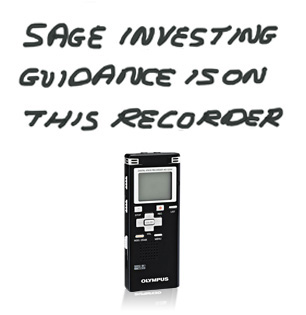
I purchased a new recorder after a glitch with the older recorder almost caused me to reschedule my interview with Charley Ellis literally minutes before I was supposed to call him. (A solution was found barely in the nick of time, and you can see a transcript of our conversation in this month’s AAII Journal.) But as I look at the recorder, I thought it might be worthwhile to share a compilation of the some of the advice that’s on it. In initially writing this week’s commentary, I quickly realized that there was more than enough to blow far past the word count I try to stick to (typically between 500 and 600 words). So, to avoid being overly verbose, I’ve chosen some select highlights to share. I hope you find them useful.
- David Laibson, Harvard, on aging (September 2011): “Mostly, we’re getting better as we age, until about the 50s. And then, after the 50s, on average, we’re getting worse. After the 50s, the decline in fluid intelligence becomes the dominant force and our ability to make sophisticated decisions, for most people, declines. This does not mean that we fall off the cliff at age 55, but rather that we’re peaking around 50–55, and then we’re gently declining thereafter. The decline tends to become steeper as we age, and by the time we’re in our 80s, for many of us, the ability to make good decisions is significantly compromised, particularly decisions that involve complicated new problems.”
- Mike Mayo, CLSA, on earnings conference calls (July 2012): “When there’s a discussion that’s so complicated that you can’t understand what’s going on, it’s not your fault. It’s the company’s fault for not explaining it in very clear and simple terms. Those are red flags for anybody paying attention to the management team.”
- Michael Mauboussin, Credit Suisse, on assessing whether a stock is attractive (September 2013): “As an investor, the key thing to differentiate or think about is distinguishing between the fundamentals of the business and the expectations built into the price… What you’re looking for are not necessarily the best companies or the worst companies. You’re looking for mispriced companies.”
- Roger Ibbotson, Yale, on overlooked stocks (April 2013): “When you’re getting the less liquid stocks, they also are the less popular stocks. If they have strong fundamentals, but are less popular, these stocks tend to be selling at discounts. When the market recognizes more what’s going on, these stocks tend to migrate to becoming more popular. Then, if their fundamentals improve from there, they’ve got a double-whammy: improving fundamentals and the increase in popularity—this often creates very good returns.”
- Michael Falk, Focus Consulting Group, on retirement withdrawal strategies (September 2014): “At the end of the day, your first hurdle is to cover your fixed expenses, to be able to live your life. Everything else is secondary then. And this changes the math, right? Because now it’s not about a withdrawal percentage, it’s about whether we’ve got enough money or we have Social Security, pension benefits, an annuity or a laddered bond portfolio to cover our fixed expenses.”
- Robert Arnott, Research Affiliates, on his favorite valuation measure (October 2014): “Price-to-sales is largely unrecognized, or under-recognized, in the marketplace. If you have a company that has a low price-to-sales ratio because its profit margins are thin, are they going to attract relatively few competitors? Probably. Can they then ramp up their profit margins? Probably. Does that mean they can see earnings growth that exceeds revenue growth? Absolutely. So if I had to pick one, I would say sales is the most interesting figure, and price-to-sales ratios are the most interesting of the valuation ratios, but they get very little attention in the marketplace, and I view that as a positive.”
- John Bogle, Vanguard, on market efficiency (June 2014): “Whether the market is efficient or inefficient doesn’t matter as long as you get costs out of the way, invest for the long term, and pay no attention to the foolishness that goes on in the short term in the stock market. In one of the better sentences I’ve written, it was in ‘The Little Book of Common Sense Investing’ (John Wiley, 2007), I said, ‘The stock market is a giant distraction to the business of investing.’”
- William “Bill” Sharpe, Stanford, on the investment advice he would give (October 2014): “Save more. Just save more; if you’re still working, you probably need to save more because you almost certainly aren’t saving enough. If you do the calculations based on having X when you get to retirement, you can begin to understand what X can do for you given all the uncertainties that come with later life. I’ll bet most investors would say, ‘I wish I had saved more, even though I had to give something up.’”

- The Role of Luck and Skill in Investing – Michael Mauboussin on how our natural tendency toward overconfidence makes it easy for us to attribute sheer luck to something else.
- Managing the Mental Aspect of Investing – Though not included above, Meir Statman was among the first people I interviewed. He provided good insight into the psychological aspect of investing.
- A Financial Planner’s Guidance for Women on Planning for Retirement – One of the first steps married women should take is having an open discussion with their spouses about what they envision retirement to be like.
- SEC Adopts New Mutual Fund and ETF Rules – Funds will have to assess their ability to quickly sell assets, and mutual funds will have the flexibility to adjust their share prices when inflows or redemptions are large.
Earning season continues with just eight members of the S&P 500 scheduled to report. Those companies include: Autodesk (ADSK), Mallinckrodt plc (MNK) and Tiffany & Co. (TIF) on Tuesday; PVH Corp (PVH) on Wednesday; and Dollar General (DG), Kroger (KR) and Ulta (ULTA) on Thursday.
The week’s economic reports include the first gross domestic product (GDP) revision, the September Case-Shiller home price index and November consumer confidence, which will be released on Tuesday. Wednesday will feature the November ADP employment report, October personal income and outlays, the November Chicago purchasing managers’ index (PMI), October pending home sales index, and the Federal Reserve’s Beige Book, which is a summary of commentary on current economic conditions. November motor vehicle sales, the November PMI manufacturing index, the November ISM manufacturing index and October construction spending will be released on Thursday. Friday will feature the November employment situation.
Five Federal Reserve officials will make public appearances: vice chair Stanley Fischer and New York president William Dudley on Tuesday; governor Jerome Powell on Wednesday; Cleveland president Loretta Mester on Wednesday and Thursday; and governor Daniel Tarullo on Friday.
- Choosing Between Mutual Funds and ETFs
- Cash Dividend Types, Dates and Taxes
- William O’Neil’s CAN SLIM Approach to Selecting Growth Stocks Using Fundamental and Technical Data

November 17, 2016 Putting the Rise in Bond Yields Into Perspective
November 3, 2016 Thanks to Mr. Market, My Portfolio Doesn’t Need Altering
October 27, 2016 An Election Trend That Might Not Be Repeatable
October 20, 2016 Earnings Estimates’ Effect on Stock Prices