Save the Date! Our 2017 Investor Conference will be held at Loews Royal Pacific Resort in Orlando, Florida, from November 3 through November 5. More information will be coming soon.
If one were to create a list of good advice for life, I would suggest including a simple rule: “Always know where the exits are.” It’s guidance that works in a variety of situations. For example, while I was traveling this past weekend, I looked to see where the doors were located on the planes I boarded. On Black Friday last November, taking the back way out of an outlet shopping center allowed me to avoid having to wait in a mile-long line of cars heading for the highway.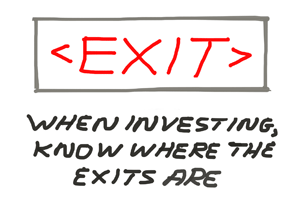
In investing, having a predetermined exit strategy will boost your returns. Clear, established sell rules provide the needed guidance to determine whether you should hold or fold. Without such rules in place, you (and me) will be left to our emotions and our cognitive biases—never a good thing. The best time to determine when to sell is before the decision needs to be made.
Exit strategies work well at the portfolio level. Preset rules alert you to when it is time to trim an allocation to stocks, bonds or another asset class for those who use rebalancing to keep their allocations within a targeted range. Similarly, an exit strategy can help you maintain a bucket strategy (e.g., one to five years of living expenses held in cash, three to seven years of expenses held in bonds and high-quality dividend-paying stocks, and the remainder in stocks.) The sell rules would be a prompt to replenish the shorter-term buckets. You could also use preset rules to keep a specific position from becoming too large.
None of these exit strategies require a working crystal ball. Quite the opposite; they use a list of criteria and rules to compare a portfolio or investment against. For a stock, you could use a lack of sales and/or earnings growth, an ending of annual dividend increases, an earnings miss, a high valuation or a breakdown of a technical formation as reasons to sell. A credit downgrade or a deterioration of financial strength on the part of the issuer could be the reasons for selling a bond. A change in the manager, a shift in strategy or an extended period of underperformance relative to its peers could be a reason to sell a mutual fund or ETF.
At the portfolio level, you could set up barriers at which your allocations are not allowed to fluctuate beyond (e.g., more than 5% above or below target). Those of you who are retired could direct all dividends, interest payments and realized capital gains to cash to fund distributions. To keep any single stock holding from having too much influence on returns, holdings in the AAII Stock Superstars Report and Dividend Investing portfolios are trimmed when they exceed 2.5 times the average dollar amount invested in all of the stocks held in each of the respective portfolios.
In all cases, there are clear lines in the sand. If they are not crossed, the investment is held. If they are crossed, the investment is sold. Having an exit strategy written down and available when it comes time to make an investment decision will better enable you to make rational sell decisions on a consistent basis.
Realize that you won’t be able to create an exit strategy for every possible event. Strange and unusual events can and do occur. Your goal should be to set up guidelines that cover the most common occurrences and to develop a habit of sticking to them. Doing so will make you a better, more disciplined investor.
- Strategies for Selling Stocks, Including Guidelines From Experts – Disciplined rules for selling include a deterioration in the company’s prospects, preset targets and stop limits.
- Shorting: A Strategy for Profiting From Price Declines – One way to develop sell rules is to base them on the characteristics that make a stock a good candidate for shorting.
- The Role Meditation Can Play in Investing – Meditation not only relieves stress, it also increases mental functioning and helps investors to overcome behavioral biases.
- Deep Value Investing Has Not Gone Out of Style – A portfolio composed of Ben Graham deep value stocks beat the market with all of its holdings making money.
No changes were made to either the Model Shadow Stock or the Model Fund portfolios. Within the Shadow Stock portfolio, five stocks qualify for purchase: AV Homes (AVHI), Key Tronic Corp. (KTCC), Seneca Foods (SENEA), Townsquare Media (TSQ) and VOXX International (VOXX). L S Starrett (SCX) remains on earnings probation.
Last month, the Model Shadow Stock Portfolio outperformed the Vanguard Small Cap fund (NAESX), gaining 5.1% versus 1.9% for the fund. For all of 2016, the Shadow Stock Portfolio realized a gain of 29.8%, outpacing the Vanguard fund’s 18.2% return.
The AAII Model Fund Portfolio returned 1.8% in December, compared to a 2.0% gain for the SPDR S&P 500 ETF (SPY). The Model Fund Portfolio gained 15.3% in 2016, while the SPDR S&P 500 gained 11.8%.
The Internal Revenue Service will start accepting tax returns on Monday. Procrastinators have until April 18. Filing as early as you can can help deter identity thieves, though I realize many of you are still waiting on tax forms, such as 1099s, to arrive.
Fourth-quarter earnings season picks up steam with 106 members of the S&P 500 scheduled to report. Included in this group are 12 Dow Jones industrial components: McDonald’s Corp. (MCD) on Monday; 3M (MMM), Du Pont (DD), Johnson & Johnson (JNJ), Travelers Companies (TRV) and Verizon Corp. (VZ) on Tuesday; Boeing (BA) and United Technologies Corp. (UTX) on Wednesday; Caterpillar (CAT), Intel Corp. (INTC) and Microsoft Corp. (MSFT) on Thursday; and Chevron Corp. (CVX) on Friday.
The week’s first economic reports will be the January purchasing managers’ manufacturing index flash and December existing home sales, both of which will be released on Tuesday. Thursday will feature December international trade and December new home sales. December durable goods orders, the initial estimate of fourth-quarter gross domestic product (GDP) and the University of Michigan’s final January consumer sentiment survey will be released on Friday.
The Treasury Department will auction $26 billion of two-year notes on Tuesday, $15 billion of two-year floating rate notes and $34 billion of five-year notes on Wednesday and $28 billion of seven-year notes on Thursday.
- Deep Value Investing Has Not Gone Out of Style
- Vanguard’s Dynamic Spending Strategy for Retirees
- Using ETFs in a Tough, Sideways-to-Bear Market
Optimism among individual investors waned, falling to its lowest level since the election, in the latest AAII Sentiment Survey. Both neutral sentiment and pessimism rose.
Bullish sentiment, expectations that stock prices will rise over the next six months, fell 6.6 percentage points to 37.0%. Optimism was last lower on November 2, 2016 (23.6%). The historical average is 38.5%.
Neutral sentiment, expectations that stock prices will stay essentially unchanged over the next six months, rose 0.9 percentage points to 30.3%. Neutral sentiment was last higher on December 7, 2016 (30.4%). The rise is not large enough to keep neutral sentiment from remaining below its historical average of 31.0% for the seventh consecutive week and the ninth time in 10 weeks.
Bearish sentiment, expectations that stock prices will fall over the next six months, jumped 5.7 percentage points to 32.7%. Pessimism was last higher on November 2, 2016 (34.3%). This is also just the second time in 11 weeks that bearish sentiment is above its historical average of 30.5%.
The drop in optimism ends a streak of nine consecutive weeks with bullish sentiment above 40%, the longest such streak since October 15 through December 10, 2014. The decline is occurring as the post-election rally has paused. At current levels, all three sentiment indicators are close to their historical averages.
The potential impact that President-elect Donald Trump could have on the economy is causing uncertainty or concern among some investors, while encouraging others. Also influencing investor sentiment are valuations, earnings, consumer sentiment and the magnitude and timing of future interest rates.
This week’s special question asked AAII members for their thoughts about the recent new record highs set by the NASDAQ. Responses were very mixed. Approximately 18% of respondents think that the NASDAQ will continue to rise, with the upward momentum primarily being driven by tech stocks. An additional 6% view the record highs as a positive event. Slightly more than 12% attributed the upward momentum to President-elect Donald Trump’s November victory. These respondents were largely split between those who viewed the new administration as being business-friendly and those who think the index will stabilize after tomorrow’s inauguration. Nearly 18% of respondents think the NASDAQ and/or the broader market will pull back. An additional 11% say that the index is overvalued.
Here is a sampling of the responses:
- "An overreaction due to Trump’s victory. Will ‘normalize’ after January 20.”
- "It’s about time.”
- "May have gone up too far, too fast.”
- "Pent-up demand waiting for a business-friendly administration.”
- "There is a lot of technology in the NASDAQ and that is the future.”

Bullish: 37.0%, down 6.6 points
Neutral: 30.3%, up 0.9 points
Bearish: 32.7%, up 5.7 points
Bullish: 38.5%
Neutral: 31.0%
Bearish: 30.5%
Local Chapter Meetings

January 12, 2017 A Simple Solution to Offering an Active ETF
January 5, 2017 Is Now a Good Time to Invest in Stocks?
December 29, 2016 17 Investing Resolutions for 2017
December 22, 2016 Dow 20,000 Shows How Bad We Are at Analyzing Numbers