The return of downside volatility has exposed problems with perception and with certain exchange-traded products.
On Tuesday, the front page of the Chicago Sun-Times declared, “Dow’s Historic Drop: 1,175-point plunge—its biggest one-day loss in history—puts the once-roaring 2018 market in the red.” The headline correctly reported how much the blue-chip average fell, but it failed to provide any context.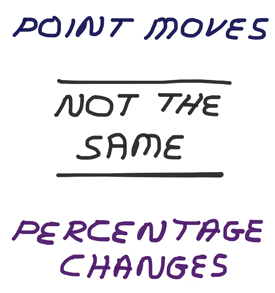
Monday’s drop put the Dow Jones industrial average and the S&P 500 index about where they were in early December. Was that mentioned in any of the headlines you saw? I’m guessing not. How about today? The large-cap indexes are about where they were on Thanksgiving. Yes, we’ve given up two months of gains, but it’s normal to incur downward price volatility.
You’re likely not hearing this message because point moves are bigger attention grabbers. Monday’s 1,175-point drop was huge on an absolute basis, but not nearly so on a percentage basis. The Dow’s 4.6% loss, while sizeable, didn’t even crack the top 20 in terms of the largest daily percentage declines. During October 2008—in the midst of the financial crisis—the blue-chip average experienced three daily declines of greater than 7%. None of these were records either. The biggest daily drop on a percentage basis remains October 19, 1987 (aka “Black Monday”), when the Dow shed 22.6% of its value.
Point moves stand out because they are easier to grasp and remember. We can look at, say, the Dow or the S&P 500 and see that it is down X number of points. Percentages require more mental work. If the Dow is down 2%, then we have to expend the cognitive effort to determine the average’s new price level. The human mind prefers the easier route of focusing on point moves. While saving the mind cognitive energy, this can also cause us miss the forest for the trees.
The reason has to do with what is known as anchoring. We base our opinions on a prior piece of information. For instance, many people still perceive a 200-point move in the Dow as a big thing. With the Dow still trading close to 24,000, a 200-point move isn’t even headline-worthy. It represents a normal fluctuation of less than 1%. Our ability to quickly calculate this math is overridden by our minds’ tendency to anchor on the previous perception of a 200-point move being a significant change. A daily move of 200 points used to be notable; it’s not anymore.
Compounding the problem is the lack of volatility that the market has experienced. We’ve gotten use to Mr. Market vacillating between a serene mood and a happy mood. He hasn’t thrown a good-sized tantrum in quite some time. Prior to this month, the S&P 500 went more than 500 days without experiencing a daily loss of 2%. Such calm is highly unusual. Stock declines of 5% or more typically occur once every six months, according to Sam Stovall of CFRA Research. Last year’s calm markets were what was unusual, not the volatility we’re now experiencing.
As far as the cause of the volatility is concerned, last Friday’s job data is being blamed. More specifically, the increase in average hourly earnings is being viewed as a sign of higher inflation ahead. Overlooked in this narrative is the fact that the current decline in stock prices started before the January employment data was released.
The bigger issue may be the bond market. Since the start of the year, yields on the 10-year Treasury note have risen by approximately 40 basis points (0.4%) to 2.85% today. The benchmark bond has not consistently traded above 3% since 2011. I point this out because the scuttlebutt suggests a 3% yield is the demarcation between the ongoing low interest rate environment and a new, higher interest rate environment. Whether yields actually rise above 3% and stay at that rate remains to be seen. Traders seem to be adjusting for this possibility, but temporary adjustments often do not turn out to be accurate forecasts. Plus, while attempting to forecast bond yields is extremely difficult, forecasting how others will react if those forecasts prove to be correct is even tougher.
We saw the adverse effects of trying to predict how others will react with two exchange-traded products plunging this week: the VelocityShares Daily Inverse VIX Short-Term ETN (XIV) and ProShares Short VIX Short-Term Futures ETF (SVXY). Both are bets on traders not paying premiums for protection against higher volatility. Think of them as bets on what other people will pay for insurance against yet other people becoming more skittish. The ETN and ETF worked when the markets were calm, but when volatility returned with a vengeance, their shortcomings were fully exposed. XIV lost 93% of its value and SVXY lost 83% of value on Tuesday. Both have continued to fall. In reaction, Credit Suisse announced its intention to liquidate the VelocityShares ETN by next week. ProShares sent out a press release saying its ETF’s performance “was consistent with its objective and reflected the changes in the level of its underlying index.” The big lesson from both is an axiom every investor should remember: Just because you can trade something doesn’t mean you should.

- Stock Market Retreats and Recoveries – Not only is downside volatility normal, but those who bought stocks on every 7% drop would have looked like terrific market timers.
- A Lifetime Investment Strategy – This timeless guide by AAII founder James Cloonan is worth reading anytime you feel nervous about the market.
- The Individual Investor’s Guide to the Top Mutual Funds 2018 – Our annual mutual fund guide is fully updated. The online version of this guide has information on nearly 1,600 funds.
- Retirement Doesn’t Negatively Impact Health – Two new studies found that retirees have fewer negative health shocks than they expected and experience a decrease in hospitalization rates relative to preretirement.
Fourth-quarter earnings season will remain busy with 57 members of the S&P 500 reporting. Included in this group are Dow Jones industrial average components: Cisco Systems Inc. (CSCO) on Wednesday and The Coca-Cola Co. (KO) on Friday. Many smaller companies will also report.
The week’s first economic report will be the January Consumer Price Index (CPI), January retail sales and December business inventories, all released on Wednesday. Thursday will feature the February Philadelphia Federal Reserve’s business outlook survey, the January Producer Price Index (PPI), the February Empire State Manufacturing Survey, January industrial production and the February housing market index. January housing starts and building permits, January import and export prices and the University of Michigan’s preliminary February consumer sentiment survey will be released on Friday.
Only one Federal Reserve official will make a public appearance this week, Cleveland president Loretta Mester on Tuesday.
- The Individual Investor’s Guide to the Top Mutual Funds 2018
- Analyzing Your Financial Health Using Personal Financial Ratios
- Reassessing Your Risk Tolerance? Don't Overlook Estate Planning
The percentage of individual investors expecting a decline in stock prices is at a three-month high in the latest AAII Sentiment Survey. At the same time, optimism is at a two-month low.
Bullish sentiment, expectations that stock prices will rise over the next six months, plunged 7.7 percentage points to 37.0%. Optimism was last lower on December 7, 2017 (36.9%). The drop ends a streak of eight consecutive weeks with bullish sentiment above its historical average of 38.5%.
Neutral sentiment, expectations that stock prices will stay essentially unchanged over the next six months, rebounded by 1.5 percentage points to 28.0%. Even with the increase, neutral sentiment remains below its historical average of 31.0% for the 10th consecutive week.
Bearish sentiment, expectations that stock prices will fall over the next six months, jumped 6.3 percentage points to 35.0%. Pessimism was last higher on November 16, 2017 (35.2%). The increase puts bearish sentiment above its historical average of 30.5% for the first time in nine weeks.
The timing of when AAII members voted may have had an impact on the results. We send out email reminders to take the survey on Mondays, though members can take the survey at any time during the Thursday through Wednesday survey period.
During the past three weeks, optimism has fallen by a cumulative 17.1 percentage points. Over the same period, pessimism has risen by a cumulative 13.6 percentage points. Such a shift is not unexpected given the market’s recent volatility and the recent streak of unusually high bullish sentiment readings. At current levels, all three sentiment indicators are within their historical ranges.
Many individual investors have been expecting a return of volatility and/or a decline in stock prices. Some AAII members have previously described themselves as waiting for a market drop to provide a buying opportunity. As an organization, we encourage our members to think long term. Still, the speed at which downside volatility occurred may have been a surprise.
Some individual investors are encouraged by the recent record highs for the major indexes, the tax cuts and/or the Federal Reserve’s decision to continue raising interest rates at a gradual pace. Other individual investors are concerned about the possibility of a more severe drop occurring. Also affecting investor sentiment are the previously perceived high levels of individual and institutional investor sentiment, earnings growth, economic growth and valuations. Washington politics remain at the forefront of many individual investors’ minds.
This week’s special question asked AAII members what industries or sectors they like right now. One-third of all respondents (33%) said financial companies and banks. Nearly as many (31%) said technology. Health care, pharmaceuticals and biotech were named by 22% of respondents. Nearly 18% said industrial and materials companies. Energy was picked by 14% of respondents, while retail and consumer discretionary was favored among 12% of respondents. Many AAII members listed more than one industry or sector.

Bullish: 37.0%, down 7.7 points
Neutral: 28%, up 1.5 points
Bearish: 35%, up 6.3 points
Bullish: 38.5%
Neutral: 31.0%
Bearish: 30.5%
Local Chapter Meetings

February 1, 2018 Two Important Rules Go Into Effect on Monday
January 25, 2018 Partisan Conflict and Market Volatility
January 18, 2018 Comparing the 2018 Melt Up to the 1999 Bubble
January 11, 2018 Two Ways to Build and Preserve Wealth