Lately, friends and acquaintances have been bringing up the stock’s market volatility in conversation. While it’s always possible for me to be an outlier, I suspect in this case that I’m not.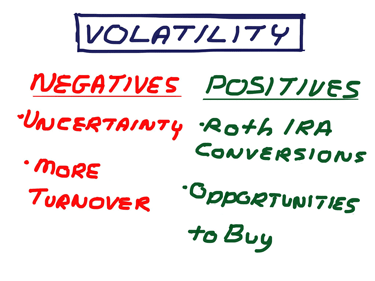
The magnitude of the moves is one reason market volatility is a topic of conversation. I suspect many people still view a 200-point move in the Dow Jones industrial average as significant. It’s not; 200 points represents less than 1% of the Dow’s value. Another reason is that the stock market is on pace to experience its most volatile year since at least 2011.
Through today’s close, the S&P 500 index has incurred a daily gain or loss of greater than 2% seven times year to date (six losses less than 2% and one gain in excess of 2%). This number already exceeds the total number of such days for 2012 (six), 2013 (four) and 2017 (zero). With nearly eight months still to go, 2018 is likely—but is not guaranteed—to have more days with a gain or loss in excess of 2% than 2014 (seven), 2015 (10) and 2016 (nine). If the S&P 500 does experience more such days over the next approximate seven and a half months, 2018 will be the most volatile year since at least 2011, when there were 35 days with gains or losses greater than 2% (21 up days and 14 down).
The volatility creates both opportunities and dangers, depending on how you react. I’m going to offer a few suggestions and point out things to watch for. Before I do, I want to share what I consider to be the most important point: If you’re feeling nervous about the volatility, the headlines, politics or anything else, don’t alter your portfolio. Rather, disengage (including ignoring news and not looking at your portfolio) until you get back into a calmer mood. You’ll make more rational decisions by doing so.
Here are some suggestions given the market’s volatility:
Roth IRA Conversions—If you have been thinking about or are intending to make a Roth IRA conversion, take advantage of the down days. The IRS only cares about the dollar amount converted, not the number of shares. So down markets can give you the opportunity to move more shares of a stock or fund (e.g., 110 shares instead of 100 shares) to a Roth IRA for the same dollar amount you will have to report on your taxes.
Think in Terms of Time Horizons—Money you don’t need for at least seven to 10 years should be allocated to stocks. You have more than enough time to ride out any volatility. On the other hand, money you need within the next few years should be allocated to cash. This cash bucket not only reduces the odds of having to sell stocks during a downturn, it can also give you peace of mind. Knowing your shorter-term needs are covered can give you the confidence to handle more volatility with your long-term investments.
Buy the Dips—CFRA Research’s chief investment strategist Sam Stovall found buying stocks during each 7% decline threshold in the S&P 500 (7%, 14%, etc.) can be a profitable strategy. In fact, he thinks an investor who followed such a strategy in the past “would have looked like a terrific market timer.”
Be Careful If You’re Using the 200-Day Moving Average—One portfolio strategy is to stay allocated to stocks when the S&P 500 (or a related benchmark) is above the 200-day moving average and to reduce the allocation when the index is below this long-term trend line. On Tuesday, the S&P 500 traded below its 200-day moving average. While strict adherents to the strategy may have viewed this as a reason to sell, a buy signal would have been generated following Wednesday’s close. In his book, “Stocks for the Long Run: The Definitive Guide to Financial Market Returns & Long-Term Investment Strategies” (fifth edition, McGraw-Hill, 2013), Jeremy Siegel suggested using a 1% band before buying and selling. This, he says, will result in fewer transactions. At current levels, the lower 1% band is approximately at 2,570—a level that the S&P 500 has yet to close below so far this year.
Downplay or Outright Ignore Forecasts—Lots of prognosticators are going to give advice about what to do. Relatively few will admit to lacking confidence in their predictions. Yet, a big part of the volatility is that market participants don’t know how trade policy will actually change and what new/revised tariffs will be implemented—much less their actual impact on the economy and earnings.
Ignore the Volatility—The constant focus on what the market did today has nothing to do with investors’ long-term goals. If you don’t need the money over the short term, then what happens over the short term shouldn’t matter as long as you end up where you need to be over the long term. Will there be adjustments to make along the way? Certainly, but they should be driven by your strategy and/or changes in your personal situation (age, lifecycle events, etc.) not whether Mr. Market is in a good or bad mood on a given day.
Have a Process and Follow It—Few things can keep you more disciplined than having a set list of rules and routinely following them. A written set of rules takes the emotion out of your decisions and helps you make more consistent, disciplined decisions.

- Real Returns Favor Holding Stocks – Jeremy Siegel explains why he views stocks as being good hedges against inflation. He also compared a 200-day moving average strategy to a buy-and-hold strategy.
- Charles Dow’s Theory Still Valid for the 21st Century – The recent volatility has led to some discussions about Dow Theory. Find out what it is and how to use it.
- Revisiting the Lakonishok Approach to Patient Value Investing – This value-oriented strategy uses price momentum to find bargain stocks with resurgent share prices.
- Model Shadow Stock Portfolio: Insights and a New Stock – AAII president John Bajkowski explains how small-cap stock investors are rewarded for enduring periods of short-term underperformance.
I will speak to our Boston chapter about investing at the intersect of value, momentum and quality on Tuesday, April 10.
First-quarter earnings season will officially start next week with some of the largest financial companies reporting: BlackRock Inc. (BLK) on Thursday and Citigroup Inc. (C), Dow component JPMorgan Chase & Co. (JPM), PNC Financial Services Group Inc. (PNC) and Wells Fargo & Co. (WFC) on Friday. Joining them will be fellow S&P 500 members Delta Air Lines Inc. (DAL) and Fastenal Co. (FAST), both of which will report on Wednesday.
The week’s first economic report will be the March Producer Price Index (PPI), released on Tuesday. Wednesday will feature the March Consumer Price Index (CPI) and the minutes from the March Federal Open Market Committee (FOMC) meeting. March import and export prices will be released on Thursday. The University of Michigan’s preliminary April consumer sentiment survey and February JOLTS report will be released on Friday.
Only one Federal Reserve official will make a public appearance: St. Louis president James Bullard on Friday.
The Treasury Department will auction $30 billion of three-year notes on Tuesday, $21 billion of 10-year notes on Wednesday and $13 billion of 30-year bonds on Thursday.
- Model Shadow Stock Portfolio: Insights and a New Stock
- Rebalancing Update: 4.5% Withdrawal Rate and Rolling Periods
- Are You Spending Too Little in Retirement?
Pessimism about the short-term direction of stock prices is at its highest level in more than seven months according to the latest AAII Sentiment Survey. At the same time, neutral sentiment is lower.
Bullish sentiment, expectations that stock prices will rise over the next six months, is unchanged at 31.9%. Optimism remains below its historical average of 38.5% for the seventh time in nine weeks.
Neutral sentiment, expectations that stock prices will stay essentially unchanged over the next six months, declined 1.3 percentage points to 31.5%. Neutral sentiment was last lower on February 14, 2018 (30.1%). Nonetheless, neutral sentiment remains above its historical average of 31.0% for the seventh consecutive week.
Bearish sentiment, expectations that stock prices will fall over the next six months, rose 1.3 percentage points to 36.6%. Pessimism was last higher on August 31, 2017 (39.9%). This is the first time bearish sentiment is above its historical average of 30.5% on consecutive weeks since November 30, 2017, and December 17, 2017.
After falling to its second-lowest level of the year on March 14, pessimism has rebounded by a cumulative 15.3 percentage points. Over the same three-week period, neutral sentiment has fallen by a cumulative 10.4 percentage points.
At current levels, all three sentiment measures are within their typical historical ranges.
Many individual investors are anticipating continued volatility and/or think that the current political backdrop could have a further impact on the stock market. Trade policy is influencing some individual investors’ sentiment, but not all. While many individual investors either approve of the recent interest rate hike or don’t expect it to affect the stock market, some are concerned about the impact that rising rates will have. Also influencing sentiment are valuations, tax cuts, earnings and economic growth.
This week’s special question asked AAII members how, if at all, they have recently adjusted their stock investing strategy. Half of the respondents (50%) said that they haven’t made any change to their strategy lately. Many of these respondents expressed satisfaction with their current strategy or described themselves as long-term investors. Several expressed a preference for value stocks and/or dividend payers. Slightly more than 30% of respondents said that they have altered their strategy, with some describing their changes as being more modest than significant in relation to their overall portfolio. The changes made varied considerably. The most common changes given were increasing cash, postponing buying new investments, adopting a more conservative approach, increasing small-cap exposure and favoring value stocks.
Here is a sampling of the responses:
- “I follow a dividend growth strategy and I don’t change it based on market conditions.”
- “I’m not changing anything. I’m satisfied with my portfolio.”
- “I’m waiting for a correction to add to my portfolio.”
- “Playing defense and raising cash during this financial storm.”
- “Focusing more on value than growth.”

Bullish: 31.9%, no change
Neutral: 31.5%, down 1.3 points
Bearish: 36.6%, up 1.3 points
Bullish: 38.5%
Neutral: 31.0%
Bearish: 30.5%
AAII Asset Allocation Survey
Individual investors’ allocations to equities are at their lowest level in five months according to the latest AAII Asset Allocation Survey. At the same time, fixed-income allocations are higher.
Stock and stock fund allocations declined for a third consecutive month, falling 0.4 percentage points to 69.7%. Equity allocations were last lower in November 2017 (68.6%). March was the 60th consecutive month that equity allocations were above their historical average of 61.0%.
Bond and bond fund allocations rebounded by 0.6 percentage points to 15.6%. This is the fifth time in seven months that fixed-income allocations are below their historical average of 16.0%.
Cash allocations pulled back by 0.3 percentage points to 14.7%. The decline puts cash allocations below their historical average of 23.0% for the 76th consecutive month.
Fixed-income allocations remain in a 0.6 percentage-point range. Since December 2017, bond and bond fund allocations have fluctuated between 15.0% and 15.6%.
Though equity fund allocations have decreased for three consecutive months, the absolute change is modest. Since rising to 72.0% in December, the cumulative pullback is just 2.3 percentage points. This modest decline has occurred as optimism in our weekly Sentiment Survey has been below average for five consecutive weeks and six out of the last eight weeks.
Last month’s special question asked AAII members what impact the rise in interest rates was having on their portfolio allocation decisions. Slightly less than half of all respondents (48%) said they haven’t altered their portfolio in response to the higher rates. Among the reasons given were a focus on a long-term strategy, the increase in interest rates hasn’t been large enough or their bond allocation has already been adjusted for a rising interest rate environment.
Answers from the other respondents were very mixed. Nearly 10% said that they have raised cash. Certificates of deposit were specifically mentioned by 4% of respondents. Eight percent of respondents said they’ve reduced their bond allocations and 3% are avoiding bonds, while 6% have increased their fixed-income exposure. An additional 3% are postponing purchasing bonds for now. Slightly less than 3% said they’ve reduced their equity exposure because of interest rates, while 2% are buying stocks.
Here is a sampling of the responses:
- “No impact. I set a desired asset allocation and am staying the course.”
- “Nothing immediately, but I will probably move some cash into fixed-income instruments in the near future.”
- “Moved from bonds and bond funds to cash, money market funds and fixed-return investments.”
- “Holding/reducing bond exposure and have invested in short-term durations.”
- “I don’t think there is enough inflation to be really concerned about my allocation of investments.”
- Stocks Total: 69.7%, down 0.4 percentage points
- Bonds Total: 15.6%, up 0.6 percentage points
- Cash: 14.7%, down 0.3 percentage points
- Stocks: 32.3%, up 1.8 percentage points
- Stock Funds: 37.4%, down 2.2 percentage points
- Bonds: 2.5%, down 0.1 percentage points
- Bond Funds: 13.1%, up 0.7 percentage points
Take the Asset Allocation Survey.
Local Chapter Meetings

March 29, 2018 An Argument for Favoring the Loser Over the Winner Funds
March 22, 2018 The Different Types of Risk
March 15, 2018 Risk Tolerances Change With Both Age and the Market
March 8, 2018 Tariffs and the Market Environment