


Related
Trading Strategies
The stocks investors buy, on average, underperform the ones they sell due to behavioral errors, such as overconfidence.

Charles Rotblut leads a class in AAII's new Essential Investing Video Course. Go to https://www.aaii.com/ves for more information and to subscribe.
Terrance “Terry” Odean is the Rudd Family Foundation Professor of Finance at the Haas School of Business at the University of California, Berkeley. He and I spoke about the impact active trading has on portfolio performance. Bonus audio of our conversation can be accessed here.
—Charles Rotblut
Charles Rotblut (CR): You’ve done quite a bit of research into the performance of individual investors. Could you comment on what you’ve found?
Terrance Odean (TD): One of the first things I looked at in my research was the performance of individual investors. I did this because I had written a theoretical paper about how markets would be different if investors and traders were overconfident. The prediction in the theoretical paper was that overconfident investors would trade more actively, they would tend to perform less well because they thought they knew more than they actually knew and that volatility would usually go up in the markets. Also, overconfident investors would tend to underdiversify because when you’re sure you’re right, you don’t feel there’s a need to diversify.
I was able to obtain, from a large discount brokerage firm, trading records with which I wanted to test the prediction that investors were trading too much. I also wanted to test whether there was a disposition effect, a tendency to hold onto losers and sell winners. It took me about 11 months to get the trading records. I contacted dozens of firms; many of them just ignored my request and others politely said no. Even the firm that eventually helped me said no the first couple of times. But I was eventually able to get trading records for 10,000 investors over a seven-year period, and then later I got another data set for 78,000 investors.
On the performance side, what I found was that, on average, the stocks that these investors bought went on to underperform the stocks they sold. If an investor sold one stock and bought another, odds were that the one he sold subsequently outperformed the one he bought. And, of course, he also paid commissions and bid-ask spreads. A reasonable metric for how much to trade—or whether, at least, you want to trade—is that, on average, you would like the stocks you buy to outperform the ones that you sell by enough to cover your trading cost. By this standard, these investors were trading too much.
Of course, there are other reasons to trade. People might trade for rebalancing purposes or they might trade for tax purposes—selling some of their losing investments, for example, particularly just before the end of the tax year. People might trade for liquidity reasons. You might sell investments to pay a tuition bill for your college-age student. So I tried to filter out trades that seemed more likely to have been made for non-speculative reasons. For example, I only considered cases where somebody sold a stock for a gain and bought another stock within three weeks—indications that the sale wasn’t tax-driven or liquidity-driven.
When I focused on trades that were most likely speculative, performance actually got worse, not better. When I looked at all trades, the stocks people bought, on average, underperformed the ones that they sold by about three percentage points over the next year. When I focused on speculative trades, the stocks bought underperformed stocks sold by about five percentage points over the next year.
There’s another study that Brad Barber (a professor at the University of California, Davis) and I did a year or two later looking at 66,000 of the investors in the second data set. We did something really simple: We divided investors into five groups based on how actively they were trading. Our prediction was that the more active traders, who are also likely to be the more overconfident traders, would trade too much and end up with lower performance after paying their trading costs. And that’s exactly what we found. We found that the buy-and-hold investors, after trading costs, were outperforming the most active investors by about six or seven percentage points a year. [Figure 1 shows a chart from this study.]
The white bar represents the net annualized geometric mean return for February 1991 through January 1997 for individual investor quintiles based on monthly turnover, the average individual investor, and the S&P 500. The net return on the S&P 500 Index Fund is that earned by the Vanguard 500 Index fund (VFINX). The blue bar represents the monthly turnover.
Households that trade frequently earned a net annualized geometric mean return of 11.4%, and those that trade infrequently earned 18.5%, based on position statements and trading activity for 78,000 households at a large discount brokerage firm over a six-year period ending in January 1997.
Source: “Trading Is Hazardous to Your Wealth: The Common Stock Investment Performance of Individual Investors,” Brad M. Barber and Terrance Odean, The Journal of Finance, Volume LV, Number 2, April 2000. © John Wiley & Sons.
Finally, Brad and I took one more look at this topic. My theory predicted that overconfidence would lead people to trade more and, as a result, earn less. We thought that ideally we’d like to separate our sample into investors who were more overconfident and investors were less overconfident and this would give us clear predictions. We predicted that the more overconfident group would trade more, and we predicted that their returns would be hurt by this trading. We didn’t have a way to administer psychological tests of overconfidence to the tens of thousands of investors in our database, but for 35,000 of them, we had quite a bit of demographic information. We separated our sample into men and women since there is some evidence from the psychology literature that—particularly in areas like mathematics, mathematical sciences and finance—men tend to be more overconfident than women. Our prediction was that men would trade more than women and that this trading would hurt men’s returns. And that’s what we found: Men traded 45% more actively than women.
We looked at a number of different measures of risk-adjusted returns, but really the most relevant one was the effect of trading on someone’s returns. So for every account, we looked at what was in the account at the beginning of the year and then calculated what that account would have earned that year if the investor had not traded at all. Then we calculated what the account actually earned. We subtracted the buy-and-hold return from the actual return. And we found that both men and women on average underperformed the buy-and-hold approach to investing, but that men underperformed by one percentage point more a year than women.
CR: It sounds like disposition effect is a factor. I know it comes up in a lot of your research. Could you explain what the disposition effect is and what role it plays?
TO: Sure. A couple of friends of mine, Meir Statman and Hersh Shefrin, wrote a theoretical paper based on Daniel Kahneman’s and Amos Tversky’s work predicting that investors would tend to hold onto their losing investments and sell their winning investments. I wanted to test this prediction using trading records from individual investors. When I did, I found that there was a strong tendency for people to sell their winners and hang on to their losers.
There are different ways you can think about why we do this, but I think the simplest one is just to consider regret. If you buy a stock and sell for a loss, you probably feel a little bit bad. You feel some regret. If you hold onto it, you can tell yourself, well, maybe it’s going to bounce back, it’s only a paper loss, let’s wait and see. And then on top of that, if you buy a stock and sell it for the loss and then the stock bounces back, you’re going to feel doubly bad. If you buy something and you sell it for a gain, you feel good. Sure, it might go on to do better in the future, but you’ll say I don’t need to be greedy, I made money on that, I feel pretty good about it.
So I think to some extent, selling winners and holding onto losers is just something investors do to manage their own emotions in the process of investing. Unfortunately, this behavior does not improve performance. So while investors may feel better about investing, they don’t end up richer.
CR: Do you think people are consciously trying to avoid loss, or do you think it’s more of an unconscious decision?
TO: What I think happens is when people buy stocks or any investments, they really focus on the future. When they sell, I think a lot of investors focus on the past.
There are two reasons they might focus on the past. One is for tax purposes, and that makes a good deal of sense. If it’s the end of the year, and the investor has some taxable investments that have lost value, it may make sense to sell them. But the other reasons why people are backward-looking when they sell is because of this regret issue. People feel good selling for gain so they sell the winners. They hold onto their losers to avoid the regret of selling for a loss.
I’m sure many investors rationalize these decisions, but in the end, I think these are emotional decisions. Sell decisions are not made the same way buying decisions are made. When buying, people focus on the future. They only look to the past in hopes that it will predict the future. Aside from tax considerations, sellers should also care about the future. They should ask themselves “is this investment a good investment to hold going forward?” rather than “will I feel good or bad if I sell this stock?”
CR: What about anchoring? Do you think some people are also thinking, “I paid $20 for this stock and now it’s trading at $15?” Is that playing a role in their decision as well?
TO: Yes, anchoring certainly does play a role. The first role it plays is that it sets your reference point. How do you judge something as a gain or loss? The most common way investors determine gains or losses is by the price that they paid. But there are other reference points that can play a role.
I used to trade quite a bit before I became an academic and certainly before I studied finance. Like other investors, I had my ups and downs. One of my experiences that was painful at the time, but also quite educational, was that I bought put warrants on the Nikkei index. This was probably around 1989 or so. The Nikkei was at around 30,000 and it got up to about 39,000, almost to 40,000. I bought put warrants on the way up and my puts lost about 90% of their value. I think I paid about $20,000 and my position was down to almost $2,000. Then, the Nikkei started falling and my put warrants started going up. They rose to around $6,000 or $7,000. I remember I felt really bad when the value of my position was down near $2,000. But from an emotional point of view, it never even occurred to me to sell at $2,000 because I’d lost 90% of my investment. I felt that, emotionally, if I sold at that point I wouldn’t feel much different than if I lost it all. When it got back up to $6,000 or $7,000, I remember thinking about the investment in terms of two different reference points. One: It was worth about third of what I paid for it, but, two, I was also very aware that it was now worth about three times the low point. I sold some of my position at that point. I held onto the remainder until I was back in the money and was able to sell some of the put warrants for a profit. As it turns out, if I had held onto everything I would’ve made quite a profit, because the Nikkei dropped a lot.
There’s some academic literature that shows that people focus not only on what they paid for something, but also on low points and high points that affect their sense of gain and loss. So if you bought something, high points can become new reference points. I knew some neighbors who had bought a house pretty cheaply. Years later a real estate agent told them that the house was worth much more money, and the higher price became their new reference point. When the real estate market dropped again, they had a very difficult time adjusting to the drop. They no longer were thinking about gain and loss in terms of what they paid. Rather, they were thinking of their gain or loss in terms of the price at which they might have sold their house.
CR: I know you’ve done a study of Taiwanese traders and, if I remember correctly, you said that they weren’t actually learning from their experiences. Even when traders lost money, they kept day trading.
TO: Right. Brad Barber and two of my colleagues in China, Yi-Tsung Lee and Yu-Jane Liu, looked at day traders in Taiwan. There are a lot of day traders in Taiwan and they trade very actively. What we found was that day traders did eventually tend to respond to outcomes; that is, day traders who had lost money over and over and over again were more likely to quit day trading than those who had been very successful. But these people generally sustained losses for a long time before they quit. Really, it’s a very small minority, in the neighborhood of 1%, who appeared to be able to make money after costs through their skill. The vast, vast majority of day traders were losing money. Unless you really had a strong reason to think that your ability to day trade was much greater than that of most people, it made no sense to start day trading in the first place. It’d be like, to some extent, going into a casino and saying I’m really good at roulette; even though I know everyone else loses money at roulette, I’m going to win.
CR: Do you think there’s any difference between the Taiwanese day traders and the American day traders in terms of culture or personality, or do you think there’s an overlap in terms of the mindset?
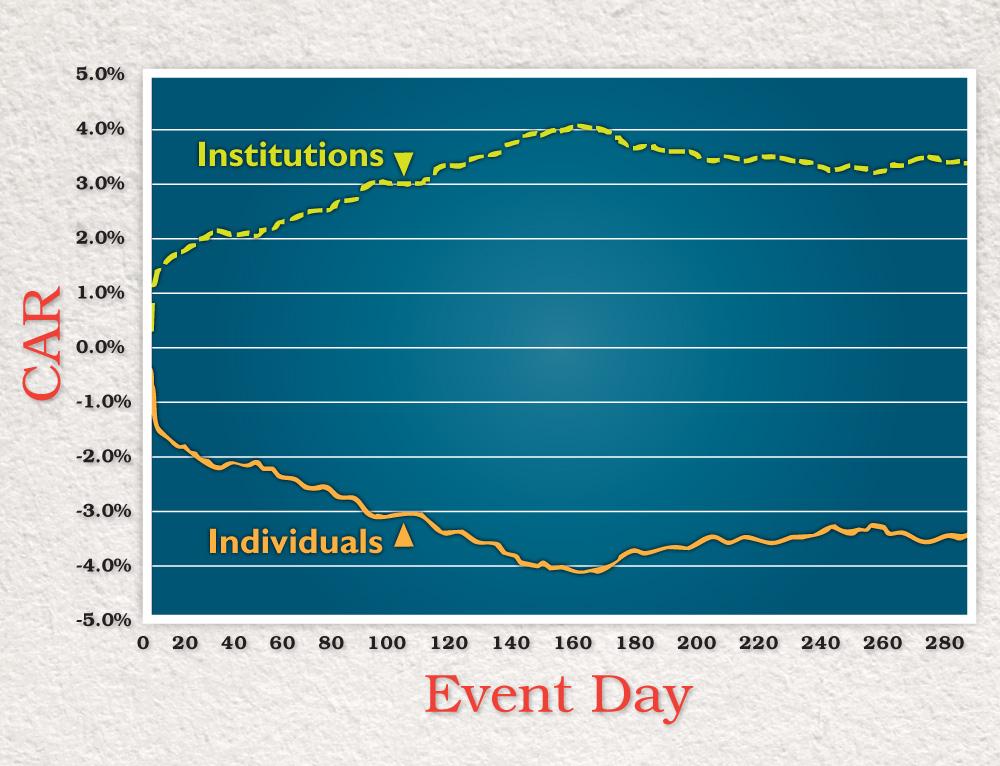
TO: There are differences and there are overlaps. In general, the Taiwanese investors trade much more actively than the U.S. investors, and they pay for that. We did another study, the same co-authors and I, and just looked at the cost of trading to the individual investors in Taiwan. [See Figure 2 for a chart showing related results from this survey.]
CAR=cumulative (market-adjusted) abnormal return
Chart shows the extent to which returns differed from expectations for stocks bought less stocks sold by institutions and individuals weighted by the net value of stocks bought and sold. Stocks that are net bought by institutions outperform those that are net sold by four percentage points after 140 trading days.
Source: “Just How Much Do Individual Investors Lose by Trading?,” Brad M. Barber, Yi-Tsung Lee, Yu-Jane Liu and Terrance Odean, The Review of Financial Studies, Volume 22, Issue 2, 2009. © Oxford University Press.
We looked at individual investors as a group and we calculated what they were making or losing from trading with institutional investors. On average, if an individual investor bought something from an institutional investor and sold the institutional investor something else, the institutional investor ended up on the better side of both trades. We also factored in commissions, taxes—in Taiwan there is a stamp tax, that is, a transactions tax—and we looked at market timing. When we added all of these things together, individual investors’ trading was costing them the equivalent of about 2% of GDP [gross domestic product]. It was reducing the return on their aggregate portfolio by about 3.7 percentage points a year. So one difference is that Taiwanese investors trade really actively and there are a lot more day traders, percentage-wise, than there are in the U.S.
There are some other differences that favor the Taiwanese. For example, if you place a trade in Taiwan as an individual, chances are the person on the other side of that trade is also an individual. So you’re trading with someone who, on average, doesn’t have any better information than you do.
When an individual investor in the U.S. places a trade, chances are the counterparty to that trade—the person on the other side of the trade—is an institutional investor. And institutions often do have more and better information than the average individual investor. So U.S. investors have to deal with more asymmetric information risk—the risk that they’re trading with someone who knows something they don’t know.
CR: Do you think U.S. investors are overconfident by not considering the expertise of the competition on the other side of the trade?
TO: What always amazes me when I talk to investors is how few ask themselves who’s on the other side of their trades. Whether you’re buying a stock, an option or a futures contract, there’s someone else who’s willing to sell it to you. And if you’re selling, there’s someone buying it. You should really be asking yourself, well, if I’m buying this, why is someone willing to sell it to me? And who do I think that seller is and do I really think I know more than that person does?
Now, I’m not talking about buying a well-diversified portfolio and holding it for many years. You do that because you need to invest for your future retirement. If you’re buying a well-diversified portfolio, it’s a very reasonable thing to do and you just go with the prevailing price.
But if you’re actively trading, then you’re making short-term bets on what’s going to go up and what’s going to go down. And you’ve got to figure that you’re trading with someone else who’s making bets on the other side, and it’s very likely that person makes their living trading. So why do you think you know more than that person does?
CR: Given these biases and these errors, what suggestions do you have for investors so they don’t keep making some of the same mistakes?
TO: There are different levels of advice here. I think that most investors should be buying well-diversified low-cost mutual funds, such as open-end index funds or low-fee ETFs [exchange-traded funds]. If you want to trade individual common stocks, consider putting most of your long-term savings in low-cost mutual funds and trading stocks with a smaller proportion of your wealth.
Let’s say you are trading in individual stocks. I think the best thing to do to deal with your biases is to come up with some reasonable rules that you try to adhere to. Doing so can help to offset some of the well-known biases and emotional responses.
For example, you could come up with rules for when you are going to sell a position that’s at a loss. There are various things you might do in a taxable account: You could say, “When it’s a couple months before the end of the tax year, I am going to sell my losing positions.” This makes sense from a tax point of view and doing so gives you the opportunity to break that emotional bond of holding onto losers.
Be careful about chasing performance: Don’t buy something just because it went up last month or last year. Make yourself write down the reasons that you’re purchasing a stock or fund. Another thing that Brad Barber and I found in our research is that a lot of investors simply buy stocks that catch their attention. So generally, I’d say don’t buy impulsively, don’t buy something because—I’m sure none of your readers do this—because Jim Cramer recommended it. Don’t even buy because you read about it in The Wall Street Journal this morning and thought, wow, that sounds like a great idea. Put a little more research into your decisions and try not to be impulsive.
Trading Strategies


Murray Gendell from VA posted over 11 years ago:
Jeff Goodsill from MA posted over 11 years ago:
Charles Rotblut from IL posted over 11 years ago:
Randall Huleva from CA posted over 11 years ago:
Scott Sneddon from CA posted over 11 years ago:
Scott Sneddon from CA posted over 11 years ago:
You need to log in as a registered AAII user before commenting.
Log InCreate an account