The new tax law provides a few incentives for taking advantage of Roth IRAs and similar types of retirement accounts. It also preserves the contribution limits in effect prior to this year for both tax-deferred and aftertax accounts. Roth IRA conversions, however, can no longer be undone.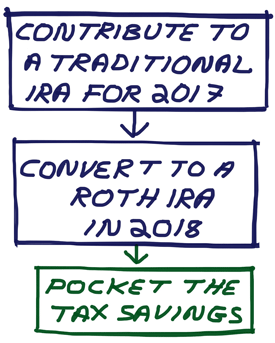
I bring this up now because you currently have the chance to take advantage of a little tax arbitrage. Contributions to a traditional individual retirement account attributable to the 2017 tax year can be made up to April 17, 2018. The contributions are deductible, though income limits apply to those who are covered or have a spouse who is covered by retirement plan at work.
In 2018, many taxpayers will see their marginal tax rates decline by a range of two to four percentage points. Some will see an even bigger drop in their marginal tax rates because the income brackets have widened. The differential in tax rates allows a taxpayer to deduct an IRA contribution at the higher tax rate on their 2017 tax return and then convert the same dollar amount at the lower 2018 tax rate. (Roth IRA conversions are taxable events.) The net savings is money in their pocket.
An example might add some clarity. A married couple, Bob and Sue, have adjusted gross income of $150,000 in 2017, putting them in the 25% tax bracket. Bob is covered by a workplace retirement plan, but Sue isn’t. They make a 2017 tax-year contribution of $5,500 to Sue’s traditional IRA. This deductible contribution results in a tax savings of $1,375 ($5,500 × 25% = $1,375).
The Tax Cuts and Jobs Act (TCJA) lower’s the couples tax rate this year (2018) to 22%. They convert the $5,500 in Sue’s traditional IRA to a Roth IRA. The conversion results in tax liability of $1,210. Though Bob and Sue will have to pay extra tax this year, they still come out ahead by $165 ($1,375 deduction – $1,210 taxes = $165). While $165 may not be a lot relative to the size of Bob and Sue’s overall portfolio, it is still a nice sum of money for filling out a just a few forms to facilitate the conversion. Plus, the actual savings could be greater if a person is able to take advantage of the extra $1,000 catch-up contribution for those age 50 to 70 and/or has an even bigger decline in their marginal tax rate.
Why not just make a direct Roth IRA contribution instead? The reason is the tax arbitrage. The contribution is being made at the higher 2017 tax rate, while the conversion is being made at the lower 2018 tax rate.
The arbitrage only works if your 2018 tax rate will be lower than your 2017 tax rate. Changes regarding various deductions (e.g., the $10,000 cap on state and local taxes) and exemptions (e.g., the repeal of the personal exemption) will cause some taxpayers’ adjusted gross income to rise, so make sure you have a reasonable idea of what your 2018 taxes will be. The March AAII Journal will have an updated tax guide discussing the TCJA.
You are, of course, not just limited to converting contributions made to an IRA last year. You can also use the now lower tax rate to convert contributions made during previous years. In addition, you can convert contributions made to a 401(k) plan to a Roth 401(k) plan, if doing so is an option. When making conversions, make sure the total dollar amount being converted does not inadvertently push you into a higher tax bracket.
Keep in mind that once you make a Roth IRA conversion, you can no longer undo it. Prior to the start of this year, doing so was an option—and a beneficial one for taxpayers during down markets. This is no longer the case. Still, the potential long-term tax advantages of a Roth IRA may outweigh any short-term regret over timing of the conversion.

- Tax Uncertainty and Traditional Versus Roth IRAs – Roth IRAs are preferable for those with high or low incomes; workers with moderate incomes should use both types of accounts.
- IRA Rollover Chart: Rules Regarding Rollovers and Conversions – This helpful chart shows which types of retirement accounts can be rolled over or converted into another type.
- The Individual Investor’s Guide to the Top Mutual Funds 2018 – Our annual mutual fund guide is fully updated. The online version of this guide has information on nearly 1,600 funds.
- Prioritizing HSA Contributions and 401(k) Contributions – It can make sense to contribute to a health savings account before contributing to a 401(k) plan if certain conditions are met.
No changes were made to the Model Shadow Stock Portfolio last month.
The Model Shadow Stock Portfolio, which is a real-money portfolio of micro-cap value stocks, lost 2.9% in January. The Vanguard Small Cap Index fund (NAESX) added 2.8% for the month, and the DFA U.S. Micro Cap fund (DFSCX) added 2.0% in January.
Since its inception in 1993, the portfolio has a compound annual average return of 15.7% versus the Vanguard 500 Index fund’s (VFINX) gain of 9.7% per year on average over the same period. Over the same period, the Vanguard Small Cap Index fund (NAESX) posted an average annual gain of 10.4%.
The U.S. financial markets will be closed on Monday, February 19, in observance of Presidents Day.
I will speak to our Chicago chapter about investing at the intersect of value and momentum on Saturday, February 24.
The earnings calendar lists 54 S&P 500 companies as being scheduled to report, including Dow Jones industrial average components Home Depot Inc. (HD) and Walmart Inc. (WMT). Both retailers will report on Tuesday.
The week’s economic reports will be the February Purchasing Managers’ Index (PMI) composite flash, January existing home sales and the January Federal Open Market Committee (FOMC) meeting minutes, all of which will be released on Wednesday.
Four Federal Reserve officials will make public appearances: Minneapolis president Neel Kashkari on Wednesday; Atlanta president Raphael Bostic on Thursday; New York president William Dudley on Thursday and Friday; and Cleveland president Loretta Mester on Friday.
The Treasury Department will auction $28 billion of two-year notes on Tuesday, $15 billion of two-year floating rate notes (FRNs) and $35 billion of five-year notes on Wednesday and $29 billion of seven-year notes on Thursday.
- The Individual Investor’s Guide to the Top Mutual Funds 2018
- Achieving Greater Long-Term Wealth Through Index Funds
- Stock Market Retreats and Recoveries
Optimism among individual investors about the short-term direction of stock prices rebounded strongly and pessimism plunged in the latest AAII Sentiment Survey. The changes put bullish and bearish sentiment at a four-week high and low, respectively.
Bullish sentiment, expectations that stock prices will rise over the next six months, jumped 11.5 percentage points to 48.5%. Optimism was last higher on January 17, 2018 (54.1%). This week’s increase puts bullish sentiment back above its historical average of 38.5% for the ninth time in 10 weeks.
Neutral sentiment, expectations that stock prices will stay essentially unchanged over the next six months, rose 2.1 percentage points to 30.1%. Even with the increase, neutral sentiment remains below its historical average of 31.0% for the 11th consecutive week.
Bearish sentiment, expectations that stock prices will fall over the next six months, fell 13.6 percentage points to 21.4%. Pessimism was last at this level on January 17, 2018. This week’s drop puts bearish sentiment below its historical average of 30.5% for the ninth time in 10 weeks.
This week’s jump puts bullish sentiment at the top of its typical historical range. The breakpoint between typical and unusually high readings is 48.6%. During the first seven weeks of 2018, bullish sentiment has averaged 48.3%.
The survey period runs Thursday through Wednesday, with email reminders sent out to a rotating group of AAII members every Monday. Prior to the recent correction, some AAII members said they were looking for a drop in prices to either reduce valuations and/or buy stocks. As the responses to this week’s special question show, many individual investors saw the correction as being related to the market specifically and not signaling any change in the economy.
This week’s special question asked AAII members which factors are most influencing their six-month outlook for stock prices. The possibility of higher interest rates or the direction of interest rates in general topped the list, named by 18% of respondents. Earnings, particularly earnings growth, was second, listed by 17% of respondents. A close third was tax cuts, named by just under 17% of respondents. Some AAII members said tax cuts will boost earnings, while others expressed uncertainty or skepticism about their impact. Almost 10% of respondents discussed the correction. Some thought it was overdue, some thought it was just a temporary drop, while a few thought it could be a sign of lower prices to come. Also mentioned were concerns about the federal debt, politics and valuations. The majority of respondents listed more than one factor.
Here is a sampling of the responses:
- “Tax cuts will translate into higher corporate profits.”
- “I think we will recover from last week’s panic, especially as earnings and other economic indicators remain strong.”
- “Inflation, interest rates and unexpected world events.”
- “Equal force at present: Rising rates, inflation and central bank balance sheets versus earnings growth and fundamentals.”
- “Politics, earnings and interest rates.”

Bullish: 48.5%, up 11.5 points
Neutral: 30.1%, up 2.1 points
Bearish: 21.4%, down 13.6 points
Bullish: 38.5%
Neutral: 31.0%
Bearish: 30.5%
Local Chapter Meetings

February 8, 2018 Volatility, and Not Seeing the Forest for the Trees
February 1, 2018 Two Important Rules Go Into Effect on Monday
January 25, 2018 Partisan Conflict and Market Volatility
January 18, 2018 Comparing the 2018 Melt Up to the 1999 Bubble