


Related

ETFs and Mutual Funds
ETFs, and mutual funds to a limited extent, pave the way for individual investors to gain exposure to cryptocurrency and other securities in the digital-asset ecosystem.
Love it or hate it, digital assets are a part of mainstream investment options. Cryptocurrency and blockchain are heterogeneous, and their universe covers a varied landscape—not unlike going from a scorching desert to cool wetlands in a short trip. More specifically, the digital-asset umbrella includes cryptocurrency assets such as bitcoin and ethereum, stablecoins, nonfungible tokens (NFTs) and decentralized financial assets.
Thematic strategies expand this universe by investing in companies comprising the digital-asset ecosystem. These companies include cryptocurrency miners, blockchain technology providers and users, as well as other enabling technologies.
Digital assets are known for both volatility and momentum. Each of these assets is unique and warrants a thorough understanding and careful evaluation before investing in mutual funds or exchange-traded funds (ETFs) that hold them.
Bitcoin and ethereum are the best-known cryptocurrencies, but they have very different uses. Bitcoin was created as an alternative to fiat currencies, while ethereum is the locomotive for the ethereum network. Bitcoin is stored on a distributed ledger called a blockchain. Blockchain transactions are registered and linked together cryptographically in a string of blocks that cannot be modified.
The ethereum network is a platform designed for applications like stablecoins, NFTs and decentralized applications and is tied to the ethereum blockchain. A stablecoin is linked to a fiat currency like the U.S. dollar or the Japanese yen.
Cryptocurrencies have presented a regulation puzzle, falling into a gray area. The U.S. Securities and Exchange Commission (SEC) doesn’t view them as securities, whereas the U.S. Commodity Futures Trading Commission (CFTC) views them as commodities. Last month, the U.S. House of Representatives passed a bill that would establish regulation for digital-asset markets. The bill places the bulk of cryptocurrency regulation under the CFTC.
Traditional lines between brokers, custodians and exchanges don’t exist in cryptocurrency markets. Investors can buy and sell cryptocurrency on centralized exchanges like Coinbase. Retail brokerages such as Fidelity, TradeStation and Robinhood offer cryptocurrency trading. There are also decentralized exchanges that specialize in trading cryptocurrency; these have done away with intermediaries and instead use preprogrammed smart contracts on a blockchain to connect buyers and sellers.
Trading cryptocurrency through a centralized counterparty is often expensive when compared with trading equities, ETFs or mutual funds. Fidelity includes a 1% spread in its quoted prices. Many brokerages offer investors free or low-cost trading. Though Robinhood touts zero-commission cryptocurrency trading on five platforms and a wide range of currencies including stablecoins, it routes orders to its preferred third parties for execution.
How large and liquid is the digital-asset marketplace? As of mid-June 2024, the global cryptocurrency market is $2.5 trillion, compared to $45.4 trillion for the S&P 500 index. Bitcoin currently represents $1.3 trillion of cryptocurrency’s market capitalization.
CoinMarketCap.com tracks price, trading volume and other statistics for over 10,000 cryptocurrencies. Liquidity is measured as trading volume divided by market cap for the past 24 hours. Market cap considers a cryptocurrency’s circulating supply. On June 17, 2024, bitcoin’s volume per market cap was 2.91% and ethereum’s was 4.86%. This implies that most of the value of these two cryptocurrencies is not being traded on a daily basis.
Cryptocurrency-related funds must be approved by the SEC. Earlier this year, bitcoin ETFs were allowed to be launched. The SEC has approved ether ETF applications but not the actual launch of such funds as we write this article.
ETFs, and mutual funds to a limited extent, pave the way for individual investors to gain exposure to cryptocurrency and other securities in the digital-asset ecosystem. The mutual fund and ETF structure provides investors convenience by eliminating the need for a crypto wallet or separate account. Funds trade on regulated exchanges and holdings are held with qualified custodians.
ETFs might be futures-based, relying on contracts for future delivery rather than direct asset ownership, or they might operate as grantor trusts, where the fund holds the actual assets. Spot ETFs directly invest in the underlying digital assets. Additionally, management styles vary, with some ETFs tracking specific indexes and others adopting active management strategies.
Trading digital-asset ETFs offers advantages over direct cryptocurrency investments, particularly in terms of liquidity and ease of access via exchanges. These ETFs tend to have better liquidity and higher trading volumes compared to direct trading on platforms like Coinbase. Understanding buy/sell orders and trading strategies is essential for navigating this market effectively.
Premiums and discounts to net asset value (NAV) are not unusual for ETFs and vary widely. Due to differences in price movements between the underlying assets and the creation and redemption process, ETF prices and their NAVs do not always line up. Over longer periods of time, premiums and discounts tend to shrink or are structural and explainable. Using limit orders to buy or sell ETFs can help with situations where ETFs are experiencing temporary volatility and/or the ETF’s underlying assets are infrequently traded, especially in specialty markets such as digital assets.
A limit order can also help with orders placed at the opening or closing of markets, which may have greater price volatility. (We suggest avoiding trading during the first and last half hour of the market day, when possible, because of the greater volatility.) Checking the last trade date and the average daily trading volume should provide further insights into the nature of the discrepancies.
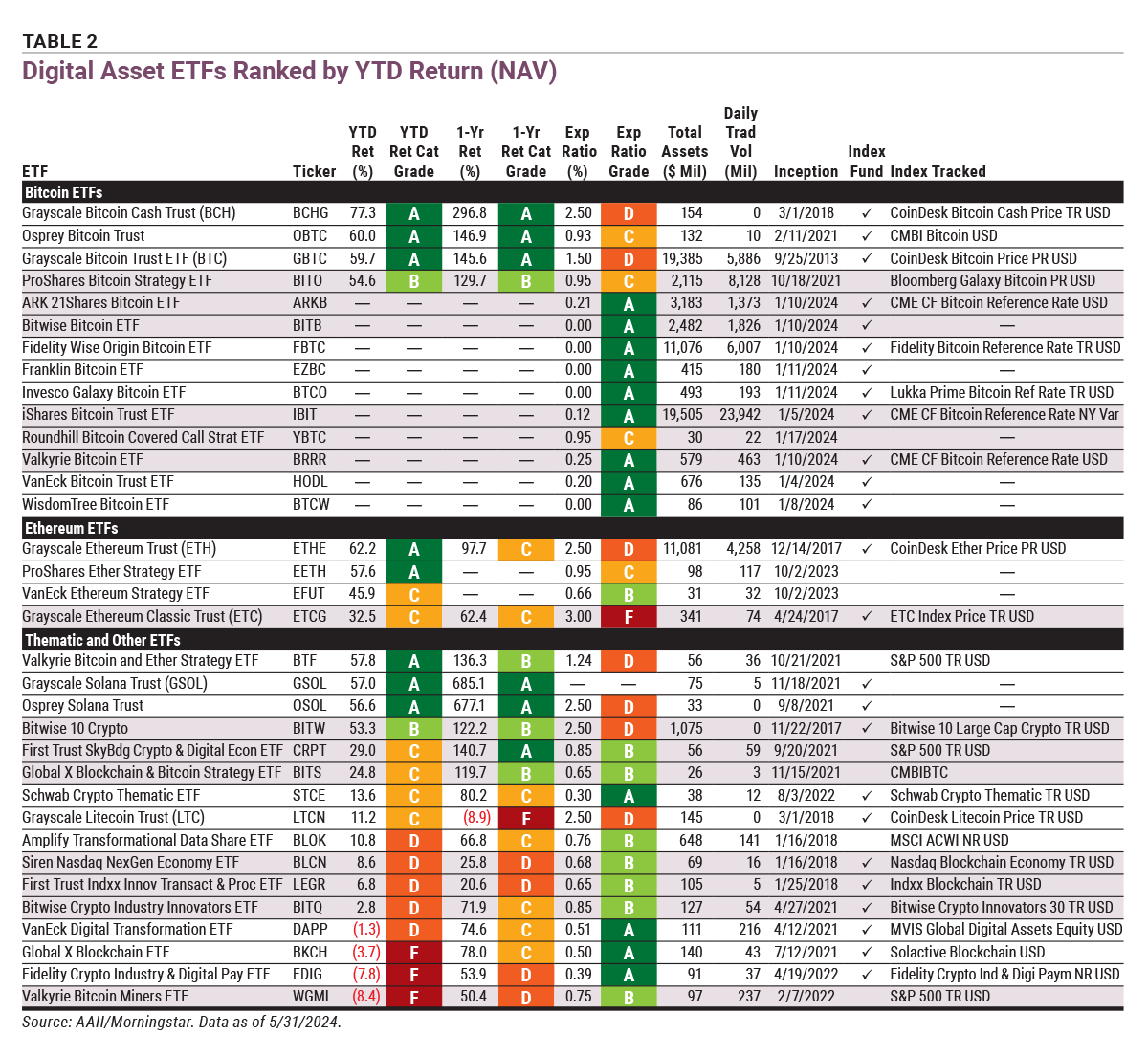
Table 1 displays two mutual funds that focus on investing in bitcoin, and Table 2 displays ETFs that cover cryptocurrency and digital-asset thematic strategies. In Table 2, we excluded all ETFs that did not have at least $25 million in assets. ETFs are grouped by bitcoin, ethereum or thematic/other. Inverse and leveraged strategies were excluded.

Download the Excel spreadsheet of Table 1.
The mutual funds and ETFs in the digital-asset category lack long-term track records. Since most lack even a three-year track record, performance is ranked by year-to-date returns with one-year returns included, if available. Bitcoin ETFs include 10 that were recently launched. These are presented in alphabetical order since they lack a year-to-date performance record. For mutual funds and ETFs that track an index, the index is also listed.
We filtered for no-load mutual funds that are accessible to all individual investors. There are only two digital-asset mutual funds meeting these criteria. Both are actively managed and focus on bitcoin. The Bitcoin Strategy ProFund Investor fund  (BTCFX) gains exposure to bitcoin through entering bitcoin futures contracts. Year-to-date and one-year performance are above the digital-assets category average at 53.4% and 126.2%, respectively with A+ Investor Grades of A. The expense ratio of 1.41% is high on an absolute basis and also above the average of its category peers (grade of D), reflecting the active management of futures contracts.
The Vest Bitcoin Strategy Managed Volatility Investor fund (BTCLX) takes a different path. The fund invests in a combination of bitcoin futures and cash investments. The performance is designed to achieve total return with the aim of both managing fund volatility and limiting losses due to severe sustained decline. Its year-to-date return of 51.6% and one-year return of 117.8% rank near the bottom among the six mutual funds in the digital-asset category (grades of F). (The category includes four institutional-only funds.) Its expense ratio of 1.24% is high on an absolute level but average among its peers (grade of C).
Investors can choose from an eclectic variety of digital-asset ETFs. Spot bitcoin ETFs are the largest category of comparable products in Table 2. Spot bitcoin ETFs are designed to directly track the current market (“spot”) price of bitcoin.
Download the Excel spreadsheet of Table 2.
In January 2024, the SEC approved 11 spot bitcoin ETFs. Out of those 11, 10 met our requirement for a minimum of $25 million in assets. These are shown in Table 2, along with four older bitcoin ETFs that have performance figures.
Trading volumes have mostly been low so far: Volume in the Grayscale Bitcoin Cash Trust (BCHG) was 4.7 million shares on June 14, 2024. For comparison, the large-cap SPDR S&P 500 ETF Trust (SPY) had volume of over 40 million shares on the same day. The Grayscale Bitcoin Cash Trust had previously traded on the over-the-counter (OTC) market and was moved to the NYSE Arca exchange upon approval. It is the oldest ETF shown in Table 2. The ETF has taken some heat over its high expense ratio (2.50%).
Expense ratios for the Bitwise Bitcoin ETF (BITB), the Fidelity Wise Origin Bitcoin ETF (FBTC), the Franklin Bitcoin ETF (EZBC), the Invesco Galaxy Bitcoin ETF (BTCO) and the WisdomTree Bitcoin ETF (BTCW) are currently 0.00%, reflecting fee waivers. These waivers typically apply to the first $1.0 billion to $10.0 billion and are nearing the end of the six-month period in conjunction with the January launches. The waivers are set to expire in mid-July to early August, depending upon the terms and conditions of each ETF sponsor.
The ProShares Ether Strategy ETF (EETH) and the VanEck Ethereum Strategy ETF (EFUT) both launched in the U.S. in October 2023. Both are actively managed and track ethereum futures. The year-to-date return for the ProShares Ether Strategy ETF is 57.6%, ranking in the highest 20% for the digital-assets category as indicated by its A+ Investor Grade of A. The VanEck Ethereum Strategy ETF’s gain of 45.9% is average for the category at a grade of C. Expense ratios for these two ETFs are average and above average, respectively.
The best performer in this category was the Grayscale Ethereum Trust (ETHE) with a year-to-date return of 62.2% (grade of A), and one-year performance of 97.7% (grade of C). The ETF is passively managed and trades on over-the-counter markets. Its expense ratio of 2.50% ranks high for the category (grade of D). It has the most assets under management (AUM) of the four ethereum ETFs. The ETF’s name is often shown with the letters “ETH” in parentheses, which stands for ethereum.
Grayscale Ethereum Classic Trust (ETCG) has average year-to-date and one-year returns of 32.5% and 62.4%, respectively. This passively managed ETF tracks the value of ethereum classic. Among other differences, ethereum classic has a fixed limit of coins that can be issued, whereas ethereum does not. This ETF also trades over the counter and has a very high expense ratio of 3.00%.
Looking ahead, spot ethereum ETFs are anticipated to join the digital-asset ETF group. The SEC approved proposals for eight spot ethereum ETFs on May 23, 2024. The launch dates are unknown, but assuming they follow a similar timeline as spot bitcoin ETFs, some in the investment industry are targeting late August. The initial group of ethereum ETF issuers include ARK Invest, Bitwise, BlackRock, Fidelity, Franklin Templeton, Grayscale, Invesco Galaxy and VanEck.
ETFs in this category are cryptocurrency-themed or home in on various niches of the cryptocurrency economy. Behind bitcoin and ethereum in popularity is the blockchain solana. The Grayscale Solana Trust (GSOL) and the Osprey Solana Trust (OSOL) both provide exposure to solana, but trade over the counter with limited volumes.
For those wishing to gain exposure to the broader cryptocurrency market, the Bitwise 10 Crypto ETF (BITW) tracks an index of the 10 largest cryptocurrency assets, weighted by market cap and screened for certain risks. Its holdings include bitcoin and ethereum. Year-to-date and one-year returns are above the category average (grades of B) at 53.3% and 122.2%, respectively. Investors will pay a high expense ratio of 2.50% for this exposure though.
The Amplify Transformational Data Sharing ETF (BLOK) focuses on companies actively involved in the development and utilization of blockchain technologies. The First Trust Indxx Innovative Transaction & Process ETF (LEGR) offers similar exposure. The VanEck Digital Transformation ETF (DAPP) expands this exposure to include digital-asset economies. The Fidelity Crypto Industry and Digital Payments ETF (FDIG) includes digital payments processing in its objective in addition to companies engaged in activities related to cryptocurrency and blockchain technology. Year-to-date and one-year returns have mostly been below average and expense ratios are above average.
The short history of digital-asset funds means there is little return information to base decisions on. Expense ratios, however, have historically been good predictors of the future relative returns investors will see. Investors should pay attention to past capital gains distributions and take into account any potential tax implications. Tax-cost ratios aren’t currently available for most funds because they require three years of fund data to calculate.
Premiums and discounts for the ETFs shown in Table 2 vary widely from 178.7% to –0.01%. The Grayscale Solana Trust has the largest premium year to date of 178.7%. This ETF is one of the few ways to gain exposure to solana’s native cryptocurrency SOL aside from holding the cryptocurrency directly or trading futures contracts. This exchange-traded vehicle invests in a trust that holds SOL instead of directly investing in the cryptocurrency.
Cryptocurrencies are characterized by volatility. Bitcoin experienced an all-time low price of $0.04865 on July 14, 2010, and an all-time high price of $73,750.07 on March 14, 2024. During the past 12 months, its price range was $24,930.30 (September 11, 2023) to $73,750.07.
Being able to invest in cryptocurrency through an ETF reflects ongoing acceptance of digital assets. Nonetheless, a risky asset is a risky asset. Cryptocurrencies have not only experienced a high level of volatility but remain highly speculative. When a high-risk asset is placed into an ETF or something similar, it remains a high-risk asset. Digital-asset mutual funds and ETFs just make it easier and cheaper for most investors to gain exposure. If you’re interested, tread carefully. Given the history of volatility, including even a small amount of cryptocurrency in a portfolio may change its risk profile.
ETFs and Mutual Funds

Alternative Investments


JIM L from MI posted over 2 years ago:
BARRY J from TX posted over 2 years ago:
JAMES F from OH posted over 2 years ago:
You need to log in as a registered AAII user before commenting.
Log InCreate an account