


Related

ETFs and Mutual Funds
Conversions of mutual funds into exchange-traded funds (ETFs) have been a growing trend.

Since the first quarter of 2021, conversions of mutual funds into exchange-traded funds (ETFs) have been a growing trend. Actively managed and higher-fee mutual funds are using this to attract investors by providing a lower-cost, more tax-efficient version of their strategy.
The U.S. Securities and Exchange Commission (SEC) approved a rule in 2019 that opened the door to allowing such conversions. Rule 6c-11, known as the ETF Rule, allowed fund providers to create and redeem ETF shares with so-called custom baskets. Custom baskets allow authorized participants—typically large trading firms like market makers—to exchange assets with an ETF that do not perfectly match the ETF’s portfolio. This is in contrast with a standard basket where authorized participants exchange assets matching an ETF’s portfolio.
The exchange of baskets between the authorized participants and the ETF helps to keep the ETF trading at a price equal to or close to the value of its underlying assets. The process also works to create new shares or eliminate shares based on prevailing demand for them.
The advent of the SEC’s ETF Rule spurred product development in the ETF industry by allowing for a level of opacity between the fund’s manager and the authorized participants. Prior to the rule’s passage, active managers had concerns about revealing intended portfolio changes before having the chance to make them.
With the rule, converting a mutual fund into an ETF became comparatively more appealing for active managers and their firms. Investors in various mutual funds expressed their desire to benefit from the greater tax efficiency of ETFs. According to Morningstar Direct, as of September 5, 2024, there are 82 actively managed ETFs that started their lives as mutual funds. These are U.S.-domiciled ETFs converted from open-ended mutual funds. An additional four funds were converted but subsequently shuttered.
Mutual fund companies communicate with investors about upcoming plans to convert a mutual fund to an ETF. Shareholders may be asked to vote on approval of the conversion.
Converting a mutual fund to an ETF retains the strategy’s track record, which provides meaningful information for investors. Upon conversion, the ETF also retains the same portfolio and managers as the mutual fund.
One of the big points that investors should think about is tax savings. ETFs typically make smaller capital gains distributions than their mutual fund counterparts. Once a mutual fund converts to an ETF, the ETF creation and redemption process will be used. Unlike mutual funds, ETFs don’t have to sell holdings and thus realize taxable capital gains when the portfolio manager desires to make a change or investors sell their shares.
Additionally, when investors buy or sell shares of an ETF on an exchange, the dollars flow to and from another investor. In contrast, transactions of mutual fund shares result in either inflows (purchases of fund shares) or outflows (sales of fund shares) of cash to the mutual fund.
Regarding taxation of the conversion itself, investors holding their mutual funds in tax-deferred accounts should not owe taxes when a mutual fund they own converts to an ETF. There is a small difference with taxable accounts.
Investors specify a dollar amount they want to invest when buying mutual funds. This results in constant fractional share purchases. Since ETFs are traded like stocks, they are commonly bought and sold on a per-share basis. (Only a small number of brokers facilitate fractional share purchases of ETFs.) Because of this, a conversion could result in a portion of your mutual fund shares being returned to you as cash—a potentially taxable event.
For example, if you have $1,500 invested in a mutual fund in a taxable account that converts to an ETF selling for $140.00 per share, you would receive 10 ETF shares (10 x $140) and $100 in cash. The distribution of the cash would be treated as a sell transaction and would be subject to the capital gains tax rules.
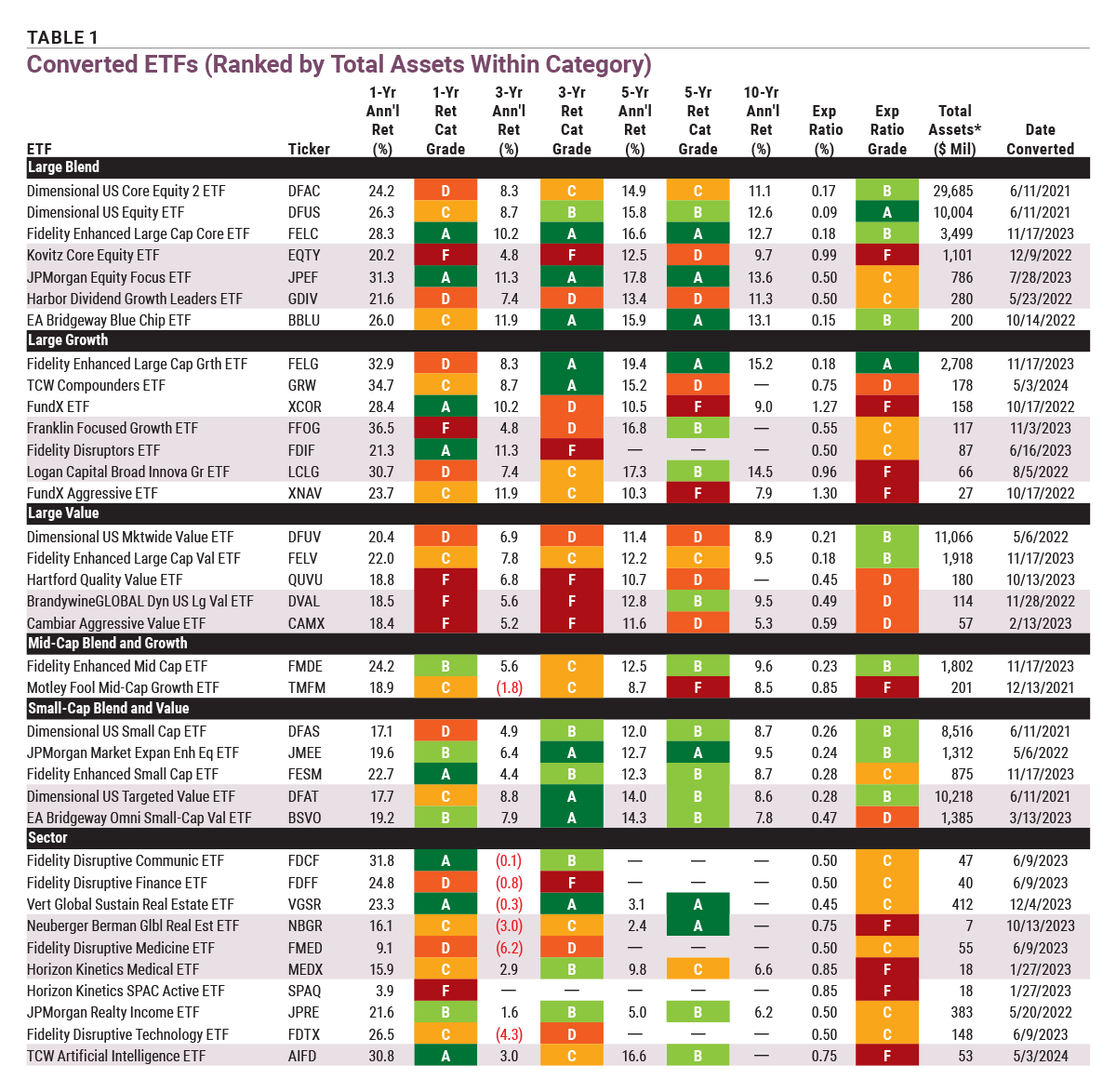
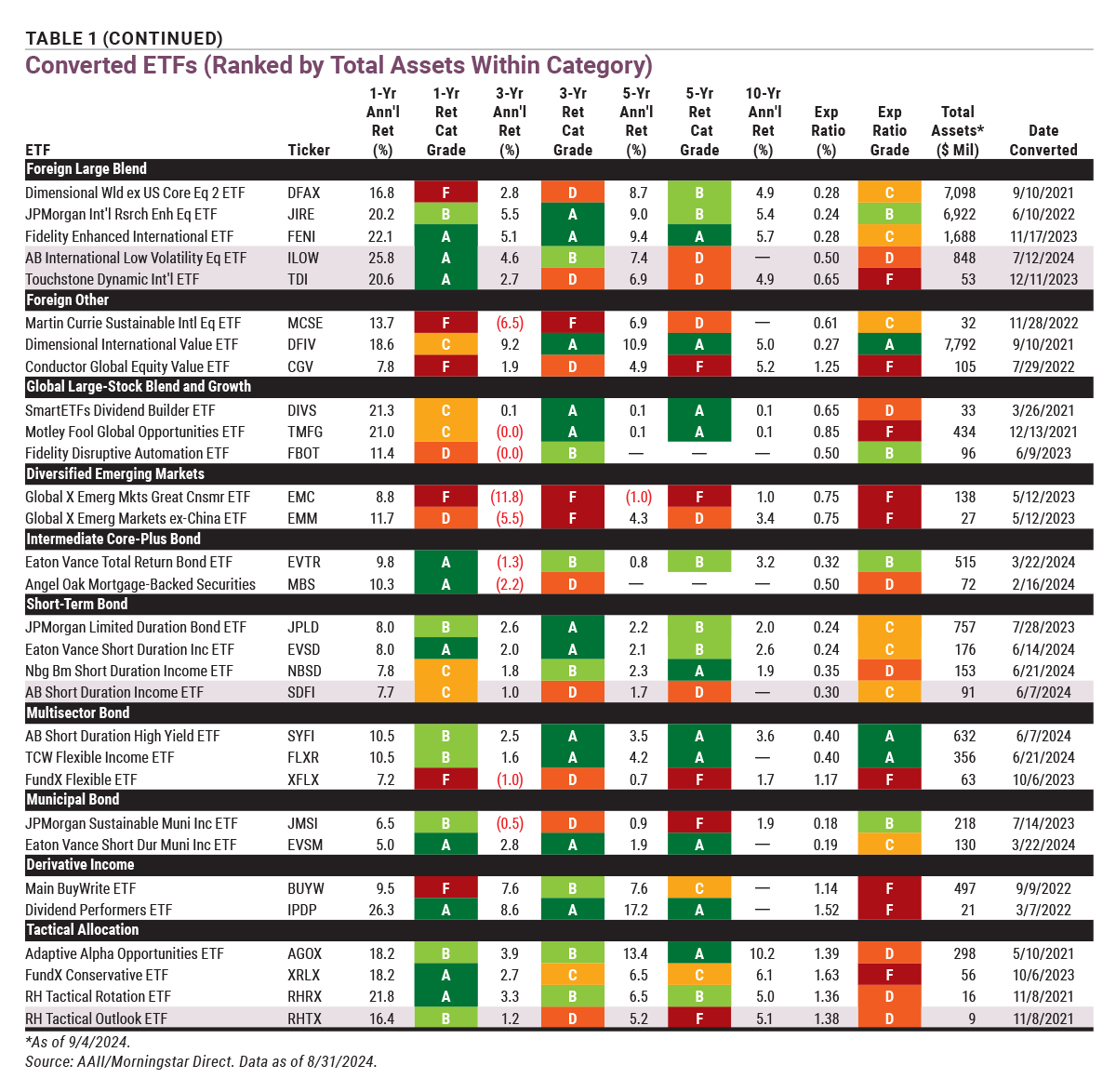
The converted ETFs shown in Table 1 are displayed by category and ranked by total assets within the category. We included categories we believe most investors hold in their portfolios. Alternative asset class ETFs or those that use option or trading strategies were excluded.
Converted ETFs have the reputation of being recently launched mutual funds that were then converted to ETFs. In fact, inception dates for the funds shown range from November 1984 to June 2021. Of the 66 funds displayed, 45 have at least a 10-year track record.
Most are small; the largest assets under management (AUM) is just under $30 billion and the smallest is around $7 million. The average expense ratio is 0.59%. Expense ratios tend to be above average (expensive). Only 18 ETFs have A+ Investor Grades of A or B for their expense ratios; 30 have grades of D or F. All ETFs in the table are actively managed.
Download the Excel spreadsheet for Table 1.
The Eaton Vance Total Return Bond ETF  (EVTR) is the oldest fund in Table 1. It was incepted as a mutual fund on November 14, 1984. The Eaton Vance Total Return Bond provides exposure to a diversified mix of investment-grade bonds. It is classified as an intermediate core-plus bond fund because of its 7.6% allocation to high-yield debt.
The newest fund is the Angel Oak Mortgage-Backed Securities ETF (MBS), which was launched as a mutual fund on June 4, 2021. It includes exposure to residential mortgage-backed securities, which is why it is classified as an intermediate core-plus bond ETF instead of as an intermediate core bond ETF.
FundX’s family of four ETFs hold other ETFs. Strategies include growth, multisector bond and tactical. The four funds alter their allocations based on FundX’s proprietary trend strategy. Asset allocations are shifted in response to market conditions with the goal of improving returns, diversifying the portfolio and adapting to market conditions. Sector rotation strategies strive to profit from business cycle changes.
This “fund of funds” approach results in comparatively higher expense ratios versus tracking an index with individual stocks. The FundX Conservative ETF (XRLX) has the highest expense ratio at 1.63%. It holds core equity ETFs and bond ETFs.
The Dimensional U.S. Equity ETF (DFUS) has the lowest expense ratio at 0.09%. It intends to provide broad exposure, with a portfolio of nearly 2,500 U.S. stocks. The Dimensional U.S. Equity may also buy or sell futures contracts and options on futures contracts to increase or decrease equity market exposure based on actual or expected cash inflows to or outflows from the portfolio.
Despite the potential tax benefits, converted ETFs—as a group—don’t show superior returns. Only six have A+ Investor Grades of A for one-, three- and five-year returns. Such grades are awarded when an ETF’s return ranks in the top 20% of its category.
Those six are the Dividend Performers ETF (IPDP), Eaton Vance Short Duration Municipal Income ETF (EVSM), Fidelity Enhanced International ETF (FENI), Fidelity Enhanced Large Cap Core ETF (FELC), JPMorgan Equity Focus ETF (JPEF) and Vert Global Sustainable Real Estate ETF (VGSR). Most of these have average expense ratios for their respective categories. The Fidelity Enhanced Large Cap Core is the cheapest with an expense ratio of 0.18%, while the Dividend Performers is the most expensive of this group with an expense ratio of 1.52%.
The Dividend Performers is categorized as a derivative income fund. It invests in dividend-paying U.S. stocks as well as in credit spread options on an S&P 500 ETF or the S&P 500 index. It may also invest in equity real estate investment trusts (REITs). A credit spread is an options strategy that involves the purchase of one option and the sale of another option in the same class and with the same expiration but different strike prices.
There are 10 ETFs in the table that have below-average one-, three- and five-year returns, as evidenced by their A+ Investor Grades of D and F for all three periods.
The active bent of these ETFs permits following a general theme, but often with a twist. The large blend and large growth categories contain the largest number of converted mutual funds. Both the Dimensional U.S. Core Equity 2 ETF (DFAC) and the Dimensional U.S. Equity invest in large-cap stocks but also use futures contracts and options on futures contracts for U.S. equity securities and indexes.
The two ETFs are similar, with familiar top holdings including Apple Inc. (AAPL), Microsoft Corp. (MSFT) and Nvidia Corp. (NVDA). More specifically, part of the Dimensional U.S. Equity’s objective is to minimize taxes. It has also realized better returns than the Dimensional U.S. Core Equity 2. The latter’s objective simply says it considers the “federal income tax implications of investment decisions.” Notably, both ETFs have three-year tax-cost ratios of 0.5%.
The Fidelity Enhanced Large Cap Core also has familiar stocks in its top holdings. It invests in S&P 500 constituents but utilizes a quantitative analysis of historical valuation, growth, profitability and other factors. The intention is to select a broadly diversified group of stocks with the potential to outperform the S&P 500. The Fidelity Enhanced Large Cap Core’s objective also allows its managers to venture outside the U.S. borders to invest a small portion in foreign issuers.
Some mutual funds have taken the opportunity to rebrand when converting to an ETF. We observed this more frequently among smaller funds than larger ones. The Kovitz Core Equity ETF (EQTY), for example, was converted from the Marathon Value Portfolio. The Kovitz Core Equity seeks long-term capital appreciation through fundamental research while also aiming to minimize the odds of capital loss. Its category risk index of 1.05 is low enough to earn it a grade of B.
Kovitz is a registered investment adviser (RIA). We point this out because pressure from clients of wealth managers can help push a mutual fund manager to consider an ETF conversion.
While there are no specific factors we can point to, we do observe that the ETFs currently converted from mutual funds are mostly actively managed and more likely to be the types held in taxable accounts. There is less benefit for low-cost mutual funds to convert. Target-date funds’ primary role in retirement accounts also makes them less likely to be converted to ETFs.
ETFs and Mutual Funds

ETFs and Mutual Funds


BARRY J from TX posted over 2 years ago:
ROBERT A from NC posted over 2 years ago:
Bernard C from VA posted over 2 years ago:
LYNN K from MO posted over 2 years ago:
JOHN L from NJ posted over 2 years ago:
You need to log in as a registered AAII user before commenting.
Log InCreate an account