

Related

AAII How-To
One of the challenges for investors in ETFs and mutual funds is deciding whether to use an actively managed (“active”) or a passively managed (index) fund.

Charles Rotblut leads a class in AAII's new Essential Investing Video Course. Go to https://www.aaii.com/ves for more information and to subscribe.
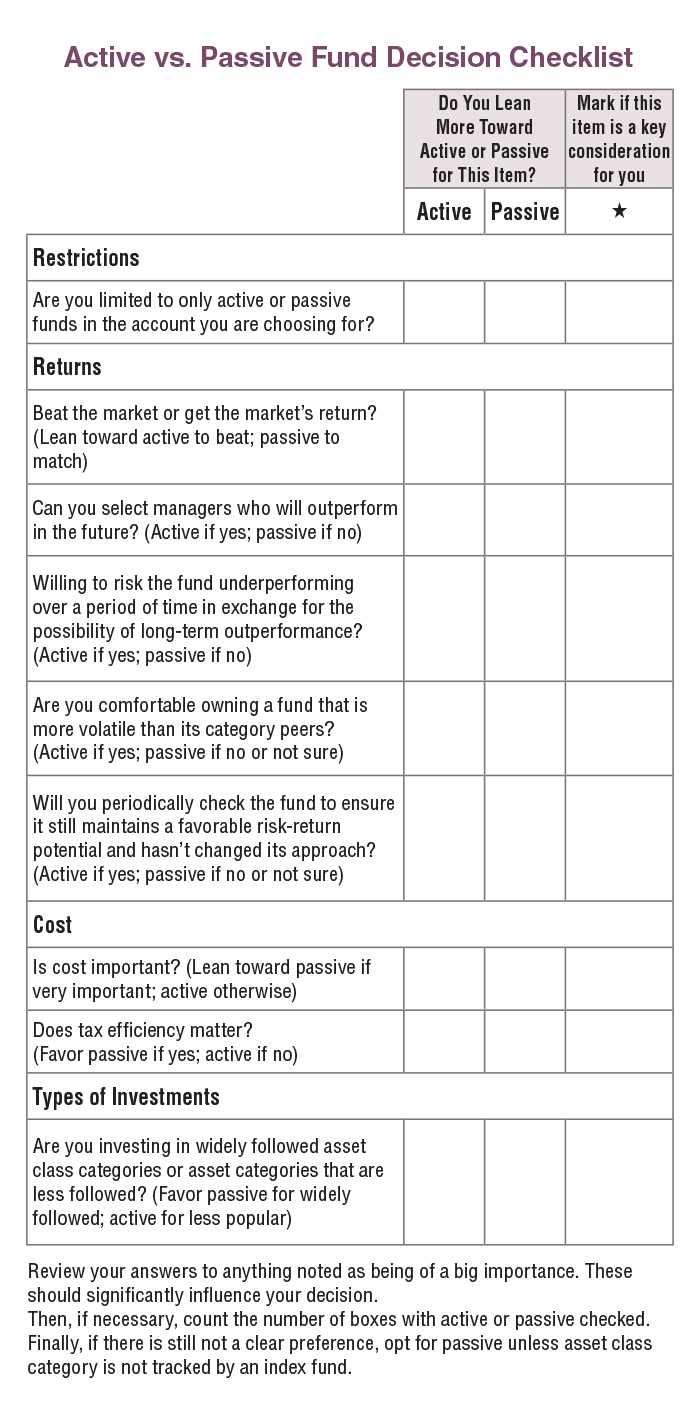
One of the challenges for mutual fund and exchange-traded fund (ETF) investors is deciding whether to use an actively managed (“active”) or a passively managed (index) fund. We’ve created a checklist to help you think through various considerations and reach a conclusion.
Actively managed funds rely on fund managers to handpick securities. Active managers may have the discretion to time the market and hold cash investments. They offer the potential, but not the guarantee, of beating the benchmark index or taking advantage of areas within the financial market less covered by indexes. Passively managed funds seek to mimic the returns of an underlying index. They tend to have very low expense ratios and are designed to limit the odds of underperforming the index.
When we first published the checklist in Investor Update on February 2, 2023, several AAII members commented on the performance of active funds. We’ve incorporated responses to these concerns in this article.
As you look at the checklist, you will notice three columns with spaces to mark your preferences: The first two pertain to whether your fund preferences for a specific criterion lean more toward active or passive management, and the third column is reserved for whether those criteria are key considerations for you. Anything marked in this column should significantly influence your decision. (Download a PDF of the checklist here.)
The checklist is broken into four main characteristics: restrictions, returns, cost and types of investments. While there are certainly other criteria to consider when choosing between specific funds, we believe these four characteristics provide a good framework for choosing between active and passive management.
The simplest question is the first one to answer: Are there any restrictions on what you can invest in?
If you want to buy a fund within a 401(k), 529 college savings plan or health savings account (HSA), you may have no choice but to buy, say, an actively managed mutual fund due to the plan’s offerings. In such instances, the decision is made for you.
Do you want to attempt to beat the market or get the market’s return? This question prompted the most feedback from AAII members.
There is reason to be skeptical of fund managers’ ability to outperform. Data from S&P Global’s SPIVA report shows that just 18% of equity and 30% of fixed-income funds maintained their five-year top-quartile performance rankings over the following five-year periods (“U.S. Persistence Scorecard Mid-Year 2022,” November 28, 2022). While there are some active managers who outperform, identifying them in advance is very difficult.
Passively managed funds, on the other hand, are designed to mimic the performance of their underlying benchmark indexes less their expense ratio.
Do you think you can select managers who will outperform in the future? As the aforementioned data from S&P Global demonstrates, this is not easy to do.
Are you willing to endure periods of underperformance for a chance at long-term outperformance? Even good fund managers can underperform their peers for periods of a year or longer with their outperformance not truly being evident for periods of five or 10 years.
Are you comfortable owning a fund that is more volatile than its category peers? Actively managed funds can be more volatile than their category peers because outperformance comes from investing differently than their benchmarks and category peers. (The category risk index, which can be seen on a fund’s Evaluator page on AAII.com, shows whether a mutual fund’s or an ETF’s returns have been more or less volatile than its peers.) Your ability to tolerate larger swings in an actively managed fund’s returns will determine your ability to stick with it.
Will you periodically check the fund to ensure it still maintains favorable risk/return potential and hasn’t changed its approach? Actively managed funds can more easily change their approach, especially when a new manager takes over.
Cost is the one aspect of fund returns an investor can control. There are two key aspects listed on the checklist that are revealed in the expense ratio and the tax-cost ratio. We do not think investors should pay any loads or transaction fees when it comes to mutual funds if comparable no-load alternatives or ETFs are available.
Is cost important? In other words, how important are low expense ratios to you? The higher the expense ratio, the greater the gross return a fund must realize just to match the category average net return. You may be willing to consider a fund with a higher expense ratio if you believe an active manager can outperform or if they target investments that are less widely followed.
Does tax efficiency matter? The tax-cost ratio—also accessible on the AAII Mutual Fund and ETF Evaluator pages—measures how much of a fund’s annualized return is reduced by the taxes paid on distributions, assuming the maximum marginal tax rate. The lower the ratio, the more tax-efficient the fund. This is a consideration if you intend to hold a mutual fund or ETF in a taxable account. It is not a consideration if you are using a tax-preferred account such as a 401(k), IRA, Roth IRA, HSA or 529.
Are you investing in widely followed asset class categories or asset categories that are less followed? The most popular asset class categories are likely to be represented by passive funds. More specialized areas aren’t as widely tracked and therefore offer better opportunities for active management to outperform.
Download a PDF of the Active vs. Passive Fund Decision Checklist here.
AAII How-To

PRISM Wealth-Building Process

Exchange-Traded Funds

ROBERT A from NC posted over 3 years ago:
JOHN L from NJ posted over 3 years ago:
Deepak M from FL posted over 3 years ago:
Norm Y from OR posted over 2 years ago:
BARRY J from TX posted over 2 years ago:
JAMES B from TX posted over 2 years ago:
You need to log in as a registered AAII user before commenting.
Log InCreate an account