


Related

Alternative Investments
Participating in prediction markets should be regarded as speculative due to their binary outcomes, novel nature, evolving regulation, relatively high costs and low liquidity.
by Tudor Pop, Sam Levine | May 2026
Successful investors are content with being ‘right enough.’ When one takes a moment to consider just how many factors influence stock and bond prices, it’s clear that evaluating every potential influence is impossible—and unnecessary.
Imagine a scenario where an investor has a strong expectation of how much gross domestic product (GDP) will rise, but they aren’t as confident about interest rates or the stock market’s appetite for risk. How can they act on that belief?
Prediction markets allow participants to focus their investments—or gamble, depending on one’s perspective—on very specific beliefs, provided there are big enough markets for them. Prediction markets are also referred to as betting markets, information markets or decision markets.
Participants typically buy event contracts that pay $1 per contract if their prediction is correct. They receive nothing if their prediction is wrong as of the contract resolution date. This binary outcome shares similarities with options contracts. Prior to the resolution date, the price varies by supply and demand. An event contract trading at $0.89 implies that the market is giving that contract an 89% chance of being correct, plus or minus the bid-ask spread. Traders buy an event contract for either a “yes” or “no” resolution to a very specific question. The resolution is governed by the contract’s rules and the prediction market platform’s policies.
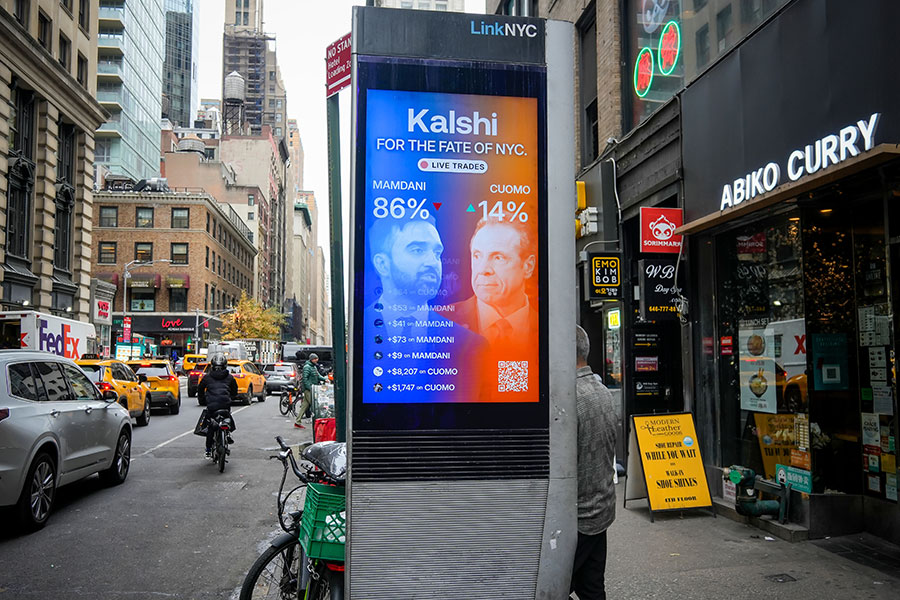
Prediction markets are surging. According to Next.Io, event contract trading volume surged over 400% to nearly $64 billion from 2024 to 2025. This trend is expected to continue. Though approximately 90% of prediction markets trading is in sports-related contracts, market participants can also make predictions on future stock index levels, the weather, politics and even pop culture phenomena. For example, there are contracts about where Taylor Swift and Travis Kelce will get married. Currently, the two largest prediction market platforms are Kalshi and Polymarket.
If some, or even most, of these predictions seem speculative and more akin to gambling, rest assured that many regulators and industry observers agree. State regulators claim jurisdiction over sports betting. Some Native American tribes see prediction markets as a competitive threat to their gambling franchises.
Monetized predictions have a long history. Early examples include betting on the outcome of the September 1503 papal enclave and betting on the outcome of the 1884 presidential election on Wall Street. The modern model of prediction markets dawned in academia one century after the 1884 election. The University of Iowa’s Iowa Electronic Markets (IEM) began in 1988 and is an ongoing research effort that allows participants to buy contracts on political events, such as which party will control the House of Representatives. Studies have shown that prediction markets are more accurate than polls in predicting presidential elections.
Capital markets provide many benefits to society beyond simply being a place to raise and invest money. Their auction-driven buying and selling provides more accurate and timely price information than advertised prices. Market-driven prices also deliver real-time information that policymakers use to guide fiscal and monetary policy. Business leaders and consumers use market prices in their decisions.
Investors and speculators have profit motives that encourage them to be thoughtful in their forecasts. Even if market prices can occasionally become irrational from groupthink or turn out to be inaccurate due to chance events, many economists perceive prices determined by the “wisdom of the crowds” as valuable data points.
By establishing a market price on an uncertain outcome, event contracts share many characteristics with established investments such as stocks and index exchange-traded funds (ETFs). However, they are closer to options and futures contracts, which have specific expiration dates and exercise prices. One key difference between event contracts and traditional derivatives is the binary payoff of a prediction at expiration; a prediction contract is either worth $1 or nothing. In theory, long options and futures positions have unlimited upside potential.
Like an options contract, the prediction buyer’s potential downside is only the cost to enter the position. Futures contracts require settlement that may mean paying a multiple of the difference between the asset’s price at expiration and the exercise price.
Let’s illustrate these differences through a scenario. Deborah, who is very knowledgeable about the U.S. economy, is quite confident that the first release of the quarter’s annualized GDP growth for the U.S. will be higher than 1.5%. She also thinks, but with less certainty, that this will drive the S&P 500 index higher, possibly up 10% from its recent level of 6,816 on April 10, 2026. If we exclude some of the more exotic or complicated investments available, there are four potential choices:
 (IVV), and hold it until the end of the year;
All four possibilities position Deborah for profit if the S&P 500 closes above 7,500, but each instrument will vary dramatically in outcome should the index close far away in either direction at the end of her time horizon. Let’s examine the key differences between them, keeping in mind that space prevents us from providing a detailed description of each instrument.
An index fund has no expiration date. Theoretically, the index ETF could drop to zero, but that’s unlikely. It is possible for Deborah to suffer a loss at the end of the year, but her position will almost certainly have some value. She will also capture all the gain if the S&P 500 closes 20% higher instead of 10% higher, and, if she wishes, she can continue to hold the fund beyond the end of the year.
Buying a call option allows her to leverage a relatively small amount of money (called the premium) to control a larger amount of the underlying asset—in Deborah’s case, shares of iShares Core S&P 500. An option, like owning shares of an ETF, also positions her for theoretically unlimited upside. Conversely, if the option closes at or below the contract’s exercise price, she will lose her entire investment at expiration.
Deborah could go long a futures contract. A long index futures contract would only require her to put up an initial margin amount to obtain a very large exposure to the price fluctuations of the S&P 500 or another underlying index. Though the futures broker should quickly close the position if it falls below a maintenance threshold, Deborah could also be on the hook for all the downside if the market were to move fast enough to leave her account with negative equity.
As mentioned earlier, event contracts have binary outcomes at expiration. If Deborah bought an event contract predicting that the quarter’s annualized GDP increase will be above 1.5% and the actual reported growth was 1.0%, she would receive nothing. If the reported growth was double her expectation, she would only receive $1 per contract.
A market that evaluates an economic number such as GDP growth or a stock index level may offer several contracts that accommodate different levels, which would allow her to tailor her exposure even more closely to her beliefs. Figure 1 shows a prediction market for annualized GDP growth on Kalshi as of April 14, 2026. This prediction market ends on April 30, 2026, when the GDP growth for first-quarter 2026 is first released by the Bureau for Economic Analysis (BEA).
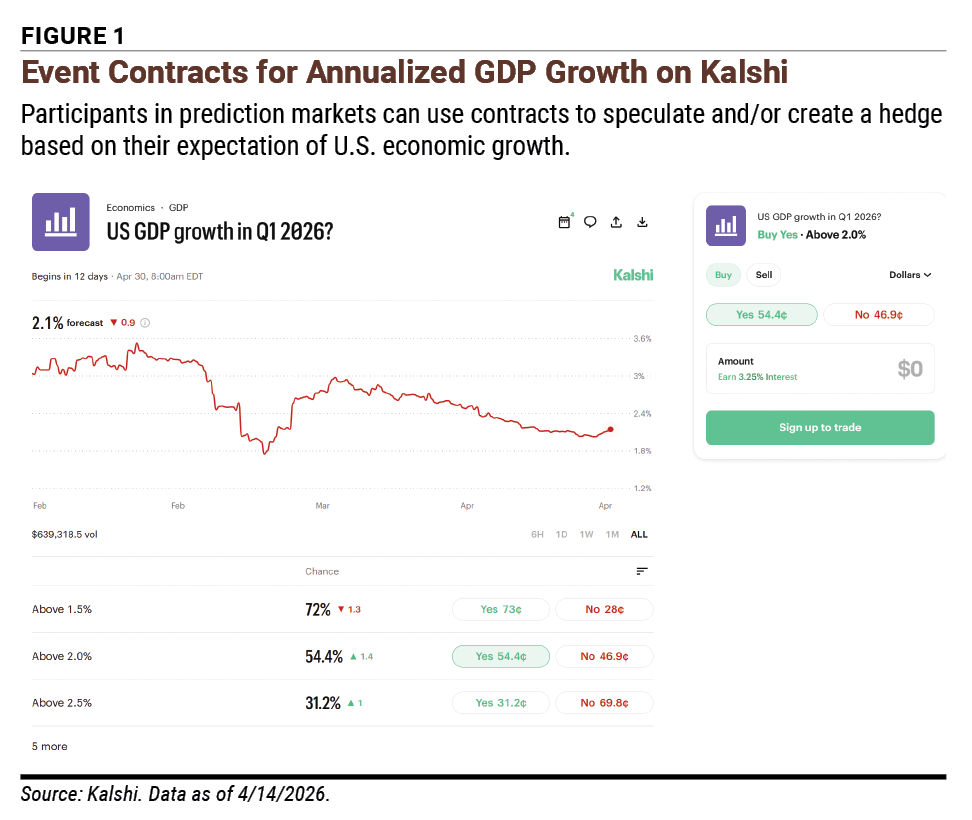
Deborah can tailor her exposure to reflect her expectation of the range of possible outcomes. If she thinks that GDP growth will not exceed 2.0%, she can also buy “No” contracts for growth above 2.0% or for higher growth rates.
When considering buying an event contract, Deborah’s focus should be on whether she believes the market is overestimating or underestimating the probability of GDP growth coming in above 1.5% on the contract’s resolution date. If she believes that the market’s estimation is lower than it should be and there’s enough potential upside, only then should Deborah consider buying the contract. Deborah may also exit a position if her forecast changes or she wants to lock in a profit or loss.
In our example, Deborah is confident in her expectation for GDP growth but less so about how much of that GDP growth would be reflected in a stock market rally. Event contracts allow buyers to express their expectations precisely, if there’s an appropriate market available. That alone may be enough for some investors to consider looking at the prediction markets.
Like most nascent financial products, event contracts carry significant risks, including regulatory risk, information asymmetry and overconfidence. Regulation is evolving, and platforms may be compelled to exit jurisdictions. Polymarket initially exited the U.S. in January 2022 after it incurred a fine from the U.S. Commodity Futures Trading Commission (CFTC) for unregistered contract trading activity. Adverse rulings against platforms can lead to market participants facing difficulty cashing out of contracts or withdrawing their funds on a timely basis.
The trend, at least on the federal level, seems to be in favor of loosening restrictions. Multiple states assert that prediction betting, especially in sports, is gambling and thus falls under state law rather than federal law. These states have won cases that, at a minimum, restrict platforms’ operations. In April 2026, the CFTC sued some states to assert its jurisdiction over prediction markets.
One of the conditions of fair markets is that all participants have equal access to information, or that those people who do have material nonpublic insider information will not trade on that information. Many of the prediction markets face the risk of information asymmetry, where one participant has inside knowledge that other participants do not have.
In early April 2026, at least 50 new accounts on Polymarket bought contracts relating to a cease-fire between Iran and the U.S. hours, even minutes, before President Donald Trump announced a cease-fire. Likewise, in January 2026, a trader made $400,000 by betting that former Venezuelan president Nicolas Maduro would be out of office hours before the U.S. captured him.
Securities markets regulators in the U.S. actively monitor for insider trading. The courts have issued mixed rulings on how applicable those regulations are to prediction markets, with some controversy stemming from how to apply existing regulations to a relatively novel trading asset. Congress has proposed several pieces of legislation seeking to address this issue.
However, the most immediate danger that investors should consider is our arguably innate overconfidence in our ability to make accurate forecasts. Psychologists believe that overconfidence stems from our rejection of information that contradicts our beliefs, illusions of control and other tendencies. Though this tendency manifests itself when investing in stocks and other established financial instruments, stock markets have historically trended upward while prediction markets are a zero-sum game.
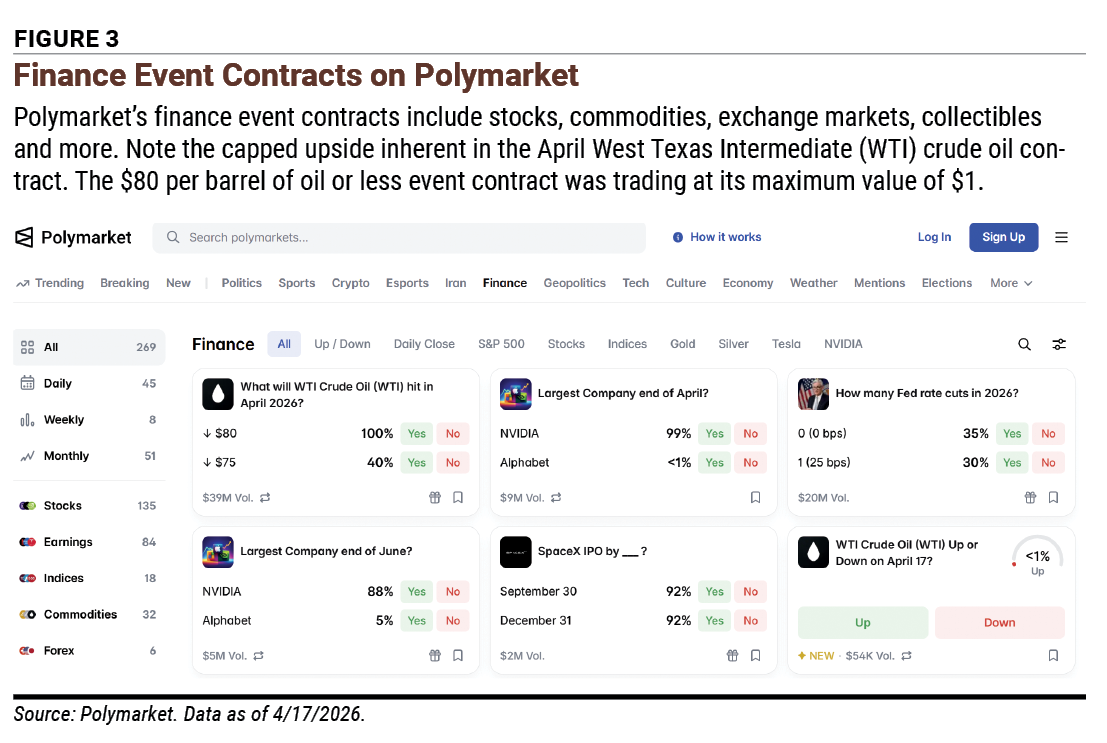
According to an April 2026 Bank of America report, Kalshi (Figure 2), which has CFTC derivatives market approval for its platform, currently holds an 89% market share. Competitors include cryptocurrency-based Polymarket (Figure 3), which holds a 7% market share, and Crypto.com, with a 4% market share. Interactive Brokers facilitates trading through its CFTC-regulated affiliate, ForecastEx. Robinhood white-labels Kalshi trading on its brokerage platform.
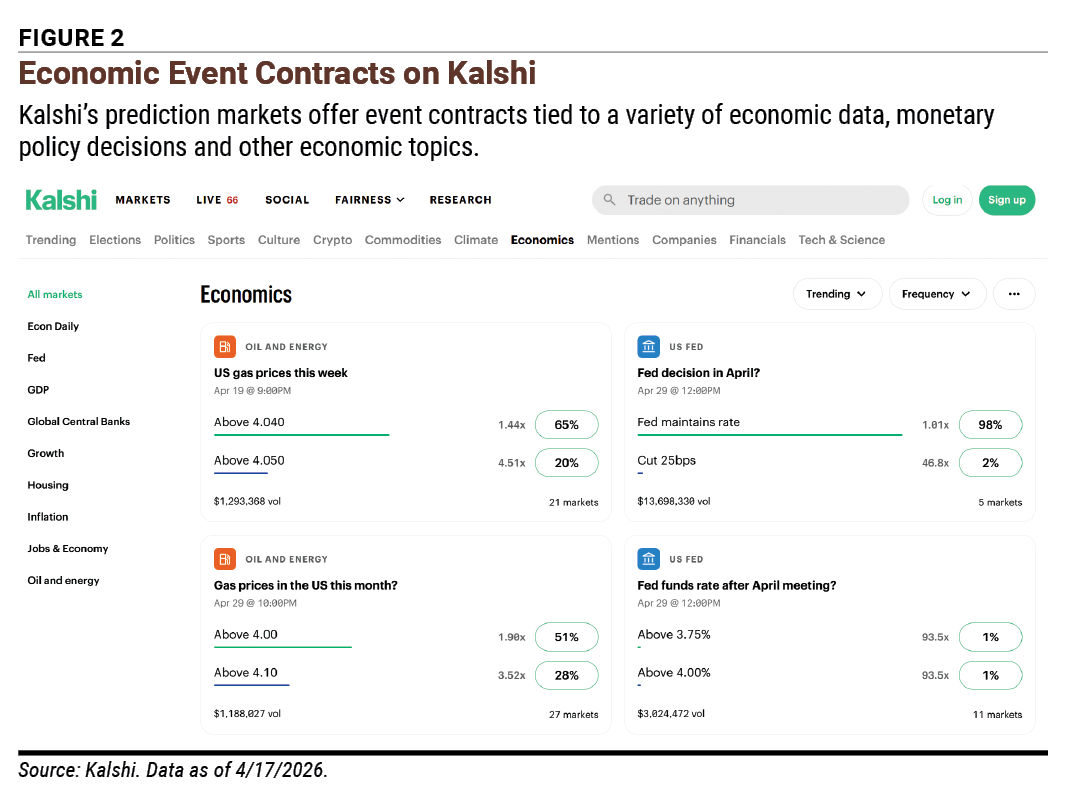
Kalshi currently dominates the market, but there’s heavy competition coming. The rapidly evolving regulatory environment keeps a revolving door of entrants and exits. The CFTC cleared Polymarket to return to the U.S. market in 2025. It is reasonable to expect that innovation, price competition and regulation will keep prediction market executives and their customers on their toes for the next several years.
Opening an account is straightforward and takes minutes on most prediction market platforms. There are few requirements other than depositing money to start trading. There is some quick identification verification and, unlike stock brokerage accounts, there are no questions about investment suitability or one’s current financial position. Options and futures accounts typically have net worth, investment suitability and trading experience requirements.
Cost structures differ. Kalshi charges when the trade is executed. There is no charge if the trade is not executed or if the order is canceled. The fee is based on the potential profit of the contract and the number of contracts traded, with the fee being dramatically lower if the order isn’t immediately executed (e.g., a limit order). The formula for an executed market trade is:
0.07 x Number of Contracts x Contract Price in Dollars x (1 – Contract Price in Dollars)
Fees are rounded up to the nearest cent.
Using this formula, an executed market order of 500 event contracts at a price of $0.75 per contract would be rounded up to $6.57 [0.07 x 500 x $0.75 x (1 – $0.75)]. Trading fees may differ by the type of contract traded. For example, contracts tied to the S&P 500 and the Nasdaq 100 index have their own posted fee table.
Kalshi also credits accounts with a variable interest rate for cash and the value of held contracts. The rate was an annual percentage yield (APY) of 3.25% as of April 2026 for balances of $250 and over.
Polymarket uses blockchain technology for a decentralized structure. Trading uses USD Coin (USDC), a U.S.-dollar pegged stablecoin, and contracts are held in users’ digital wallets. Even the resolution of the contracts is done through peer voting when there’s a dispute about the outcome of a question. Polymarket overhauled its fee structure in March 2026. Fees are calculated as:
Number of Shares (Contracts) Traded x Fee Rate x Share Price x (1 – Share Price)
This fee structure is similar to Kalshi’s structure for executed market orders, but the fees range from $0.00 per contract for geopolitics to $0.072 per contract for crypto. Limit orders, which create liquidity, are incentivized through rebates that can be as high as 25% of the fee charged on executed market trades.
Robinhood charges $0.01 per contract, per side (i.e., opening or closing a position) excluding any exchange fees. Interactive Brokers lists its tiered and fixed fees at $0.01 per contract.
Event contracts should be regarded as speculative due to their binary outcomes, novel nature, evolving regulation, relatively high costs compared to large-cap stocks and index funds, and low liquidity. The markets do provide compelling insights into how traders view the probabilities of current event outcomes, which can aid in investing decisions on traditional assets.
Should prediction markets continue to expand in size and scope, they may offer useful ways to reduce household and business risk, much in the same way that airlines might hedge against rising fuel costs by buying futures contracts. For example, a homebuilder might buy contracts that pay off if a piece of adverse legislation becomes law. Likewise, households could conceivably reduce their inflation risk by buying contracts that pay off when egg prices rise high enough.
Alternative Investments

Active Investing

Trading Strategies

ROBERT A from NC posted 5 months ago:
BARRY J from TX posted 5 months ago:
BARRY J from TX posted 5 months ago:
MAHYAR R from CA posted 4 months ago:
MAHYAR R from CA posted 4 months ago:
You need to log in as a registered AAII user before commenting.
Log InCreate an account