

Related

AAII Sentiment Investing
How to steer clear of the basic errors and pitfalls that have led many traders and active investors to fail.

Raymond Rondeau leads a class in AAII's new Essential Investing Video Course. Go to https://www.aaii.com/ves for more information and to subscribe.
So, you want to become a successful—or more successful—trader or active investor. The most logical path forward is to learn from those who’ve achieved consistent success before you and to steer clear of the errors and pitfalls that have led so many to fail. In this article, I explore seven key ideas that highlight the approaches, traits and philosophies of successful traders.
This article draws on insights from my 20+ years as a full-time trader and my roles as an investment strategist and Active Investing tool developer at AAII.
Successful traders and active investors focus on sound principles and master them. Furthermore, they are always learning and looking for ways to refine their craft to gain that elusive but necessary edge to outperform the markets.
To be a successful trader, you must start by surviving your first few months of the journey. Once established, successful traders continuously evolve with the markets by refining strategies, adapting approaches and staying open to emerging opportunities from market imbalances and new investments.
Successful traders and active investors approach their endeavor as a business with an intellectually grounded approach, and they always have a plan. They develop a personalized plan tailored to their own intellectual, analytical and psychological strengths and weaknesses, as well as their financial goals and life circumstances.
Successful traders and active investors have the discipline to follow through by “planning the trade and then trading the plan.” They focus on risk first, expect the unexpected and understand that trading is about probabilities. They recognize that no trade is foolproof and that some level of uncertainty must be accepted in order to thrive.
Successful traders and active investors are pragmatic in their approach. They realize that not every trade will be a winner, and they’re quick to cut losses when the market turns against them. At the same time, they use smart money management strategies to scale out of winning positions—maximizing profits while resisting the urge for instant gratification.
Successful traders and active investors understand that markets are dynamic, interactive and complex. Because of this, they always prioritize unbiased, evidence-based, third-party-verified data and research whenever possible.
Lastly, successful traders are confident. They believe in their systems, their processes and, most importantly, themselves. They know that other traders have been successful and that they can be too with consistent effort, discipline and growth.
We think you’d like this related AAII VES Education Class Segment. Intellectual-based Investment Approaches
Simply memorizing a list of key traits isn’t the same as truly understanding them.
Think of it this way: If I rattled off a few iconic movie lines—“Make my day!” or “Rosebud”—you might recognize them. But without context, they are just empty lines. The same goes for trading and active investing.
Successful traders and active investors don’t just know how, when and why to execute a technique—they’ve developed the intuition, instincts and discipline to apply those techniques consistently under pressure. That kind of proficiency doesn’t come from a checklist. It comes from deep understanding.
There will always be bearish and bullish arguments for any trade or investment. One common technique that the best traders and active investors use is to consider the counter side of the position. It’s like playing chess against yourself.
This approach has numerous benefits. For example, it forces traders and investors to be aware of and manage individual position risk, and it keeps their position sizes relative and proportional. It also maintains their desired level of risk across their entire portfolio and enables them to stay flexible and objective.
With this technique, traders and active investors often force themselves to write down at least three reasons why they may be wrong about the direction of an investment. Areas to consider are vast, but some examples are interest rate directions, stretched fundamental valuations, extreme market sentiment, high short interest levels, derivative expiration dates (maximum pain theory), pending litigation or regulatory risk, seasonal trends, and conflicting technical indicators and price patterns.
Those who cannot list three valid counterpoints may not be knowledgeable or experienced enough to trade with real money.
We think you’d like this related AAII VES Education Class Segment. Investing is About Probabilities
The single biggest reason so many traders fail is simple: They don’t survive their first trading experiences because they try to take shortcuts to success.
Although it may be unpopular—and to some, even trading blasphemy—the truth is this: The most skilled traders and investors today weren’t skilled when they started.
As with any demanding pursuit, trading mastery requires experience, and experience takes time. But to get time in the investing world, you must first survive. Survival means one thing above all else: capital preservation. Aspiring traders frequently lose their capital before they ever gain the experience needed to be successful because they enter the arena without the necessary skills or insights to navigate it.
The first priority of new traders and active investors should be to learn as much as possible, then begin paper trading until they can demonstrate consistent success over several months.
When your paper results show consistent performance, begin live trading with ridiculously small amounts—$50, $100 or even less. Why? Because paper trading, while valuable, doesn’t trigger the real-world emotions of fear, greed, hesitation or doubt that often sabotage newer traders. In addition, individual positions should be limited to 5% of capital for very small accounts, and leverage or margin should be strictly avoided.
Diversification is paramount, risk is always the first consideration and survival is the primary goal. Emotional discipline and trading instincts take time to develop. Easing into real-money trading is the only way to build these traits without blowing up your account.
We think you’d like this related AAII VES Education Class Segment. Dealing with Unexpected Events & Risk
Next to the challenge of surviving, the area that causes many traders and active investors to underperform the markets is their failure to evolve and adjust.
The failure to evolve takes many forms—one being the reluctance to embrace newer, more efficient investment vehicles. In many cases, the advantages are clear, such as replacing traditional mutual funds with exchange-traded funds (ETFs). Another example is failing to leverage tools like derivatives—particularly options—to generate additional income, hedge risk or take advantage of more advanced, less conventional strategies.
Similarly, some (often older) investors fail to recognize or refuse to evaluate the advantages of new asset class opportunities, even when they become blatantly obvious. The emergence of cryptocurrency is a prime example of this. Many younger traders and investors have excelled in cryptocurrency investing, while more established investors who learned in a different environment have failed to capitalize.
More broadly, this failure to adapt can involve approaches and strategies. Here, many investors continue to apply the same investing approaches—such as fixed-income and dividend strategies—regardless of the interest rate environment. Alternatively, some investors always favor specific sectors or value- or growth-oriented stock approaches, irrespective of where we are in the current economic and business cycle.
It is as if, once traders or active investors find something that works, they assume it will continue working indefinitely. They fall into the trap of positive reinforcement—a classic case of operant conditioning—where early success reinforces the behavior, regardless of shifting market dynamics. They often fail to acknowledge the certainty that markets are constantly evolving, as are the best opportunities within them. Many traders and active investors are reluctant to adjust, often resulting in underwhelming or subpar performance.
This becomes most evident in the continued reliance on outdated investing tools and technical indicators. This is where the line is drawn between traders and active investors who merely survive and those who truly excel.
We think you’d like this related AAII VES Education Class Segment. Evolving with the Markets
A critical yet often overlooked flaw in modern investing is the reliance on outdated, first-generation data types and trading tools.
For example, while traditional volume is widely used, its popularity stems more from accessibility than effectiveness. Dollar volume (dollar value of executed trades) consistently outperforms traditional volume (number of shares traded) in backtested strategies. It also eliminates the intensity-based price distortions that can skew chart analysis.
Because this area is so critical, let’s take a closer look at two of the widely promoted, readily available traditional volume-based indicators, comparing them to a new generation of intensity-based tools that use conviction (dollar volume).
On Balance Volume (OBV) is one of the oldest technical indicators still in use. It attempts to measure buying and selling pressure by adding volume on up days and subtracting volume on down days, plotting the result as a cumulative line.
The problem? OBV completely ignores the magnitude of the price move. If a stock finishes up by one cent, OBV adds all the day’s volume; if the stock finishes down by one cent (just a two-cent difference), OBV subtracts all the day’s volume.
Chaikin’s Accumulation/Distribution (A/D) indicator suffers from a similar issue. A stock could close 30% lower than the prior day’s close, but if it closes one cent higher than the current day’s open, Chaikin’s A/D indicator reads it as a bullish accumulation signal.
Are these truly the optimal ways to measure and track intensity? No. Yet, many traders and active investors continue to rely on these indicators because they’re free and because the readily available, evidence-backed alternatives that professionals use are unknown to them. One such set of indicators is AAII’s conviction series of indicators, which includes three intensity-based indicators: Relative Conviction Momentum (RCM), Kinetic Conviction (KC) and Optimized Balance Conviction (OBC).
These conviction-based indicators utilize a dollar volume approach, account for overnight gapping and proportionally scale intensity magnitude—eliminating the “all or nothing” bias of legacy indicators.
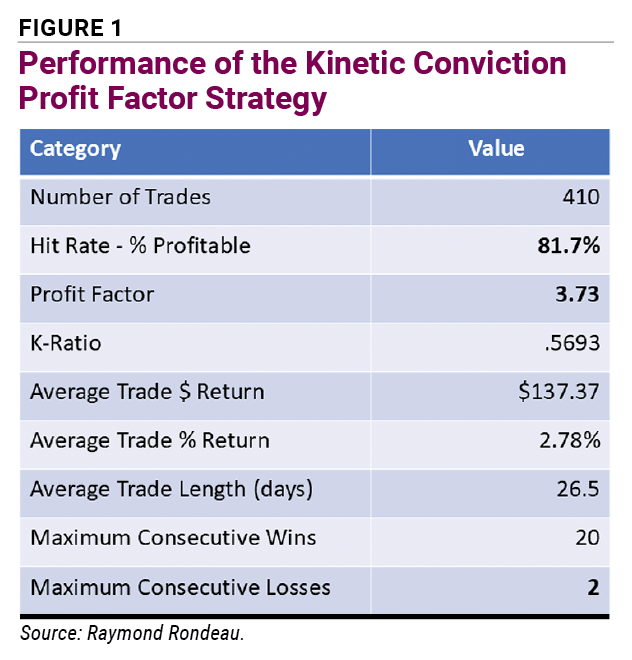
Consider the backtested results of the Kinetic Conviction Profit Factor (PF) strategy, which is based on Conviction Theory and its proprietary indicators. As Figure 1 shows, this 10-year study of every S&P 500 index stock found the strategy to have delivered hit rates (percentage of profitable trades) exceeding 80%, profit factors above 3.50 and an exceptionally smooth and consistent realized equity curve.
We think you’d like this related AAII VES Education Class Segment. Volume vs Dollar Volume
Evolving with the markets, adapting to current conditions and leveraging technology are three essential ways to enhance investing and trading efficiency. One often overlooked method is the ability to synergize multiple tactics, approaches and strategies to create a more comprehensive analytical framework.
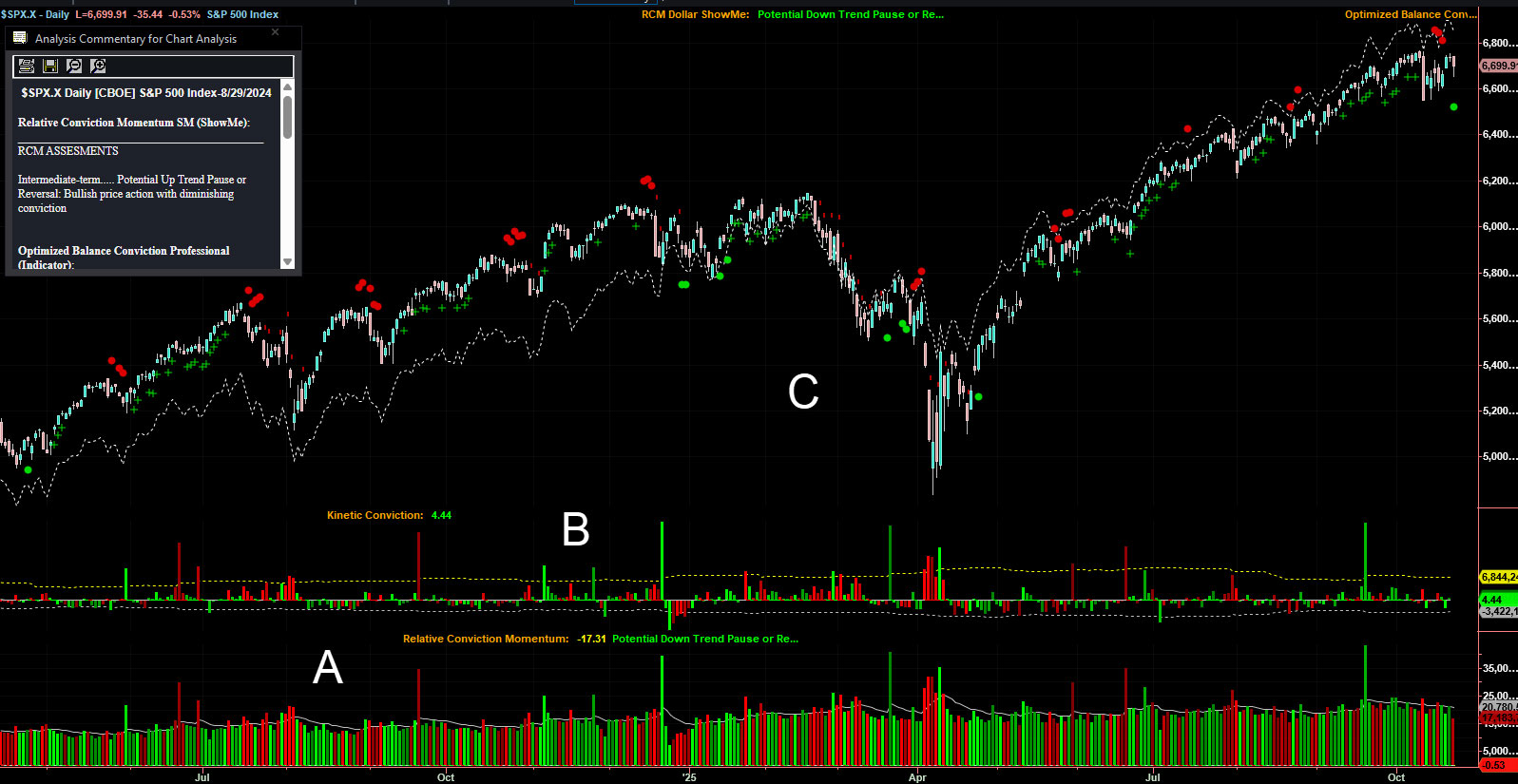
In Figure 2, the three conviction indicators mentioned above work together to illustrate this concept across the three major areas of intensity-based analysis. At the bottom, in Area A, Relative Conviction Momentum measures the strength or weakness of a move’s intensity relative to the prevailing trend, helping investors gauge the likelihood of a continuation or reversal. Key turning points are visually identified in the upper price pane with green dots for potential upward turns and red dots for potential downward turns.
FIGURE 2
Conviction Trilogy
Charts created using TradeStation. ©TradeStation Technologies, Inc. 2001–2025. All rights reserved. No investment or trading advice, recommendation or opinions are being given or intended.
In Area B, Kinetic Conviction plots the conviction differential from its exponentially adjusted average, allowing investors to quickly assess the significance of a move by how far conviction bars extend beyond key standard deviation thresholds.
Finally, in Area C, Optimized Balance Conviction compares the intensity of upward versus downward moves. When this indicator diverges from price, it often signals a significantly increased probability of a trend reversal.
Download: Kinetic Conviction Profit Factor Performance Report.pdf
Synergizing different techniques and approaches is both logical and proven to enhance performance. The Kinetic Conviction Profit Factor system exemplifies this by combining multiple conviction-based factors to produce more reliable signals. As in fundamental analysis, where investors review numerous metrics rather than a single data point, a multifactor approach offers deeper insight and a stronger foundation for informed decision-making.
We think you’d like this related AAII VES Education Class Segment. Kinetic Conviction Profit Factor Performance
Our last area, although obviously simple, is one of the most difficult elements to maintain as a trader and active investor: the need to believe that you can and will be successful.
If a trader or active investor doesn’t believe they can succeed, they will probably fall short of putting in the effort required for success. Without action, every other skill, strategy and insight becomes irrelevant.
Unfortunately, there are many reasons why people come to believe they can’t be successful traders or active investors. While some of these beliefs stem from personal setbacks, many are planted and reinforced by the self-serving interests of others.
Often, this starts at an individual level with friends and family, or even social media connections. These circles are filled with cautionary tales from people who “tried” trading or active investing and failed. In my experience, such attempts are often half-hearted or fueled by excessive risk-taking and get-rich-quick expectations. When those unrealistic plans collapsed, the ego’s natural defense was to conclude that success simply wasn’t possible.
Then there’s the financial industry itself. Many institutions benefit when individual traders or investors feel confused, overwhelmed or incapable. Why? Because these feelings keep individuals dependent on their products, advice and management services. To sustain that dependency, they use jargon-heavy language, exaggerate complexity and present certain strategies as off-limits or “too advanced” for the average investor.
At the same time, they downplay the real advantages individual traders enjoy, including tax optimization, personalized risk levels, lower costs and greater flexibility.
We think you’d like this related AAII VES Education Class Segment. Believe Your Way to Investing Success
Lastly, from a broader, systemic perspective, there’s the possibility that the financial system prefers individuals not to move money frequently. Institutions need counterparties on the other side of their trades to profit, and the entire structure benefits when capital stays put, helping reduce volatility and stabilize global market systems.
Yet the reality is clear: Businesses, financial institutions and large investors all successfully move capital in response to changing market conditions. It’s no different than timing interest rates to refinance a mortgage—it’s both logical and practical.
The bottom line is: No one cares about your financial success more than you. Many individuals have built—and will continue to build—wealth through trading and active investing.
Success is absolutely possible, but only if you believe it is and commit to taking planned action. As Henry Ford said, “Whether you think you can, or you think you can’t, you’re right.”
We think you’d like this related AAII VES Education Class Segment. Learn More with AAII’s Essential Investing Course
Download: AAII’s Essential Investing Course Features & Highlights
AAII Sentiment Investing
Trading Strategies
Technical Analysis

BARRY J from TX posted 11 months ago:
ROBERT A from NC posted 11 months ago:
JAN S from NY posted 11 months ago:
You need to log in as a registered AAII user before commenting.
Log InCreate an account