


Related

The Big Question
A comparison of Charles Schwab, Fidelity Investments and Interactive Brokers reveals that each has its particular strengths.
by Sam Levine | November 2026

With zeroed-out stock commissions leveling a big part of the playing field, online discount brokers have been forced to up their game over the years in terms of their features and services. Clients who have grown comfortable with their present broker might be missing out on time-saving features, thought-provoking research or money-saving trading tools.
Trying out a new broker doesn’t require the same commitment as it once did. Curious investors can open accounts without depositing money or transferring assets. Some brokers, including the three discussed in this article, offer “paper trading” that uses simulated money for their customers’ experimentation and practice online. This means your portfolio dollars aren’t at risk while you try out the firm.
For this article, I evaluated Charles Schwab, Fidelity Investments and Interactive Brokers. Charles Schwab and Fidelity are popular among AAII members. Interactive Brokers provides a noteworthy contrast. All three firms assisted with this article. Charles Schwab and Interactive Brokers provided demo accounts. Fidelity made a noble effort but could not provide access in time for the article. I relied on survey feedback from a randomized group of AAII members to guide the format of this overview. The survey indicated that AAII members are primarily (but not exclusively) focused on reporting, ease of use and research capabilities.
I look forward to reviewing other online discount brokers throughout 2027. Future articles and AAII website content will also evaluate brokers’ charting capabilities, mobile apps, desktop trading platforms and other trading features.
Charles Schwab has a bit of a dual personality. On one hand, the firm takes a high-touch, full-service approach to serving investors. On the other hand, it also has amazingly capable trading platforms available for desktop, browser and mobile under the Thinkorswim name. If you’re tempted to try out Thinkorswim’s desktop app for the first time, go ahead, but I suggest that you watch a tutorial first.
Charles Schwab allows clients to invest in stocks, options, futures, exchange-traded funds (ETFs), mutual funds, fixed income and cryptocurrency. It also offers international investing, with trading available in 30 markets and seven local currencies through its Schwab Global Account. As shown in Table 1, Charles Schwab keeps its pricing competitive, but it isn’t striving to be the cost leader.
Charles Schwab puts proprietary and third-party research front and center (Figure 1). It offers computer-generated analyses, Charles Schwab stock ratings, and useful third-party research from providers such as Argus Research and CFRA Research. The firm also provides in-house commentary from famous names like Liz Ann Sonders, its chief investment strategist. Charles Schwab’s live video channel is competitive with cable financial news channels and worth keeping on your screen throughout the day.
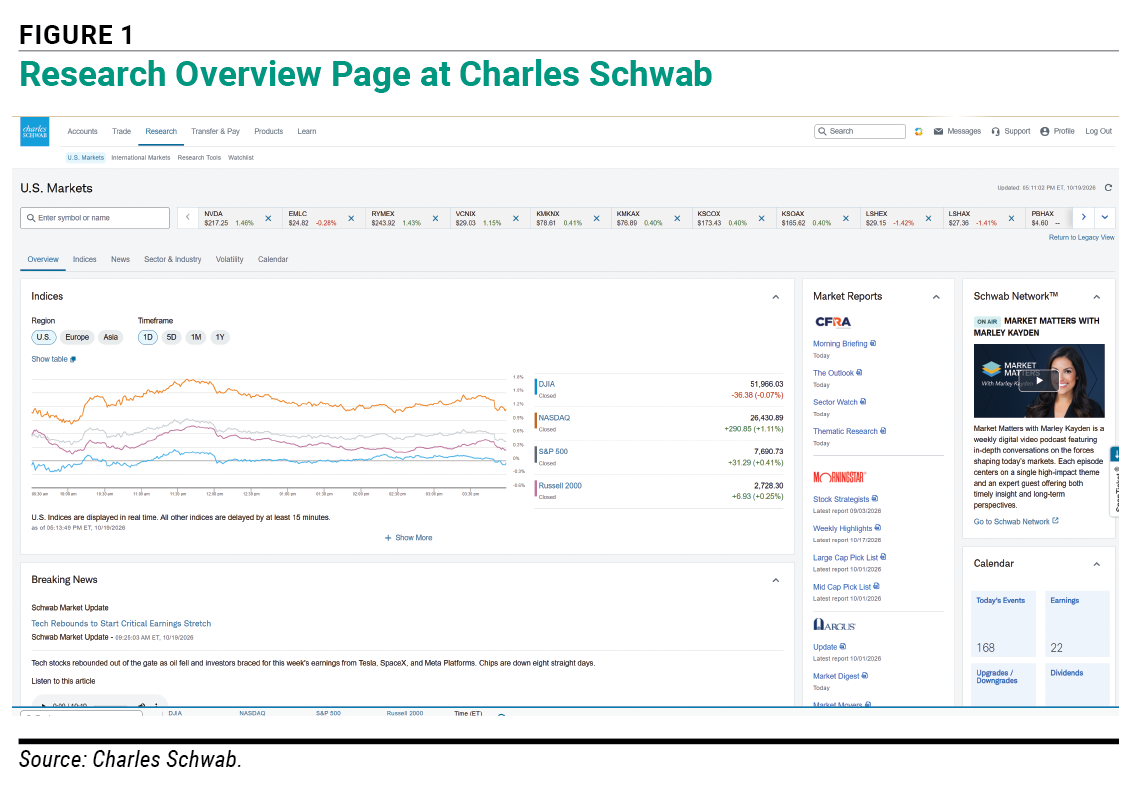
The portfolio holdings page is customizable, with 66 data column choices. Watchlists offer six preconfigured views and one fully customizable view with 63 column choices. I found Charles Schwab’s preconfigured views far more relevant to long-term investing based on fundamentals than Fidelity’s standard views.
If you’re a thematic investor, Schwab Investing Themes is a great source of ideas. Themes are baskets of stocks that may be tweaked according to individual preferences. There are 45 themes to choose from. Some examples of themes are Genomics, Healthcare Access and Efficiency, and Pet Passion.
Though the themes are excellent for getting a feel for what’s exciting the stock market, they require ongoing decisions once they are bought. A research team updates the baskets quarterly. Once you buy a theme basket, you will be notified when its theme allocations change; the firm requires your permission to make any changes to your portfolio.
AAII member survey responses agree with my own firsthand experience that Charles Schwab’s client-facing support is remarkably good, both over the phone and in person. Beginning traders can get free coaching sessions via webinars. In the one I watched, the coach stayed on topic but also flexed enough to accommodate the questions and interests of the attendees.
Clients with $1 million to $10 million in assets at the firm are assigned to Schwab Private Client Services. Those with $10 million or more at the firm are assigned to Schwab Private Wealth Services. Both tiers are eligible for discounts on mortgages and credit card perks. Private Wealth Services clients receive invitations to exclusive events and have prompt, personal access to subject matter experts in estate and tax planning. Unlike Fidelity, Charles Schwab also has a private bank division.
Fidelity’s website is a thoughtfully curated experience that most investors will find exceptionally easy to navigate—possibly the easiest among the three broker websites discussed in this article. It’s a bit unfair to Fidelity’s other capabilities to say that it’s beginner-friendly, but it is. As an example of its friendliness, Fidelity places links to informative or educational content next to most of its account tools and data. Its deep coverage of basic and niche financial topics, such as how to choose where to live in retirement, make for intriguing reads.
The firm allows trading in stocks, options, ETFs, mutual funds, fixed income and cryptocurrency. Clients may trade in 25 foreign markets and trade 16 foreign currencies. Fidelity keeps its pricing on par with other large firms but skips a few fees that many other firms charge.
It’s easy to customize your portfolio position view and watchlists at Fidelity. Its site has five prepopulated watchlist views and one fully customizable view, called My View. Fidelity’s portfolio view has 76 data column options, while the watchlists have 110. Call me picky, but Charles Schwab’s column choices seemed more geared toward the sort of analysis we do here at AAII.
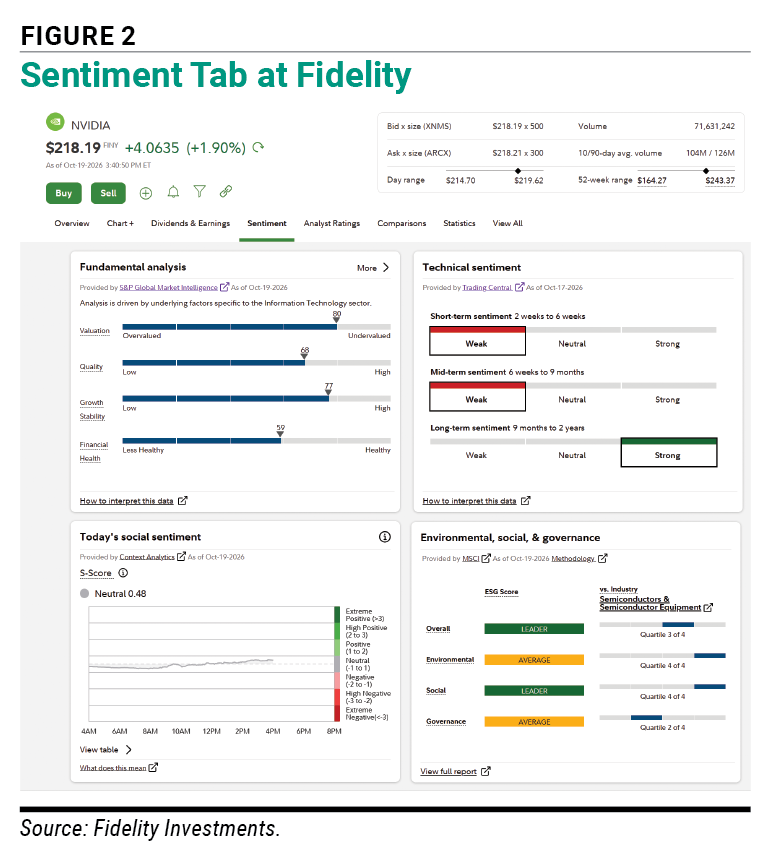
Fidelity offers stacks of research reports for popular stocks. A check of the quote page for Nvidia Corp.  (NVDA) showed research reports available from nine third-party sources. Wall Street stock ratings were also available, but price targets were not included.
There are ample third-party research widgets, too. Fidelity presents ratings in a skimmable format, sometimes at the cost of detail. For example, the technical analysis of Nvidia—found on the Sentiment tab under Research—gives vague opinions on short-, intermediate- and long-term prospects from Trading Central (Figure 2). The page includes a link to Trading Central’s methodology, but, unlike AAII’s A+ Investor Grades, there’s nary a hint of which indicators are strong enough to be driving the assessment. The Statistics tab is quite detailed, including industry averages and percentiles for each stock statistic.
Fidelity provides phone and video conferencing options along with in-person support through local branch offices. My personal experience with the firm aligns with AAII member survey responses that Fidelity’s customer service is excellent.
Fidelity also segments its services according to the amount of assets held at the firm. Clients can be assigned a representative with $500,000 in assets at the firm. Those with $10 million at the firm can use Fidelity’s Private Wealth Management services, but the firm does not have a private bank. Fidelity offers trading coaches via webinars.
Like Charles Schwab, Fidelity tends to shine a spotlight on its proprietary products. That’s not surprising, as Fidelity made its name from its mutual funds. Though Fidelity mutual funds can be bought with no transaction fees, clients should still do their research and avoid buying Fidelity mutual funds or other products simply because of their prominence on a webpage or screen.
Lastly, here’s a fun bit of trivia you can use to quiz a Fidelity representative: Fidelity has a mascot named FDIT the Frog. The frog first appeared in Fidelity’s advertising for the money market fund Fidelity Daily Income Trust (FDIT) in the 1970s. Fiddit ... like ribbit, get it?
The Interactive Brokers approach to customer satisfaction boils down to low costs, sophisticated trading algorithms, and giving clients as much data and as many ways to analyze it as they could ever want. If data gives you the feels, then Interactive Brokers—or IBKR, as the firm brands itself—will make you feel like a dog in an unattended butcher shop. Interactive Brokers is also very quick to add features. One of the most frequent sights on its website is a small flag that says “New.”
Globally minded investors can access over 175 global markets. You can trade stocks, ETFs, options, cryptocurrency, futures, options on futures, spot currencies, spot gold, bonds, mutual funds, prediction contracts and hedge funds. Its paper-trading experience replicates the real-money experience.
Interactive Brokers offers an astonishing array of data and seven platforms that you can access with your account. They range from the simplest (the IBKR GlobalTrader mobile app) to the super-complex, institutionally oriented Trader Workstation. Luckily, the happy medium can be found with the firm’s website portal, the IBKR Mobile trading app and, for those wanting more data on their screen but less hassle, the relatively new IBKR Desktop application.
Interactive Brokers’ most notable price difference from other brokers is its lower margin rates. There are a few pricing plans to choose from. IBKR Lite is designed for most individual investors and comes without basic data fees or stock commissions. However, IBKR Lite’s margin rates are higher than those of the IBKR Pro plan, which comes in fixed and tiered price structures. Heavy options traders and margin borrowers might want to consider IBKR Pro.
Interactive Brokers’ user experience is matter-of-fact. Graphic elements are minimized, presumably to ensure quick page loading times, a reassuring choice in case markets get rambunctious. All three brokers reviewed in this article offer charts, third-party research and fundamental data, but Interactive Brokers goes two or three steps beyond what’s expected.
Here’s an example: Charles Schwab provides 45 investing themes. I counted 491 themes at Interactive Brokers. My mind went on strike when I looked for ideas on that page. Interactive Brokers’ themes also pop up on stock quote screens. Nvidia appeared in 47 themes.
AAII members will enjoy the firm’s Fundamentals Explorer, which has one of my favorite presentations of fundamental data (Figure 3). Its thumbnail graphs are a visual shortcut for assessing how a particular stock’s ratios compare to those of its industry. The Context Analytics tab displays social media activity and sentiment, ultimately arriving at a Buzz Score. Fidelity also offers sentiment info from Context Analytics, but less of it.
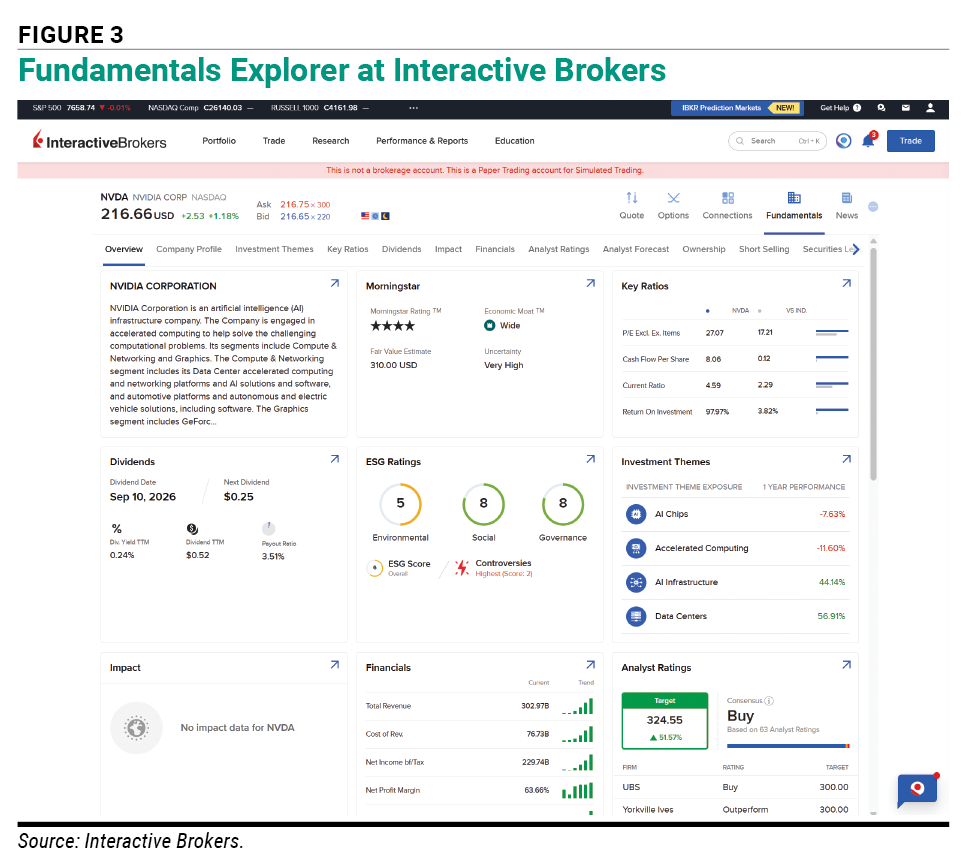
The Research tab at the top of the home page is comprehensive, but it doesn’t have the same irrational data exuberance as the themes list. Clicking on the Research tab allows you to go in 14 different directions, ranging from watchlists with over 300 data column choices to information that maybe one investor out of a thousand would use more than once per year, such as a feed of stock exchange notices.
Interactive Brokers’ news feeds avoid most of the artificial intelligence (AI) slop that afflicts us these days, but stories can be duplicated on the feed. The stock quote page has a (presumably) AI-curated news feed that does a very good job of highlighting important stories. That’s a real timesaver. Clients get Bloomberg News via the Research tab on the Market Overview page.
Prediction markets continue to gain popularity. Even if you aren’t interested in them, scrolling through prediction markets can lead to ideas and insights that you can implement with traditional investments. Interactive Brokers consolidates quotes from up to three prediction markets per topic: the firm’s own affiliate called ForecastEx, CME Group and Kalshi.
Table 1 compares the fees charged by these three brokers. Investors should always evaluate broker pricing according to how they plan to invest. Brokerage pricing is complicated. Before funding a new account, download and review the broker’s complete pricing schedule.
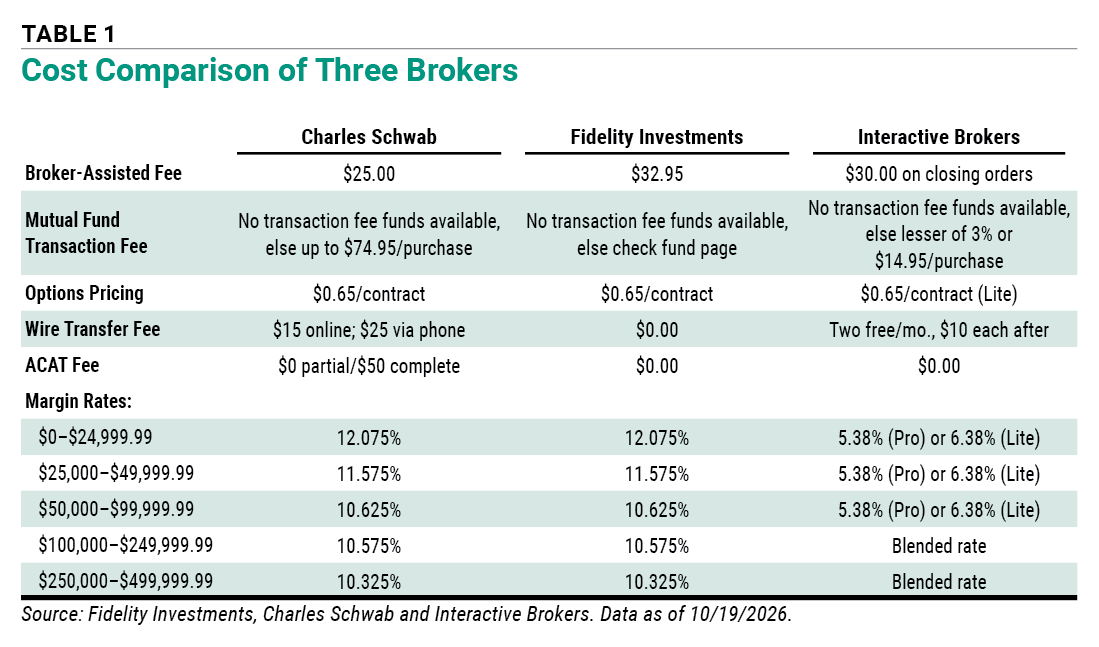
Brokers sometimes advertise options as being “zero commission,” but per contract fees on options sure feel like commissions. Expect that option prices will drop over time, because the pricing war among brokerages is still raging. Some upstart brokers such as Moomoo and Robinhood don’t charge commissions or contract fees for options.
Among these three online discount brokers, Fidelity is my top pick for beginning investors for its ease of use. Charles Schwab has a similar breadth of services as Fidelity, and it comes with the bonus of its advanced Thinkorswim platforms. I’m also a fan of Charles Schwab’s high-net-worth services. Interactive Brokers can feel a bit fussy for complete novices, but it’s a standout for data, platforms, pricing and global reach.
The Big Question

Beginning Investor


ART G from FL posted about 22 hours ago:
GLEN S from IL posted about 9 hours ago:
You need to log in as a registered AAII user before commenting.
Log InCreate an account