

Four Strategies for Reducing Capital Gains Taxes on Investments
by Charles Rotblut | December 07, 2023
As we approach the end of 2023, some of you may be looking at a combination of gains and losses in your portfolios. While the S&P 500 index has enjoyed a good year thanks to the returns of the so-called Magnificent Seven stocks, many other stocks haven’t seen their prices rise. (The S&P High Yield Dividend Aristocrats index was down year to date at the end of November, for instance.)
If you are among those who have gains and losses from investments held in your taxable accounts, you still have time to reduce your 2023 tax bill. Here are four strategies for doing so:
 1. Offset gains with losses. The tax code allows you to offset gains realized in a calendar year with losses realized the same year. Long-term losses offset long-term capital gains first. Short-term capital losses offset short-term capital gains first. If you have excess short-term (long-term) capital losses, they can then be applied to long-term (short-term) capital gains. Any net excess capital losses exceeding $3,000 can be carried over to future years. (You can also apply net excess losses from prior years to this year, as long as you don’t exceed the $3,000 limit.)
2. Harvest losses. Tax-loss harvesting involves purposely selling an investment that’s fallen since purchase to realize a loss for tax purposes. It is similar to the first strategy with the exception that you are not specifically trying to pair gains and losses. Tax-loss harvesting can make sense if the investment is close to meeting your sell rules and you want to lock in the losses this tax year. You can also use it to claim losses in specific lots of an investment that you bought on different dates (e.g., through dollar-cost averaging). If you plan on repurchasing the investment after 30 days to avoid triggering the wash-sale rule (see below), be aware that your new cost basis depends on the repurchase price. If the repurchase price is lower than your original cost basis, you could incur higher capital gains taxes in the future.
3. Donate the investment to charity. Donating an investment held in a taxable account that has risen in price since purchase gives you two positives. First, you avoid paying any capital gains taxes on the investment. Second, you can write off the full market value of the donated securities as a charitable donation. The big caveat to this is that your total deductions (charitable deductions, state and local taxes, mortgage interest, etc.) must exceed the standard deduction. The standard deduction in 2023 is $27,700 for married couples filing a joint return and $13,850 for those who are single.
4. Gift the investment. When an investment, such as a stock, is gifted to someone else, the person making the gift avoids paying capital gains taxes on the investment. However, the person receiving the investment also receives your cost basis. This can result in a potentially higher tax bill for the person who received the gift, depending on when they eventually sell the stock. (A more tax-efficient way could be to bequeath the investment as part of an estate. Doing so results in a “step up” of the cost basis for the person inheriting the investment, instead of the cost basis being based on when the deceased bought the investment.)
Be Careful of the Wash-Sale Rule
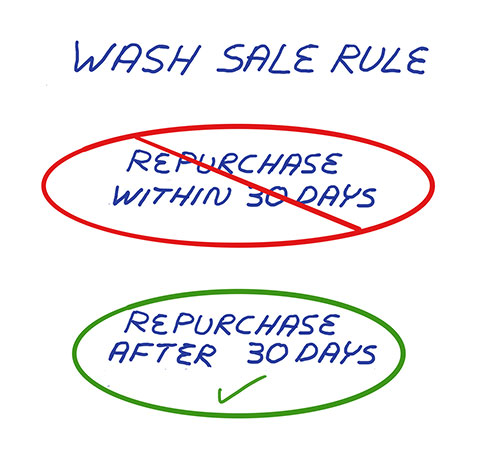
The wash-sale rule prevents investors from realizing a loss and then buying or acquiring a “substantially identical” investment within 30 days. If the wash-sale rule is broken, the realized loss cannot be claimed for tax purposes. The realized loss can, however, be used to adjust the cost basis of the new position.
The two big keys are the 30-day window and the “substantially identical” wording. You cannot buy call contracts on the sold investment or add the investment to another account—e.g., an individual retirement account (IRA)—within 30 days and still claim the loss. However, you can turn around and buy a similar investment, such as shares of a competitor or a slightly different fund. An example of the latter would be to sell a small-cap value fund and then buy a different small-cap value fund. (Buying a different share class of the same mutual fund does not count.)

-
Online Exclusive: What Is Tax-Loss Harvesting?
Tax-loss harvesting is the use of realized losses to offset realized gains, lowering taxes for the current year and potentially future years, too. -
Keeping Transactions Clean From the Wash-Sale Rules
Stocks are not the only security covered by the wash-sale rule; prudence is also required with bonds, preferred stocks, mutual funds and ETFs. -
Online Exclusive: What Are Donor-Advised Funds?
Donor-advised funds allow donors to take an immediate tax deduction on their contributions now without the need to decide at the same time where the funds will ultimately be gifted. -
Guide to Tax on Your Personal Investments 2023
This supplement to our annual tax guide provides an explanation of the tax rules regarding the buying and selling of securities. -
11 Tax Actions to Consider Before Year-End
By realizing various deductions and liabilities this December, you may be able to lower what you owe for tax-year 2023.
Members are looking for your input. Can you help with this question from the Tax Strategies Community?
“What year-end tax-related actions are you taking?”
Tap the button and then choose the Join the Community button on the right to answer this question in the AAII Community
Answer This Question in the AAII Community »
AAII Sentiment Survey
Optimism among individual investors about the short-term outlook for stocks fell for the first time in five weeks in the latest AAII Sentiment Survey. Meanwhile, pessimism rebounded from its lowest level in almost six years. Both readings have returned to their respective typical ranges.
Bullish sentiment, expectations that stock prices will rise over the next six months, decreased 1.4 percentage points to 47.3%. Optimism is above its historical average of 37.5% for the fifth consecutive week and the sixth time in nine weeks.
Neutral sentiment, expectations that stock prices will stay essentially unchanged over the next six months, decreased 6.4 percentage points to 25.3%. Neutral sentiment is below its historical average of 31.5% for the ninth time in 10 weeks.
Bearish sentiment, expectations that stock prices will fall over the next six months, increased 7.9 percentage points to 27.4%. Pessimism is below its historical average of 31.0% for the fifth consecutive week and the fifth time in 12 weeks.
The bull-bear spread (bullish minus bearish sentiment) decreased 9.3 percentage points to 19.9%. The bull-bear spread is above its historical average of 6.5% for the fifth time in nine weeks.
This week’s special question asked AAII members if they think other investors are too bullish or bearish right now.
Here is how they responded:
- They are too bullish: 48.6%
- They are too bearish: 12.5%
- Their sentiment toward the market is about right: 27.4%
- Not sure/No opinion: 11.3%
Bullish: 47.3%, down 1.4 points
Neutral: 25.3%, down 6.4 points
Bearish: 27.4%, up 7.9 points
Bullish: 37.5%
Neutral: 31.5%
Bearish: 31.0%
See more Sentiment Survey results.

AAII Asset Allocation Survey
Individual investors’ allocation to fixed income increased and equities remained relatively flat in the November Asset Allocation Survey.
Stock and stock fund allocations increased 0.2 percentage points to 64.6%. Stock and stock fund allocations are above their historical average of 61.5% for the 42nd consecutive month.
Bond and bond fund allocations increased 0.5 percentage points to 16.4%. Bond and bond fund allocations are above their historical average of 16.0% for the first time in 33 months. Fixed-income allocations were last higher in January 2021 (17.0%).
Cash allocations decreased 0.7 percentage points to 19.0%. Cash allocations are below their historical average of 22.5% for the 12th consecutive month.
Optimism in the weekly AAII Sentiment Survey reached an unusually high level in November and pessimism decreased to its lowest level in almost six years.
- Stocks and Stock Funds: 64.6%, up 0.2 percentage points
- Bonds and Bond Funds: 16.4%, up 0.6 percentage points
- Cash: 19.0%, down 0.8 percentage points
- Stocks: 29.7%, up 0.2 percentage points
- Stocks Funds: 34.9%, up 0.1 percentage points
- Bonds: 5.8%, down 0.0 percentage points
- Bond Funds: 10.6%, up 0.6 percentage points
- Stocks/Stock Funds: 62.0%
- Bonds/Bond Funds: 16.0%
- Cash: 22.0%
Take the Asset Allocation Survey.
November 30, 2023 Remembering Charlie Munger
November 23, 2023 Seven Reasons for Investors to Be Grateful in 2023
November 16, 2023 November Charts of Interest: Small-Cap Pain
November 9, 2023 Dealing With Shades of Gray in My Allocation

Discussion
Monk Jr. Monk from Texas posted over 2 years ago:
"An example of the latter would be to sell a small-cap value fund and then buy a different small-cap value fund". I think you need to be very careful with this. I read that there was a case where the IRS disallowed the losses to be claimed and ruled it a wash sale. Mutual funds and ETF's that go after the same class of investment may be considered "substantially identical".
Charles Rotblut from Illinois posted over 2 years ago:
Monk,
They need to be different funds. You cannot, say, sell a Vanguard S&P 500 mutual fund at a loss and then go out and buy the Vanguard S&P 500 ETF and claim the loss on the former. You could sell a market-cap weighted S&P 500 fund and buy an equal-weight S&P 500 fund, a Russell 1,000 fund or an actively managed large-cap fund and still claim the loss, however. There has been an ongoing loophole where investors can sell an ETF from one fund family (say BlackRock) and by a similar ETF from another fund family (e.g. State Street) and not be tagged by the wash sale rule. I would not suggest pushing your luck by stepping that close to the line.
-Charles
You need to log in as a registered AAII user before commenting.
Create an account