

Remembering Charlie Munger
by Charles Rotblut | November 30, 2023
AAII is excited to be participating in Finimize’s Modern Investor Summit 2023 on December 5 and 6, and you are invited to join us. This FREE virtual event is a unique opportunity to hear from industry titans like keynote speakers Ray Dalio and Jamie Dimon, as well as our own Wayne A. Thorp, who will offer insights on stock screening and investment strategies. Click here to learn more and secure your FREE virtual ticket.
As you have probably heard by now, Berkshire Hathaway vice chairman Charlie Munger died on Tuesday, November 28, 2023. He was just a month shy of reaching his 100th birthday. With his passing, the world lost a legendary investor and a man full of insight and wit. “If people weren’t so often wrong, we wouldn’t be so rich,” he once quipped.
Munger’s wit quickly turned my wife into a fan of his. Ask her about Berkshire Hathaway and she’ll quickly say, “Charles greatly admires Warren Buffett, but I love Charlie Munger.”
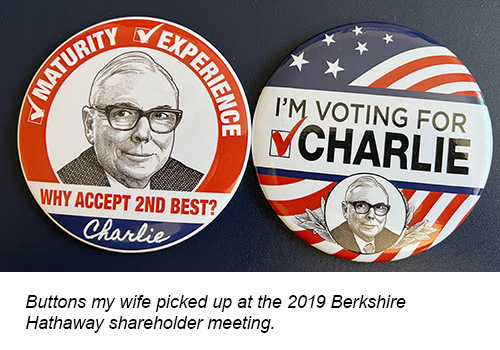 Munger was more than Buffett’s business partner and friend. It was Munger who convinced Buffett to evolve his strategy from Benjamin Graham’s deep-value approach to paying up for good companies. This shift was first apparent with Berkshire Hathaway’s purchase of See’s Candies in the 1970s. See’s Candies was what Robert Hagstrom described as a “high price-to-book business—almost the antithesis of the Graham methodology” in the November 2021 AAII Journal (“Warren Buffett and the Evolution of Value Investing”).
In the 1989 Berkshire Hathaway shareholder letter, Buffett discussed the change in his investing philosophy: “If you buy a stock at a sufficiently low price, there will usually be some hiccup in the fortunes of the business that gives you a chance to unload at a decent profit, even though the long-term performance of the business may be terrible … Unless you are a liquidator, that kind of approach to buying businesses is foolish … It’s far better to buy a wonderful company at a fair price than a fair company at a wonderful price. Charlie understood this early; I was a slow learner. But now, when buying companies or common stocks, we look for first-class businesses accompanied by first-class managements.”
Munger also deserves much credit for helping Buffett think through his decisions. “When we differ, Charlie usually ends the conversation by saying: ‘Warren, think it over and you’ll agree with me because you’re smart and I’m right,’” noted Buffett in the 2014 shareholder letter.
We’ll never know what mistakes Munger kept Buffett from making. At the 2019 Berkshire Hathaway shareholder meeting, Munger said he turned down about as many as 500 investments for every one he bought. Whatever the actual number is, it is probable that Berkshire Hathaway’s long-term performance is better than it would have been had Buffett not had Munger to bounce ideas off of.
A big part of Munger’s approach was to consider what could go wrong and try to avoid such situations. In an email yesterday, author William Green recalled how he had asked Munger specifically why he focused so much attention on avoiding common errors and predictable patterns of irrationality. “Because it works,” replied Munger. “If you try and be smart, it’s difficult. If you just go around and identify all of the disasters and say, ‘what caused that?’ and try to avoid it, it turns out to be a very simple way to find opportunities and avoid troubles.”
While Munger was nowhere near as verbose as Buffett is, he was never afraid to share an opinion when he had one on a subject. Here’s a quote from the 2017 Berkshire Hathaway shareholder meeting that CNBC shared yesterday: “What you don’t want to be is like the man who, when they had his funeral, the minister said ‘now’s the time for someone to say something nice about the deceased.’ And nobody came forward. He said ‘surely somebody can say something nice about the deceased.’ And nobody came forward. And finally one man came up and said, ‘Well, his brother was worse.’”
I’m sure there will be many people with nice things to say at Munger’s funeral. The world will miss you, Charlie.

-
Warren Buffett and the Evolution of Value Investing
Buffett realized that value investing had nothing to do with accounting factors. It was all about the cash—the return on equity. -
How the World’s Greatest Investors Think
Behaving differently and focusing on a simple idea with strict discipline are common threads that define investors who’ve become famous for their success. -
How Safe Retirement Withdrawal Rates Work in Practice
The 4% rule doesn’t guarantee safety, but combined with some judgment and adaptation based on market conditions, it gives a very high likelihood of success. -
Actively Managed Funds Gain on Passive Funds Over the Last Year
Fifty-seven percent of actively managed funds beat their average passive peers over the 12-month period through June 2023, their highest success rate in years. -
Hereditary Financial Habits: Lessons From a Businessman
Anine Sus pays tribute to her recently deceased grandfather by sharing the wisdom he imparted to her family over the years.
AAII Sentiment Survey
Optimism among individual investors about the short-term outlook for stocks continued to rise in the latest AAII Sentiment Survey. Meanwhile, pessimism decreased to its lowest level in almost six years. Both types of readings have historically been followed by below-average and below-median six-month returns for the S&P 500 index.
Bullish sentiment, expectations that stock prices will rise over the next six months, increased 3.5 percentage points to 48.8%. Optimism is unusually high and is above its historical average of 37.5% for the fourth consecutive week and the fifth time in eight weeks.
Neutral sentiment, expectations that stock prices will stay essentially unchanged over the next six months, increased 0.6 percentage points to 31.7%. Neutral sentiment is above its historical average of 31.5% for the first time in nine weeks.
Bearish sentiment, expectations that stock prices will fall over the next six months, decreased 4.1 percentage points to 19.6%. Pessimism is unusually low, at its lowest level since January 3, 2018 (15.6%), and is below its historical average of 31.0% for the fourth time in 11 weeks.
The bull-bear spread (bullish minus bearish sentiment) increased 7.5 percentage points to 29.2%. The bull-bear spread is above its historical average of 6.5% for the fourth time in eight weeks.
Over the holiday week, we asked AAII members what their favorite thing was to eat on Thanksgiving. Turkey was the most popular, followed by stuffing and desserts.
This week’s special question asked AAII members how they think the average consumer is faring relative to one year ago.
Here is the breakdown of responses:
- They are faring worse: 51.6%
- They are faring about the same: 24.9%
- They are faring better: 19.3%
- Not sure/No opinion: 4.2%
Bullish: 48.8%, up 3.5 points
Neutral: 31.7%, up 0.6 points
Bearish: 19.6%, down 4.1 points
Bullish: 37.5%
Neutral: 31.5%
Bearish: 31.0%
See more Sentiment Survey results.

November 23, 2023 Seven Reasons for Investors to Be Grateful in 2023
November 16, 2023 November Charts of Interest: Small-Cap Pain
November 9, 2023 Dealing With Shades of Gray in My Allocation
November 2, 2023 Cash Is Popular, but Be Careful When Allocating to It

Discussion
Barry from TX posted over 2 years ago:
Great tribute to a great person, Charles. AAII and Charlie Munger are in the same business - creating models to help people make better investing decisions. PRISM is presented as a 5 step process, but it is a mental model of James Cloonan's mental model of a simplified investing process to help members. Each PRISM step is a mental model of how to execute that step and the exhibits AAII created to capture the data needed for that step are mental models that lay out a plan to complete and document that step. All the AAII screens - how many dozen are there?- are mental models of famous investors mental models on how they thought about and simplified the investing process into a mental model that worked for them. Every AAII article presents someone's mental model(s) of the investing process. Charlie Munger famously said that the person with the most mental models has a big advantage in the market because they don't see a problem, they see an opportunity to apply one or more of the models they carry around in their brains.
You need to log in as a registered AAII user before commenting.
Create an account