

Cash Is Popular, but Be Careful When Allocating to It
by Charles Rotblut | November 02, 2023
Yesterday’s decision by the Federal Open Market Committee (FOMC) to keep rates unchanged was no surprise. It came on the heels of a conversation I had at this week’s MoneyShow with an individual investor. We talked about allocating to money market accounts and similar types of high-yielding cash instruments in lieu of stocks.
A conference attendee told me they were fully allocated to money market accounts yielding 5% or more. This person claimed to know other individual investors who were doing the same thing. When I raised the issue of cash not providing any capital appreciation, the attendee responded by pointing out the safety of cash and the current yields.
 Our surveys have shown mixed data about cash allocations. Nearly two of out five survey respondents (38%) to our latest Big Question survey said they are holding more cash. (The survey was sent out over the summer.) In comparison, the average of the year-to-date cash allocations recorded in our monthly Asset Allocation Survey this year is very close to the average from January to October in 2022.
Nonetheless, there has been an overall increase in the use of cash-like instruments. The Investment Company Institute (ICI) calculates that assets of money market funds available to individual (retail) investors totaled $2.19 trillion near the end of October. Institutional money market funds held assets totaling $3.44 trillion. BlackRock says the total amount allocated to money market funds at the end of August was “up $1 trillion from a year ago.”
Cash is a useful asset. It is unaffected by market volatility. You can buy things with it. It is easy to withdraw when needed.
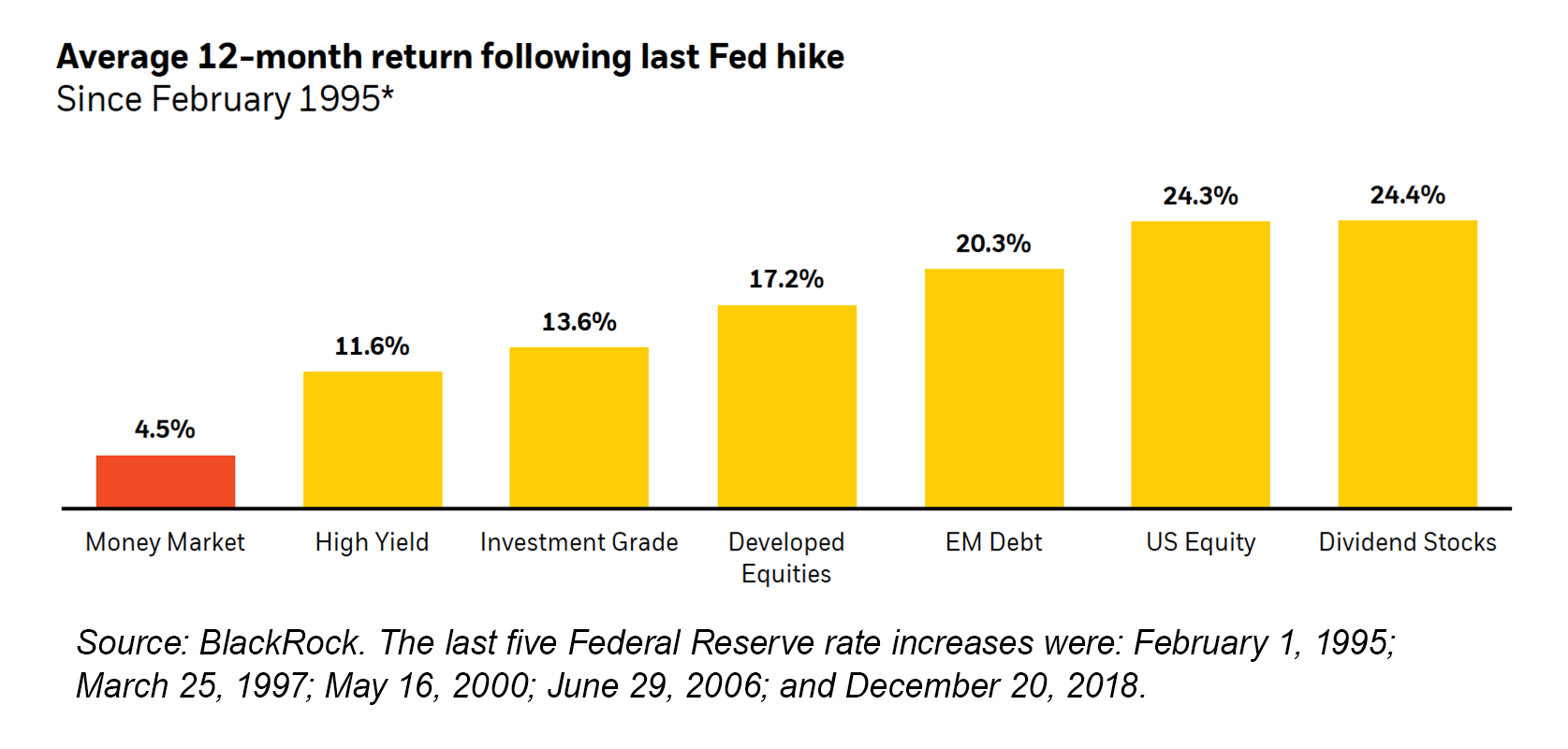
Unfortunately, cash loses value over time. A $100 bill received today buys you fewer things than the same bill received one or two years ago. Stocks have a long history of rising in price. Many pay dividends in addition to rising in price. Intermediate- and long-term bonds pay higher interest rates than money market funds when the yield curve isn’t inverted as it still currently is. In addition, bonds can also rise in price—particularly when yields fall. Both stocks and bonds have historically created more wealth for investors than money market funds after the Federal Reserve has stopped raising rates, as the BlackRock chart here shows.
Interest income earned on cash is generally taxed at ordinary income rates at the federal and state level. Qualified dividends from stocks are taxed at the discounted 0%, 15% and 20% federal rates. Municipal bond interest is tax-exempt at the federal level and generally at the state level. Interest on Treasury bonds is tax-exempt at the state level.
Cash can be an effective asset class when used properly. As I explain in this month’s AAII Journal, holding the equivalent of up to four years’ worth of withdrawals needed for living expenses in cash can allow you to avoid selling stocks when their prices are down. Certainly, having adequate savings in cash to cover emergency and unexpected expenditures is a prudent move.
Cash equivalents can also be used to dampen overall portfolio volatility. A barbell approach involving an aggressive stock allocation at one end and a much smaller allocation to, say, short-term Treasurys or certificates of deposit (CDs) at the other end is one such example.
Where cash allocations get tricky is when they are used tactically without clear, preset rules regarding when to pull out of them. The individual from the MoneyShow mentioned considering stocks if “they became cheap enough.” In this case, cheap enough seemed to be a matter of personal perception as opposed to being based on a preset metric like valuations.
The same logic applies to bonds. Those opting for cash equivalents in lieu of bonds would be well-served to have a metric for determining when they would rotate back into bonds. Even a simple metric like the return of an upward-sloping yield curve or a sign that the interest rate tightening cycle is finally over is better than going with your gut or emotions.

-
How AAII Members Have Responded to Interest Rate Hikes
A comparison of popular sources for portfolio income now and before rates began to rise. -
Allocating to Manage Risk: A Case Study
The downside risk a retired couple’s portfolio faces is examined, along with a strategy to reduce the damage of turbulent market conditions. -
Guidelines for Selecting Bonds and Cash-Like Instruments
Key characteristics when analyzing bonds, choosing between bonds and bond funds and the role of laddering. -
Five Approaches for Allocating Your Retirement Portfolio
Strategies that range from maintaining a high equity allocation to annuitizing fixed expenses all have their proponents. -
Changing of the Guard: Energy Powers Third-Quarter Returns
Fifteen of the top 25 ETFs for the third quarter of 2023 are focused on energy, and 10 of the top mutual funds.
Members are looking for your input. Can you help with this question from the Retirement Planning & Withdrawals Community?
“What challenges, if any, have you encountered in consolidating or sharing estate planning information with family members and other heirs, and how did you overcome them?”
Tap the button and then choose the Join the Community button on the right to answer this question in the AAII Community
Answer This Question in the AAII Community »
AAII Sentiment Survey
Optimism among individual investors about the short-term outlook for stocks continued its decline in the latest AAII Sentiment Survey. Meanwhile, pessimism increased and remains unusually high.
Bullish sentiment, expectations that stock prices will rise over the next six months, decreased 5.0 percentage points to 24.3%. Optimism is unusually low for the second consecutive week and is below its historical average of 37.5% for the seventh time in eight weeks. Bullish sentiment was last lower on May 18, 2023 (22.9%).
Neutral sentiment, expectations that stock prices will stay essentially unchanged over the next six months, fell 2.1 percentage points to 25.4%. Neutral sentiment is below its historical average of 31.5% for the sixth time in nine weeks.
Bearish sentiment, expectations that stock prices will fall over the next six months, increased 7.1 percentage points to 50.3%. Pessimism remains at an unusually high level for the second consecutive week and is above its historical average of 31.0% for the seventh time in nine weeks. Bearish sentiment was last higher on December 22, 2022 (52.3%).
The bull-bear spread (bullish minus bearish sentiment) decreased 12.1 percentage points to –26.0%. The bull-bear spread remains below its historical average of 6.4% for the eighth time in nine weeks.
This week’s special question asked AAII members what their six-month outlook is for bond yields. Here are the responses:
- They will rise: 30.4%
- They will be about the same: 43.5%
- They will be lower: 16.1%
- Not sure: 4.7%
- No opinion: 4.7%
Bullish: 24.3%, down 5.0 points
Neutral: 25.4%, down 2.1 points
Bearish: 50.3%, up 7.1 points
Bullish: 37.5%
Neutral: 31.5%
Bearish: 31.0%
See more Sentiment Survey results.

October 26, 2023 Expanding Upon the 10 Commandments of Investing
October 19, 2023 October Charts of Interest: Soaring Bond Yields and Falling Bond Prices
October 12, 2023 Index Fund Expense Ratios May Be Bottoming Out
October 5, 2023 Financial Independence and Retirement

Discussion
John L from NJ posted over 2 years ago:
Cash is only good for two things; Spending, and Investing in Equities.
Kevin from CA posted over 2 years ago:
Cash is king in an environment with 50% downside and no more than 15% upside in the next year.
CRAIG BORGARDT from WI posted over 2 years ago:
Cash is certainly king right now but only until it's not. And I agree it's a good parking space for a return to higher equities allocation. But after 2022's route of both equities and bonds (not to mention gold/silver and many commodities), folks nearing or in retirement were shook. I was certainly shocked but soon realized we are living in an investment era that few have ever seen before. And considering both consumer and U.S. government debt loads, Treasury auctions will often not be fully purchased with the Fed buying more, even as they sell to clean up their balance sheet. Being 70, I lived through inflation and stagflation in the 70's and early 80's and anyone thinking the Fed controls long term interest rates doesn't understand the bond market. Volcker had to play catchup and it took him a few years, not the one year our Fed chose and even the financial professionals in banking got smoked. Again but for a different reason. Way back when we built a new pharmacy in '77 and ended up with an 18.%% mortgage and the owners not drawing salaries for 18 months. Fed holding rates or not, the market will continue to be spooked by these debt loads and the loan rollovers that are just now starting to hit and which Gundlach and others predict will cause a massive loss in equities similar to 2008-2009. As Dave Ramsey said, "Buildings won't go away. They will only get new owners financing at much lower rates once the carnage is over." Hard to argue with these two as the socialist's Modern Monetary Theory of the past 50 years appears to be as false as predicted and that more sane economists' predictions of a debt crisis loom correct. Moreover, this article and like so many others (like the one Wednesday in the WSJ) fail to take into account investment horizons, Sequence of Returns Risk and the likely average age of an AAII member are as important as allocation/diversification. A possible deep recession with a three year drop and stagnation of equities prices will change a lot of Financial Plans and mostly, quality of living of many of our last years. I told my 40 year old son to just keep investing as he has been and that makes sense with likely 30 years to go before he retires. The Boomers have not only saved insufficiently for retirement but like the recession and inflation of our early working years in the 1970's, we are living in retirement with another major economic downturn. So many will drain their meager savings thus losing investors in the markets as well as creating a poverty level unseen since the 1930's. In fact, each decade of retirement from the 60's 70's, 80's into our 90's demands a different allocation. I am currently 25% cash, 25% equities, 25% short term bonds and 25% commodities (no Bitcoin). But I can see someone in their mid to late 70's going to 50% cash and those above that age level, 90-100% is not unreasonable unless of course we have sudden hyperinflation and they would be fine and dandy. Well, either fine OR dandy, if one believes George Carlin's old schtick. :) Age, number of years to retirement or just past retiring (Sequence of Returns Risk) and individual budgets (lifestyles) make cash and short term bonds enough to make it without sacrificing much. Then again, there is WW3 and talk about a "game changer", along with the Big Reset and the ongoing onslaught against capitalism. Oy vey......so maybe it's just cash, gold and a handful of Bitcoin. Double Oy vey!! :(
Barry from TX posted over 2 years ago:
BIG SHOUT OUT to Craig. He articulates the mindsets of the millions of investors who are TEMPORARILY parking large percentages of their portfolios in money market funds that pay >5%. Here is a review of the list of sources Charles referenced in this article that indicated that a lot of us dumb money folks are moving assets into cash instruments like MMFs that earn >5% IS a rational option to the meandering markets since 2Q23 and Charles' sources confirm the magnitude of the shift from equities to cash. #1 An Orlando conference attendee told [Charles] they were 100% allocated to MMFs yielding >5%. (Note: This story sounds very similar to the Minions 2 movie plot.) #2 The AAII Big Question Survey respondents said they are holding more cash. #3 AAII Allocation Survey respondents reported an overall increase in the use of cash-like instruments. #4 ICI calculates that assets of MMFs available to IIs (retail) investors @$2.19T @10/31. #5 INT MMFs held cash assets @$3.44T. #6 BLK says the total amount allocated to MMFs @08/31 was “up $1T YOY.” Whew! And now, my personal list of rationales (some "buy and hold" true-believers would call them undisciplined emotions) why I moved an increased percent of my portfolio into 5.35% MMFs for 2Q-3Q23: (1) to lock in a risk-free rate @ 5.35% (a very rare market event), (2) MMFs contain very short-term, low risk, high liquidity assets (3) that rate covers declining inflation rates @3% and headed down, (4) to reduce portfolio risks from buying into market concentration covariances from the less than 5% of SPX equites that are up YTD, (5) to avoid the whip-saw of high volatility in 2023 equity markets due to smart money traders betting on options calls/puts to cover shorts, and (6) to hedge the 50%/50% risk of a potential recession (now moved out to 2024) resulting from the build-up of the latent potentialities of many economic factors that Craig so vividly reminded us of what followed a very similar situation in the late 70’s Carter inflation and follow-on recession and the early 80’s Volker Fed actions to fight inflation. (7) and to leverage my position through 4Q23 where the current expectation is a 5% return without all 2023 market “BS” cited above. Craig's comment reminded me that Mark Twain said ( paraphrasing): “Markets don't repeat themselves, but they do rhyme.” A lot of investors were moving assets into MMFs for the SHORT TERM. It looks like October might have been the fulcrum for the upcoming shift back to equities. I have every intention of reducing my cash positions by reweighting my standard 6-10 value stock ETF portfolio after all this has passed. I have found articles on the AAII website very helpful during these adventurous times. I apologize for backsliding from the “buy and hold” theology. I am Baptist, but not a very good one. I also dance with my wife. So, such a lapse was to be expected.
Barry from TX posted over 2 years ago:
A short note to Jack, Charles, Wayne, John, and Cynthia. If October was in fact the fulcrum for the forward upside of the markets (as I suggested above), it seems that November and December would be excellent times to re-emphasize how your individual Platinum offerings provide guidance to reposition portfolios for 2024 markets since they are expected to be very different from 2023 markets. Thank God. I know I am looking for "education," and I just got my Platinum renewal notices. Bah Humbug.
John L from NJ posted over 2 years ago:
Any investment strategy that relies on market forecasting is going to fail. Yes now cash has low real yields; but investing is about the future. A future that no one can accurately forecast. Those with the discipline to buy and hold equities for the long term will ultimately out perform the market timers who believe they know the future. So spend the cash or invest it in equities!
Barry from TX posted over 2 years ago:
John, you seem to be more "invested" in past historical performance than I am. That's OK. We just use different data to arrive at different opinions of what the data we each see means. This is what the efficient market hypothesis is all about. That is what makes markets work. I wish you the best possible outcomes for your investments in the future and I appreciate you taking the time to remind me to review my portfolio choices. Where we disagree is that I am willing to "rebalance" my portfolio allocations when I become aware of data that motivates me to rethink asset allocations to accommodate market dynamics that increase the risk of my equity allocations being less productive than my fixed-income allocations. Here is my data and my reasoning. I do not advocate that anyone follow my lead. #1 ALL brokers have “PINGOFR “disclaimers for a reason. I am making a short-term bet that they're right that "Past performance is no guarantee of future results" (PINGOFR). You and I and every broker seem to agree on that widely-used warning. #2 The basic premise of investing provided by every broker to all their clients (and AAII) is that each investor should create a diversified portfolio that reflects their financial goals and risk tolerances. Again, we seem to agree on that, too. #3 I am not forecasting future market performance. I am betting that the economic data I gather from OMB, Fed FRED, and receive from brokers is reasonably accurate. #4 Market performance is a (second or maybe a third) derivative of economic performance. At least that is the logic the Fed relies on every time it explains its monetary policy decisions. #5 In 1982 Paul Samuelson famously said, “The stock market has predicted 9 out of the last 5 recessions.” In 2023, that can be updated that aphorism to say that the market has predicted 13 out of the last 7 recessions (since 1982). It seems that recessions are occurring more frequently these days, and it takes longer to recover from large “drawdowns” (better known as recessions). For example, we did not recoup pre-recession highs from the 1999-2000 dot.com recession until 2019 because we had another recession in 2008-2009 that elongated the recovery. #7 In a 1987 letter to BRK shareholders Warren Buffett, Ben Graham's most famous protégé, said, “In the short run, the market is a voting machine, but in the long run, it is a weighing machine." Heeding this sage advice from a very market-smart person, I am gathering the probabilities of where the fiscal (government spending) and monetary (government setting of interest rates) have been "voting" at their meetings and then "weighing" where the economic data they used to justify their votes are headed in the future. #8 For example, currently, the probability that the FOMC will raise FFR rates again this year is very low. That also means they are not planning to lower the FFR anytime soon. And the Fed has increased its buying of ST USTs. #9 That indicates that the "open" market for USTs is shrinking. All of these recent events will collectively maintain interest rates over 5% until the Fed either raises or finally lowers the FFR from its highest level in 50 years. All of this is good for investors who hold interest-paying cash assets. #10 ALL three of my brokers are telling me to "stay the course" with a traditional portfolio while simultaneously publishing articles that encourage everyone to "stay invested" and touting shifting into cash assets. Guess which one of us will profit from their "non-advice" no matter what the future portends? #10 I subscribe to several broker-provided weekly trading outlooks that track economic, market, open options, volatility, and VIX performance. Since 2Q23, I have noticed that ALL of them have begun to rein-in their assessments of SHORT-TERM market performance based on the deterioration of leading economic indicators (a set of 10 forward-looking leading economic measures from the Conference Board and a set of short-term measures of market performance (that varies with each broker). #11 I am merely "rebalancing" the relative weighting of my portfolio to shift a 60/40 allocation toward fixed income to hedge against short-term economic probabilities that seem to be indicated by the data I receive. #12 So far, so good. #13 The only statistic I really care about is how much my net wealth has increased each year. My goal is 15%. That figure includes all income minus all expenses for the year. #14 Despite the index's lackluster performance YTD, I am hanging on at around 13% during a year where I had 2 unusual expenses for relatives' funerals and related legal costs. #15 You are 60% correct. "Those with the discipline to buy and hold EQUITIEs for the long term will ultimately outperform the market timers who believe they know the future." The other 40% is that your data presupposes a diversified portfolio that includes some allocation to fixed-income assets which has traditionally meant around 40%. #16 Your cheer to "spend the cash or invest it in equities!" is a Hobson's Choice. It is much wiser to SAVE your cash and buy a BALANCED portfolio of equities AND fixed-income assets that align with your financial goals and risk tolerances. #17 John, thanks for helping me take the time to write down and rethink the logic of my recent portfolio allocation decisions. It helped me to reflect on and appreciate the reasoning behind them. #18 If you wish to share the logic of your investing decisions; I would be very pleased to see them. I can always learn. And I seek to invest more wisely as go move along. #19 Regards , Barry.
John L from NJ posted over 2 years ago:
Barry - In simple terms, there are three investments: Cash (short term bills or money market), Bonds (long term) and equity. As many just learned; long term Bonds are dangerous because of the interest rate risk which is magnified the longer the term (technically duration). Cash yields go up and down but historically have struggled to match inflation (1926 to 2021 only 0.4% real yield after inflation). Bonds if you are willing to take the risk returned real returns of 2.6% from 1926 to 2021). Equities yielded 7.1% real returns for the same period. Equity returns are mean reverting over long periods with a stable long term mean trend of 6.7% real returns that goes back to 1871 and we see the same mean reverting trend in world markets. The stock market is not efficient; just very difficult to beat. Periods of over valuation are followed by periods of under valuation but the length of the over and under valuation periods are highly variable as is the magnitude. Bubbles like 2000 are proof the market is driven by emotional crowd psychology and not efficient. The trouble is that very few can time these divergences from the long term trend. Everyone reads the same information from all the usual sources (Federal Reserve, Wall Street Journal, Market Gurus, AAII articles and sentiment indicators). Last year "everyone" thought a recession was going to occur in the fourth quarter. It didn't. You can't beat the average stock market returns unless you know something everyone else doesn't. Everything the AAII prints is well known. Stock screens, dividend yields, ratios, VMQ, growth investing and etc. And you can't successfully time the market by knowing what everyone else knows. So I invest 100% in cheap equity index funds with any cash I don't spend because I don't know anything unique or special. Equities have had the highest long term returns in my life (most of it is in the past). And hold forever; no matter how dire the experts claim the future might be. My motto is "this too will change". One last comment: most of modern portfolio theory was discovered to be incorrect 50 years ago but old theories even if incorrect never die in the popular investment press.
David E from DC posted over 2 years ago:
Building my cash reserves and the rising interest rates were just coincidental in my case. In backing off the investment throttle going into retirement, I just happened into decent interest rates where to park my money for future needs and eventual drawdowns. Short term CD ladders and money market funds are now favorable to place funds into.
You need to log in as a registered AAII user before commenting.
Create an account