

Financial Independence and Retirement
by Cynthia McLaughlin | October 05, 2023

This week, I am handing the keyboard over to my colleague Cynthia McLaughlin. Cindy discusses the newly launched AAII Retirement Investing newsletter and how confidence about retirement savings has changed.
—Charles Rotblut, CFA
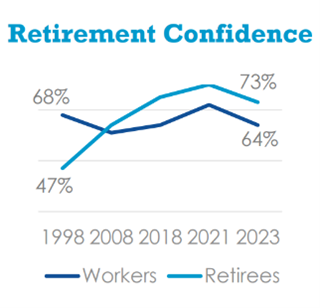
Are you confident about having enough money to maintain your preferred lifestyle in retirement? The Employee Benefit Research Institute’s (EBRI) 33rd Annual Retirement Confidence Survey—the longest-running survey of its kind—concluded that, compared to 2022, both worker and retiree confidence on this matter has decreased. The survey of 2,537 working and retired Americans was conducted online from January 5 through February 2, 2023.
About two-thirds of workers and three-quarters of retirees are confident about having enough money to live comfortably in retirement, down 10% and 6%, respectively, from 2022. Contributing to this decline are concerns about inflation, stock market volatility, increased reliance on debt and decreased retirement account balances.
Since the survey was conducted earlier this year after a disastrous 2022 for investors, it likely reflects this experience. However, anyone who has been to the grocery store recently can tell you that inflation is not abating. Plus, September lived up to its reputation as a volatile month, with the S&P 500 index down 4.9%. Compounding matters, workers reported a lack of confidence in being able to choose the right investment options in their workplace retirement plans.
Source: 2023 Retirement Confidence Survey;
Employee Benefit Research Institute and
Greenwald Research.
I bring this up because I am the lead editor of Retirement Investing, our recently launched service. As a means of introduction, I worked for a company that provided retirement plans to workplace plan sponsors in my role prior to joining AAII earlier this year.
I took delight in creating content to educate plan sponsors and participants on the merits of saving and investing for retirement and to encourage contributions. I spent a significant amount of time developing content that helped these investors better understand and utilize their specific plans and the investment options within those plans. This content included mathematical scenarios that demonstrated what a potential asset base could look like according to contribution rates and investment returns. I also addressed concerns expressed by workers and retirees in the aforementioned survey, along with those of financial literacy, wellness and how to get started on the road to investing.
My experience working with plan sponsors in the role underscored just how hard it is to save and prepare for retirement.
Saving is difficult at every stage, and all of us deserve to get our arms around financial literacy and independence as young adults or even earlier. To that point, the AAII Retirement Investing newsletter offers content that we believe young adults will find helpful (as well those in other retirement investing life phases).
What Is AAII Retirement Investing?
AAII Retirement Investing is a specialized online resource designed to serve investors at all phases of their retirement journey. Retirement Investing complements AAII’s well-respected AAII Journal as well as our other tools and products. We have defined three retirement life phases so subscribers can easily find content focused on what investors like you and your family members need.
The three life phases are:
- Accumulation: Saving for Retirement
- Transitioning: Preparing for Retirement
- Retired: Living in Retirement
Retirement is a goal that requires making good decisions throughout one’s life, and we believe this targeted content will help investors like you better make those decisions. Thursday, October 12 is National Savings Day. Celebrate by contributing to your retirement account or by subscribing to Retirement Investing. For more information or to subscribe, please visit https://retirement.aaii.com.

-
A Glimpse Into How AAII Members Built Their Savings
Tapping into the experience of other investors yields a fountain of wisdom on how to accumulate a nest egg. -
Many Retirees Limit Withdrawals to the RMD Amount
Insights into what types of accounts are favored by AAII retirees, and how they make withdrawal decisions. -
The Relationship Between Stock Market Volatility and Returns
Less volatility isn’t always a good thing, especially when considering the returns that follow periods of high volatility. -
Negative Earnings Prompts Turnover in Model Shadow Stock Portfolio
The three stocks removed for negative earnings are replaced by two additions. -
S&P 500’s Price-Earnings Ratio at High End of 60-Year Range
As of the end of August 2023, the S&P 500 index was trading with a price-earnings ratio of 25.7.
Members are looking for your input. Can you help with this question from the Tax Strategies Community?
“A recent AAII Journal article discusses the tax efficiency of mutual funds and ETFs. How much do tax considerations play in your investment selection process?”
Tap the button and then choose the Join the Community button on the right to answer this question in the AAII Community
Answer This Question in the AAII Community »
AAII Sentiment Survey
Pessimism among individual investors about the short-term outlook for stocks rose for the third consecutive week in the latest AAII Sentiment Survey. Bullish sentiment also rose for the first time in four weeks.
Bullish sentiment, expectations that stock prices will rise over the next six months, rebounded by 2.3 percentage points to 30.1%. Even with the increase, optimism is below its historical average of 37.5% for the seventh time in eight weeks.
Neutral sentiment, expectations that stock prices will stay essentially unchanged over the next six months, declined by 2.9 percentage points to 28.3%. Neutral sentiment is below its historical average of 31.5% for just the second time in eight weeks.
Bearish sentiment, expectations that stock prices will fall over the next six months, rose 0.6 percentage points to 41.6%. Though modest, it was still a large enough increase to put pessimism at its highest level since May 4, 2023 (44.9%). This is the fifth time in seven weeks that bearish sentiment is above its historical average of 31.0%.
The bull-bear spread (bullish minus bearish sentiment) rebounded by 1.7 percentage points to –11.5%.
Bearish sentiment remains at an unusually high level (more than one standard deviation above its historical average) for the second consecutive week. Historically, the S&P 500 index has gone on to realize above-average and above-median returns during the six- and 12-month periods following unusually high readings for bearish sentiment.
This week’s special question asked AAII members how, if at all, they have changed their approach to investing recently. Here are their responses:
- Become slightly more conservative: 27.7%
- Switched around some investments, but modest changes overall: 21.8%
- Become much more conservative/cautious: 19.2%
- Become more aggressive: 6.5%
- No changes: 24.2%
Bullish: 30.1%, up 2.3 points
Neutral: 28.3%, down 2.9 points
Bearish: 41.6%, up 0.6 points
Bullish: 37.5%
Neutral: 31.5%
Bearish: 31.0%
See more Sentiment Survey results.

AAII Asset Allocation Survey
Individual investors’ allocation to equities fell slightly last month. Fixed-income exposure remained flat and cash allocations rose slightly in the September Asset Allocation Survey.
Stock and stock fund allocations declined 1.2 percentage points to 65.9%. Equity allocations are at their lowest level since May 2023 (65.2%). Even with September’s decrease, stock and stock fund allocations are above their historical average of 61.5% for the 40th consecutive month.
Bond and bond fund allocations decreased 0.1 percentage points to 15.6%. September marked the 31st consecutive month with fixed-income allocations below their historical average of 16.0%.
Cash allocations increased 1.1 percentage points to 18.5%. The rise was not enough to prevent cash allocations from staying below their historical average of 22.5% for the 10th consecutive month and the 39th time out of the last 41 months.
Concurrent with equity allocations falling last month, pessimism in the weekly AAII Sentiment Survey rose to its highest level since mid-May 2023. Additionally, the benchmark 10-year Treasury bond yield rose to a 15-year high.
- Stocks and Stock Funds: 65.9%, down 1.2 percentage points
- Bonds and Bond Funds: 15.6%, up 0.1 percentage points
- Cash: 18.5%, up 1.1 percentage points
- Stocks: 30.7%, down 0.9 percentage points
- Stocks Funds: 35.3%, down 0.3 percentage points
- Bonds: 5.4%, up 0.2 percentage points
- Bond Funds: 10.2%, down 0.1 percentage points
- Stocks/Stock Funds: 62.0%
- Bonds/Bond Funds: 16.0%
- Cash: 22.0%
Take the Asset Allocation Survey.
September 28, 2023 James Cloonan's 10 Commandments for Investing
September 21, 2023 September Charts of Interest: Some Stocks Stay Expensive
September 14, 2023 Current Valuation Ranges for Stocks
September 7, 2023 Guidelines for Selling Stocks

Discussion
John L from NJ posted over 3 years ago:
For 50% of retirees (the poorest), Social Security is all they need to maintain their life style. So 32% of those who actually need to save for retirement are confident and the rest are not confident. This may reflect their actual financial conditions or a lack of knowledge concerning how much is needed to fund retirement. The 4% rule works pretty well as a guide most of the time. It only leads to old age poverty when stock market valuations are extremely high (i.e. 1965, 1966, 1998, 1999, and 2000). Just 5 out of the 152 years since 1872. Then there are the times when the market is under valued at the beginning of retirement. In these retirements, the 4% rule results in under spending and extremely high inheritances. I am about as confident as a retiree can be about the future based on analyzing the past. But as the past is not a good forecast tool; maybe no one should be confident other than those who will exclusively live on Social Security.
Curtis G... from Texas posted over 3 years ago:
My financial advisory firm offers investment portfolios of ETFs (after recently switching from mutual funds). I track the prices of these ETFs and basically they've dropped in price since February, 2022. Currently the firm has gotten out of bonds altogether but remains in stocks. Their money market fund is currently paying 5.2%, which I believe is better than the returns of their ETFs. Therefore I am now out of stock ETFs for 2 reasons: the money market is doing better than stocks, and I'm trying to reduce the impact on my portfolio by RMDs and advisor fees.
Barry from TX posted over 3 years ago:
Welcome, Cynthia. Charles is a hard act to follow. I read the referenced survey to get a deeper insight into the data there. Confidence is a “fuzzy” concept to measure. Dan Kahneman won a Nobel prize for demonstrating how fragile confidence is within each of us, over time, and across groups, even professionals, including the financial professionals he, Dick Thaler, and Terry Odean studied. A key finding in “Thinking Fast and Slow” (2011) is that “a mind that follows “WYSIATI” (“What you see is all there is”) will achieve high confidence much too easily by ignoring what it does not know. It is therefore not surprising that many of us are prone to have high confidence much too easily by ignoring what it does not know” (p. 239). You may want to review TFAS to ensure your educational planning assimilates a regime of practice and feedback which is essential for obtaining expertise and confidence. As you say in the precis of your plan, “Retirement is a goal that requires making good decisions throughout one’s life, and we believe this targeted content will help investors like you better make those decisions.” This a tougher crowd than Charles. They “don’t know what they don’t know” and therefore lack the ability to know the size of the jumps their mind makes when they say they are/are not confident, unlike Charles who can dip instantly recall and relate the parables of perseverance learned from his marathon training and experiences on how to set and achieve long-run goals and to pace oneself to have resources to reach the retirement finish line. Living is a marathon. Retirement is the finish line.
John L from NJ posted over 3 years ago:
Oh my Lord - Curtis G. Investing is a long term strategy that if successful can yield great rewards. Speculation on the other hand is for gamblers. Timing the market is impossible. Money market funds are earning 5.2% but that is before inflation. So your real return is much lower and is temporary as interest rates will change in the future. Stocks have earned 6.5% plus inflation in the long run (30 years plus) in the past going back as far as we have good data - 1871. Stocks have not done well in the last several years (since the end of 2021) and your ETFs have dropped in value like the market. But before the end of 2021, stocks had been going up since 2008 with some big corrections in between. Bonds are another story. As everyone recently discovered, Bonds especially long term can lose value in a hurry when rates go up. But no one knew in 2020 what was going to happen in the next three years. Any strategy that requires forecasting is going to fail. So here is my advice: take a big slug of your retirement money and put it in a cheap total market stock index fund. Leave it grow there for the long term (30 years +) and resist the temptation to monkey with it no matter what the stock market does. If the future is at all like the past, this strategy will result in you having funds in your old age and potentially leaving a nice inheritance. Retirement investing is just that simple. And you don't need to buy another newsletter or platinum membership from the AAII.
John L from NJ posted over 3 years ago:
Barry - Retirement is not the finish line for investing. Investing continues during retirement and your planning horizon may be as long as your wife or your children live. Since retirement is the main reason for investing (college and other big purchases are the others), it seems to me that adding a retirement newsletter to the AAII is redundant.
Barry from Texas posted over 3 years ago:
John, you are absolutely right. I got carried away with my marathon metaphor. In fact, I use the same logic you outlined as my investing model. I use my wife's life expectancy for planning investment actions. Our only daughter is married and has her own financial plan. Our granddaughters are in both plans. They have their own financial plans. All I need now are great-grandkids. Thanks for the note.
You need to log in as a registered AAII user before commenting.
Create an account