

James Cloonan's 10 Commandments for Investing
by Charles Rotblut | September 28, 2023
Join Wayne A. Thorp on October 31, 2023, at the MoneyShow in Orlando, Florida, as we explore “Understanding How to Interpret and Use Investor Sentiment,” drawing from AAII’s long-running Investor Sentiment Survey. The session concludes with a fresh approach to “Sustainable Growth Investing.” Click here for more information.
 As I was going through old files at the AAII office, I came across one of AAII founder James Cloonan’s Matter of Opinion columns I had saved. This specific article contained 10 commandments he believed “should improve the investment results of all ‘long-term’ investors.’” They were written in response to a member’s request for “easier and more understandable advice” regarding investing.
Here are Jim’s rules as they appeared in the December 1981 AAII Journal:
1. Diversify—The amount you have invested in the stock market should be spread reasonably equally among at least seven stocks.
2. Never buy preferred stock (convertibles excluded) unless you are a corporation.
3. Never put a substantial portion of your wealth in the stock market or take it out at one point in time. Ease in. Ease out.
4. Never invest any money in common stocks that you feel you will need in less than four years.
5. Never buy a stock that is getting favorable publicity in the press.
6. Never buy a stock that is recommended on a non-solicited basis by a brokerage firm.
7. Never buy a stock that is included in the S&P 500 index.
8. Never buy “safe” or low-risk stocks. Establish a suitable risk level between growth stocks and minimal risk debt securities.
9. Don’t buy a stock in the year following a presidential inauguration.
10. Don’t believe in anyone else’s system for making a “killing” in the market. If you find such a system, write me “confidential” from your yacht and send your jet for me to come and discuss it.
Cloonan described these rules as applying to “almost every long-term investor.” He also acknowledged that many of them “will start a debate.”
I’ll add a few of my comments and observations.
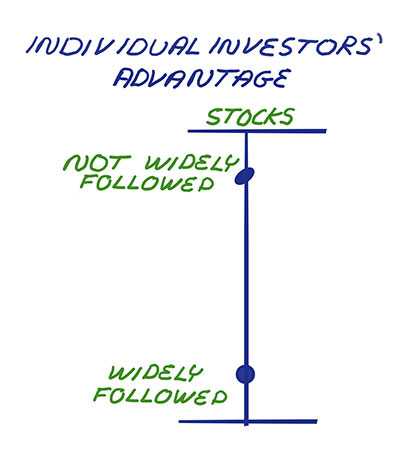
Cloonan believed individual investors should take advantage of their ability to invest in small, undervalued stocks. He called these shadow stocks because they were overlooked by institutional investors, analysts and the media. As such, they existed in the “shadows” of Wall Street. This lack of attention leads to greater mispricing and more opportunity for capital appreciation.
In Cloonan’s terminology, growth stocks were not stocks experiencing strong increases in revenues and earnings. Rather, they were stocks with greater prospects for growing a portfolio’s value. Cloonan long advocated value approaches.
The suggestion for not risking dollars needed in four years or less carried through to his last book, “Investing at Level3” (AAII, 2016). In it, Cloonan suggested that retirees and those approaching retirement allocate between two and four years of living expenses to safe assets. Doing this allows a retiree to avoid having to sell stocks during a downturn.
Cloonan made modifications to his investing rules over time as more information became apparent. For instance, I never heard him guide against buying stocks during the second year of a presidential term in the eight years I worked with him. Nevertheless, there is a presidential cycle that coincides with stock returns. The second year of a presidential term has historically experienced the weakest average returns of the four-year term. The third year has historically been the strongest. We’re currently seeing this historical cycle play out now. The S&P 500 fared poorly in 2022 (President Biden’s second year) but has rebounded considerably this year (the third year of the current presidential cycle).
My favorite Cloonan rules were not part of these commandments. Rather, they were included in his October 2012 Model Shadow Stock Portfolio article (“Adherence to Rules Helps Model Shadow Stock Portfolio’s Performance,” AAII Journal). With his choice of bolding included: “Rule number one is: Develop a consistent, well-defined approach to investing in stocks. Rule number two is: Stick to it.”

-
A Lifetime Investment Strategy
James Cloonan’s guidelines for long-term successful portfolio management incorporate many of his “10 commandments” and continue to inspire AAII writers. -
Highlights From the AAII Journal Archives: Cloonan Matter of Opinion Columns
Cloonan authored a regular column sharing his thoughts and insights. Read highlights from them and other groundbreaking AAII articles. -
Detecting Earnings Manipulation With the M-Score
The eight variables in the M-Score model are designed to capture bloating or cosmetic changes made to a company’s financial statement numbers. -
Change of Plans: Americans Retiring Later in Life
Over the past three decades, the retirement age of American workers has trended upward. -
Budgeting While Paying Down Debt
In her latest My Investing Discoveries blog post, Anine Sus updated her monthly budget to account for new expenses and discovered some helpful budgeting tips in the process.
Members are looking for your input. Can you help with this question from the Value Investing Community?
“Considering Dan Villalon’s assertion in this article that blending momentum and value strategies may yield superior returns, what challenges or suggestions have you encountered when integrating momentum with value?”
Tap the button and then choose the Join the Community button on the right to answer this question in the AAII Community
Answer This Question in the AAII Community »
AAII Sentiment Survey
Pessimism among individual investors about the short-term outlook for stocks rose to its highest level since mid-May in the latest AAII Sentiment Survey. Meanwhile, optimism fell to a four-month low.
Bullish sentiment, expectations that stock prices will rise over the next six months, fell 3.5 percentage points to 27.8%. Optimism was last lower on May 25, 2023 (27.4%). Bullish sentiment has fallen by a cumulative 14.4 percentage points over the past three weeks. Optimism is below its historical average of 37.5% for the sixth time in seven weeks.
Neutral sentiment, expectations that stock prices will stay essentially unchanged over the next six months, declined by 2.8 percentage points to 31.3%. Neutral sentiment is above its historical average of 31.5% for the sixth time in seven weeks.
Bearish sentiment, expectations that stock prices will fall over the next six months, rose 6.3 percentage points to 40.9%. Pessimism was last higher on May 11, 2023 (41.2%). This is the fourth time in six weeks that bearish sentiment is above its historical average of 31.0%.
The bull-bear spread (bullish minus bearish sentiment) plunged 9.8 percentage points to –13.2%. The bull-bear spread was last lower on May 18, 2023 (–16.8%).
Bearish sentiment is now back at an unusually high level (more than one standard deviation above its historical average). Bullish sentiment is near the bottom of its typical range. Historically, the S&P 500 index has gone on to realize above-average and above-median returns during the six- and 12-month periods following unusually high readings for bearish sentiment.
This week’s special question asked AAII members what they thought about the Federal Reserve’s decision to keep interest rates unchanged. Here are their responses:
- It was the right decision: 66.3%
- They should have raised rates: 18.6%
- They should have cut rates: 6.3%
- Not sure/no opinion: 8.6%
Bullish: 27.8%, down 3.5 points
Neutral: 31.3%, down 2.8 points
Bearish: 40.9%, up 6.3 points
Bullish: 37.5%
Neutral: 31.5%
Bearish: 31.0%
See more Sentiment Survey results.

September 21, 2023 September Charts of Interest: Some Stocks Stay Expensive
September 14, 2023 Current Valuation Ranges for Stocks
September 7, 2023 Guidelines for Selling Stocks
August 31, 2023 Interest Rates Are Higher. Your Taxes Could Be Too.

Discussion
Dave G from TX posted over 2 years ago:
Barry, I am wondering if you are from West Texas, and I am from East Texas. Did you realize that if a glass is either half empty or half full it still has the same amount of water in it. So goes investing, even in the "half full" world; 1. Thou shalt diversify, 2. Thou shalt buy preferred stock if you are a corporation, 3. Thou shalt ease in or ease out of the market, 4. Thou shalt keep money you may need in the next 4 years out of the stock market, 5. Thou shalt buy stocks that are ignored by the analysts, 6. Thou shalt do your own research to find those undervalued stocks, 7. Thou shalt buy stocks from the universe of stocks that is outside the S&P500 index, 8. Thou shalt establish a suitable risk level between growth stocks and minimal risk debt securities, 9. Thou shalt buy stocks only in year 1, 3 & 4 of the presidential cycle, 10. Thou shalt develop your own investing strategy (and write it down on paper.)
Robert R. from Texas posted over 2 years ago:
For anyone that has seen the movies 'Wolf of WallStreet' or 'Boiler Room', you should understand exactly what rule #6 is about "Never buy a stock that is recommended on a non-solicited basis by a brokerage firm." Too much opportunity for manipulation. A corollary to that rule is rule #5, "Never buy a stock that is getting favorable publicity in the press." The way stocks are manipulated are through news or stock tips masquerading as news.
You need to log in as a registered AAII user before commenting.
Create an account