

Expanding Upon the 10 Commandments of Investing
by Charles Rotblut | October 26, 2023
Join Raymond Rondeau, Wayne Thorp and me at the MoneyShow in Orlando, Florida, from October 29 through October 31, 2023! We are thrilled to share invaluable strategies, covering effective market timing; wealth building; investor sentiment interpretation; dividend investing principles; value, momentum and quality; and sustainable growth investing. Dive into a wealth of knowledge and gain insights to refine your investing approach. Click here for more information.
One month ago, I shared AAII founder James Cloonan’s 10 commandments of investing. The article elicited comments and emails from members. As luck would have it, I came across two follow-up articles by Cloonan about those commandments while looking through the 1981 and 1982 issues of the AAII Journal.
 My intention when looking at those back issues was to see what was written about the bond market back then. Those of you who are old enough will remember that yields on the benchmark Treasury bond peaked in 1981. The 10-year bond ended 1981 with a yield of 13.92%. New home mortgage rates were even higher at 14.70%. (Yikes!)
I didn’t find what I was looking for on the bond front. (I may have to look at other issues from that time period.) What I came across were two “Matter of Opinion” articles about the investing commandments in the March and April 1982 AAII Journal issues. In both, Cloonan expounded on his rules after having received “quite a number of responses” from AAII members. About half of those responses “were in the form of questions regarding the rationale for our statements, while the other half represented disagreements with the commandments.”
Here is a summary of what Cloonan further said about his 10 commandments of investing.
1. Diversify—He believed in holding “a minimum of seven different stocks” and felt that “10 to 15 is ideal.” If those numbers seem low, understand that Cloonan viewed the difference between owning seven and 30 stocks as being “probably insignificant when compared to the difference between having only a couple stocks and having at least seven.”
2. Never buy preferred stocks—This rule was centered on risk. Relative to bonds issued by the same corporation, the additional risk of preferreds at that time was “not accompanied by additional yield.” Cloonan cited the tax advantages corporations receive on dividend income relative to interest income as playing a role in reducing the yield on preferred stocks.
3. Never put a substantial portion of your wealth in the stock market or take it out at one point in time. Ease in. Ease out—Business cycles have lasted three to five years on average. Spreading out the timing of transactions eliminates “the possibility of buying everything at the high or selling it at the low.”
4. Never invest any money in common stocks that you feel you will need in less than four years—The same logic regarding the three- to five-year length of business cycles applies here.
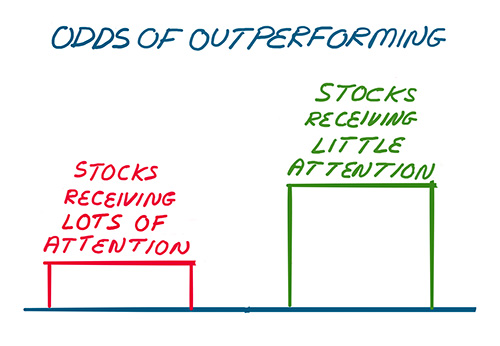
5. Never buy a stock that is getting favorable publicity in the press—“There was more debate about our fifth rule,” wrote Cloonan. “The basic reason for this rule is our belief that if an individual is going to outperform a dart thrower (the stock market averages), then they must also find stocks that are undervalued.” Stocks receiving lots of publicity are being looked at by many investors whose collective opinions have been priced into the valuations of those stocks. Cloonan added, “The real opportunity to outperform comes from discovery, not from being a follower.”
6. Never buy a stock that is recommended on a nonsolicited basis by a brokerage firm—The same belief about looking at stocks that have received less attention applies to this rule. Cloonan thought he should “probably amend” the rule to “include just major brokerage firms and extend it to include those widely followed investment advisory publications that single out only a few stocks as special.”
7. Never buy a stock that is included in the S&P 500 index—There are three reasons as to why. First, the likelihood of any of these stocks being “significantly undervalued” is small. Second, “there is little chance of any of these stocks increasing tenfold in the future.” Third, institutional investors hold large-cap stocks but “have more difficulty investing in smaller companies.”
8. Never buy “safe” or low-risk stocks—Cloonan thought investors should instead “establish an appropriate (level of) portfolio risk between growth stocks and minimal risk investments.” He used the example of combining higher-risk stocks (e.g., undervalued small-company stocks) with Treasury bills to achieve the same portfolio beta (volatility) as a diversified large-company portfolio. Cloonan thought such stocks would outperform over the long term, while the Treasury bills (or other money market instruments) may see their yields rise when the stock market is down.
9. Don’t buy a stock in the year following a presidential inauguration—“The ninth rule … is difficult to rationalize,” admitted Cloonan. Though the timing of such downturns in the second year of a presidential term has varied, the length, speed and sharpness of such moves warrant patience among investors. This rule just applies to purchases: “We don’t suggest getting out of stocks completely.”
10. Don’t believe in anyone else’s system for making a “killing” in the market. If you find such a system, write me “confidential” from your yacht and send your jet for me to come and discuss it—Though offered in humor, it was included to warn investors against such pitches. Cloonan added that if he had a system that could return 40% per year from investing in stocks (or commodities), “the one thing I wouldn’t do would be to sell my system or discuss it.”

-
The Position of the Individual Investor
This article by Jim Cloonan originally appeared in the second issue of the AAII Journal, March–April 1979, and set the stage for AAII’s mission. -
Many Avenues You Can Take to “Invest Differently”
Individual investors’ long time horizon gives us a huge opportunity to be different than our larger institutional counterparts. -
Small-Cap Value Is the Best Choice for Equity Diversification
Any long-term portfolio anchored by the S&P 500 can benefit from the addition of small-cap value stocks. -
Using EBITDA and Enterprise Value to Calculate a Stock’s Worth
Some investors feel that examining a stock’s enterprise value relative to its EBITDA is a superior method of measuring company value. -
Reprioritizing My Goals With High-Yield Savings Accounts
In her latest My Investing Discoveries blog post, Anine Sus uses a PRISM worksheet to adjust her savings plan for some new short-term goals.
AAII Sentiment Survey
Optimism among individual investors about the short-term outlook for stocks continued its decline in the latest AAII Sentiment Survey. Meanwhile, pessimism increased.
Bullish sentiment, expectations that stock prices will rise over the next six months, decreased 4.8 percentage points to 29.3%. Optimism is below its historical average of 37.5% for the sixth time in seven weeks.
Neutral sentiment, expectations that stock prices will stay essentially unchanged over the next six months, fell 3.8 percentage points to 27.5%. Neutral sentiment is below its historical average of 31.5% for the fifth time in eight weeks.
Bearish sentiment, expectations that stock prices will fall over the next six months, increased 8.6 percentage points to 43.2%. Pessimism is now at an unusually high level and is above its historical average of 31.0% for the sixth time in eight weeks.
The bull-bear spread (bullish minus bearish sentiment) decreased 4.8 percentage points to –5.3%. The bull-bear spread remains below its historical average of 6.4% for the seventh time in eight weeks.
This week’s special question asked AAII members which of the following they think is the best long-term investment:
- Stocks: 72.8%
- Cash (Savings Accounts, Money Market Funds, etc.): 11.6%
- Privately Held Real Estate: 8.4%
- Commodities (Including Gold): 4.3%
- Bonds: 2.9%
Bullish: 29.3%, down 4.8 points
Neutral: 27.5%, down 3.8 points
Bearish: 43.2%, up 8.6 points
Bullish: 37.5%
Neutral: 31.5%
Bearish: 31.0%
See more Sentiment Survey results.

October 19, 2023 October Charts of Interest: Soaring Bond Yields and Falling Bond Prices
October 12, 2023 Index Fund Expense Ratios May Be Bottoming Out
October 5, 2023 Financial Independence and Retirement
September 28, 2023 James Cloonan's 10 Commandments for Investing

Discussion
John L from NJ posted over 2 years ago:
The announcement (Sales Pitch) for the Money Show in Orlando is shocking. The AAII is actually promoting "effective market timing" as an invaluable strategy. As John Bogle said (I'm paraphrasing from memory) "I don't know anyone who has successfully timed the market or anyone who knows anyone who has successfully timed the market". If Charles and Wayne have actually invented a way to effectively time the market; they will soon be so rich they won't need to peddle investing advice and newsletters for a living. Of course if they are so foolish as to share this valuable market timing advice in Orlando, their secret will be out and it won't work any more.
Rob from NC posted over 2 years ago:
From Number 3: "Spreading out the timing of transactions eliminates 'the possibility of buying everything at the high or selling it at the low.'” Unfortunately, it also eliminates the possibility of buying everything at the low or selling at the high. Dollar cost averaging is beneficial only in a declining market. And since on any given day, week, month, or year, the market is much more likely to go up than down, the odds are against you--just like in Las Vegas. If I won the lottery, within a week of being paid, it would all be in equities, no matter what my crystal ball said about the near-term future of the market.
Rob from NC posted over 2 years ago:
I can't adhere to Rule Number 4 either. Holding four years of cash (or fixed income investments) is more likely to cause me to miss out on gains than it is to protect me from losses. Three months of expenses is my limit. The rest stays in equities.
John L from NJ posted over 2 years ago:
Rob - Agree 100% with your comments. Cloonan's investing advice changed as he gained experience and wisdom. The advice in his book "Investing at Level 3" contradicts rule 7 (never own an S&P 500 stock) as he promoted an equal weighted S&P 500 fund for the passive strategy. And Cloonan discussed the strategy of remaining 100% invested in stocks during retirement. He felt that it would be emotionally difficult for most individuals to be always 100% in stocks; which is why he suggested keeping several years in "safe" investments. However, Cloonan would have agreed that keeping the "safe" portion of the portfolio as small as possible is the best strategy. There are no investing commandments; just advice from experienced investors that needs to be constantly tested.
Barry from TX posted over 2 years ago:
It is easy (and expected) to unpack Cloonan’s prescriptions. #1 AAII investors are expected to modify them to fit their investment goals, risk tolerances, etc. Cloonan proposed a template for an overall investment strategy that meets YOUR needs. I find Cloonan’s thinking in “Investing at Level3” very valuable guidance today, although I do not necessarily incorporate all his prescriptions literally. #2 Remember that in 1979 it predated the launch of the TCP/IP protocol and using a Mosaic browser and dial-up 30-baud modem to access that fabulous invention we called the “WWW” by over 15 years. There were no instant, incessant communications of thousands of pieces of information like there are today. We must always remember to place 50-year-old recommendations in the historical “context” as Charles has suggested. #3 These are perilous times for any investment strategy due to the lock-step movements (covariances) of stocks and bonds. Investing today is not as simple as conjuring up a diversified portfolio using a formulaic “60/40 set it and forget it” as was the received wisdom back then. #4 I confess I see a lot of similarities between the economic and political conditions that imposed the Carter inflation on the market in 1979-1980 and the drastic actions the Volker Fed took to get inflation down from these levels mentioned by Charles from 1980-1893. #5 Unfortunately, I also see many parallels between the current time period and the economic environment to run up to the 2007-2009 Great Recession. #6 Sometimes I back-slide when I wonder if AAII has strayed too far from Clonan’s guidance to attract and appease investors who are not schooled in Cloonan’s philosophy.
John L from NJ posted over 2 years ago:
Barry - Your comment #3 on the perilous time for investment strategy is interesting. According to "finance wisdom" the relationship between returns on bonds and equity has been believed to have a negative covariance. And this has driven some of the logic behind the 60 /40 portfolio. However, according to Andrew Smithers in his book "The Economics of the Stock Market" the expected returns on equities do not rise and fall with the returns on bonds. Perhaps times are unchanged and the assumption of a relationship between bond returns and equity returns has always been incorrect.
Barry from TX posted over 2 years ago:
John, Thanks for the tip on this book. I have not read it. You and Smithers may be on to something. The impacts of Fed policy have changed the assumption of a relationship between bond returns and equity returns as they did in the early 1980s. Here is my take on the economics underlying current markets for equities and bonds. I know you are well-versed on this; so please bear with this recapitulation. [For readers who profess impatient attention spans, here is the net net: distortions in the current market are being driven by an inverted yield curve for bonds.] #1 Modern Portfolio Theory is based on the assumptions and principles derived from Markowitz's (1952) assumption of randomness and his translation of the use of variation as THE measure of market and portfolio risks, which have been the basis for our received wisdom ever since (CAPM pricing theory, M&M capital allocation theory, etc.). #2 MPT also incorporates the "neoclassical consensus" which ASSUMES all economic decisions are based on “rational” (measured by “marginal utility”) and the interaction of supply and demand (“equilibrium” theory). All this has been accepted because these relationships have been supported by the observable data and back-testing samples to date. #3 Under MPT theory, equities, and bonds have an inverse relationship: that is, the PRICES of stocks go UP when the PRICES of bonds go down. "QED" as they say, #4 However, in 2023 due to the impacts of the external interventions by the Federal Reserve FOMC raised FFR interest rates continuously for 20 months to try to reduce the high rates of inflation driven by $5T or so of profligate fiscal spending since CoViD in 2020. As a reference point, the total FY2020 federal debt was $27T; FY2023 federal debt is approaching $40T, a 48% increase, the highest since WWII. #5 Bond YIELDS reverse the stock-bond PRICE relationship – bond YIELDS go up when bond PRICES go down. #6 Bond PRICES have been driven up by the effects of supply and demand for various types of US Treasury bonds. “Supply and demand” is not just an economic theory; it is an observable fact, like Newton’s “theory” of gravity. If you think all theories are intellectual musings, go jump out any window and try to disprove that gravity is “only a theory.” #7 US Treasury bonds SUPPLY come from the US Treasury which implements government fiscal policy spending mandates from POTUS and the 118th Congress. Currently, most UST DEMAND comes from the Federal Reserve which buys up almost all the Treasury's USTs. This cozy, but necessary, relationship, is the prime engine that contorts assumed historical market relationships. #8 Currently, there is higher demand (lower yields) for long-term USTs than for short-term USTs (higher yields). Short-term money market yields have followed this "inverted yield curve." Whereas the historic bond rate averaged below 2% for 200 years compared to stocks which yielded a "risk premium" of 8% versus 2% "risk-free" bonds. In 2023, short-term bond yields average closer to 5% matching the yields on longer-term bonds. #9 That means that a relatively unskilled average independent investor can avail themselves of a 5% "risk-free" return while the stock market offers a higher risk opportunity to invest in (1) very high stock valuations (per CAPE data) and the risky prospect of devaluation (lower prices) in the future as yield curves revert to a more normal relationship, (2) a distorted S&P 500 where less than 2% (7 "Magnificent” high-valuation stocks) of the 500 stocks in the cap-weighted S&P produce 100% of the 2023 returns YTD, and (3) traditional small-cap, value, and growth stocks face much higher cost of capital “hurdle” rates to finance their growth (market price improvement) capabilities, and, (4) a political environment fraught with shadowy specters of increasing requirements for funding to support foreign policy imperatives on at least 3 fronts (Ukraine 2022, Israel 2023, and the South China Sea 2024), and, (5) an electorate divided 50%/50% on almost every major political issue that needs an “internally consistent” resolution. Don't panic. Times have been worse. In 1776, 1861, and 1941 for example. We faced and resolved all these perils in about 5 years. Although "screwed up beyond recognition," “We the people” are still the same “exception” in the world around us that we were then. As Churchill reminded us in 1942, "You can count on Americans doing the right thing, after exhausting all the other possibilities."
John L from NJ posted over 2 years ago:
Barry - I encourage you and every member of the AAII to read Andrew Smithers book "The Economics of the Stock Market". He sets forth a revised neoclassical model for the economy. This is a controversial book. He asserts and demonstrates with data (could be wrong?) that real stock market returns are mean reverting, that the stock market is not efficient, and that the M&M propositions are incorrect among other heresies in the church of Markowitz. Personally, I believe much of what was asserted with the invention of modern portfolio theory in the 1960 and 1970s is either incorrect or misconstrued.
You need to log in as a registered AAII user before commenting.
Create an account