

Dealing With Shades of Gray in My Allocation
by Charles Rotblut | November 09, 2023
Featured Tickers: VFIAX
VFIDX
VFSAX
VGSLX
VSIAX
VFIAX
VFIDX
VFSAX
VGSLX
VSIAX
Special note: On behalf of everyone at AAII, happy (early) Veteran’s Day to those of you who served in the military. Thank you to everyone who has or is currently serving.
I conducted my semiannual review of my 403(b) retirement account yesterday. In doing so, I noticed that the account’s allocation had entered the gray zone between not having to act and being close enough to justify taking action.
 As longtime readers of this weekly commentary know, I look at my 403(b) account at the end of May and the end of October to determine if any rebalancing is needed. These months represent the start of the worst six months (May) and the start of the best six months (November) for the stock market. I’m a week late this year, but that’s minor in the grand scheme of things.
Many of you also know that we at AAII believe in following a consistent, well-defined approach to investing. This is a massive component of successful portfolio management.
Even within the context of preset rules, there can be opportunities to “sin a little.” I’m facing one of those situations right now.
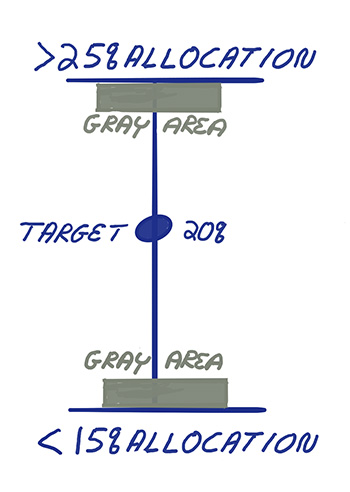
I use a quasi-equal-weighted allocation for my 403(b) account. The target allocation for each of the funds held in it is 20%. Because investing is messy and winners should be allowed room to run, I only rebalance when the weighting of one or more of the funds rises above 25% or falls below 15%.
Here is what Vanguard showed the account’s allocation to be as of Tuesday’s close:
-
Vanguard 500 Index Admiral fund
 (VFIAX): 24%
 -
Vanguard Small-Cap Value Index Admiral fund (VSIAX): 21%
-
Vanguard FTSE All-World ex-US Small-Cap Index Admiral fund (VFSAX): 18%
-
Vanguard Real Estate Index Admiral fund (VGSLX): 18%
-
Vanguard Intermediate-Term Investment-Grade Admiral fund (VFIDX): 19%
Vanguard 500 Index Admiral’s allocation is close to the level where rebalancing would be needed. Rebalancing now would reflect the spirit of the strategy but not a strict interpretation of the rules. In other words, a gray area now exists that allows me some leeway in deciding whether to act or not. Chances are many of you have encountered such a situation too.
One factor tipping the scale in favor of not acting—besides adhering more strictly to the rules—is the market’s seasonal pattern. The best six months of the year, as defined by the Stock Trader’s Almanac, started last week. The S&P 500 index has realized an average 6.6% return between November and April since 1945. Sam Stovall of CFRA Research says the average return has been slightly higher at 6.7% since 1990. Small-cap stocks and international stocks have fared better during this period of the year.
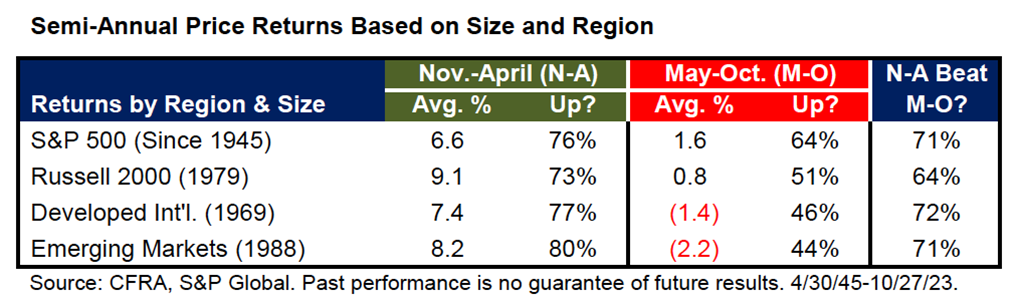
If I really wanted to sin, I could solely boost the exposure to the small-cap and international funds at the expense of others, given Stovall’s table. This would go beyond the gray area of my strategy and into one that is clearly tactical. Allowing some room for leeway is fine; abandoning the spirit of the strategy is not.
I’m adhering to a long-term allocation strategy designed to favor growth of capital with rules for rebalancing when exposure to one or more asset class category veers too far from the target. The approach is designed for the constraints I face with my 403(b)—meaning the use of Vanguard mutual funds, which isn’t a bad thing—my personal tolerance for volatility and my investing time horizon. Your approach may well be different. That’s fine as long as it is clear when you will act, when you won’t and where any boundaries regarding some subjectiveness exist.

-
Rebalancing to Navigate Bear Markets and Sequence Risk
Periodically adjusting allocations back to intended targets lessens the magnitude of swings in a portfolio’s returns. -
The Building Blocks of a Successful Portfolio Allocation
The mix of assets held primarily determines the returns you will realize. The other keys are sticking to your strategy and making periodic adjustments to keep your allocations at the desired level. -
Asset Class Group Returns: Short-Term Bonds Lead During a Rough Year
The year 2022 was a tough one for asset allocators as returns were down across the board. -
Valuing a Stock Using Dividends
The dividend discount model offers an intuitive method to calculate the intrinsic value of a dividend-paying stock. -
Third-Highest Social Security COLA Since the Global Financial Crisis
Last month, the Social Security Administration announced a 3.2% cost-of-living adjustment (COLA) to both Social Security and Supplemental Security Income (SSI) benefits. The increase will take effect in January 2024.
Members are looking for your input. Can you help with this question from the Allocation Strategies Community?
“Considering the sequence of returns risk and its significant impact on retirement portfolios, especially during the transition into retirement, how did you adjust your portfolio allocation heading into retirement and once in retirement?”
Tap the button and then choose the Join the Community button on the right to answer this question in the AAII Community
Answer This Question in the AAII Community »
AAII Sentiment Survey
Optimism among individual investors about the short-term outlook for stocks soared in the latest AAII Sentiment Survey. Meanwhile, pessimism decreased.
Bullish sentiment, expectations that stock prices will rise over the next six months, increased 18.3 percentage points to 42.6%. Optimism is above its historical average of 37.5% for the third time in 10 weeks. This week’s increase was the largest since July 15, 2010 (an 18.4-percentage-point jump), and the 23rd largest week-over-week increase in bullish sentiment in the survey’s history.
Neutral sentiment, expectations that stock prices will stay essentially unchanged over the next six months, increased 4.8 percentage points to 30.2%. Neutral sentiment is below its historical average of 31.5% for the seventh time in 10 weeks.
Bearish sentiment, expectations that stock prices will fall over the next six months, decreased 23.1 percentage points to 27.2%. Pessimism is below its historical average of 31.0% for the third time in 10 weeks.
The bull-bear spread (bullish minus bearish sentiment) increased 41.4 percentage points to 15.4%. The bull-bear spread is above its historical average of 6.4% for the second time in 10 weeks.
This week’s special question asked AAII members what they thought about the Federal Reserve’s decision to keep interest rates unchanged. Here are the responses:
- It was the right decision: 71.8%
- They should have raised rates: 14.6%
- They should have cut rates: 6.1%
- Not sure/No opinion: 6.8%
Bullish: 42.6%, up 18.3 points
Neutral: 30.2%, up 4.8 points
Bearish: 27.2%, down 23.1 points
Bullish: 37.5%
Neutral: 31.5%
Bearish: 31.0%
See more Sentiment Survey results.

November 2, 2023 Cash Is Popular, but Be Careful When Allocating to It
October 26, 2023 Expanding Upon the 10 Commandments of Investing
October 19, 2023 October Charts of Interest: Soaring Bond Yields and Falling Bond Prices
October 12, 2023 Index Fund Expense Ratios May Be Bottoming Out

Discussion
Hugh from WA posted over 2 years ago:
I like the Shadow Stock's idea of putting items that creep into the the gray area "on watch". Not being too quick to interrupt "letting winners run" but also being ready to make the adjustment in the next review if the market doesn't self-correct.
adam from MA posted over 2 years ago:
I would like to see an article that addresses the use of simple, commonly available technical indicators to augment allocation rebalancing decisions. Such things as moving averages, Bollinger bands etc. are readily available on line ( I use Yahoo Financial) and may address the issue mentioned above re: selling winners to soon. Thanks
Rob from NC posted over 2 years ago:
I have a simple, and perhaps dumb, question: Why? Why rebalance this portfolio at all? Is the idea that in the long run these five funds should all provide equivalent returns? I humbly suggest they do not now and never will. You're obviously holding these long-term, so what benefit do you derive from regularly selling off the winners and buying more of the laggards?
Barry from TX posted over 2 years ago:
Charles, I am sure many AAII members learn a lot when you share how you manage your retirement portfolio using the tenets of the AAII PRIAM philosophy. I know I learned from this series of articles. As I always do, I looked up all the articles in the AAII database to expand my investing knowledge. I found 5. You may have already posted this before, but I wish to know the analog Vanguard ETFs for the 5 Vanguard mutual funds you in your portfolio hold ( VFIAX, VFIDX, VFSAX, VGSLX, VSIAX) in your retirement portfolio..
John L from NJ posted over 2 years ago:
Rob - The only benefit for rebalancing this 80/20 portfolio is the volatility reduction from selling stock (or stock equivalents) when they are "overvalued" and buying stocks when they are "undervalued" (i.e. fall short of his percentage target). This will result in lower long term returns as he sells his high return stocks and increases his intermediate term bonds. But his volatility will be lower. Not a good trade off if this is a retirement investment as he will miss the extra money when he is old and won't be able to remember the lessened volatility. The rest of the rebalancing is selling stock winners and buying laggards. Not a good strategy as long term all of the stock funds will have equivalent results and momentum is one of the stronger factors. Another downside is the waste of time and thumb sucking when it comes time to rebalance the portfolio.
You need to log in as a registered AAII user before commenting.
Create an account