

New Stimulus and Extended Tax Breaks
by Charles Rotblut | December 24, 2020
This week, Congress passed a mammoth spending bill simply known as the “Consolidated Appropriations Act, 2021.” As I write this commentary, President Trump had yet to sign it into law. He criticized the legislation on Tuesday evening and asked Congress to amend it. The act authorizes new stimulus payments, extends more generous charitable deductions and renews the lower floor for deducting medical expenses, among other things.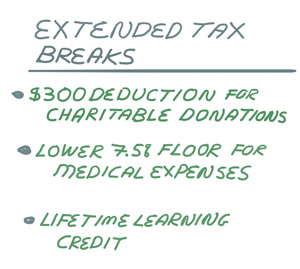
One aspect of the bill making the headlines is the new round of stimulus payments. The additional recovery rebates will be $600 per individual or $1,200 for those filing a married joint return plus $600 for each qualifying child. (President Trump has asked for the larger payments; as of midday Wednesday, it’s unclear as to whether Republican legislators will agree to the request.) The payments will be issued based on your 2019 adjusted gross income (AGI) but are 2020 rebates. This means if your gross income declined in 2020 and you did not receive the maximum payment, you may be able to claim additional stimulus on your 2020 tax return. Furthermore, because they are rebates, the stimulus payments do not count as taxable income.
Phaseouts for the stimulus payments start at $150,000 for married couples filing jointly and $75,000 for single filers. The rebates are phased out by 5% of the amount AGI exceeds those levels. Initial calculations show married joint/singles with AGI of $174,000/$87,000 or more not receiving any rebate. The income ceiling for receiving payments is now lower than it was in the spring because the maximum rebates are smaller.
Those of you who take the standard deduction may be able to write off more charitable donations in 2021. The new legislation reinstates the $300 above-the-line deduction of qualifying cash deductions for single filers and doubles it to $600 for those filing married joint returns. (Sorry fellow joint filers, the larger $600 deduction for married couples was not included in the CARES Act and therefore does not apply to your 2020 tax return.)
If you itemize and give to charity, you can now deduct qualifying contributions up to your full contribution base (which is typically AGI) in both 2020 and 2021. This provides additional flexibility in terms of your giving plans—though it may come too late this calendar year to shift the timing of large charitable donations.
The minimum floor for deducting medical expenses will be kept at 7.5% of adjusted gross income. The change was included in a list of extenders “made permanent.” Without this clause, the floor would have reverted back to 10% in 2021.
Other extenders include the Lifetime Learning Credit (phaseouts start at $160,000 and $80,000 for those filing joint and single returns), which is now permanent. The mortgage insurance premium deduction was extended through 2021.

- Our individual investor tax guide covers all of the changes made for 2020 and will help you plan for 2021. We’ll update the guide to reflect the appropriations act after it has been signed into law.
- Lots of changes were made to the tax code over the past approximate 12 months. In April, Jamie Hopkins discussed the top SECURE Act provisions investors should be aware of.
- Mutual fund and exchange-traded fund (ETF) capital gain distributions can be unwelcome surprises during tax time. We show you how to determine whether a fund is tax-friendly in this month’s AAII Journal.
- We’ll be hosting a special tribute to AAII founder James Cloonan on January 6. Click here to register.
No commentary on this week’s results due to the holiday. Please go to www.aaii.com/sentimentsurvey for the current results.

Bullish: 43.6%, up 0.1 points
Neutral: 34.4%, up 4.2 points
Bearish: 22.0%, down 4.3 points
Bullish: 38.5%
Neutral: 31.0%
Bearish: 30.5%
December 17, 2020 Answers to Individual Investors’ Tax Questions
December 10, 2020 A Few Thoughts in Remembrance of Jim Cloonan
December 3, 2020 The CAPE Ratio Is High but not Pricey
November 26, 2020 Reasons for Individual Investors to Be Grateful in 2020

Discussion
No comments have been added yet. Add your thoughts to the discussion!
You need to log in as a registered AAII user before commenting.
Create an account