

How Much Are Mega Millions and Powerball Lottery Tickets Worth?
by Charles Rotblut | January 14, 2021
Given the current (as of the time of writing) $640 million jackpot for the Powerball and the $750 million jackpot for the Mega Millions lotteries, I thought I’d share an updated version of an Investor Update commentary I wrote three years ago. Its focus was determining how much a lottery ticket is worth.
Ask most people how much a lottery ticket is worth and the most probable answers will be the price of the ticket, the value of the jackpot or simply: “Is it a winning ticket?” The value of a ticket for a forthcoming drawing is none of these. The reason for this is related to a concept of risk and reward many people often fail to grasp, aren’t aware of or ignore at their own peril.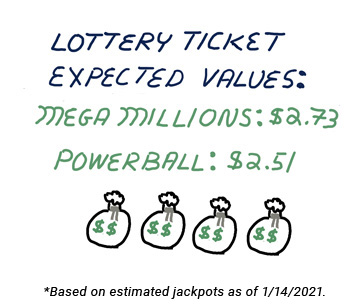
The concept is expected value. This is the projected value based on the probability of a given set of outcomes occurring. If it is possible to assign odds to a set of monetary outcomes, an expected value can be calculated. Expected value is a concept that works in a variety of situations. Investors, for instance, can use historical data to determine the likelihood of being able to fund retirement with a certain savings rate or allocation strategy.
The two multi-state jackpot lottery games provide great examples of how the concept of expected value works. Both Mega Millions and Powerball have specific and published odds for the possible winning outcomes. They also have published prize amounts. This allows anybody with a calculator—though a spreadsheet makes the calculations easier—to determine when the expected value of a lottery ticket exceeds the $2.00 cost.
The calculation is simply each potential payout times the odds of having a ticket with the right combination of numbers. For example, the odds of having a single matching number and the Powerball number correct on a single ticket is 1 in 92. One divided by 92 equals approximately 1.09%. Multiplying 1.09% by the fixed $4.00 payout results in an expected value of $0.04. Put another way, if you adjust the value of the prize by the probability of actually winning the prize, you end up with an expected value of $0.04. Running this math for all of the fixed payouts gives us cumulative expected values of $0.25 for a Mega Millions ticket and $0.32 for a Powerball ticket.
The big prize in both games is, of course, the jackpots. Both the sheer size and the variable nature of a jackpot have great influence on the expected value of a lottery ticket. Not surprisingly, the larger the jackpot, the higher expected value. The current estimated $750 million Mega Millions jackpot equates to an expected pretax value of $2.73 for a single ticket. The jackpot single-handedly adds $2.48 to the expected value of a single ticket purchased for the drawing. The math is $750 million times the 0.0000003% odds of matching all five primary numbers plus the sixth Mega Ball number.
The expected value of a Powerball ticket is different not only because the jackpot is different, but also because there are differences in the odds for the various payouts as well. The jackpot prize accounts for $2.19 ($640 million times 0.0000003%) of the total $2.51 expected value of a single ticket.
The impact that the size of the jackpot has should be very apparent. This has significance for investing as well. The riskier the investment is, the higher the required return must be to justify the excess risk. And the higher the required return is, the greater the likelihood of not realizing that return. This is why so-called “lottery stocks” and similar types of securities are risky. For every Facebook, Apple, Netflix, Alphabet (aka Google) and Tesla, there is a very large number of companies that flounder.
While it may be hard to assign exact odds, a person can use historical data to judge when a projected rate of growth is unusually high. Adding basic industry and economic research can add to the scenario analysis (e.g., is it realistic for the company to sell $X dollars of its product or service). Even when you lack the data necessary to calculate an expected value, you should be able to gather enough information to place some odds on whether an “everything goes right” scenario will or will not occur. For returns large enough to justify the risks, the “everything goes right” scenario is often necessary.
When doing such analysis, be aware of the element of luck. Just as every lottery jackpot has an eventual winner, the odds of losing everything spent on a lottery ticket always remain steady at 96%. The same principle applies to investing in high-risk stocks and securities: While a few will realize huge returns, many will end up losing most of their value.
(Note: The calculation used to determine the expected value of the Mega Millions and Powerball tickets does not factor in taxes on the winnings, how the jackpot will be claimed—lump sum or a series of payments—or what will be done with the winnings afterward. Nor do they consider how sharing the jackpot with one or more other winning ticket holders will impact the expected value. I avoided going down this rabbit hole in order to focus on the concept of expected value. In a real-world environment, all three have a significant impact.

- One challenge to the lottery is that it can lead to “sudden wealth syndrome.” We shared some of the tips BMO Wealth Management gave for handling sudden windfalls in this AAII Journal Dispatch article.
- Any time there is a significant change in your wealth, you should reassess your goals and risk tolerance. Our Individual Investor Wealth-Building Process can help.
- Speaking of goals, the current issue of the AAII Journal explains why goals should drive your investing decisions.
- If you are lucky enough to win the lottery, you will need to pay attention to the SIPC limits on brokerage accounts.
- Tune in next Wednesday to our Individual Investor Show for more about goals and SIPC limits. We’ll discuss stock screening too.
January 7, 2021 11 More Financial and Investing Resolutions for 2021
December 31, 2020 Financial and Investing Resolutions for 2021, Part 1
December 24, 2020 New Stimulus and Extended Tax Breaks
December 17, 2020 Answers to Individual Investors’ Tax Questions

Discussion
David M from CA posted over 5 years ago:
It is very important to consider the possibility of multiple winners. If there is just 1 other winner your expected value is cut in half. This is far more important than to consider taxes or payout. Too many people who can least afford it buy lottery tickets. Please don't encourage people that can afford it. The State lottery is the worst form of taxation and the crudest way to redistribute wealth!
LakeMechanic from AZ posted over 5 years ago:
Lotteries are a tax on the mathematically impaired.
Mike from GA posted over 5 years ago:
One must calculate how much tax they would win. If they give it to you and then take it away it does not count. It is almost worth $2 (not $2.73) If no wins next time I may play $4 for fun. I do like to dream about it...good entertainment.
Robert from California posted over 5 years ago:
I've decided not to share it. Puts me in a class with the President.
Michael from ID posted over 5 years ago:
"Lotteries are a tax on the mathematically impaired." Or for those of us that fully understand the odds but happen to have a few singles in our pocket and figure, "what the heck. It's only $2"
joseph from NC posted over 5 years ago:
Good article Sir Charles. I hope all readers know to only gamble with very small amounts that they will likely never see again and will not miss. The same advice relates to "lending" money to friends and relatives. Another adage: When your ship finally comes in, all your relatives are waiting at the dock. It is a sad truth in America that all the annual billions in gambling exceeds the total annual contributions to religious organizations. I have seen good friends become enemies over gambling debts.
Alan from IL posted over 5 years ago:
The Lottery tickets can not possibly be worth more than they cost. Otherwise.... We would all be buying them. ( And we are not). Part of the explanation is they pay out over a period of about 20 years so. the estimate of $2.73 ( .000..3 x $750 M) is a little high. It a The present Value this is a lot less. Currently 20 Year Treasury rate is 1.7% Using this the present value is X1.4 less. That does not include the risk that inflation will come back over the next 20 years. So, ifs probably worth even less. The other part is that it does not include the possibility that no one wins.
Gary B? from OH posted over 5 years ago:
Your analysis is only for this week. The states win because there have been about 4 months of twice weekly drawings with no winner. This is about 35 drawings worth of input. You would need to divide your numbers by 35 if you take into account all the time when there is no winner.
Billy B from MI posted over 5 years ago:
If you buy a ticket, the odds of winning are very, very low. But, the odds of winning if you don't buy a ticket are exactly zero.
Karl Z from WV posted over 5 years ago:
You should expand your analogy to include the two oversights which have led you to grossly overestimate the value of a lottery ticket; namely taxes and the time value of money. To estimate the true value of a lottery ticket, do not use the stated jackpot amount, but rather the single payment amount. This us usually about 60% of the stated amount. Next apply US and state income taxes which will take approximately 40% of what is left. Net: the actual value is 60% of 60% or 36% of the published prize amount. These same issues (discount rate and taxes) are too often ignored by amateur investors as well and need to be emphasized.
David B from OH posted over 5 years ago:
If you temporarily ignore the effect of multiple winners, an equally interesting calculation is: How high does the payout have to be for you to lose money if you don't play? Including all 3 factors: winnings taken as a lump sum, tax rate at the margin, and the mitigating effect of lesser payouts, you can calculate how high the maximum payout has to be for the expected value to be higher than the cost of a ticket. When that point is reached, it would behoove you to buy ALL the tickets because your payout minus ticket cost is > 0. I'm guessing the payout amount would have to be in the billions, and, of course, sharing the winnings would be devastating.
Tom M from IL posted over 5 years ago:
I use the magic of rounding to determine my odds of winning: I will not win... but I might! Interestingly, rounding yields the same odds for winning both lotteries simultaneously. Sometimes it's fun to play the "I might" odds, but mostly I play the "I will not" odds.
Barry C Johnson from TX posted over 5 years ago:
I realize this column focuses on "value" only rational ("classical") economic quantity, but, as several comments point out, "value" can be an irrational quantity which is no less important in driving behaviors that are "rational" in a psychological sense. To address ALL the outcomes in each lottery set, you should have pointed out that E(V) of NOT buying a ticket = 0. This is the same rationale AAII uses to justify why AAI members should participate and stay in the markets long term. Comments?
Jerry Campbell from MA posted over 5 years ago:
There are several problems with simplifying lottery analysis. 1) As others have pointed out, the possibility of multiple jackpot winners dramatically reduces value. 2) Most lotteries specify payout over 20 years. The headline prize number is significantly discounted if the winner chooses the lump sum payout option. 3) It is possible to win smaller prizes without hitting the jackpot. This is a small incremental positive to the expected value.
Bryan from Minn. posted over 5 years ago:
Sure there are more variables, per the comments, but the article is a useful reminder. And welcome. My own analysis uses fewer calculations: Q. Will I win? A. No, of course not. That's just stupid. But, mayybee. Therefore, (agreeing with Tom M) create a set of rules where I end up spending less than $20 or so most years. And follow them. Q. How much would it take to dramatically improve my circumstances? A. Any winning lottery ticket (of these two). Even the smallest of prizes. Therefore, size of the pot doesn't really matter. That noted, my particular set of rules includes the pot being pretty big. Final note, adding to what David M said, up top. When prize numbers are greater, higher ticket sales will increase the chance of more than one ticket getting the same number. Oh. And the first hypothetical phone calls would be to CPA(s), lawyer(s) and others of a select trusted group.
Harry Rich from OH posted over 5 years ago:
As I've said before, I may win the lottery someday, but someone else is going to have to buy me a ticket. I recall a TV ad some years ago which promoted the lottery as a means of dealing with the high cost of education. This points up the terrible thing about the lotteries, they not only trade on hope, but tax it and diminish it. Even the winners are apt to mismanage their winnings and go bankrupt.
You need to log in as a registered AAII user before commenting.
Create an account