

11 More Financial and Investing Resolutions for 2021
by Charles Rotblut | January 07, 2021
Last week, I shared the first part of my financial and investing resolutions for 2021. This week, I’m sharing the second part of the list in numeric order (which is why it starts with resolution #12). Both are part of an ongoing set of resolutions I’ve been sharing and updating since 2012.
You may notice the lack of a discussion about the political backdrop. Though yesterday’s insurrection at the U.S. Capitol is fresh on the minds of many, the day-to-day news headlines should not drive your financial and investing decisions. Rather, the goals you’ve set and what you need to do to accomplish them should be what drive your decisions. A set of good resolutions can help.
Some of these resolutions in this annual list can be accomplished fairly quickly. Others may take time or require a change in behavior. Psychology Today offered a few suggestions on how to make resolutions stickier. Their suggestions were to choose what’s important, focus on one goal at a time and ask for support.
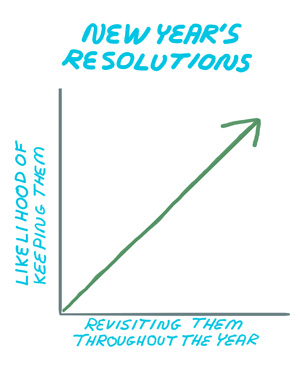
I would suggest also checking back in on your resolutions throughout the year. Are you sticking to them? If not, what can you do to get yourself back on track? Resolutions requiring a lasting change won’t be fulfilled with one step. They require ongoing effort and attention. So, pull out your calendar or smartphone and add reminders to revisit your resolutions. Doing so will increase the odds of fulfilling them.
With this in mind, here is the second part of this year’s updated list of New Year’s resolutions for investors.
12. Check your beneficiary designations. (UPDATED!) It is critical that all of your beneficiary designations are current and correctly listed. Even if nothing has changed over the past year, ensure that the designations on all of your accounts are correct. Also, make sure your beneficiaries know the accounts and policies they are listed on. Finally, be certain that those you would depend on to take over your financial affairs have access to the documents they need in the event of an emergency. We think this step is so important that we included a checklist for it in our Wealth-Building Process toolkit.
While you are in the process of checking your beneficiaries, contact all of the financial institutions you have an account or policy with to ensure your contact information is correct.
13. Be disciplined, not dogmatic. When you come across information that contradicts your views, do not automatically assume it is wrong. The information may highlight risks you have not previously considered or that you have downplayed in the past. At the same time, don’t be quick to change your investing style just because you hear of a strategy or an approach that is different than yours. Part of investing success comes from being open to new ideas while maintaining the ability to stick with a rational strategy based on historical facts. When in doubt, remember resolution #1, only follow strategies you can stick with no matter how good or bad market conditions are.
14. Never panic. (UPDATED!) Whenever stocks incur a correction (a decline of 10%–20%) or fall into bear market territory (a drop of 20% or more), the temptation to sell becomes more intense. Our brains are programmed to disdain losses as well as to react first and think later.
This focus on the short term causes us to ignore the lessons of history. Market history shows a pattern of rewards for those who endure the bouts of short-term volatility. We saw this last year. The coronavirus bear market was sharp, and the drop was quick. Those who were steadfast—or used it as an opportunity to add to their equity positions—were rewarded with new record highs being set late in the year and so far this year.
Drops happen regularly and so do recoveries. If you sell in the midst of a correction or a bear market, you will lock in your losses. If you don’t immediately buy when the market rebounds—and people who panic during bad market conditions wait too long to get back in—you will also miss out on big gains, compounding the damage to your portfolio. Bluntly put, panicking results in a large and lasting forfeiture of wealth.
15. Don’t make a big mistake. (UPDATED!) Things are going to go haywire. A stock you bought will suddenly plunge in value. A mutual fund strategy will hit the skids. A bond issuer will receive a big credit downgrade. The market will drop at the most inopportune time.
If you are properly diversified, don’t make big bets on uncertain outcomes (including how President-elect Biden’s administration and the Democrats’ control of Congress will impact the financial markets), avoid constantly chasing the hot investment or hot strategy and set up obstacles to prevent your emotions from driving your investment decisions, you will have better long-term results than a large number of investors.
16. Take advantage of being an individual investor. (UPDATED!) Perhaps the greatest benefit of being an individual investor is the flexibility you are afforded. As AAII founder James Cloonan wrote: “The individual investor has a distinct advantage over the institution in terms of flexibility. They can move more quickly, have a wider range of opportunities and can tailor their program more effectively. They have only themselves to answer to.”
Not only are we as individual investors not restricted by market capitalization or investment style, but we also never have to report quarterly or annual performance. This means we can invest in a completely different manner than institutional investors can. Take advantage of this flexibility, because doing so gives you more opportunity to achieve your financial goals.
17. Treat investing as a business. The primary reason you are investing is to create or preserve wealth, and no one cares more about your personal financial situation than you do. So be proactive. Do your research before buying a security or fund, ask questions of your adviser and be prepared to sell any investment at any given time if your reasons for selling so dictate.
18. Alter your passwords and use anti-virus software. There continues to be news stories about hacks. The best way you can protect yourself is to vary your passwords and use security software. A password manager is helpful for this. (I use Dashlane, though there are competitors, such as LastPass.) Anti-virus software and firewalls can keep viruses off of your computer and help thwart hackers.
19. Protect your identity. Identity theft can cause significant problems. Freezing your credit, monitoring your credit reports (Consumer Reports recommends AnnualCreditReport) and paying your taxes as early as possible can help prevent you from becoming a victim. Promptly challenge any suspicious charges on your credit card or telephone bills. If you get an unsolicited call asking for personal information, such as your Social Security number, or from someone claiming to be an IRS agent, hang up. (Better yet, don’t answer the phone unless you are certain you know who is calling.) It’s also a good idea to cover the keypad when typing your passcode into an ATM. Never click on a link in an email purporting to be from a financial institution (a bank, a brokerage firm, an insurance company, etc.). Instead, type the company’s website address directly into your browser.
The Economic Growth, Regulatory Relief, and Consumer Protection Act of 2018 required credit bureaus to allow consumers to freeze their credit reports at no cost. The following links will go directly to the relevant pages on each credit bureau’s website:
- Equifax: www.equifax.com/personal/credit-report-services
- Experian: www.experian.com/freeze/center.html
- TransUnion: www.transunion.com/credit-freeze
20. To help others, invest in yourself first. (UPDATED!) Investing based on your values, donating to charity, devoting your time to causes you are passionate about and giving to family and friends are all noble actions and goals. To do so now and in the future requires taking care of yourself. Keep yourself on a path to being financially sound through regular saving and controlled spending. Good sleep habits, exercise and following a healthy diet (eat your vegetables!) are also important—as are continuing to wear a face mask and practicing social distancing. The better shape you keep yourself in from a physical, mental and financial standpoint, the more you’ll be able to give back to society.
For those of you seeking to follow an ESG strategy, be it due to environmental, social or governance issues, make sure you stay on a path to achieve financial freedom. The same applies to other values-based investing, such as following religious beliefs. While it is possible to do well by doing good, every restriction you place on what you’ll invest in reduces the universe of potential investments you will have to choose from. For ESG ideas, see “The Next Generation of Socially Responsible Investing” in the March 2017 AAII Journal and “Identifying and Screening for Vice and Virtue Stocks” in the September 2018 AAII Journal.
21. Be a mindful investor. Slow down and carefully consider each investment choice before making a decision. Ensure that the transaction you are about to enter makes sense given your investing time horizon, which may be 30 years or longer, and that it makes sense given your buy and sell rules. A common trap that investors fall into is to let short-term events impact decisions that should be long-term in nature. If you think through your decision process, you may well find yourself making fewer, but smarter, investment decisions.
22. Take a deep breath. Often, the best investing action is to simply take a deep breath and gather your composure. Short-term volatility can fray anyone’s nerves, but successful investors don’t let emotions drive their trading decisions. It’s okay to be scared; it’s not okay to make decisions that could impact your portfolio’s long-term performance based on short-term market moves. If you find yourself becoming nervous, tune out the investment media until you get back into a calm state of mind and then focus on resolutions #1, #2, #3 and #4 (found in last week’s Investor Update). Success comes from being disciplined enough to focus on your strategy and goals and not on what others think you should do.
Finally, remember that you have a life outside of the financial markets. Investing is merely a means to an end. Put the majority of your energy into activities you truly enjoy, including spending time with family and friends.

- Five Steps for Gaining Control of Your Investments and Avoiding Mistakes—Simple actions you can take to focus on the things you can control.
- Avoid Becoming a Victim of Investment Schemes—The creative imaginations of con artists permit almost limitless ways to swindle investors. Find out how to thwart them.
- AAII founder James Cloonan believed that no special talent is required to be a successful investor. We’ve republished Cloonan’s final interview along with a special remembrance from AAII president John Bajkowski in this month’s AAII Journal.
- If you missed last night’s special tribute to Cloonan, a replay can be accessed on our webinars page.
- On Wednesday, we’ll be airing a replay of Wayne Thorp discussing how to use the A+ Grades to find and analyze stocks.
- If you’re looking for investment ideas for the new year, our stock screens can help. Derek Hagemen tells you which screens have worked well, and which haven’t.
AAII Sentiment Survey
Fewer than one out of five individual investors described their short-term outlook for stocks as “neutral” in the latest AAII Sentiment Survey. Optimism, meanwhile, is back at an unusually high level.
Bullish sentiment, expectations that stock prices will rise over the next six months, jumped 8.0 percentage points to 54.0%. Optimism was last higher on November 11, 2020 (55.8%). The increase keeps bullish sentiment above its historical average of 38.0% for the ninth consecutive week.
Neutral sentiment, expectations that stock prices will stay essentially unchanged over the next six months, plunged 7.8 percentage points to 19.4%. Neutral sentiment was last lower on November 11, 2020 (19.3%). The drop keeps neutral sentiment below its historical average of 31.5% for the 49th time out of the past 52 weeks.
Bearish sentiment, expectations that stock prices will fall over the next six months, declined 0.2 percentage points to 26.6%. Pessimism is below its historical average of 30.5% for the ninth consecutive week.
Optimism is now at an unusually high level. Neutral sentiment is at an unusually low level. Historically, both above-average readings for bullish sentiment and below-average readings for neutral sentiment have been followed by below-average six- and 12-month returns for the S&P 500 index.
The rollout of the vaccines has helped to improve the outlook of many individual investors. The stock market’s momentum is also having an influence on sentiment. Concern about the shorter-term trends in coronavirus cases and the resulting economic impact remain, however. Also playing a role are the forthcoming administration and the Democrats’ control of the Senate, the rising level of national debt, valuations and interest rates.
Bullish: 45.2%, down 0.9 points
Neutral: 23.1%, down 4.0 points
Bearish: 31.7%, up 4.9 points
Bullish: 38.5%
Neutral: 31.0%
Bearish: 30.5%
See more Sentiment Survey results.

AAII Asset Allocation Survey
Individual investors’ exposure to equities reached a 20-month high in December according to the latest AAII Asset Allocation Survey. Cash allocations, meanwhile, declined to a 10-month low.
Stock and stock fund allocations increased by 4.4 percentage points to 67.6%. Equity allocations were last higher in April 2019 (67.8%). The historical average is 61.0%.
Bond and bond fund allocations pulled back by 1.3 percentage points to 17.0%. Even with the decrease, bond and bond fund allocations are above their historical average of 16.0% for the 22nd consecutive month.
Cash allocations declined 3.0 percentage points to 15.4%. This decrease marks the eighth consecutive month that cash allocations have been below their historical average of 23.0%. Cash allocations were last lower in February 2020 (14.8%).
The major U.S. indexes ended the year at or near record highs. This upward run boosted the value of individual investors’ equity holdings. Optimism among AAII members about the short-term direction of the stock market has also stayed above average. Bullish sentiment in our weekly sentiment survey averaged 46.0% last month.
December’s special question asked AAII members how their current allocation compares to what they expected it to look like at the beginning of 2020.
More than two out of five respondents (43%) say that their current allocation saw miniscule changes and was about the same as expected overall. This compares to 4% of respondents who say that their allocation saw absolutely no changes and is exactly what they expected.
Of the remaining respondents, 15% say that they had more cash allocated than expected, while 18% say that they had more allocated to stocks and stock funds than expected and 4% say that they had more allocated to bonds than expected. Additionally, 15% of respondents fall into ‘other’ due to answers that don’t fit under the previously mentioned categories.
Here is a sampling of the responses:
- “Allocation is about what I expected, although the market far surpassed my projections.”
- “A bit more cash and bonds which will maintain until after the Georgia elections. But slightly less in cash and bonds than your average allocation. My target is 70% stocks but is currently at 68%”
- “Heavier on stocks and stock funds due to excellent market performance for the year, chasing yields and low interest rates on bonds. I have had several bonds called away. I will need to do some asset allocation adjustments, but into what?”
- “I expected to have more invested, but as the pandemic surged after Thanksgiving, I moved enough money to live on for the next two years into cash. Unfortunately, I expect things will get worse before they get better; people thrust into unemployment and poverty cannot spend, and our economy is too dependent on consumer demand. When the market bottoms out, I don’t want to have to sell. I anticipate reinvesting in the future, after the carnage is over.”
- “I now have a lot more in cash. Typically, I have 5% to 10% in cash, now I have 20%. I have had unexpectedly large profits in my stocks, so I trimmed my stock allocation and moved the sale proceeds to cash.”
- “My allocation is the same. I have not moved anything, and I haven’t bought or sold anything. I did defer my IRA required minimum distribution (RMD) to 2021. All of my holdings are up pleasantly for 2020.”
- Stocks and Stock Funds: 67.6%, up 4.4 percentage points
- Bonds and Bond Funds: 16.9%, down 1.4 percentage points
- Cash: 15.4%, down 3.0 percentage points
- Stocks: 30.2%, up 2.3 percentage points
- Stocks Funds: 37.4%, up 2.1 percentage points
- Bonds: 2.6%, down 0.5 percentage points
- Bond Funds: 14.4%, down 0.9 percentage points
- Stocks/Stock Funds: 62.0%
- Bonds/Bond Funds: 16.0%
- Cash: 22.0%
Take the Asset Allocation Survey.
December 31, 2020 Financial and Investing Resolutions for 2021, Part 1
December 24, 2020 New Stimulus and Extended Tax Breaks
December 17, 2020 Answers to Individual Investors’ Tax Questions
December 10, 2020 A Few Thoughts in Remembrance of Jim Cloonan

Discussion
K C Gupta from Illinois posted over 5 years ago:
The new graphic display has been in error all day today. Please fix it. https://www.aaii.com/sentimentsurvey
Charles Rotblut from Illinois posted over 5 years ago:
Hi K C,
It is fixed now. Sorry for the inconvenience.
-Charles
T Holland from Florida posted over 5 years ago:
Can you please verify this weeks sentiment data. Thanks !
You need to log in as a registered AAII user before commenting.
Create an account