

Helpful Resources for Dividend Investors
by Charles Rotblut | June 17, 2021
Featured Tickers: MDT
MDT
Yesterday, the Federal Open Market Committee (FOMC) reiterated its intention to postpone interest rate hikes until inflation and employment levels meet its expectations. The updated forecasts show the first rate hike not occurring until at least 2022, and possibly 2023.
I realize many of you are using dividends to help make up for the still-low levels of interest paid by bonds, certificates of deposit (CDs) and savings accounts. Given this, I thought I’d share suggestions from my colleague Derek Hageman about researching dividend stocks. He listed several dividend resources in last week’s AAII Dividend Investing commentary.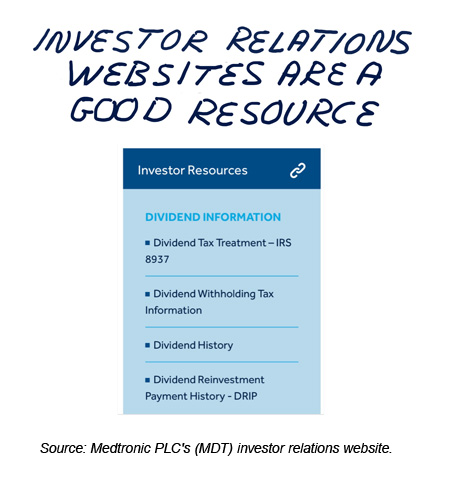
Before I do, I’d like to point you to a useful resource on the AAII.com website. The charts tab on the Stock Evaluator page provides historical dividend information, including the date and the amount. This information is available to all AAII members. To access the evaluator, simply type in a ticker symbol or company name into the search bar located at the top of most pages on AAII.com.
Our Dividend Investing website has other useful features, including our Dividend Grader tool. We’ll be making enhancements to it soon. And now, some other helpful dividend resources from Derek.
The Investor Relations Section of Companies’ Websites
A wide range of useful information can be found on a company’s website. The investor relations section typically includes, but is not limited to, investor resources, company profile, events and presentations, financial information, stock information, news, shareholder services, dividend information and FAQs.
No two companies have identical investor relations pages. Many companies tend to include dividend facts and figures in the financial information or stock information sections. At a minimum, you should be able to find a history of dividend payments with the declaration date, record date and payment date. Some companies also share their dividend payment policy in their earnings call presentations or U.S. Securities and Exchange Commission (SEC) filings (10-K annual reports and 10-Q quarterly reports), so you will want to check out those as well.
Medtronic PLC (MDT), a Dividend Investing portfolio holding, provides an excellent example of an investor relations section with all of the relevant categories referenced above. In fact, Medtronic has a specific section dedicated to dividend information. As illustrated in the graphic here, Medtronic presents information on its dividend tax treatment, dividend withholding tax information, dividend history and dividend reinvestment plan (DRIP) payment history.
If you can’t find the dividend information you are looking for on the company’s investor relations page, you can email investor relations and ask them to provide it.
A Star With Dividend Information
Morningstar.com is a robust website that provides articles and detailed company data and analysis. From Morningstar’s home page, you can search for an individual company by entering its ticker into the search quotes and site box at the top left of the page.
Morningstar provides several categories of company information including stock analysis, news, sustainability, financials, valuation, operating performance, dividends and ownership. The dividends tab provides seven years of statistics focused on the company’s dividend facts and figures. This includes dividend-oriented information such as dividends per share, trailing dividend yield, buyback yield percentage, payout ratio and important dividend dates.
Seeking Dividend Information
SeekingAlpha.com is another comprehensive site for dividend information. It focuses on dividend stock research and analysis through articles, data and ratings. From Seeking Alpha’s home page, you can search by entering stock symbols, authors or keywords into the search box. There is a lot of company data and analysis content for free, although there is a premium service available as well.
Seeking Alpha provides several classifications of company information including ratings, financials, earnings, growth, profitability, charting and dividends. The dividends tab provides several subtabs with information on a company’s dividend grades, yield, growth, safety, history and estimates.
There are several other worthwhile dividend resource sites including Computershare.com to find information regarding a company’s specific direct stock purchase plan (DPP) or dividend reinvestment plan and Dividend.com, which provides dividend stock research information and tools.
For all of the dividend resources mentioned in this commentary, there are different versions from basic (free) to premium subscriptions.
Researching dividend information is an important task when you’re seeking to identify the best dividend-paying stocks, one for which you need reliable sources. Researching dividends requires more than simply viewing the company’s payment history and dividend dates. You must also examine the company’s financials to decide if the dividend payment is sustainable and expected to grow.

- Another way you can research a dividend payer is read its annual report. John Deysher explains what to pay attention to when doing so in this month’s AAII Journal.
- Another option for portfolio income is convertible bonds. These debt instruments offer both interest payments and the potential for equity-like returns.
- Some companies have raised their dividends for 50 consecutive years or longer.
- As part of its quarterly review, the rules were revised, and two stocks were replaced in the Model Shadow Stock Portfolio.
- Be sure to tune in next Wednesday for our latest Individual Investor Show. We’ll talk about convertible bonds, offer suggestions on how to pick investments based on your investing preferences and more.
AAII Sentiment Survey
The percentage of individual investors describing their outlook for stocks as “neutral” pulled back from its recent highs in the latest AAII Sentiment Survey. At the same time, bearish sentiment rebounded after having previously been at an unusually low level.
Bullish sentiment, expectations that stock prices will rise over the next six months, rose 0.9 percentage points to 41.1%. Optimism remains above its historical average of 38.0% for the 26th week out of the past 31 weeks.
Neutral sentiment, expectations that stock prices will stay essentially unchanged over the next six months, dropped 6.4 percentage points to 32.7%. This is the lowest reading since May 6, 2021 (32.5%). Nonetheless, neutral sentiment is above its historical average of 31.5% for the eighth consecutive week.
Bearish sentiment, expectations that stock prices will fall over the next six months, rose 5.5 percentage points to 26.2%. Even with the increase, pessimism remains below its historical average of 30.5% for the 19th consecutive week.
All three indicators are within their typical historical ranges. Bearish sentiment had been at an unusually low level during the two previous weeks.
The return to normalcy from the coronavirus pandemic, monetary and fiscal stimulus and inflationary pressures are influencing individual investors’ outlook for stocks. Other factors include earnings, valuations and the Biden administration’s initiatives.
This week’s special question asked AAII members to share how the passage of an infrastructure bill would impact their outlook for the stock market.
Two out of five respondents (40%) say that the passage of an infrastructure bill would positively impact their outlook on the stock market. Many within this group say that such legislation would reflect a healthier economy and many infrastructure stocks would rise in price as a result. In addition, about 10% of respondents had a conditional outlook on a proposed infrastructure bill, saying that it could be a positive if paid for in an effective manner and spent on the right things.
This compares to 19% of respondents who say that an infrastructure bill would have minimal to no impact. About 16% of respondents have a negative outlook, saying that an infrastructure bill would be inflationary. Approximately 8% of respondents say that an infrastructure bill would yield mixed results such as short-term growth but potential long-term inflation.
Here is a sampling of the responses:
- “Spending on infrastructure would be bullish for the entire economy and I would expect stock prices to reflect both the increase in business activity and the reduction of ‘friction’ costs that improved infrastructure would have on the cost of doing business.”
- “Neutral. I think that some version of an infrastructure bill is already priced into the market.”
- “I believe if the present proposal were passed, the stock market would take a downturn. Inflation would be a big factor.”
- “If it were paid for, it should help the economy for many years. If not paid for, it depends largely on the growth elements of infrastructure contents.”
- “It would provide a temporary boost but be a serious long-term negative.”
Bullish: 41.1%, up 0.9 points
Neutral: 32.7%, down 6.4 points
Bearish: 26.2%, up 5.5 points
Bullish: 38.0%
Neutral: 31.5%
Bearish: 30.5%
See more Sentiment Survey results.

June 10, 2021 Compound Interest Returns and Your Portfolio
June 3, 2021 Periodic Adjustments Are Key for Preserving a Portfolio's Survival
May 27, 2021 Creating Watchlists to Track Investing Ideas
May 20, 2021 More Buybacks and Bigger Dividends

Discussion
Robert from Missouri posted over 5 years ago:
Some dividend sites such as Kiplingers sometimes recommend MLP or Master Limited Partnerships which are common in oil and gas but these can have terribly complicated tax implications including having to file multiple state tax returns. This can complicate your tax life and I have avoided these after many years ago owning one. It was very profitable and not as much tax trouble as some as located in an income tax free state. There are a few limited partnerships that are treated as corporations to avoid the tax problem but they are few in number. As if tax complications were not enough many of these report very late in the season so you often would have to file a tax extension to report even if only one state tax return involved. So even if if you live in state with no income tax the problem owning these can be substantial.
You need to log in as a registered AAII user before commenting.
Create an account